
Introduction
The ecommerce industry is becoming more competitive every year. Online stores must attract customers, personalize shopping experiences, optimize marketing campaigns, manage inventory, provide customer support, and increase conversions while controlling costs.
Fortunately, artificial intelligence is helping ecommerce businesses achieve these goals more efficiently than ever before.
The best AI tools for ecommerce can automate repetitive tasks, improve customer experiences, generate product descriptions, personalize recommendations, optimize advertising campaigns, and increase sales.
Whether you operate a Shopify store, WooCommerce website, Amazon business, or direct-to-consumer brand, AI can help you scale faster and compete more effectively.
Many ecommerce businesses already combine the solutions discussed in Best AI Tools for Customer Support in 2026, and Best AI Tools for Business Automation in 2026 to improve efficiency and revenue.
In this guide, we will explore the best AI tools for ecommerce in 2026, compare their features, benefits, pricing considerations, and use cases, and help you choose the right solutions for your online business.
Why Ecommerce Businesses Are Adopting AI
Artificial intelligence is transforming how online stores operate.
Personalized Shopping Experiences
AI analyzes customer behavior and recommends products that are more likely to generate sales.
Improved Customer Support
AI chatbots provide instant assistance and improve customer satisfaction.
Better Marketing Performance
AI helps businesses optimize campaigns, target audiences, and improve conversions.
Automated Product Content
AI can generate product descriptions, ad copy, email campaigns, and promotional content.
Smarter Inventory Management
AI helps predict demand and reduce stock-related issues.
Increased Revenue
The best AI tools for ecommerce help businesses improve customer engagement and maximize sales opportunities.
What Makes a Great AI Ecommerce Tool?
Not every AI platform is suitable for ecommerce businesses.
Before choosing a solution, consider the following factors.
Ease of Use
The platform should be easy to implement and manage.
Integration Support
The tool should integrate with Shopify, WooCommerce, Amazon, and other ecommerce platforms.
Automation Capabilities
Automation reduces manual work and improves efficiency.
Personalization Features
AI should help deliver customized customer experiences.
Scalability
The solution should support future business growth.
Return on Investment
The best AI tools for ecommerce should provide measurable improvements in sales, efficiency, or customer satisfaction.
1. Shopify Magic
Shopify Magic is Shopify’s built-in AI solution designed specifically for ecommerce businesses.
It helps store owners generate content, improve product listings, automate routine tasks, and manage online stores more efficiently.
Who Should Use It?
- Shopify Store Owners
- Small Businesses
- Growing Ecommerce Brands
Why Ecommerce Businesses Use It
Shopify Magic simplifies store management by helping merchants create product descriptions, marketing content, and customer communications without spending hours on manual writing.
Standout Features
- AI-generated product descriptions
- Email content creation
- Customer communication assistance
- Store content generation
- Marketing support
Strengths
- Built directly into Shopify
- Easy implementation
- Saves content creation time
- No additional integrations required
Limitations
- Primarily designed for Shopify users
- Fewer advanced capabilities than dedicated AI platforms
2. Klaviyo
Klaviyo is one of the most popular AI-powered email marketing platforms for ecommerce businesses.
It helps online stores create highly personalized email and SMS campaigns that improve customer retention and revenue.
Who Should Use It?
- Ecommerce Marketers
- Online Retailers
- DTC Brands
Why Ecommerce Businesses Use It
Klaviyo uses customer behavior and purchase history to create highly targeted campaigns that improve engagement and repeat purchases.
Standout Features
- AI-powered segmentation
- Predictive analytics
- Personalized email campaigns
- SMS marketing automation
- Revenue tracking
Strengths
- Excellent ecommerce integrations
- Advanced personalization
- Powerful automation workflows
- Detailed customer insights
Limitations
- Costs increase as subscriber lists grow
- Requires setup for advanced automation
Many online stores combine Klaviyo with strategies discussed in Best AI Tools for Email Marketing in 2026 to maximize customer engagement and repeat purchases.
3. Jasper
Jasper helps ecommerce businesses create marketing content at scale.
Store owners use it for product descriptions, ad copy, blog content, email campaigns, and promotional materials.
Who Should Use It?
- Ecommerce Content Teams
- Online Retailers
- Marketing Agencies
Why Ecommerce Businesses Use It
Jasper reduces the time required to create high-quality marketing content while maintaining brand consistency.
Standout Features
- AI content generation
- Product description writing
- Marketing copy creation
- Brand voice customization
- Campaign assistance
Strengths
- Fast content production
- Consistent brand messaging
- Suitable for large product catalogs
- Improves content efficiency
Limitations
- Human editing is still recommended
- Premium plans can be expensive
4. AdCreative.ai
AdCreative.ai specializes in generating conversion-focused advertising creatives for ecommerce businesses.
The platform helps brands create ad visuals and marketing assets more efficiently.
Who Should Use It?
- Ecommerce Advertisers
- Performance Marketers
- Online Brands
Why Ecommerce Businesses Use It
AdCreative.ai helps reduce design time while creating advertisements optimized for conversions and campaign performance.
Standout Features
- AI ad creatives
- Conversion-focused designs
- Performance predictions
- Campaign optimization
- Creative automation
Strengths
- Speeds up ad creation
- Supports multiple ad platforms
- Improves campaign efficiency
- Useful for scaling paid advertising
Limitations
- Best suited for businesses running paid ads
- Limited value without active advertising campaigns
5. ChatGPT
ChatGPT is one of the most versatile AI tools for ecommerce businesses.
It supports customer communication, content creation, product research, marketing, and operational planning.
Who Should Use It?
- Ecommerce Entrepreneurs
- Content Teams
- Customer Support Teams
Why Ecommerce Businesses Use It
ChatGPT can assist with multiple business functions, reducing the need for separate tools for writing, research, and customer communication.
Standout Features
- Product description generation
- Customer support assistance
- Marketing content creation
- Research support
- Business planning assistance
Strengths
- Extremely versatile
- Easy to implement
- Affordable compared to many specialized tools
- Supports multiple ecommerce workflows
Limitations
- Requires human review for important business decisions
- May occasionally generate inaccurate information
6. Canva AI
Visual content plays a critical role in ecommerce success. Product promotions, social media posts, advertisements, banners, and branding materials all influence customer purchasing decisions.
Canva AI helps ecommerce businesses create professional-quality visual content quickly without requiring advanced design skills.
Who Should Use It?
- Ecommerce Store Owners
- Social Media Marketers
- Small Business Teams
Why Ecommerce Businesses Use It
Canva AI allows businesses to produce attractive marketing materials, promotional graphics, and product-focused content while reducing design costs.
Standout Features
- AI image generation
- Magic Design
- Social media templates
- Product promotion graphics
- Presentation creation
Strengths
- User-friendly interface
- Affordable pricing
- Large template library
- Fast content creation
Limitations
- Limited advanced design customization
- Not a replacement for professional design software
Businesses that prioritize branding often combine Canva AI with the best AI tools for ecommerce to improve visual marketing performance.
7. HubSpot AI
HubSpot AI combines customer relationship management, marketing automation, sales tools, and customer insights within a single platform.
For ecommerce businesses, it provides valuable data that helps improve customer retention and lifetime value.
Who Should Use It?
- Growing Ecommerce Brands
- Customer-Centric Businesses
- Marketing Teams
Why Ecommerce Businesses Use It
HubSpot AI helps businesses understand customer behavior, automate marketing activities, and build stronger customer relationships.
Standout Features
- CRM automation
- Customer tracking
- AI recommendations
- Email automation
- Marketing analytics
Strengths
- Unified customer database
- Excellent reporting capabilities
- Powerful automation tools
- Strong ecosystem integrations
Limitations
- Premium plans can be costly
- Advanced features require setup and training
8. Omnisend
Omnisend is an AI-powered marketing automation platform built specifically for ecommerce businesses.
It combines email marketing, SMS marketing, automation, and customer segmentation into one platform.
Who Should Use It?
- Ecommerce Stores
- Shopify Merchants
- Online Retailers
Why Ecommerce Businesses Use It
Omnisend helps businesses increase customer engagement through personalized communication and automated marketing workflows.
Standout Features
- Email automation
- SMS marketing
- Customer segmentation
- Campaign analytics
- Ecommerce integrations
Strengths
- Ecommerce-focused features
- Easy workflow automation
- Multi-channel marketing support
- Good ROI for online stores
Limitations
- Limited functionality for non-ecommerce businesses
- Advanced plans may become expensive
9. Tidio
Tidio combines live chat, AI chatbots, and customer support automation to improve customer service and conversions.
Many online stores use Tidio to engage visitors and answer customer questions instantly.
Who Should Use It?
- Ecommerce Stores
- Customer Support Teams
- Small Businesses
Why Ecommerce Businesses Use It
Fast customer support improves trust and reduces abandoned carts. Tidio helps businesses provide instant assistance without requiring large support teams.
Standout Features
- AI chatbot automation
- Live chat support
- Visitor tracking
- Lead generation
- Customer engagement tools
Strengths
- Easy setup
- Improves customer support efficiency
- Helps reduce cart abandonment
- Affordable pricing options
Limitations
- Limited enterprise-level capabilities
- Advanced automation requires premium plans
Many online retailers also combine Tidio with strategies discussed in Best AI Chatbots in 2026 to improve customer engagement and automate support interactions.
10. Prisync
Pricing plays a major role in ecommerce success. Prisync uses AI-powered competitor monitoring and pricing intelligence to help businesses remain competitive.
Who Should Use It?
- Ecommerce Retailers
- Competitive Markets
- Pricing Managers
Why Ecommerce Businesses Use It
Prisync helps businesses monitor competitors, optimize pricing strategies, and protect profit margins.
Standout Features
- Competitor price tracking
- Dynamic pricing insights
- Market monitoring
- Product analytics
- Pricing intelligence
Strengths
- Valuable competitive insights
- Helps optimize pricing decisions
- Supports profit growth
- Easy competitor monitoring
Limitations
- Most valuable in competitive product categories
- Less useful for businesses with unique products
AI Tools for Ecommerce Comparison Table
| Tool | Primary Use | Key Benefit |
|---|---|---|
| Shopify Magic | Store Management | Product Content Creation |
| Klaviyo | Email Marketing | Customer Retention |
| Jasper | Content Creation | Marketing Efficiency |
| AdCreative.ai | Advertising | Higher Conversions |
| ChatGPT | Business Operations | Versatility |
| Canva AI | Visual Marketing | Professional Designs |
| HubSpot AI | CRM & Automation | Customer Insights |
| Omnisend | Marketing Automation | Multi-Channel Campaigns |
| Tidio | Customer Support | Instant Assistance |
| Prisync | Pricing Intelligence | Competitive Pricing |
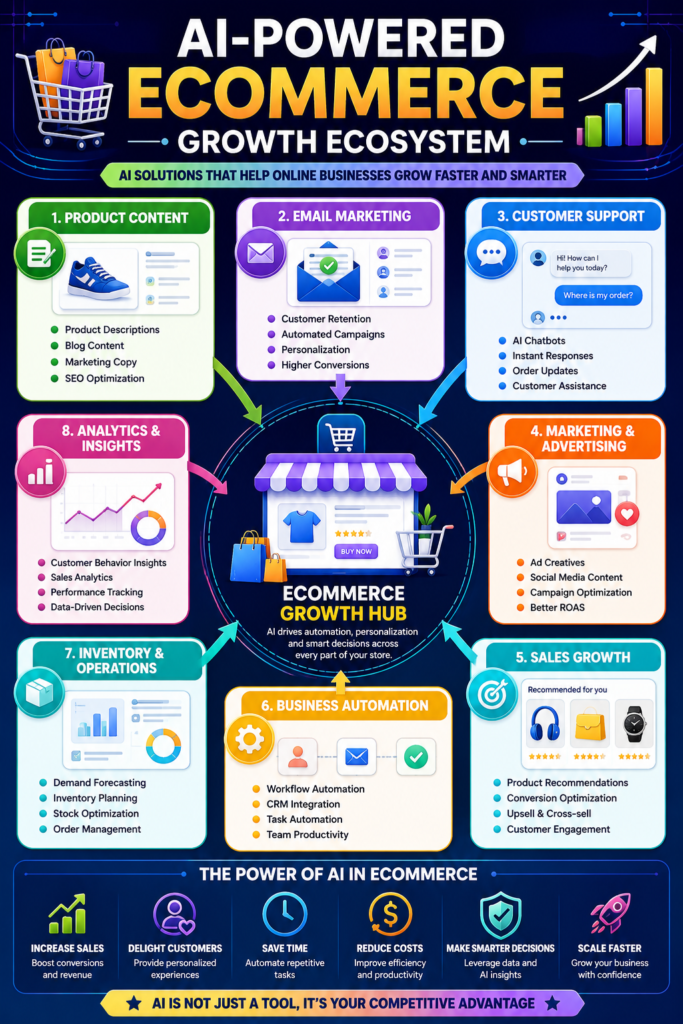
The best AI tools for ecommerce serve different business functions, and many successful online stores use a combination of multiple platforms rather than relying on a single solution.
Benefits of Using AI in Ecommerce
Artificial intelligence is transforming online retail by helping businesses automate operations, improve customer experiences, and increase profitability. Businesses that focus on content-driven growth may also benefit from Best AI Tools for Content Creators in 2026.
Higher Conversion Rates
AI helps businesses recommend relevant products, personalize shopping experiences, and optimize marketing campaigns, resulting in better conversion rates.
Improved Customer Experiences
Customers receive personalized recommendations, faster support, and more relevant content throughout their shopping journey.
Better Marketing Performance
The best AI tools for ecommerce help businesses improve email campaigns, advertising performance, and customer targeting.
Reduced Operational Costs
Automation minimizes repetitive tasks and allows teams to focus on strategic business activities. Many online retailers also use strategies discussed in Best AI Productivity Tools in 2026 to streamline workflows, save time, and improve team efficiency.
Smarter Business Decisions
AI-powered analytics provide valuable insights into customer behavior, product performance, and sales trends.
Increased Customer Retention
Personalized communication and intelligent automation help businesses build stronger customer relationships.
Real-World Ecommerce Use Cases for AI
AI is being used across nearly every aspect of modern ecommerce operations.
Product Description Generation
Online stores use AI tools such as ChatGPT and Shopify Magic to create product descriptions quickly and consistently.
Personalized Product Recommendations
AI analyzes customer behavior and suggests products that are more likely to generate sales.
Abandoned Cart Recovery
Platforms such as Klaviyo and Omnisend automate abandoned cart emails and encourage customers to complete purchases.
Customer Support Automation
AI chatbots answer common questions, provide order updates, and improve customer satisfaction.
Dynamic Pricing Optimization
Tools such as Prisync help businesses adjust pricing strategies based on market conditions and competitor activity.
Advertising Optimization
AI platforms analyze campaign performance and help businesses improve return on ad spend.
The best AI tools for ecommerce are often used together to create a complete growth ecosystem rather than solving a single problem.
Common Mistakes Ecommerce Businesses Make When Using AI
Although AI offers significant benefits, improper implementation can reduce its effectiveness.
Using Too Many Tools
Many businesses subscribe to multiple platforms without a clear strategy.
Start with a few high-impact tools and expand gradually.
Ignoring Data Quality
AI systems depend on accurate data.
Poor customer data often leads to poor recommendations and weak campaign performance.
Over-Automating Customer Interactions
Customers still value human support for complex situations.
Businesses should maintain a balance between automation and personal communication.
Choosing Tools Based Only on Popularity
The most popular platform may not be the best choice for your specific business model.
Not Measuring ROI
Businesses should monitor:
- Conversion rates
- Customer retention
- Revenue growth
- Advertising performance
- Customer satisfaction
These metrics help determine whether AI investments are generating results.
How to Choose the Right AI Tool for Your Ecommerce Business
Every ecommerce business has different goals and challenges.
For Product Content Creation
Recommended tools:
- ChatGPT
- Jasper
- Shopify Magic
For Email Marketing
Recommended tools:
- Klaviyo
- Omnisend
- HubSpot AI
For Customer Support
Recommended tools:
- Tidio
- ChatGPT
For Advertising
Recommended tools:
- AdCreative.ai
- Canva AI
For Pricing Optimization
Recommended tools:
- Prisync
For Business Automation
Recommended tools:
- HubSpot AI
- Shopify Magic
Choosing the best AI tools for ecommerce depends on your budget, store size, growth objectives, and operational priorities.
Future of AI in Ecommerce
Artificial intelligence is expected to play an even bigger role in ecommerce over the coming years.
As AI technology continues to evolve, online stores will gain access to smarter automation, deeper customer insights, and more personalized shopping experiences.
Hyper-Personalized Shopping
AI will increasingly analyze customer preferences, browsing behavior, and purchase history to deliver highly personalized product recommendations.
Predictive Customer Behavior
Businesses will be able to anticipate customer needs and proactively offer products, discounts, and support before customers even request them.
AI Shopping Assistants
Virtual shopping assistants will help customers discover products, compare options, and make purchasing decisions more efficiently.
Smarter Inventory Forecasting
AI systems will improve demand prediction and inventory planning, helping businesses reduce stock shortages and overstock situations.
Automated Ecommerce Operations
The best AI tools for ecommerce will continue automating marketing, customer support, content creation, pricing management, and operational workflows.
Voice Commerce Growth
Voice-based shopping experiences are expected to become more common as AI assistants improve their understanding of customer intent.
Ecommerce AI Trends in 2026
Several trends are shaping the future of online retail.
Generative AI for Product Content
Businesses are increasingly using AI to create product descriptions, blogs, emails, advertisements, and landing pages.
AI-Powered Personalization
Modern ecommerce platforms are delivering customized shopping experiences for individual customers.
Conversational Commerce
AI chatbots and virtual assistants are helping customers complete purchases directly through conversations.
Predictive Analytics
AI helps businesses identify future opportunities, customer trends, and revenue growth areas.
Automated Marketing Ecosystems
Marketing platforms are becoming increasingly capable of managing campaigns with minimal human intervention.
Dynamic Pricing Intelligence
AI systems continuously monitor competitors and market conditions to optimize pricing strategies.
The best AI tools for ecommerce are evolving from simple automation solutions into comprehensive business growth platforms.
Choosing the Right AI Solution for Ecommerce Growth
Artificial intelligence has become one of the most valuable technologies available to ecommerce businesses.
From product descriptions and email marketing to customer support, advertising, pricing intelligence, and business automation, AI helps online stores operate more efficiently and grow faster.
The best AI tools for ecommerce include Shopify Magic, Klaviyo, Jasper, AdCreative.ai, ChatGPT, Canva AI, HubSpot AI, Omnisend, Tidio, and Prisync. Each platform offers unique capabilities that support different aspects of ecommerce operations.
Rather than relying on a single solution, many successful online stores combine multiple tools to create an integrated ecosystem that improves customer experiences, increases conversions, and drives long-term growth.
Businesses that adopt AI strategically can gain a significant competitive advantage while improving efficiency, profitability, and customer satisfaction.
Frequently Asked Questions About AI Tools for Ecommerce
What are AI tools for ecommerce?
AI tools for ecommerce are software platforms that use artificial intelligence to automate tasks, improve customer experiences, optimize marketing campaigns, generate content, and increase online sales.
What are the best AI tools for ecommerce?
Some of the best AI tools for ecommerce include Shopify Magic, Klaviyo, Jasper, AdCreative.ai, ChatGPT, Canva AI, HubSpot AI, Omnisend, Tidio, and Prisync.
Can AI help increase ecommerce sales?
Yes. AI can improve product recommendations, customer targeting, personalization, email marketing, advertising performance, and customer support, helping businesses increase conversions and revenue.
Which AI ecommerce tool is best for Shopify stores?
Shopify Magic is one of the best AI tools for Shopify stores because it integrates directly with the Shopify platform and helps automate content creation and store management tasks.
Can AI create product descriptions for online stores?
Yes. Tools such as ChatGPT, Jasper, and Shopify Magic can generate professional product descriptions quickly and consistently.
Are AI ecommerce tools suitable for small businesses?
Yes. Many AI ecommerce tools offer affordable plans and help small businesses automate marketing, customer support, content creation, and operational tasks.
Which AI tool is best for ecommerce email marketing?
Klaviyo and Omnisend are among the most popular AI-powered email marketing platforms for ecommerce businesses due to their automation and personalization capabilities.
Can AI improve customer support for ecommerce stores?
Yes. AI chatbots and support platforms can answer customer questions, provide order updates, and improve customer satisfaction while reducing support workloads.
Do AI ecommerce tools help with pricing optimization?
Yes. Platforms such as Prisync help businesses monitor competitors and optimize pricing strategies based on market conditions and customer demand.
Can beginners use AI tools for ecommerce?
Yes. Most modern AI ecommerce tools are designed to be user-friendly and can be used by beginners, entrepreneurs, and small business owners without advanced technical skills.
Are free AI ecommerce tools worth using?
Free AI ecommerce tools can be useful for startups and small businesses. They often provide content generation, automation, and basic marketing features, although premium plans offer more advanced functionality.
What is the future of AI in ecommerce?
The future of AI in ecommerce includes hyper-personalization, predictive analytics, AI shopping assistants, dynamic pricing, conversational commerce, and increasingly automated business operations.