
AI Trends in 2026 are transforming how people work, learn, communicate, and solve problems. As Artificial Intelligence continues to advance, technologies such as AI Agents, Multimodal AI, Quantum AI, and autonomous systems are moving from research labs into everyday life.
Just a few years ago, AI was primarily used for search engines, recommendation systems, and basic automation. Today, it can generate content, write code, create videos, assist doctors, accelerate scientific research, and even act as an autonomous digital assistant.
Artificial Intelligence is evolving faster than ever before. Just a few years ago, AI was primarily used for search engines, recommendation systems, and basic automation. Today, it can generate content, write code, create videos, assist doctors, accelerate scientific research, and even act as an autonomous digital assistant.
In 2026, Artificial Intelligence is entering a new phase of development. Technologies that once seemed futuristic are becoming part of everyday life. Businesses are adopting AI at unprecedented rates, governments are creating AI regulations, and researchers are pushing the boundaries of what intelligent machines can achieve.
The question is no longer whether AI will change the world.
The real question is:
“How will AI transform the way we live, work, learn, create, and innovate in the years ahead?”
This article explores the most important AI Trends in 2026, the technologies driving innovation, and the opportunities and challenges shaping the future of Artificial Intelligence.
What Are AI Trends and Why Do They Matter?
AI trends are the major technological developments, innovations, and research directions that influence how Artificial Intelligence evolves over time.
Some trends remain experimental, while others quickly become part of everyday life. Understanding these trends helps individuals and organizations prepare for future opportunities and challenges.
AI trends matter because they influence:
🔹 Education and learning
🔹 Healthcare and medicine
🔹 Business operations
🔹 Scientific research
🔹 Transportation and logistics
🔹 Cybersecurity
🔹 Employment and future careers
🔹 Government policies and regulations
Today, AI is no longer a technology used only by researchers and technology companies. It is becoming an essential part of modern society.
💡 Did You Know?
According to industry estimates, billions of people now interact with AI-powered systems every day, often without realizing it. Search engines, recommendation systems, navigation apps, virtual assistants, and online shopping platforms all rely heavily on Artificial Intelligence.
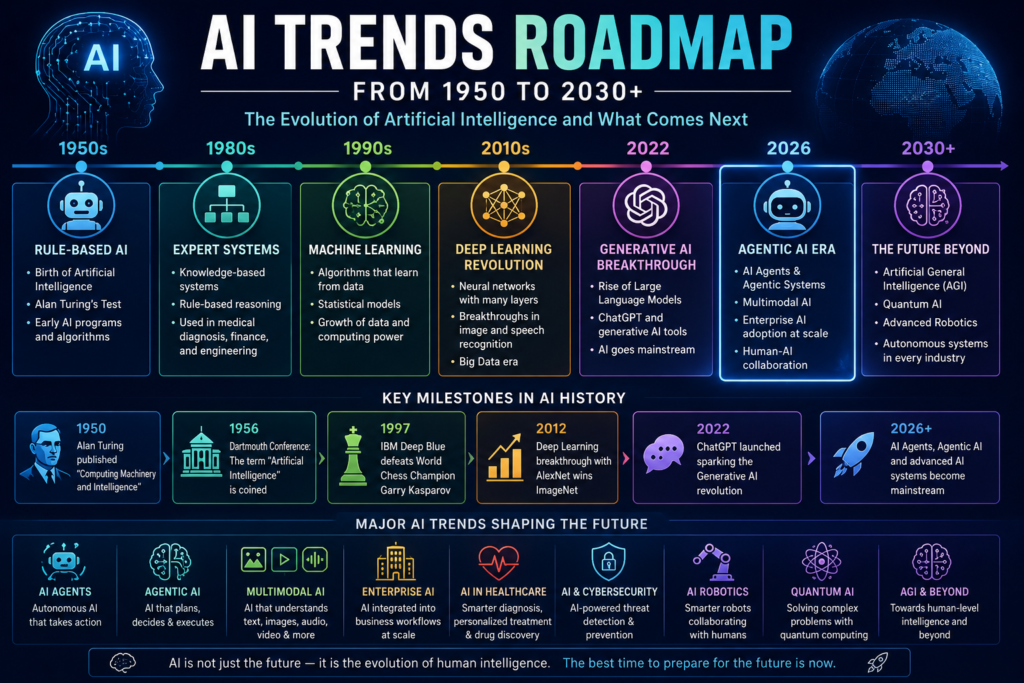
A Quick Look at the Evolution of AI
To understand the latest AI trends, it is helpful to see how Artificial Intelligence has evolved over the decades.
1950s – Rule-Based AI
Early researchers such as Alan Turing and John McCarthy believed machines could simulate aspects of human intelligence through logical reasoning and symbolic processing.
1980s – Expert Systems
Businesses began adopting rule-based Expert Systems that could assist with decision-making in specific domains.
1990s – Machine Learning
Researchers shifted toward systems capable of learning from data rather than relying solely on manually programmed rules.
2010s – Deep Learning Revolution
Advances in neural networks, computing power, and large datasets led to major breakthroughs in image recognition, speech recognition, and Natural Language Processing.
2020s – Generative AI Era
The emergence of tools such as ChatGPT, Gemini, and Claude brought Artificial Intelligence into mainstream use and demonstrated the power of Large Language Models.
2026 – The Age of Intelligent AI Systems
The focus is now shifting toward autonomous AI agents, multimodal intelligence, scientific discovery, robotics, and advanced human-AI collaboration.
🧠 Research Insight
Many experts believe that 2026 may represent a transition period from Generative AI toward more autonomous and action-oriented AI systems capable of performing complex tasks with minimal human supervision.
The 15 Biggest AI Trends in 2026
Trend #1 – Agentic AI
One of the most important AI trends in 2026 is the rise of Agentic AI.
Unlike traditional AI systems that simply respond to prompts, Agentic AI can plan, reason, make decisions, and perform multi-step tasks independently.
Instead of asking AI for a single answer, users can assign goals and allow the system to determine how those goals should be achieved.
Examples include:
🔹 Research assistants
🔹 Autonomous workflow systems
🔹 AI-powered business automation
🔹 Multi-step task execution
Many experts believe Agentic AI represents the next major step in the evolution of Artificial Intelligence.
Trend #2 – AI Agents
AI Agents are becoming increasingly sophisticated.
An AI Agent can interact with software, gather information, analyze data, and perform actions on behalf of users.
Major technology companies are investing heavily in AI agent development because these systems have the potential to dramatically improve productivity.
Future AI agents may:
🔹 Schedule meetings
🔹 Manage projects
🔹 Conduct research
🔹 Analyze documents
🔹 Handle customer support tasks
For many businesses, AI agents could become digital coworkers rather than simple software tools.
Trend #3 – Multimodal AI
Multimodal AI can process and understand multiple forms of information simultaneously.
Instead of working only with text, these systems can analyze:
🔹 Text
🔹 Images
🔹 Audio
🔹 Video
🔹 Documents
Modern AI systems are rapidly becoming capable of understanding information in ways that more closely resemble human perception.
This trend is expected to drive major advances in education, healthcare, customer support, and content creation.
Trend #4 – AI Copilots Everywhere
AI copilots are becoming common across industries.
These systems assist users while they work rather than replacing them entirely.
Examples include:
🔹 Coding assistants
🔹 Writing assistants
🔹 Design assistants
🔹 Business productivity tools
🔹 Research assistants
The goal is simple:
“Help humans work faster, smarter, and more efficiently.”
Trend #5 – Hyper-Personalized Education
Artificial Intelligence is rapidly transforming education through personalized learning experiences.
Traditional classrooms often follow a one-size-fits-all approach. AI-powered educational platforms can adapt lessons, quizzes, and learning paths according to the needs of individual students.
Modern systems can:
🔹 Identify learning gaps
🔹 Recommend personalized study materials
🔹 Generate practice questions
🔹 Provide real-time feedback
🔹 Track student progress
As AI becomes more sophisticated, students may receive highly customized learning experiences that improve engagement and academic outcomes.
🌍 Global AI Fact
Countries including Singapore, South Korea, China, and the United States are increasingly integrating AI technologies into educational systems.
Related reading: AI-powered learning is already changing classrooms around the world.
Trend #6 – AI-Powered Healthcare
Healthcare is expected to remain one of the most important beneficiaries of Artificial Intelligence in 2026.
AI systems can analyze enormous amounts of medical data faster than humans and help doctors make better-informed decisions.
Current and emerging applications include:
🔹 Medical image analysis
🔹 Disease prediction
🔹 Drug discovery
🔹 Personalized treatment planning
🔹 Virtual health assistants
Researchers are increasingly using AI to identify patterns that may be difficult for humans to detect.
💡 Did You Know?
AI-assisted systems have demonstrated the ability to detect certain medical conditions from scans with impressive levels of accuracy, helping doctors identify diseases earlier.
Trend #7 – AI-Driven Scientific Discovery
One of the most exciting developments in AI is its growing role in scientific research.
Scientists are now using Artificial Intelligence to:
🔹 Analyze massive datasets
🔹 Simulate complex systems
🔹 Discover new materials
🔹 Accelerate drug development
🔹 Assist with climate research
The pace of scientific discovery is increasing as AI helps researchers evaluate possibilities that would otherwise take years to investigate.
🧠 Research Insight
Several major breakthroughs in biology, chemistry, and materials science have been accelerated through AI-assisted research techniques.
Trend #8 – AI Robotics
The combination of Artificial Intelligence and robotics is creating machines capable of performing increasingly complex physical tasks.
Modern AI-powered robots can:
🔹 Navigate environments
🔹 Recognize objects
🔹 Understand instructions
🔹 Collaborate with humans
🔹 Adapt to changing conditions
Robotics is expanding beyond factories into healthcare, logistics, agriculture, and household assistance.
Many experts believe the coming decade will see rapid growth in intelligent robotic systems.
Trend #9 – Quantum AI Research
Although still in its early stages, Quantum AI is attracting significant attention from researchers worldwide.
Quantum AI combines Artificial Intelligence with Quantum Computing to solve highly complex problems more efficiently than traditional computing systems.
Leading countries investing in Quantum AI research include:
🔹 United States
🔹 China
🔹 Canada
🔹 United Kingdom
🔹 Germany
💡 Did You Know?
Physicist Richard Feynman proposed the concept of quantum computing in 1981, laying the foundation for many of today’s Quantum AI research efforts.
Quantum AI has the potential to influence:
🔹 Drug discovery
🔹 Climate modeling
🔹 Financial forecasting
🔹 Advanced scientific simulations
Trend #10 – Enterprise AI Expansion
Artificial Intelligence is rapidly moving beyond experimentation and becoming a core part of business operations.
In 2026, organizations across industries are integrating AI into customer service, marketing, finance, human resources, supply chain management, and strategic decision-making.
Businesses are using AI to:
🔹 Automate repetitive tasks
🔹 Improve operational efficiency
🔹 Analyze large datasets
🔹 Enhance customer experiences
🔹 Support business forecasting
Large enterprises are increasingly building AI-first strategies to remain competitive in a rapidly evolving digital economy.
🌍 Global AI Fact
According to industry reports, AI adoption among enterprises continues to increase as organizations seek productivity gains and operational advantages.
Trend #11 – AI Cybersecurity
As cyber threats become more sophisticated, Artificial Intelligence is playing an increasingly important role in cybersecurity.
Modern AI systems can identify unusual behavior, detect threats, and respond to attacks much faster than traditional security tools.
Applications include:
🔹 Threat detection
🔹 Fraud prevention
🔹 Malware analysis
🔹 Network monitoring
🔹 Security automation
However, AI is creating new challenges as well.
Cybercriminals are also using AI to develop more advanced attacks, creating an ongoing technological race between defenders and attackers.
💡 Did You Know?
Many cybersecurity experts now consider AI both a powerful defense tool and a potential security risk depending on how it is used.
Trend #12 – Responsible AI and Governance
As Artificial Intelligence becomes more powerful, concerns about ethics, fairness, transparency, and accountability continue to grow.
Governments, businesses, and international organizations are developing frameworks to ensure that AI is used responsibly. Many governments and organizations are adopting Responsible AI principles to ensure fairness, transparency, and accountability in AI systems.
Key areas of focus include:
🔹 Data privacy
🔹 Algorithmic bias
🔹 Transparency
🔹 Accountability
🔹 AI safety
🔹 Regulatory compliance
Responsible AI is no longer just a research topic. It is becoming a strategic priority for organizations worldwide.
🧠 Research Insight
Many experts believe that the future success of AI will depend not only on technological advances but also on public trust and responsible governance.
Trend #13 – AI-Generated Video and Media
The ability of Artificial Intelligence to generate high-quality media is advancing rapidly. Recent advances in Generative AI technologies have dramatically improved the quality of AI-generated content across multiple media formats.
Modern AI tools can now create:
🔹 Videos
🔹 Images
🔹 Voiceovers
🔹 Music
🔹 Animations
🔹 Marketing content
These technologies are transforming industries such as entertainment, advertising, education, and digital marketing.
Content creation that once required large teams can now be completed in significantly less time with AI assistance.
Trend #14 – Human-AI Collaboration
One of the most important AI trends in 2026 is the growing partnership between humans and intelligent machines.
Rather than replacing people entirely, many AI systems are designed to enhance human capabilities.
Examples include:
🔹 Research assistants
🔹 Writing assistants
🔹 Coding assistants
🔹 Design assistants
🔹 Medical decision-support systems
The future of work is increasingly focused on collaboration between human expertise and AI capabilities.
“The most successful professionals may not be those who compete with AI, but those who learn how to work effectively alongside it.”
Trend #15 – The Road Toward AGI
Perhaps the most discussed long-term goal in Artificial Intelligence research is Artificial General Intelligence (AGI).
Unlike today’s AI systems, which are designed for specific tasks, AGI would be capable of performing a wide range of intellectual activities at a human-like level.
Researchers continue to debate:
🔹 When AGI might emerge
🔹 How it should be developed
🔹 Its potential benefits
🔹 Its potential risks
Although AGI has not yet been achieved, ongoing advances in reasoning, learning, planning, and autonomous systems are bringing researchers closer to this ambitious objective.
🔮 Future Outlook
Many experts believe that developments in Agentic AI, Multimodal AI, Robotics, and Quantum AI will play an important role in the journey toward AGI.
Countries Leading the AI Revolution
Artificial Intelligence has become a strategic priority for nations around the world.
Several countries are investing heavily in AI research, infrastructure, education, and innovation.
Countries investing heavily in AI research and innovation are expected to gain significant technological and economic advantages.
🇺🇸 United States
Home to many leading AI companies and research institutions, the United States remains a global leader in AI development.
🇨🇳 China
China continues to invest heavily in AI research, smart infrastructure, robotics, and advanced technologies.
🇬🇧 United Kingdom
The United Kingdom has a strong tradition of AI research and remains an important center for innovation.
🇨🇦 Canada
Canada is widely recognized for its contributions to Deep Learning and Machine Learning research.
🇮🇳 India
India is rapidly expanding its AI ecosystem through education, startups, government initiatives, and digital transformation programs.
🇪🇺 European Union
European nations are focusing on responsible AI, regulation, and ethical technology development.
How AI Trends Will Affect Everyday Life
Artificial Intelligence is no longer limited to research laboratories or large technology companies. The latest AI trends are increasingly influencing everyday activities, often in ways that people may not immediately recognize.
Students
Students can benefit from AI-powered tutoring systems, personalized learning platforms, research assistants, and intelligent study tools. These technologies are making education more accessible and adaptive.
Teachers
Educators are using AI to create lesson plans, generate assessments, identify learning gaps, and improve classroom efficiency. The use of AI in modern classrooms continues to expand globally.
Healthcare Professionals
Doctors and healthcare providers can use AI-assisted diagnostic systems, medical imaging tools, and predictive analytics to support patient care and improve decision-making.
Business Owners
Businesses are leveraging AI for customer service, marketing, data analysis, workflow automation, and strategic planning.
Content Creators
AI-powered writing, image generation, video creation, and editing tools are helping creators produce content more efficiently than ever before.
Researchers
Researchers are using intelligent systems to analyze massive datasets, identify patterns, and accelerate scientific discovery.
🌍 Global AI Fact
Artificial Intelligence is expected to influence nearly every major industry during the coming decade, making AI literacy an increasingly valuable skill for individuals and organizations alike.
Opportunities and Challenges of AI Trends
The rapid growth of Artificial Intelligence creates significant opportunities, but it also introduces important challenges that society must address.
Opportunities
🔹 Increased productivity
🔹 Faster innovation
🔹 Improved healthcare outcomes
🔹 Personalized education
🔹 Scientific breakthroughs
🔹 New business opportunities
🔹 Enhanced decision-making
🔹 Economic growth
Challenges
🔹 Data privacy concerns
🔹 Algorithmic bias
🔹 Misinformation and deepfakes
🔹 Cybersecurity risks
🔹 Workforce disruption
🔹 Ethical concerns
🔹 Regulatory challenges
⚠️ AI Challenge
As AI systems become more capable, governments, researchers, and businesses must balance innovation with responsibility. Building trustworthy and transparent AI systems will be one of the defining challenges of the coming decade.
🔮 Future Outlook
The organizations and individuals that learn to adapt to emerging AI technologies today are likely to gain significant advantages in the future. AI is expected to become an increasingly important tool for learning, creativity, productivity, and innovation.
Readers interested in the future of Artificial Intelligence can explore how emerging technologies may shape the coming decades.
To better understand the concepts mentioned in this article, you can also review our guide to essential AI terms.
For a deeper understanding of the evolution of AI, it is useful to examine the major breakthroughs that shaped modern Artificial Intelligence.
Students and educators can learn more about AI-powered learning and its impact on modern education.
Professionals looking to improve their AI skills may also benefit from learning effective AI prompting techniques.
Looking Beyond 2026
The AI Trends in 2026 discussed in this article represent more than just technological innovations—they reflect a fundamental shift in how people interact with information, machines, and the world around them.
From Agentic AI and AI Agents to Quantum AI, Multimodal AI, and the growing pursuit of Artificial General Intelligence (AGI), Artificial Intelligence is moving beyond simple automation and becoming an increasingly capable partner in human progress.
At the same time, challenges related to privacy, security, ethics, regulation, and workforce transformation will require careful attention from governments, businesses, researchers, and society as a whole.
One thing is becoming increasingly clear:
“Artificial Intelligence is no longer a technology of the future—it is a technology of the present that is actively shaping the future.”
The organizations, professionals, students, and creators who understand today’s AI trends will be better prepared for the opportunities and challenges of tomorrow.
As AI continues to evolve, staying informed about emerging technologies may become one of the most valuable investments anyone can make in the digital age.
Continue Learning
- Discover how AI is transforming modern education and reshaping learning experiences for students and teachers.
- See how Generative AI tools are changing content creation, productivity, and digital workflows across industries.
- Readers who want to build a stronger understanding of Artificial Intelligence should explore the key AI terms everyone should know.
What are the biggest AI trends in 2026?
The biggest AI trends in 2026 include Agentic AI, AI Agents, Multimodal AI, AI Copilots, AI Robotics, Quantum AI research, AI-powered healthcare, enterprise AI adoption, responsible AI, and the continued development of Artificial General Intelligence (AGI).
Why are AI trends important?
AI trends help individuals, businesses, educators, researchers, and governments understand how Artificial Intelligence is evolving and how it may affect jobs, education, healthcare, productivity, and innovation.
What is the difference between AI Agents and traditional AI?
Traditional AI typically responds to specific prompts, while AI Agents can take actions, use tools, perform tasks, and work toward goals with greater autonomy.
What is Agentic AI?
Agentic AI refers to Artificial Intelligence systems that can plan, reason, make decisions, and complete multi-step tasks with limited human supervision.
Will AI replace human jobs in the future?
AI is expected to automate certain tasks and transform many jobs, but it is also likely to create new opportunities in technology, research, education, healthcare, and other industries.
What is Quantum AI?
Quantum AI combines Artificial Intelligence and Quantum Computing to solve highly complex problems more efficiently than traditional computing systems.
Which countries are leading AI development?
The United States, China, the United Kingdom, Canada, India, and several European nations are among the global leaders in Artificial Intelligence research and development.
What skills will be important in an AI-driven future?
AI literacy, critical thinking, problem-solving, creativity, data analysis, and the ability to work effectively with AI tools will become increasingly valuable in the future.