
Artificial Intelligence is no longer limited to technology companies, research laboratories, or software developers. Today, AI has become a practical part of everyday life, helping millions of people work smarter, learn faster, communicate better, and save valuable time.
Whether you are a student preparing for exams, a teacher creating lesson plans, a freelancer managing multiple projects, a professional handling emails, or simply someone looking to become more productive, modern AI tools can make daily tasks easier and more efficient.
The challenge is that thousands of AI applications are now available. Some are genuinely useful, while others offer little real value. The key is choosing tools that solve everyday problems rather than adding unnecessary complexity.
In this guide, we explore the best AI tools for everyday life in 2026. These tools can help with writing, research, organization, learning, creativity, communication, language learning, and personal productivity.
If you are new to artificial intelligence, you may also find our What Is Artificial Intelligence? guide helpful for understanding the technology behind these powerful tools.
Why AI Tools for Everyday Life Are Becoming Essential
AI tools are rapidly becoming digital assistants that support people throughout their daily routines.
Modern AI applications can:
- Answer questions instantly
- Summarize long documents
- Organize schedules
- Improve writing
- Create images and videos
- Translate languages
- Solve mathematical problems
- Assist with research
- Manage tasks and projects
Instead of replacing human intelligence, these tools enhance productivity by automating repetitive work and helping users focus on more important activities.
The most successful AI users are not necessarily technology experts. They are people who understand how to use AI strategically to save time and improve results.
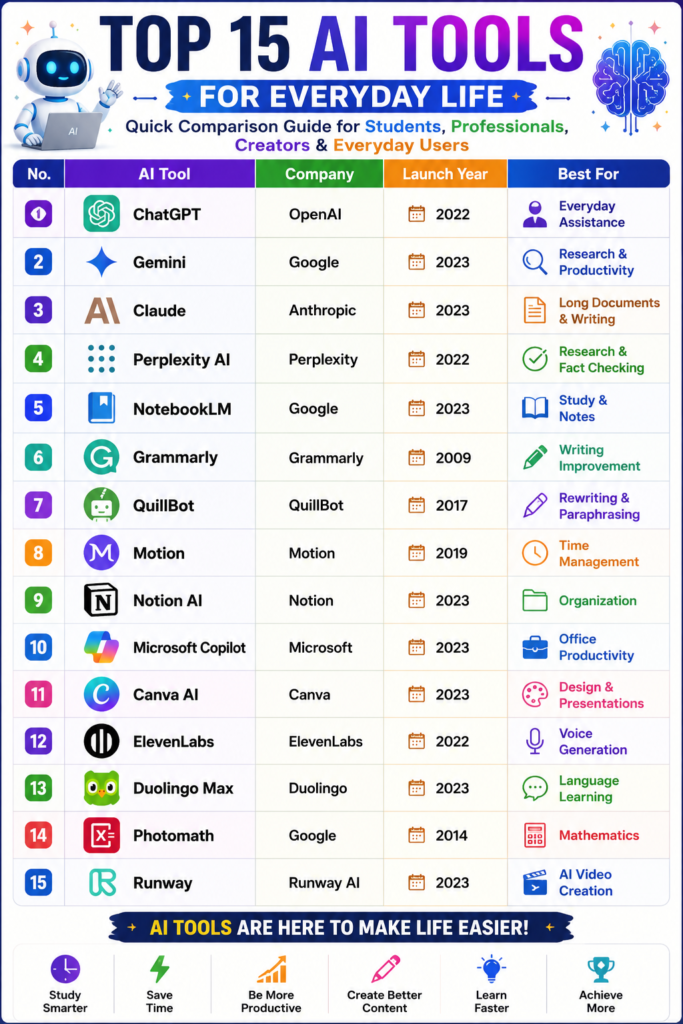
Quick Comparison Table
| AI Tool | Company | Launch Year | Best For |
|---|---|---|---|
| ChatGPT | OpenAI | 2022 | Everyday Assistance |
| Gemini | 2023 | Research & Productivity | |
| Claude | Anthropic | 2023 | Long Documents & Writing |
| Perplexity AI | Perplexity | 2022 | Research & Fact Checking |
| NotebookLM | 2023 | Study & Notes | |
| Grammarly | Grammarly | 2009 | Writing Improvement |
| QuillBot | QuillBot | 2017 | Rewriting & Paraphrasing |
| Motion | Motion | 2019 | Time Management |
| Notion AI | Notion | 2023 | Organization |
| Microsoft Copilot | Microsoft | 2023 | Office Productivity |
| Canva AI | Canva | 2023 | Design & Presentations |
| ElevenLabs | ElevenLabs | 2022 | Voice Generation |
| Duolingo Max | Duolingo | 2023 | Language Learning |
| Photomath | 2014 | Mathematics | |
| Runway | Runway AI | 2023 | AI Video Creation |
1. ChatGPT (OpenAI, 2022)
ChatGPT is one of the most widely used AI tools for everyday life. Developed by OpenAI and launched in November 2022, it introduced millions of people to conversational artificial intelligence.
Think of ChatGPT as a digital assistant available 24 hours a day.
It can help users:
- Write emails
- Generate ideas
- Summarize content
- Explain difficult concepts
- Create study notes
- Draft social media posts
- Assist with coding
- Plan daily activities
For students, ChatGPT can explain complex topics in simple language. For professionals, it can help create reports, presentations, and business communications. For everyday users, it can answer questions, provide recommendations, and assist with personal projects.
Best For
- Everyday assistance
- Learning
- Writing
- Brainstorming
- Productivity
Why It Matters
If you only use one AI tool, ChatGPT is often the best starting point because of its versatility.
Readers interested in conversational AI can also explore our Best AI Chatbots in 2026 guide.
2. Gemini (Google, 2023)
Gemini is Google’s advanced AI assistant designed to integrate deeply with the Google ecosystem.
Because many people already use Gmail, Google Docs, Google Drive, Google Calendar, and Google Search, Gemini fits naturally into existing workflows.
Gemini is particularly useful for:
- Research
- Content creation
- Information gathering
- Productivity tasks
- Learning support
One of Gemini’s strengths is its connection to Google’s vast information ecosystem, making it highly effective for finding and organizing information.
Best For
- Research
- Productivity
- Google Workspace users
- Daily planning
Why It Matters
For users who rely heavily on Google services, Gemini can significantly improve efficiency and organization.
3. Claude (Anthropic, 2023)
Claude is an AI assistant developed by Anthropic and is known for producing thoughtful, detailed, and well-structured responses.
Unlike some AI systems that focus on quick answers, Claude excels when working with longer content.
Users frequently rely on Claude for:
- Reading lengthy documents
- Summarizing reports
- Writing articles
- Analyzing information
- Improving business communication
Many professionals prefer Claude when working with large documents because of its ability to maintain context and generate comprehensive explanations.
Best For
- Long-form writing
- Reports
- Detailed analysis
- Professional communication
Why It Matters
Claude is particularly valuable for users who regularly work with extensive documents and complex information.
4. Perplexity AI (2022)
Perplexity AI combines the power of artificial intelligence with internet search.
Unlike traditional search engines that provide a list of links, Perplexity generates direct answers while also providing citations to original sources.
This makes it one of the most useful AI tools for everyday life when accuracy and verification are important.
Users commonly rely on Perplexity for:
- Research
- Fact checking
- Current information
- Academic projects
- Learning new topics
Best For
- Research
- Source verification
- Knowledge discovery
Why It Matters
Perplexity helps users save time by delivering researched answers instead of requiring them to visit multiple websites.
For readers interested in AI-powered research, our Best AI Research Tools in 2026 guide explores similar platforms in greater detail.
5. NotebookLM (Google, 2023)
NotebookLM is one of the most innovative AI tools introduced by Google.
Unlike standard chatbots that rely primarily on internet information, NotebookLM focuses on documents provided by the user.
Users can upload:
- PDFs
- Research papers
- Lecture notes
- Meeting notes
- Study materials
- Project documents
The AI then generates:
- Summaries
- Study guides
- FAQs
- Timelines
- Key insights
- Audio overviews
This makes NotebookLM particularly useful for students, researchers, teachers, and professionals managing large amounts of information.
Best For
- Notes
- Study materials
- Research
- Knowledge management
Why It Matters
NotebookLM transforms large collections of information into organized, easy-to-understand knowledge.
Students looking for additional learning resources can also explore our Best Free AI Tools for Students in 2026 guide.
6. Grammarly (Grammarly, 2009)
Even in the age of AI, strong communication skills remain essential. Grammarly is one of the most popular writing assistants in the world and has helped millions of users improve their writing quality.
Grammarly works in real time and checks:
- Grammar mistakes
- Spelling errors
- Punctuation issues
- Writing clarity
- Tone of communication
- Sentence structure
Whether you are writing emails, reports, essays, blog posts, or social media content, Grammarly helps ensure that your writing appears professional and polished.
Best For
- Emails
- Essays
- Business communication
- Professional writing
Why It Matters
Good writing creates a positive impression. Grammarly helps users communicate clearly and confidently without needing advanced language skills.
7. QuillBot (QuillBot, 2017)
QuillBot is one of the most useful AI tools for everyday life when it comes to improving written content.
Many people know what they want to say but struggle to express it effectively. QuillBot helps by rewriting and refining sentences while preserving their original meaning.
Popular features include:
- Paraphrasing
- Sentence rewriting
- Summarization
- Grammar checking
- Citation generation
Students often use QuillBot to improve assignments, while professionals use it to refine reports and presentations.
Best For
- Rewriting content
- Improving clarity
- Academic writing
- Professional communication
Why It Matters
QuillBot helps transform average writing into more professional and readable content.
8. Motion (Motion, 2019)
Time management is one of the biggest challenges in modern life.
Motion is an AI-powered productivity platform that automatically organizes tasks, meetings, and deadlines into an optimized schedule.
Instead of manually planning every hour of the day, users simply enter tasks and deadlines. The AI then creates a realistic schedule and continuously updates it as priorities change.
Motion can:
- Organize daily schedules
- Prioritize tasks
- Manage deadlines
- Rearrange calendars automatically
- Improve focus and productivity
Best For
- Busy professionals
- Freelancers
- Students
- Project management
Why It Matters
Motion helps users spend less time planning and more time completing important work.
Readers interested in productivity-focused tools can also explore our Best AI Productivity Tools in 2026 guide.
9. Notion AI (Notion, 2023)
Notion was already one of the world’s most popular productivity platforms before introducing AI capabilities.
Today, Notion AI helps users transform scattered information into organized knowledge.
It can assist with:
- Note taking
- Task management
- Content creation
- Project planning
- Meeting summaries
- Knowledge organization
For students, Notion AI can organize study materials. For professionals, it can manage projects and document workflows.
Best For
- Organization
- Knowledge management
- Team collaboration
- Personal productivity
Why It Matters
Notion AI turns notes and information into actionable insights, making it one of the most practical daily AI tools available.
10. Microsoft Copilot (Microsoft, 2023)
Microsoft Copilot brings artificial intelligence directly into workplace productivity tools used by millions of people every day.
Integrated with:
- Microsoft Word
- Excel
- PowerPoint
- Outlook
- Teams
Copilot helps users complete tasks faster and more efficiently.
Examples include:
- Drafting documents
- Summarizing emails
- Creating presentations
- Analyzing spreadsheets
- Generating reports
For professionals already working within the Microsoft ecosystem, Copilot can significantly reduce repetitive work.
Best For
- Office productivity
- Business communication
- Data analysis
- Presentation creation
Why It Matters
Microsoft Copilot brings AI directly into the tools people already use every day, making adoption simple and practical.
How AI Tools for Everyday Life Are Changing Daily Life
The best AI tools for everyday life are not necessarily the most advanced tools. Instead, they are the tools that solve real-world problems and save time consistently.
A student may use NotebookLM to create study guides.
A teacher may use ChatGPT to generate lesson ideas.
A professional may rely on Copilot to summarize emails.
A freelancer may use Motion to manage deadlines.
A content creator may use Canva AI and Runway to produce visual content.
This flexibility is one of the main reasons AI adoption continues to grow across industries and age groups.
As artificial intelligence becomes more accessible, everyday users are discovering that AI can help with far more than simple question answering. It can support planning, learning, communication, creativity, and personal growth.
For users who want better results from modern AI systems, our AI Prompt Engineering Guide explains how writing better prompts can dramatically improve AI-generated outputs.
11. Canva AI (Canva, 2023)
Canva AI has transformed graphic design by making professional-quality visuals accessible to everyone.
Today, users can create:
- Social media posts
- Presentations
- Posters
- Infographics
- Thumbnails
- Marketing graphics
without advanced design skills.
Its AI-powered Magic Studio includes tools for image generation, background removal, text-to-image creation, presentation building, and content generation.
Best For
- Design
- Presentations
- Social media content
- Visual communication
Why It Matters
Canva AI is one of the most practical AI tools for everyday life because it helps users create professional visuals in minutes.
12. ElevenLabs (ElevenLabs, 2022)
ElevenLabs is one of the world’s leading AI voice generation platforms.
It can convert written text into highly realistic human speech and supports multiple languages and voice styles.
Users commonly rely on ElevenLabs for:
- Voiceovers
- Educational content
- Audiobooks
- Podcast narration
- Language learning
Best For
- Voice generation
- Audio content
- Accessibility
Why It Matters
As voice technology becomes increasingly important, ElevenLabs provides a simple way to create high-quality spoken content.
13. Duolingo Max (Duolingo, 2023)
Learning a new language has become much easier thanks to AI.
Duolingo Max combines language education with artificial intelligence to create more personalized learning experiences.
Features include:
- Interactive conversations
- Pronunciation feedback
- Personalized explanations
- Real-world language practice
Best For
- Language learning
- Pronunciation improvement
- Daily practice
Why It Matters
Duolingo Max turns language learning into a practical daily habit rather than a traditional classroom activity.
14. Photomath (Google, 2014)
Photomath is one of the most useful AI tools for everyday life for students and parents.
Users simply scan a mathematics problem using a smartphone camera.
The app then provides:
- Step-by-step solutions
- Explanations
- Visual guidance
- Learning support
Best For
- Mathematics
- Homework support
- Exam preparation
Why It Matters
Rather than simply providing answers, Photomath helps users understand the process behind solving problems.
15. Runway (Runway AI, 2023)
Runway has become one of the most popular AI video creation platforms.
Users can generate videos from text prompts, edit content using AI, and create professional visual content without traditional video production skills.
Best For
- Video creation
- Content creation
- Creative projects
Why It Matters
Runway makes video production accessible to everyday users, businesses, educators, and creators.
How AI Tools for Everyday Life Are Changing Daily Life
The best AI tools for everyday life are helping people save time, reduce repetitive work, and become more productive.
Students use NotebookLM and Photomath.
Professionals use ChatGPT, Copilot, and Motion.
Writers use Grammarly and QuillBot.
Designers use Canva AI and Runway.
Researchers use Perplexity AI and Gemini.
This wide range of applications demonstrates why AI tools for everyday life are becoming essential rather than optional.
Which AI Tool Should You Choose?
| Need | Recommended Tool |
|---|---|
| Everyday Assistance | ChatGPT |
| Research | Perplexity AI |
| Study Notes | NotebookLM |
| Writing | Grammarly |
| Productivity | Motion |
| Office Work | Microsoft Copilot |
| Design | Canva AI |
| Language Learning | Duolingo Max |
| Mathematics | Photomath |
| Video Creation | Runway |
Safety Tips for Using AI Tools
While AI tools are powerful, users should follow a few important guidelines:
- Never share passwords or financial information.
- Verify important facts before making decisions.
- Use AI as an assistant, not as a replacement for critical thinking.
- Review AI-generated content before publishing or submitting it.
Final Thoughts
The rise of AI tools for everyday life represents one of the most significant technology shifts of the modern era. Whether you are a student, teacher, freelancer, professional, or business owner, AI can help simplify routine tasks, improve productivity, and create more opportunities for learning and creativity.
The best approach is to start with one or two AI tools for everyday life, learn how they work, and gradually integrate them into your daily routine. Over time, these tools can save hours of work every week and help you focus on what matters most.
What are the best free AI tools for everyday use?
The best free AI tools for everyday use include ChatGPT for writing and general assistance, Perplexity AI for fast web research, Gemini for productivity and information gathering, and Grammarly for improving writing quality. These tools offer powerful free versions that are suitable for most users.
How can a student use AI for daily homework without cheating?
Students should use AI as a learning assistant rather than a homework replacement. AI can explain difficult concepts, create study outlines, generate practice questions, and provide step-by-step explanations. Instead of copying answers, students should use AI to improve understanding and learning.
Can I use AI tools on my phone?
Yes. Most popular AI tools such as ChatGPT, Gemini, Perplexity AI, Grammarly, Canva AI, and Duolingo Max offer official mobile apps for both Android and iPhone users. This makes AI assistance available anytime and anywhere.
Which AI app is best for fixing my English writing?
Grammarly is one of the best AI tools for correcting grammar, spelling, punctuation, and writing clarity. If you want to rewrite sentences or improve writing style, QuillBot is another excellent option.
Is my private data safe with AI apps?
Most major AI companies use security measures to protect user information. However, users should avoid sharing passwords, banking information, government identification numbers, or other sensitive personal data with AI systems. Always review privacy settings before using any AI application.
What is the best AI tool for everyday productivity?
ChatGPT, Microsoft Copilot, Motion, and Notion AI are among the best AI productivity tools available today. These tools help users manage tasks, organize schedules, create content, summarize information, and improve overall efficiency.
Which AI tool is best for research and finding accurate information?
Perplexity AI is one of the best research-focused AI tools because it provides answers with source citations. Gemini and NotebookLM are also excellent choices for learning, research, and information organization.
Can AI tools save time in daily life?
Yes. AI tools can automate repetitive tasks such as writing emails, organizing schedules, summarizing documents, creating presentations, and conducting research. Many users save several hours each week by incorporating AI into their daily routines.
What is the best AI tool for students?
ChatGPT, NotebookLM, Photomath, Gemini, and Duolingo Max are among the most useful AI tools for students. These platforms help with studying, note-taking, research, language learning, and exam preparation.
Will AI replace human thinking in the future?
No. AI is designed to assist people, not replace human intelligence. While AI can provide information and automate tasks, human creativity, critical thinking, judgment, and decision-making remain essential. The most effective approach is to use AI as a tool that enhances human capabilities.