
Introduction
Research has become faster and more efficient than ever before thanks to artificial intelligence. In 2026, AI-powered research tools are helping students, academics, professionals, and content creators discover information, analyze data, summarize papers, and generate insights in minutes rather than hours.
The Best AI Research Tools can simplify literature reviews, find relevant research papers, verify sources, generate summaries, organize references, and improve overall research productivity. Whether you are writing a university assignment, preparing a thesis, conducting academic research, or gathering information for professional projects, AI research assistants can significantly improve your workflow.
Today, researchers have access to powerful tools such as Perplexity AI, Elicit, Consensus, ChatGPT, Scite, Semantic Scholar, and Research Rabbit. Each platform offers unique features designed to solve specific research challenges.
In this guide, we will explore the Best AI Research Tools in 2026, compare their features, strengths, and limitations, and help you choose the right AI research assistant for your needs.
What Are AI Research Tools?
AI research tools are software platforms that use artificial intelligence to help users discover, analyze, organize, and understand information more efficiently. These tools can search academic databases, summarize research papers, generate insights, answer research questions, and assist with literature reviews.
Unlike traditional search engines, modern AI research assistants focus on providing evidence-based answers and relevant sources, making research faster and more reliable.
The Best AI Research Tools are increasingly used by students, professors, researchers, writers, analysts, and business professionals to improve productivity and decision-making.
How AI Research Tools Work
Most AI research tools use large language models, machine learning algorithms, and academic databases to process vast amounts of information.
When users enter a question or research topic, the AI searches relevant sources, analyzes information, identifies patterns, and presents useful findings in an easy-to-understand format.
Many advanced tools also provide citations, source verification, paper recommendations, and literature review support.
Benefits of Using AI Research Tools
Faster Research
The Best AI Research Tools can reduce the time required to gather and analyze information by quickly identifying relevant sources.
Better Literature Reviews
Researchers can discover important studies, identify research gaps, and explore related papers more efficiently.
Improved Accuracy
Many AI research platforms provide citations and source references, helping users verify information.
Increased Productivity
Students and professionals can spend less time searching for information and more time analyzing and applying it.
Easier Knowledge Discovery
AI tools can identify connections between studies and uncover insights that may be difficult to find manually.
Best AI Research Tools in 2026
The Best AI Research Tools available today offer a combination of search capabilities, paper analysis, citation support, and knowledge discovery features. Below are some of the most useful options for researchers and students.
Perplexity AI
Perplexity AI has become one of the most popular AI research tools because it combines conversational AI with source-based search. Instead of simply providing answers, it also cites sources and references, making it useful for research tasks.
Researchers, students, and professionals often use Perplexity AI to gather information quickly while maintaining confidence in source credibility.
Key Features
- AI-powered search engine
- Source citations
- Real-time web search
- Research summaries
- Follow-up questions
- Knowledge exploration
Best For
- Students
- Researchers
- Professionals
- General research
Pros
- Fast and accurate answers
- Source-backed responses
- Easy to use
Cons
- Source quality may vary
- Advanced features require paid plans
Elicit
Elicit is specifically designed for academic research and literature reviews. It helps researchers identify relevant papers, summarize findings, and extract important information from academic studies.
The platform is widely used by graduate students and researchers who need to review large volumes of scientific literature efficiently.
Key Features
- Literature review assistance
- Research paper discovery
- Evidence extraction
- Research summaries
- Academic database integration
Best For
- Academic researchers
- Graduate students
- Literature reviews
- Scientific studies
Pros
- Excellent academic focus
- Saves significant research time
- Strong literature review support
Cons
- Less useful for general web research
- Advanced features may require subscription
Consensus
Consensus is a specialized AI research platform that focuses on scientific evidence and peer-reviewed research. Unlike traditional search engines, it helps users find research-backed answers from published academic studies.
The platform is particularly useful for students, educators, healthcare professionals, and researchers who need evidence-based information.
Key Features
- Research-backed answers
- Peer-reviewed paper analysis
- Scientific evidence search
- Research summaries
- Academic insights
Best For
- Academic research
- Evidence-based studies
- Healthcare research
- Scientific investigations
Pros
- Strong focus on scientific accuracy
- Reliable academic sources
- Easy-to-understand summaries
Cons
- Limited non-academic content
- Some advanced features require paid access
ChatGPT
ChatGPT has become one of the most widely used AI research assistants in 2026. It helps users brainstorm ideas, summarize information, explain complex topics, generate outlines, and analyze research findings.
While ChatGPT is highly effective for research assistance, users should verify important information through trusted sources and academic references.
Key Features
- Research assistance
- Topic explanations
- Summarization
- Data interpretation
- Writing support
- Brainstorming
Best For
- Students
- Researchers
- Writers
- Professionals
Pros
- Easy to use
- Excellent explanations
- Supports multiple research tasks
Cons
- May occasionally provide inaccurate information
- Citations should be verified independently
Semantic Scholar
Semantic Scholar is a powerful academic search engine that uses artificial intelligence to help researchers discover relevant scientific literature.
The platform analyzes millions of research papers and provides useful insights, citations, and recommendations.
Key Features
- Academic paper search
- Citation analysis
- Research recommendations
- Author tracking
- Scientific literature discovery
Best For
- Researchers
- University students
- Academic professionals
Pros
- Large academic database
- High-quality research papers
- Strong citation support
Cons
- Focused primarily on academic content
- Less useful for general-purpose research
Scite
Scite is an innovative AI research tool that helps users evaluate scientific papers by analyzing how studies are cited by other researchers.
Instead of simply counting citations, Scite shows whether later studies support, contradict, or mention previous findings.
Key Features
- Smart citation analysis
- Evidence tracking
- Research validation
- Citation context
- Scientific impact assessment
Best For
- Academic researchers
- PhD scholars
- Scientific studies
- Literature reviews
Pros
- Unique citation intelligence
- Improves research reliability
- Strong academic value
Cons
- Specialized academic focus
- Learning curve for new users
Research Rabbit
Research Rabbit is a visual research discovery platform that helps researchers explore relationships between papers, authors, and research topics.
Its interactive approach makes it easier to discover relevant studies and identify important research trends.
Key Features
- Visual research mapping
- Paper discovery
- Author networks
- Research recommendations
- Literature exploration
Best For
- Literature reviews
- Research exploration
- Academic discovery
Pros
- Unique visual interface
- Excellent paper discovery
- Helpful for large research projects
Cons
- Not designed for general web research
- Requires time to learn effectively
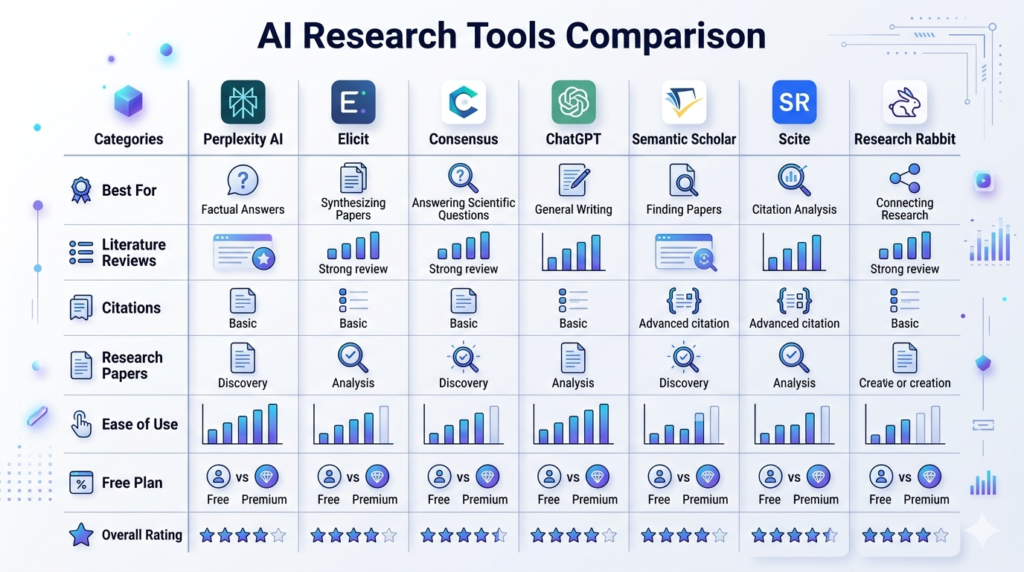
Comparison Table: Best AI Research Tools
| Tool | Best For | Ease of Use | Research Quality | Free Plan |
|---|---|---|---|---|
| Perplexity AI | General Research | Easy | Excellent | Yes |
| Elicit | Literature Reviews | Easy | Excellent | Limited |
| Consensus | Scientific Research | Easy | Excellent | Yes |
| ChatGPT | Research Assistance | Easy | Very Good | Yes |
| Semantic Scholar | Academic Papers | Easy | Excellent | Yes |
| Scite | Citation Analysis | Medium | Excellent | Limited |
| Research Rabbit | Research Discovery | Medium | Very Good | Yes |
Best AI Research Tools for Students
Students often need tools that can quickly explain concepts, summarize information, and help locate reliable sources.
Among the Best AI Research Tools, ChatGPT, Perplexity AI, and Elicit are particularly useful for students because they simplify complex topics and improve research efficiency.
Best AI Research Tools for Academic Researchers
Academic researchers require access to high-quality studies, citations, and literature review support.
Elicit, Consensus, Semantic Scholar, and Scite are among the Best AI Research Tools for academic work because they focus on peer-reviewed research and evidence-based analysis.
Best AI Research Tools for Literature Reviews
Literature reviews can be time-consuming, especially when dealing with hundreds of papers.
Elicit, Research Rabbit, and Semantic Scholar help researchers discover relevant studies, identify trends, and organize information more efficiently.
Best AI Research Tools for Finding Research Papers
Finding relevant academic papers is one of the most important aspects of research.
Semantic Scholar, Research Rabbit, Consensus, and Elicit are among the Best AI Research Tools for discovering high-quality research papers and tracking related studies.
How to Choose the Right AI Research Tool
Selecting the Best AI Research Tools depends on your research goals, academic requirements, and preferred workflow.
Choose Perplexity AI If
- You need fast answers with source citations.
- You conduct general research regularly.
- You want a simple and user-friendly experience.
Choose Elicit If
- You perform literature reviews.
- You work with academic papers frequently.
- You need evidence extraction from research studies.
Choose Consensus If
- You want research-backed answers.
- You rely on scientific evidence.
- You conduct healthcare or academic research.
Choose ChatGPT If
- You need help understanding complex topics.
- You want research summaries and explanations.
- You frequently brainstorm ideas and outlines.
Choose Semantic Scholar If
- You search for academic papers regularly.
- You need citation tracking.
- You work in higher education or research.
Choose Scite If
- You want to verify research claims.
- You analyze citations in detail.
- You need evidence-based validation.
Choose Research Rabbit If
- You explore new research topics.
- You conduct extensive literature reviews.
- You want visual research discovery tools.
Pros and Cons of AI Research Tools
Pros
- Faster information gathering
- Improved literature reviews
- Better research productivity
- Easier paper discovery
- Time-saving summaries
- Citation assistance
- Enhanced knowledge discovery
- Useful for students and professionals
Cons
- Some tools require paid plans
- AI-generated summaries may miss context
- Source verification is still important
- Quality varies between platforms
- Overreliance can reduce critical analysis
Frequently Asked Questions
What is the best AI research tool in 2026?
Perplexity AI, Elicit, Consensus, and ChatGPT are among the best AI research tools in 2026. The right choice depends on whether you need literature reviews, source verification, academic research, or general research assistance.
Which AI research tool is best for students?
ChatGPT, Perplexity AI, and Elicit are excellent research tools for students because they help explain complex topics, summarize information, and find reliable sources quickly.
Is Perplexity AI better than ChatGPT for research?
Perplexity AI is often better for source-based research because it provides citations and references. ChatGPT is stronger for explanations, brainstorming, and understanding complex concepts.
Can AI help with literature reviews?
Yes. AI research tools such as Elicit, Research Rabbit, and Semantic Scholar can help researchers discover relevant studies, summarize findings, and organize literature reviews more efficiently.
What is the best free AI research tool?
Perplexity AI, ChatGPT, Semantic Scholar, and Research Rabbit offer useful free plans that support academic research, learning, and information discovery.
Which AI tool is best for finding research papers?
Semantic Scholar, Elicit, Research Rabbit, and Consensus are among the best AI tools for finding academic papers, citations, and related research studies.
Can AI replace academic researchers?
No. AI research tools can assist with information gathering and analysis, but researchers are still required for critical thinking, interpretation, methodology, and original contributions.
Are AI research tools worth using?
Yes. The best AI research tools can save time, improve productivity, simplify literature reviews, and help researchers discover relevant information more effectively.
Which AI Research Tool Should You Choose?
The Best AI Research Tools can significantly improve the way students, researchers, academics, and professionals discover and analyze information. Whether you need help finding research papers, conducting literature reviews, verifying sources, or understanding complex topics, there is an AI research tool designed for your needs.
Perplexity AI is an excellent choice for general research, Elicit excels at literature reviews, Consensus focuses on scientific evidence, and Semantic Scholar remains one of the best platforms for academic paper discovery. ChatGPT provides versatile research assistance, while Scite and Research Rabbit offer unique capabilities for citation analysis and research exploration.
Ultimately, the best AI research tool depends on your goals, workflow, and research requirements. By choosing the right platform, researchers can work more efficiently, make better-informed decisions, and stay ahead in an increasingly data-driven world.
Related AI Guides: