
Artificial intelligence is transforming the way students learn, research, write, and organize information. Today, many students use AI tools to save time, improve productivity, and understand complex topics more effectively.
The best part is that many powerful AI tools are available for free. These tools can help with note-taking, research, writing assignments, grammar checking, presentation creation, and exam preparation.
In this guide, we will explore the best free AI tools for students in 2026, their features, benefits, limitations, and how to choose the right tool for your academic needs.
What Are AI Tools for Students?
AI tools for students are software applications that use artificial intelligence to assist with learning, research, writing, organization, and productivity.
These tools can answer questions, summarize notes, generate ideas, improve grammar, create presentations, and help students understand difficult concepts more efficiently.
Unlike traditional software, AI tools can interact with users in natural language and provide personalized assistance based on individual needs. This makes them valuable study companions for students at all educational levels.
Why Students Are Using AI Tools in 2026
Students today face increasing academic demands. Research projects, assignments, presentations, and exams require significant time and effort.
AI tools help students work smarter by automating repetitive tasks and providing instant access to information. Instead of spending hours searching for answers, students can use AI tools to summarize content, explain concepts, generate study materials, and improve their writing.
The growing popularity of AI tools is also driven by accessibility. Many leading AI platforms offer free plans that provide enough functionality for everyday academic tasks.
Quick Comparison Table of Free AI Tools for Students
| Tool | Best For | Free Plan | Category |
|---|---|---|---|
| ChatGPT | Learning & Writing | Yes | AI Assistant |
| Perplexity | Research | Yes | AI Search |
| NotebookLM | Study Notes | Yes | AI Learning |
| Grammarly | Writing Improvement | Yes | Writing Tool |
| Canva AI | Presentations | Yes | Design Tool |
ChatGPT for Students
ChatGPT is one of the most popular AI tools for students. It can explain difficult topics, summarize notes, generate study plans, and answer academic questions in simple language.
Students use ChatGPT to improve understanding, brainstorm ideas, create outlines, and prepare for exams.
Best Uses
- Understanding difficult concepts
- Summarizing notes
- Creating study plans
- Exam preparation
- Improving writing skills
Advantages
- Easy to use
- Available on free plan
- Supports multiple subjects
- Helpful for research and learning
Perplexity for Research
Perplexity is an AI-powered research assistant that provides answers along with source references. This makes it particularly useful for students who need reliable information for assignments and projects.
Unlike many AI chatbots, Perplexity often shows where the information comes from, helping students verify facts and improve research quality.
Best Uses
- Research projects
- Fact-checking
- Finding sources
- Academic learning
Advantages
- Source citations
- Fast information retrieval
- User-friendly interface
- Free access available
NotebookLM for Study Notes
NotebookLM is a powerful study tool developed by Google. It allows students to upload their own notes, documents, PDFs, and research materials and then ask questions based on those sources.
This makes NotebookLM especially useful for exam preparation and understanding large amounts of information.
Best Uses
- Study notes
- Research papers
- Exam preparation
- Document summaries
Advantages
- Works with personal documents
- Generates summaries
- Answers questions from uploaded content
- Free to use
Grammarly for Academic Writing
Grammarly helps students improve grammar, spelling, punctuation, and sentence structure. It is widely used for essays, assignments, reports, and academic writing.
The free version provides essential writing suggestions that help students produce clearer and more professional content.
Best Uses
- Essay writing
- Assignment editing
- Grammar checking
- Proofreading
Advantages
- Easy to use
- Real-time suggestions
- Improves writing quality
- Free plan available
Canva AI for Presentations
Canva AI helps students create attractive presentations, infographics, posters, and academic projects with minimal design experience.
Its AI-powered features can generate layouts, suggest designs, and speed up the creation process.
Best Uses
- Presentations
- Infographics
- Academic projects
- Visual learning materials
Advantages
- Beginner-friendly
- Professional templates
- AI-assisted design tools
- Free version available
Additional Free AI Tools for Students
While ChatGPT, Perplexity, NotebookLM, Grammarly, and Canva AI are among the most popular choices, several other free AI tools can help students improve productivity and learning.
Google Gemini
Google Gemini can assist students with research, brainstorming, summarization, and answering academic questions. It integrates well with Google’s ecosystem and is useful for everyday learning tasks.
Microsoft Copilot
Microsoft Copilot helps students work with documents, presentations, and research materials. It can summarize information and improve productivity when working on academic projects.
QuillBot
QuillBot is widely used for paraphrasing, rewriting, and improving sentence clarity. It is especially useful for students who want to improve the readability of their assignments.
Notion AI
Notion AI helps students organize notes, manage projects, create study plans, and keep track of assignments. It combines productivity and AI assistance in a single workspace.
Elicit
Elicit is a research-focused AI tool that helps students find academic papers, summarize research findings, and explore scientific literature more efficiently.
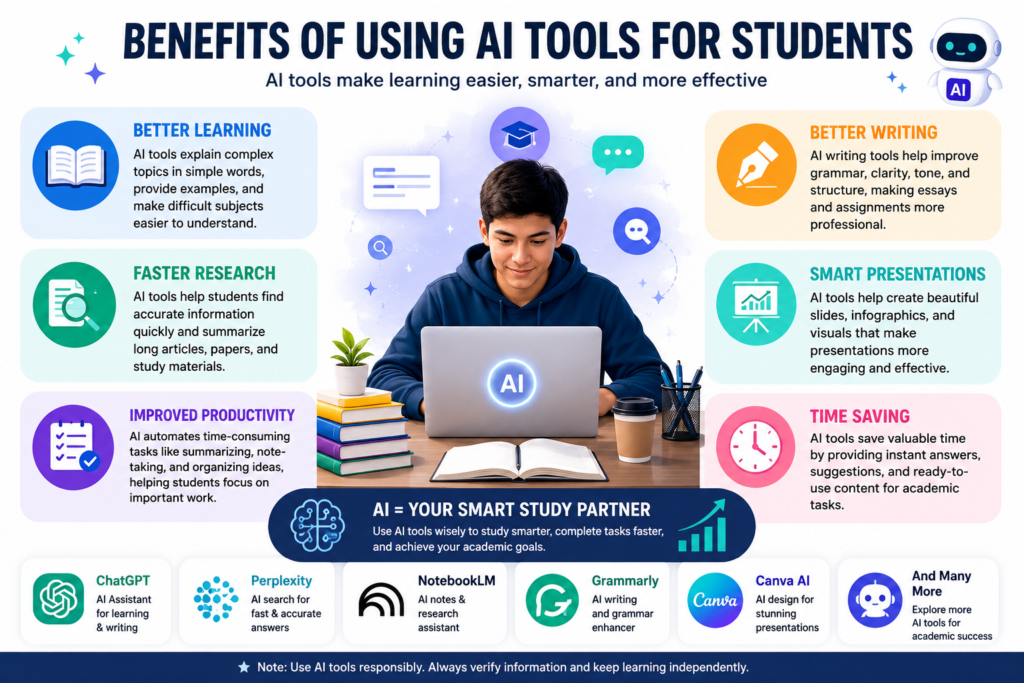
Benefits of Using AI Tools for Students
AI tools provide several advantages for students.
Some of the most important benefits include:
- Saving time on repetitive tasks
- Improving productivity
- Supporting research and learning
- Enhancing writing quality
- Organizing study materials
- Creating presentations more efficiently
- Helping students understand complex topics
When used responsibly, AI tools can become valuable academic assistants that support learning rather than replace it.
How AI Improves Student Productivity
AI tools help students complete tasks more efficiently. Instead of spending hours searching for information or organizing notes, students can use AI assistants to summarize content, generate ideas, and create study materials within minutes.
This increased efficiency allows students to focus more on understanding concepts rather than managing repetitive academic tasks.
Personalized Learning Support
Every student learns differently. AI tools can adapt explanations to different learning styles and provide customized support based on individual needs.
For example, students can request simplified explanations, detailed examples, step-by-step solutions, or practice questions depending on their learning preferences.
Better Time Management
Many students struggle with balancing classes, assignments, projects, and examinations. AI tools can help create study schedules, prioritize tasks, and organize academic workloads more effectively.
This support reduces stress and helps students maintain consistent study habits throughout the academic year.
How AI Helps Students Save Time
One of the biggest advantages of AI tools is their ability to save time. Students often spend hours searching for information, organizing notes, proofreading assignments, and creating presentations.
AI tools can automate many of these tasks and allow students to focus more on understanding concepts and improving academic performance.
For example, AI can summarize lengthy articles, generate study guides, organize research notes, and identify writing mistakes within seconds. This efficiency allows students to manage their workload more effectively while reducing stress during busy academic periods.
AI Study Tips Using Free AI Tools
Students can maximize the value of AI tools by using them strategically rather than relying on them for direct answers.
Here are some practical study tips:
Create Study Summaries
Use AI tools to summarize long chapters and research materials into concise notes that are easier to review before exams.
Generate Practice Questions
Students can ask AI tools to create quizzes and practice questions based on specific topics.
Build Study Plans
AI assistants can help organize daily and weekly study schedules based on learning goals and deadlines.
Simplify Complex Topics
Students can request explanations in simpler language when studying difficult concepts in science, mathematics, technology, or humanities.
Improve Writing Skills
Writing tools can identify grammar mistakes and suggest improvements without rewriting the student’s original ideas.
Limitations and Ethical Considerations
While AI tools offer many benefits, students should use them responsibly. AI-generated information may sometimes contain errors, outdated facts, or incomplete explanations.
Students should avoid relying entirely on AI for assignments and research. Critical thinking, independent learning, and fact-checking remain essential skills.
Educational institutions may also have specific policies regarding AI usage. Students should always follow academic guidelines and use AI as a learning aid rather than a replacement for their own work.
Responsible use of AI helps students gain the benefits of technology while maintaining academic integrity.
Common Mistakes Students Make with AI Tools
Although AI tools are extremely useful, students often make mistakes that reduce their effectiveness.
Some common mistakes include:
- Copying AI-generated content without understanding it.
- Using AI without verifying facts and sources.
- Depending completely on AI for assignments.
- Ignoring academic integrity policies.
- Using too many AI tools at the same time.
The best approach is to treat AI as an assistant that supports learning rather than replacing independent thinking.
AI and Academic Integrity
The use of AI in education raises important questions about academic honesty and responsible learning.
Students should use AI to support understanding rather than to complete assignments without effort. Educational institutions increasingly encourage responsible AI use while discouraging plagiarism and misuse.
A good rule is to use AI for learning, brainstorming, and improving work rather than submitting AI-generated content without review. This approach helps students benefit from technology while maintaining ethical academic standards.
Free vs Paid AI Tools for Students
Most students begin with free AI tools, and for many academic tasks, free plans are sufficient.
Free plans typically provide access to core features such as AI chat, grammar checking, note summarization, and presentation creation.
Paid plans often include:
- Higher usage limits
- Faster responses
- Advanced AI models
- Additional customization features
- Priority access during peak usage
Students should start with free plans and upgrade only if they regularly need advanced capabilities.
Best AI Tools for Different Student Needs
Different students have different requirements. Choosing the right AI tool depends on specific academic goals.
For Research
Perplexity and Elicit are excellent choices for finding information, exploring sources, and understanding research topics.
For Writing
ChatGPT and Grammarly help students create better assignments, improve grammar, and organize ideas.
For Study Notes
NotebookLM and Notion AI are useful for managing notes, summarizing documents, and organizing learning materials.
For Presentations
Canva AI helps students create professional-looking presentations and visual projects without advanced design skills.
How to Choose the Right AI Tool
Choosing the right AI tool depends on your academic needs.
Ask yourself the following questions:
- Do I need help with research?
- Do I need help with writing?
- Do I need better study organization?
- Do I need presentation tools?
- Do I need note summarization?
Students who focus on research may benefit most from Perplexity and NotebookLM, while those working on assignments may find ChatGPT and Grammarly more useful.
The best approach is to test several free tools and determine which ones fit your learning style.
Real-World Student Use Cases
AI tools are already being used by students across schools, colleges, and universities.
Common examples include:
Research Projects
Students use AI tools to gather information, understand topics, and organize research materials.
Assignment Writing
AI writing assistants help improve grammar, clarity, and structure.
Exam Preparation
Students create summaries, study plans, and practice questions using AI tools.
Presentations
Design tools such as Canva AI help students create visually appealing academic presentations quickly and efficiently.
Future of AI in Education
Artificial intelligence is expected to play an increasingly important role in education over the coming years.
Future AI systems may provide personalized learning experiences, adaptive study plans, intelligent tutoring systems, and real-time academic support. Students will be able to learn at their own pace while receiving guidance tailored to their individual strengths and weaknesses.
Educational institutions are also exploring ways to integrate AI into classrooms while maintaining academic integrity and critical thinking skills.
As AI technology continues to improve, students who learn how to use AI responsibly will gain valuable advantages in learning, research, and productivity.
Personalized Learning Platforms
Future AI systems are expected to provide highly personalized learning experiences. Students may receive customized study plans, targeted practice exercises, and real-time feedback based on their strengths and weaknesses.
Intelligent Academic Assistants
AI-powered academic assistants will become more capable of helping students manage coursework, research projects, and exam preparation.
These assistants may eventually function as digital tutors that provide continuous support throughout a student’s educational journey.
Greater Accessibility
AI technology can make education more accessible for students around the world by providing affordable learning assistance, language support, and educational resources regardless of location.
This could help reduce educational barriers and create more opportunities for learners globally.
Frequently Asked Questions
What is the best free AI tool for students?
ChatGPT is one of the best free AI tools for students because it helps with learning, writing, brainstorming, note summarization, and exam preparation.
Which AI tool is best for student research?
Perplexity and Elicit are among the best free AI tools for student research because they help find information, explore sources, and understand academic topics more effectively.
Can AI tools help students study better?
Yes. AI tools can create study summaries, generate practice questions, explain difficult concepts, organize notes, and help students prepare more efficiently for exams.
Is it safe for students to use AI tools?
Yes. Most popular AI tools are safe when used responsibly. Students should verify information, protect personal data, and follow their school or university guidelines.
Are free AI tools enough for academic work?
For most students, free AI tools provide enough functionality for research, writing, note-taking, presentations, and everyday learning tasks.
Which AI tool is best for study notes?
NotebookLM and Notion AI are among the best tools for study notes because they help organize information, summarize documents, and answer questions from uploaded materials.
Can AI replace studying?
No. AI should be used as a learning assistant rather than a replacement for studying. Critical thinking, practice, and independent understanding remain essential for academic success.
What is the best AI tool for student presentations?
Canva AI is one of the best free AI tools for student presentations because it helps create professional slides, infographics, posters, and academic projects quickly.
Why Students Should Start Using AI Today
Artificial intelligence is changing education by making learning more accessible, efficient, and personalized. Students now have access to powerful free AI tools that can help with research, writing, note-taking, presentations, and exam preparation.
Tools such as ChatGPT, Perplexity, NotebookLM, Grammarly, and Canva AI provide valuable support for everyday academic tasks. When used responsibly, these tools can save time, improve productivity, and enhance learning outcomes.
The key is to use AI as an assistant rather than a replacement for independent thinking. Students who learn how to combine AI tools with strong study habits will be better prepared for academic success in the future.
As artificial intelligence continues to evolve, students who learn how to use AI responsibly will gain valuable advantages in research, learning, communication, and productivity. The goal is not to replace traditional learning but to enhance it through intelligent assistance and better access to information.
By combining strong study habits with the right AI tools, students can become more efficient learners and better prepare themselves for future academic and professional success.
Related AI Guides: