
Marketing has changed dramatically over the last few years. Businesses no longer rely only on manual research, content creation, email campaigns, and data analysis. Today, artificial intelligence helps marketers work faster, make better decisions, and achieve better results with less effort.
Whether you run a small business, manage a startup, work as a freelancer, or handle marketing for a large company, AI tools can save time and improve performance. From writing blog posts and social media content to analyzing customer behavior and optimizing advertising campaigns, AI is becoming an essential part of modern marketing.
The good news is that there are now AI tools available for almost every marketing task. Some tools help create content, while others improve SEO, automate emails, generate advertising creatives, or provide detailed marketing insights.
In this guide, we will explore the best AI tools for marketing in 2026. We will compare their features, advantages, limitations, and ideal use cases to help you choose the right tool for your marketing goals.
Why AI Is Transforming Marketing
Artificial intelligence helps marketers automate repetitive tasks and focus on strategy. Instead of spending hours writing content or analyzing data, AI can complete these tasks in minutes.
Some major benefits of AI marketing tools include:
- Faster content creation
- Improved SEO performance
- Better audience targeting
- Automated email marketing
- Smarter advertising campaigns
- Data-driven decision making
- Increased productivity
- Reduced marketing costs
As AI technology continues to improve, businesses that adopt AI marketing tools gain a competitive advantage over those that rely only on traditional methods.
What Makes a Great AI Marketing Tool?
Not every AI tool is suitable for marketing. The best tools usually provide a combination of automation, content generation, analytics, and ease of use.
When evaluating AI marketing tools, consider the following factors:
Ease of Use
A good AI marketing tool should be beginner-friendly and easy to implement without requiring technical skills.
Content Quality
The generated content should be accurate, engaging, and suitable for your target audience.
Automation Features
Automation saves time by handling repetitive tasks such as scheduling posts, sending emails, and generating reports.
Integration Options
The best tools connect with platforms such as WordPress, CRM systems, social media networks, and email marketing software.
Pricing
Choose a tool that provides good value based on your business size and marketing requirements.
Best AI Tools for Marketing in 2026
1. ChatGPT
ChatGPT has become one of the most widely used AI tools in the marketing industry. It helps marketers create blog posts, social media captions, email campaigns, product descriptions, advertising copy, and customer support responses.
Key Features:
- Content writing assistance
- Marketing strategy brainstorming
- Email creation
- Social media content generation
- Customer communication support
Best For:
Content marketers, bloggers, freelancers, and small businesses.
Pros:
- Easy to use
- Fast content generation
- Supports multiple content formats
- Excellent idea generation
Cons:
- Requires fact-checking for important content
- Output quality depends on prompts
2. Jasper
Jasper is one of the most popular AI marketing platforms designed specifically for businesses and professional marketers.
Key Features:
- Marketing-focused templates
- Brand voice customization
- Campaign creation tools
- Long-form content generation
- Team collaboration features
Best For:
Marketing agencies and growing businesses.
Pros:
- High-quality marketing content
- Strong workflow automation
- Brand consistency features
Cons:
- Higher pricing than many competitors
- Learning curve for beginners
3. Copy.ai
Copy.ai focuses on generating marketing copy quickly and efficiently. It is particularly useful for social media, email marketing, and sales content.
Key Features:
- Marketing copy generation
- Social media content creation
- Email campaign assistance
- Sales content automation
- Workflow automation
Best For:
Small businesses and startups.
Pros:
- User-friendly interface
- Fast content generation
- Good automation features
Cons:
- Limited advanced customization
- Some outputs require editing
4. Surfer SEO
Surfer SEO is one of the best AI-powered tools for content optimization and search engine rankings. It helps marketers create content that is more likely to rank higher on Google by analyzing top-performing pages and providing data-driven recommendations.
Unlike traditional SEO tools, Surfer SEO combines artificial intelligence with real-time search data. It guides users on keyword usage, content structure, headings, and content length.
Key Features:
- AI-powered content editor
- Keyword optimization suggestions
- Content scoring system
- SERP analysis
- SEO audit tools
Best For:
SEO professionals, bloggers, content marketers, and agencies.
Pros:
- Improves content ranking potential
- Easy-to-follow optimization recommendations
- Strong keyword research support
- Helpful for both beginners and experts
Cons:
- Can be expensive for small businesses
- Some recommendations may require manual review
5. Semrush AI
Semrush is a well-known digital marketing platform that now includes powerful AI features. It helps marketers with keyword research, competitor analysis, content planning, SEO optimization, and advertising insights.
Its AI-powered tools can identify content opportunities, analyze market trends, and help businesses create more effective marketing strategies.
Key Features:
- AI-assisted keyword research
- Competitor analysis
- Content marketing toolkit
- SEO recommendations
- Advertising research
Best For:
Digital marketers, agencies, and growing businesses.
Pros:
- Comprehensive marketing platform
- Excellent SEO and competitor data
- Reliable keyword insights
- Suitable for large-scale campaigns
Cons:
- Premium plans can be costly
- Beginners may need time to learn the platform
6. HubSpot AI
HubSpot AI combines customer relationship management (CRM) with artificial intelligence to help businesses improve marketing, sales, and customer engagement.
The platform assists with content creation, email marketing, lead nurturing, customer segmentation, and performance analysis.
Key Features:
- AI-powered CRM
- Email marketing automation
- Content generation tools
- Lead management
- Marketing analytics
Best For:
Businesses that want an all-in-one marketing solution.
Pros:
- Powerful automation features
- Excellent customer management tools
- Easy integration with marketing workflows
- Strong reporting capabilities
Cons:
- Advanced features require higher plans
- Can be overwhelming for first-time users
7. Canva Magic Studio
Canva is already popular among marketers, and its AI-powered Magic Studio features make content creation even easier.
Marketers can generate social media graphics, presentations, advertisements, videos, and promotional materials using simple prompts. This makes Canva one of the Best AI Tools for Content Creators in 2026.
Key Features:
- AI image generation
- Magic Design
- AI writing assistance
- Background remover
- Video creation tools
Best For:
Social media marketers, content creators, and small businesses.
Pros:
- Very beginner-friendly
- Fast graphic creation
- Large template library
- Affordable pricing options
Cons:
- Limited advanced design controls
- Some premium features require a paid plan
8. AdCreative.ai
AdCreative.ai focuses on helping businesses create high-converting advertisements. The platform uses AI to generate ad creatives, headlines, and marketing visuals designed to improve campaign performance.
It is particularly useful for businesses running Facebook, Instagram, and Google Ads campaigns.
Key Features:
- AI-generated ad creatives
- Advertising copy generation
- Performance-focused designs
- Creative scoring system
- Multiple ad format support
Best For:
Advertisers, ecommerce businesses, and marketing agencies.
Pros:
- Saves significant design time
- Optimized for conversions
- Easy to create multiple ad variations
- Supports various advertising platforms
Cons:
- Mainly focused on advertising
- Premium pricing for larger teams
9. Grammarly
Although Grammarly is known as a writing assistant, it has become an important AI tool for marketers. It helps improve grammar, clarity, tone, and readability across marketing content.
Whether writing blog posts, emails, landing pages, or social media content, Grammarly helps maintain professionalism and consistency.
Key Features:
- Grammar correction
- Tone suggestions
- Readability improvements
- AI writing assistance
- Plagiarism checking
Best For:
Content writers, marketers, and business professionals.
Pros:
- Easy to use
- Improves content quality
- Works across multiple platforms
- Saves editing time
Cons:
- Advanced features require a paid plan
- Sometimes over-corrects writing style
10. Notion AI
Notion AI is becoming increasingly popular among marketing teams for project management, content planning, and workflow organization.
It can generate content ideas, summarize information, create meeting notes, and assist with campaign planning.
Key Features:
- AI writing assistance
- Content planning
- Task management
- Meeting summaries
- Workflow automation
Best For:
Marketing teams, freelancers, and content managers.
Pros:
- Combines productivity and AI
- Helps organize marketing projects
- Easy collaboration features
- Saves planning time
Cons:
- Limited marketing-specific features
- Requires a learning period for new users
Comparison of the Best AI Marketing Tools in 2026
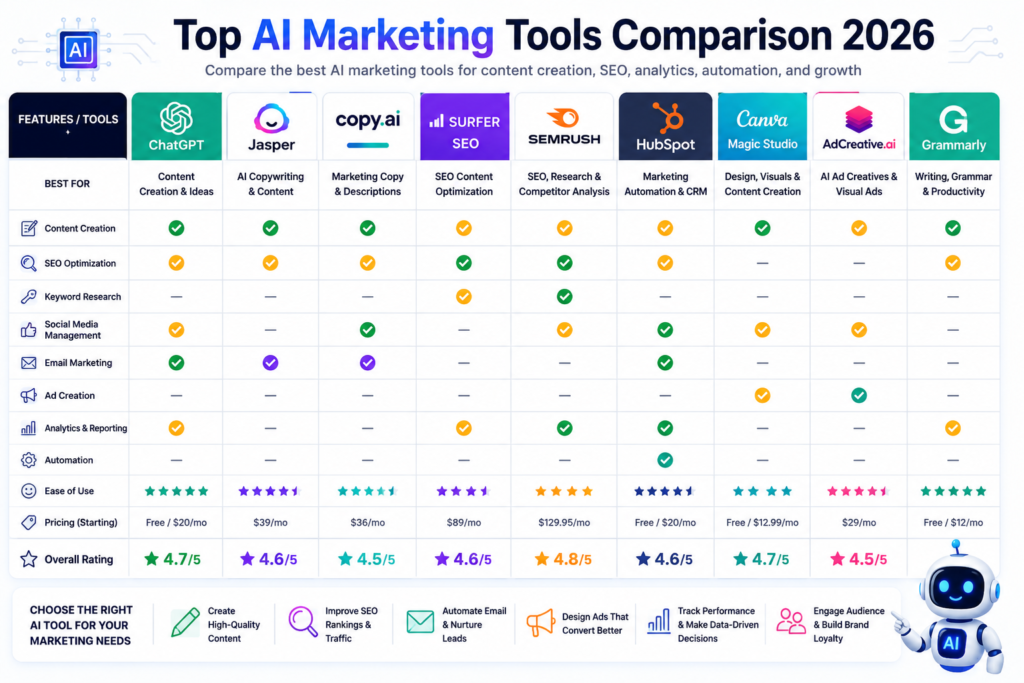
| Tool | Best For | Key Strength |
|---|---|---|
| ChatGPT | Content Creation | Versatile AI assistant |
| Jasper | Marketing Teams | Brand-focused content |
| Copy.ai | Sales & Marketing Copy | Fast content generation |
| Surfer SEO | SEO Optimization | Content ranking improvement |
| Semrush AI | SEO & Research | Competitor analysis |
| HubSpot AI | CRM & Automation | Marketing automation |
| Canva Magic Studio | Visual Content | Graphic design creation |
| AdCreative.ai | Advertising | High-converting ad creatives |
| Grammarly | Content Editing | Writing improvement |
| Notion AI | Project Management | Content planning and organization |
How to Choose the Right AI Marketing Tool
Choosing the right AI marketing tool depends on your goals, budget, and workflow.
For Content Marketing
If your primary goal is creating blog posts, social media content, emails, and marketing copy, ChatGPT, Jasper, and Copy.ai are excellent choices.
For SEO and Organic Traffic
Businesses focused on ranking higher in search engines should consider Surfer SEO and Semrush AI. These tools provide keyword research, competitor analysis, and optimization recommendations.
For Visual Marketing
If you regularly create social media graphics, advertisements, presentations, or videos, Canva Magic Studio can significantly speed up your workflow.
For Advertising Campaigns
AdCreative.ai is specifically designed for creating ad creatives and improving advertising performance across multiple platforms.
For Marketing Automation
HubSpot AI is a strong choice for businesses looking to automate customer communication, lead nurturing, and campaign management.
For Team Collaboration
Marketing teams that need project management and content planning support may benefit from Notion AI.
Benefits of Using AI in Marketing
AI is no longer a luxury for marketers. It has become an essential tool for businesses that want to remain competitive.
Saves Time
AI can automate repetitive tasks such as content creation, email drafting, keyword research, and reporting.
Improves Productivity
Marketing teams can complete more work in less time, allowing them to focus on strategy and creativity. Many of these solutions are also featured in our Best AI Productivity Tools in 2026 guide.
Enhances Customer Targeting
AI analyzes customer behavior and helps marketers deliver more relevant content and offers.
Supports Better Decision-Making
Data-driven insights allow businesses to make smarter marketing decisions based on real performance metrics.
Reduces Marketing Costs
By automating routine activities, businesses can reduce operational expenses while maintaining marketing effectiveness.
Scales Marketing Efforts
AI makes it easier to manage larger campaigns without significantly increasing workload.
Limitations of AI Marketing Tools
Despite their advantages, AI marketing tools are not perfect.
Human Creativity Is Still Important
AI can generate ideas and content, but it cannot fully replace human creativity, emotional understanding, and brand storytelling.
Accuracy Issues
Some AI-generated content may contain errors or outdated information. Human review remains essential.
Learning Curve
Certain advanced tools require training before users can take full advantage of their capabilities.
Cost Considerations
Premium AI platforms can be expensive for startups and small businesses with limited budgets.
Dependence on Quality Inputs
The quality of AI outputs often depends on the quality of prompts, instructions, and data provided.
Future of AI in Marketing
The role of artificial intelligence in marketing will continue to grow over the coming years. Future AI tools are expected to offer deeper personalization, improved predictive analytics, smarter automation, and better customer engagement capabilities.
Businesses that adopt AI early can gain a significant competitive advantage. However, successful marketing will still require a balance between automation and human creativity.
Rather than replacing marketers, AI is becoming a powerful assistant that helps professionals work smarter and achieve better results.
AI Marketing Trends to Watch in 2026
Artificial intelligence is evolving rapidly, and marketers are finding new ways to use it every year. Businesses that stay updated with these trends can gain a significant competitive advantage.
Hyper-Personalized Marketing
AI tools are becoming better at understanding customer preferences and behavior. This allows businesses to deliver highly personalized emails, advertisements, and content recommendations.
Instead of sending the same message to everyone, marketers can create customized experiences for different audience segments.
Predictive Analytics
Modern AI tools can analyze historical data and predict future customer behavior. Marketers can use these insights to improve campaign planning, budget allocation, and customer targeting.
Predictive analytics helps businesses identify opportunities before competitors do.
AI-Powered Customer Support
AI chatbots and virtual assistants are becoming smarter and more human-like. They can answer customer questions, provide product recommendations, and support users around the clock.
This improves customer satisfaction while reducing support costs.
Automated Content Production
Content creation is one of the fastest-growing applications of AI. Businesses are using AI to generate blog posts, social media updates, video scripts, product descriptions, and email campaigns more efficiently than ever before.
Voice and Visual Search Optimization
As voice assistants and image-based search become more popular, marketers will need to optimize content for these new search methods. AI tools can help businesses prepare for these changes.
Common Mistakes When Using AI Marketing Tools
While AI can be extremely useful, many businesses fail to get the best results because they use the technology incorrectly.
Relying Completely on AI
AI should support human marketers, not replace them. Content generated by AI should always be reviewed and improved before publication.
Ignoring Brand Voice
Many businesses publish AI-generated content without adjusting it to match their brand personality. This can make content feel generic and inconsistent.
Using Too Many Tools
Some marketers subscribe to multiple AI platforms but use only a small portion of their features. It is often better to master a few powerful tools than to manage too many at once.
Not Fact-Checking Content
AI systems can occasionally generate inaccurate information. Always verify important facts, statistics, and claims before publishing content.
Focusing Only on Automation
Automation saves time, but successful marketing still depends on creativity, customer understanding, and strategic thinking.
Recommended AI Marketing Stack for Different Users
Choosing the right combination of tools can help marketers maximize results while staying within budget.
For Beginners
- ChatGPT
- Canva Magic Studio
- Grammarly
This combination is affordable, easy to use, and suitable for most marketing tasks.
For Bloggers and Content Creators
- ChatGPT
- Surfer SEO
- Grammarly
These tools help create, optimize, and polish content for search engines and readers.
For Small Businesses
- ChatGPT
- HubSpot AI
- Canva Magic Studio
This setup supports content creation, customer management, and visual marketing.
For Marketing Agencies
- Jasper
- Semrush AI
- HubSpot AI
- AdCreative.ai
These tools provide advanced capabilities for managing multiple clients and campaigns.
For Ecommerce Businesses
- AdCreative.ai
- ChatGPT
- Canva Magic Studio
- Semrush AI
This combination helps improve product marketing, advertising, and customer acquisition.
What are the best AI tools for marketing in 2026?
Some of the best AI tools for marketing in 2026 include ChatGPT, Jasper, Copy.ai, Surfer SEO, Semrush AI, HubSpot AI, Canva Magic Studio, AdCreative.ai, Grammarly, and Notion AI.
Can AI replace digital marketers?
No. AI can automate repetitive tasks and improve efficiency, but human creativity, strategy, and decision-making remain essential for successful marketing.
Which AI marketing tool is best for content creation?
ChatGPT, Jasper, and Copy.ai are among the best AI marketing tools for content creation. They can help marketers write blog posts, social media content, email campaigns, product descriptions, and advertising copy more efficiently.
Which AI tool is best for SEO marketing?
Surfer SEO and Semrush AI are among the best AI tools for SEO marketing. They help with keyword research, content optimization, competitor analysis, and improving search engine rankings.
Are AI marketing tools worth it for small businesses?
Yes. AI marketing tools can help small businesses save time, reduce marketing costs, automate repetitive tasks, and improve overall productivity. Many AI tools also offer affordable plans suitable for startups and small teams.
What is the biggest benefit of AI in marketing?
The biggest benefit of AI in marketing is automation. AI can handle repetitive tasks such as content creation, email marketing, customer support, data analysis, and campaign optimization, allowing marketers to focus on strategy and growth.
Final Thoughts
Artificial intelligence is no longer a future technology. It has become a practical marketing solution that businesses of all sizes can use today. Whether your goal is creating better content, improving SEO, running advertising campaigns, managing customer relationships, or increasing productivity, AI tools can help you achieve those objectives more efficiently.
The best AI tools for marketing in 2026 offer far more than simple automation. They provide valuable insights, improve decision-making, and allow marketers to focus on strategy rather than repetitive tasks. Tools such as ChatGPT, Jasper, Copy.ai, Surfer SEO, Semrush AI, HubSpot AI, Canva Magic Studio, AdCreative.ai, Grammarly, and Notion AI each serve different purposes and can significantly enhance marketing performance when used correctly.
The ideal choice depends on your business goals, budget, and marketing needs. Start with the tools that solve your biggest challenges, learn how to use them effectively, and gradually build a marketing workflow that combines AI efficiency with human creativity. Businesses that successfully adopt AI today will be better positioned to compete, grow, and adapt in the rapidly evolving digital marketing landscape.