
Artificial Intelligence (AI) is one of the most revolutionary technologies ever created. From smartphones and search engines to self-driving cars and advanced chatbots, AI is transforming the way people live, work, learn, and communicate.
Today, artificial intelligence powers many of the services people use every day. Whether someone is searching on Google, watching recommendations on YouTube, asking questions to ChatGPT, using voice assistants like Siri, or navigating through Google Maps, AI is working behind the scenes.
Over the last decade, AI has evolved from a specialized technology used by researchers into a mainstream tool used by students, teachers, businesses, healthcare professionals, content creators, governments, and scientists.
As AI continues to develop, understanding its fundamentals has become increasingly important. This Artificial Intelligence Guide is designed to help students, beginners, professionals, and general readers understand AI from its origins to its future impact on society.
By the end of this guide, you will understand what artificial intelligence is, how it works, its history, types, benefits, risks, applications, major companies, popular tools, and future possibilities.
Quick AI Facts
| Item | Information |
|---|---|
| Full Form | Artificial Intelligence |
| Short Form | AI |
| Coined By | John McCarthy |
| Coined In | 1956 |
| Father of AI | John McCarthy |
| Famous Pioneer | Alan Turing |
| First Major AI Conference | Dartmouth Conference |
| Most Popular AI Tool | ChatGPT |
| Main Goal | Simulate Human Intelligence |
| Current AI Leaders | OpenAI, Google, Microsoft, Anthropic |
What Is Artificial Intelligence?
Artificial Intelligence (AI) refers to the ability of machines and computer systems to perform tasks that normally require human intelligence.
These tasks include learning, reasoning, decision-making, problem-solving, language understanding, pattern recognition, and content generation.
In simple terms, AI enables machines to think, learn, and act in ways that resemble human intelligence.
Today, AI powers many technologies people use every day. For example:
- ChatGPT can answer questions.
- Google Translate can translate languages.
- Netflix recommends movies and TV shows.
- YouTube suggests relevant videos.
- Self-driving cars can navigate roads.
- AI image generators can create artwork from text prompts.
All of these systems use Artificial Intelligence to analyze information and provide useful results.
If you want to explore the most useful AI platforms available today, check out our detailed guide on Best AI Tools in 2026: Complete Guide for Beginners.
Simple Definition of AI
Artificial Intelligence is the ability of a machine to imitate human intelligence and perform tasks that normally require human thinking.
Technical Definition of AI
Artificial Intelligence is a branch of computer science that develops systems capable of performing tasks that typically require human intelligence, including learning, reasoning, perception, language understanding, decision-making, and problem-solving.
Why Is Artificial Intelligence Important?
Artificial Intelligence is important because it helps people and organizations complete tasks faster, more accurately, and more efficiently.
AI is now used in education, healthcare, business, research, banking, transportation, manufacturing, and entertainment. As AI technology continues to evolve, it is becoming one of the most influential innovations of the modern era.
To better understand how AI tools are improving workplace efficiency, explore our guide on Best AI Productivity Tools in 2026
What Is Artificial Intelligence and Why Is It Important?
Artificial Intelligence is important because it allows computers to process information faster and more accurately than humans in many situations.
Today, AI helps individuals, businesses, educational institutions, researchers, and governments improve efficiency, productivity, and decision-making.
AI helps organizations:
- Automate repetitive tasks
- Improve productivity
- Reduce costs
- Analyze large datasets
- Improve customer experiences
- Enhance decision-making
- Accelerate innovation
AI-powered tools are also helping professionals work smarter and save time. To discover some of the most effective solutions available today, explore our guide on Best AI Productivity Tools in 2026
Today, Artificial Intelligence is becoming as important as electricity, the internet, and smartphones in shaping modern society.
Real-Life Examples of AI
Many people use AI every day without realizing it. From smartphones and navigation apps to streaming platforms and chatbots, AI has become a part of daily life.
Search Engines
Google uses AI to understand search queries, analyze user intent, and rank the most relevant results.
Voice Assistants
Siri, Alexa, and Google Assistant use Artificial Intelligence to understand spoken language and respond to user commands.
Recommendation Systems
Netflix, Spotify, Amazon, and YouTube use AI algorithms to recommend content, products, and services based on user preferences and behavior.
Navigation Apps
Google Maps uses AI to analyze traffic conditions, predict travel times, and suggest the fastest routes.
AI Chatbots
ChatGPT, Claude, Gemini, and Microsoft Copilot can answer questions, generate content, assist with research, and improve productivity.
To learn how the leading AI assistants compare, read our detailed ChatGPT vs Gemini vs Claude comparison guide.
AI Image Generators
Tools such as Midjourney and ChatGPT can generate images from text prompts within seconds.
These platforms are transforming graphic design, marketing, content creation, and digital art. Learn more in our guide to the Best AI Image Generators in 2026.
History of Artificial Intelligence
The history of artificial intelligence began long before modern computers existed. Philosophers and scientists have dreamed of creating intelligent machines for centuries.
However, the scientific development of AI started during the twentieth century with advances in mathematics, computing, and logic.
Artificial intelligence has experienced periods of rapid progress as well as setbacks known as AI Winters. Today, AI is advancing faster than ever before.
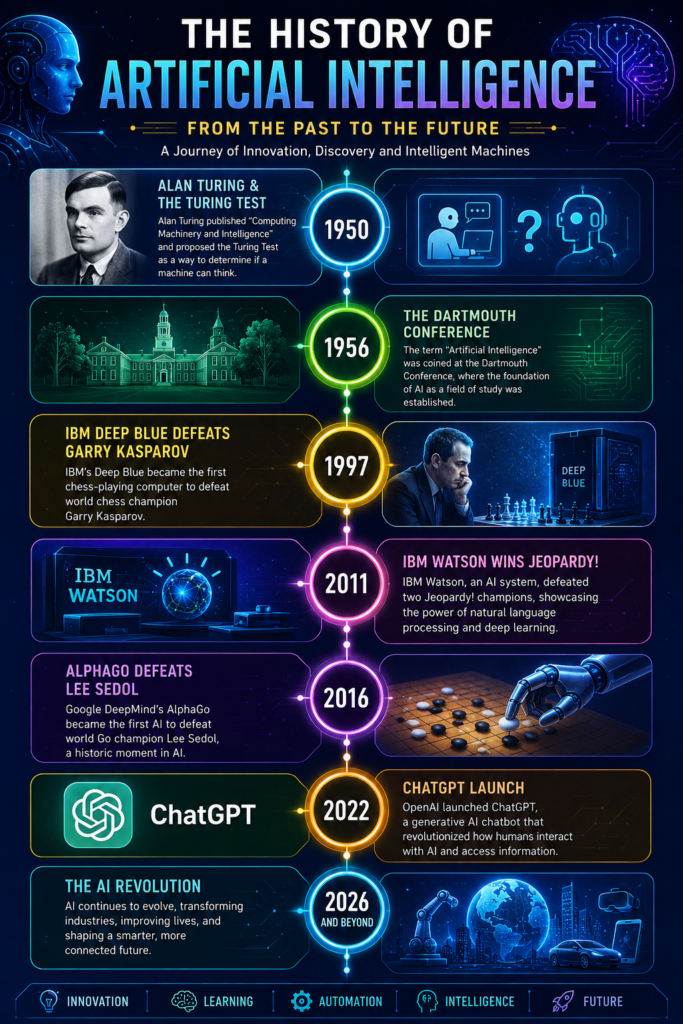
AI Timeline
| Year | Event |
|---|---|
| 1943 | First artificial neural network concept introduced |
| 1950 | Alan Turing proposes the Turing Test |
| 1956 | John McCarthy coins the term Artificial Intelligence |
| 1960s | Early AI research expands |
| 1970s | First AI Winter begins |
| 1980s | Expert systems become popular |
| 1997 | IBM Deep Blue defeats Garry Kasparov |
| 2011 | IBM Watson wins Jeopardy |
| 2016 | AlphaGo defeats Lee Sedol |
| 2022 | ChatGPT launches globally |
| 2023–2026 | Generative AI revolution accelerates |
Early AI Programs That Shaped Artificial Intelligence
Before modern AI systems like ChatGPT, Gemini, and Claude existed, researchers developed several pioneering AI programs that demonstrated the potential of machine intelligence.
Logic Theorist (1956)
Developed by Allen Newell, Herbert A. Simon, and Cliff Shaw, Logic Theorist is often considered the world’s first Artificial Intelligence program.
The system was designed to prove mathematical theorems and demonstrated that computers could perform tasks involving logical reasoning.
ELIZA (1966)
Created by Joseph Weizenbaum at MIT, ELIZA was one of the earliest AI chatbots.
ELIZA simulated human conversation by responding to user inputs using pattern-matching techniques. Although simple by today’s standards, it showed how computers could interact with humans using natural language.
SHRDLU (1970)
Developed by Terry Winograd, SHRDLU was an early Natural Language Understanding system.
It could understand and respond to commands written in English within a virtual block world, making it one of the first successful demonstrations of human-computer language interaction.
These pioneering systems laid the foundation for many modern AI technologies, including chatbots, language models, reasoning systems, and intelligent assistants.
Alan Turing and the Birth of Modern AI
Alan Turing is considered one of the most influential figures in computer science and artificial intelligence.
In 1950, he introduced the Turing Test, which evaluates whether a machine can demonstrate intelligent behavior similar to a human.
The Turing Test remains one of the most famous concepts in AI history.
John McCarthy and the Creation of AI
John McCarthy officially introduced the term Artificial Intelligence during the Dartmouth Conference in 1956.
Because of his contributions, he is often referred to as the Father of Artificial Intelligence.
The Dartmouth Conference is widely regarded as the birth of AI as an academic discipline.
Expanded History of Artificial Intelligence
The history of Artificial Intelligence has not been a straight path of continuous success. Instead, AI has experienced periods of optimism, major breakthroughs, disappointment, and revival.
Understanding these developments helps explain how AI evolved into the powerful technology we see today.
The Dartmouth Conference (1956)
The Dartmouth Summer Research Project on Artificial Intelligence was held in 1956 in Hanover, New Hampshire, USA.
This conference is considered the official birth of AI as an academic discipline.
The event was organized by:
- John McCarthy
- Marvin Minsky
- Nathaniel Rochester
- Claude Shannon
During this conference, researchers proposed that machines could potentially simulate aspects of human intelligence.
The term “Artificial Intelligence” was officially introduced here for the first time.
Early Optimism (1956–1970)
After the Dartmouth Conference, many researchers believed intelligent machines would soon become a reality.
Scientists developed programs capable of:
- Solving mathematical problems
- Playing simple games
- Proving logical theorems
These early successes created tremendous excitement within the scientific community.
However, researchers underestimated the complexity of human intelligence.
The First AI Winter (1970s)
By the early 1970s, progress was slower than expected.
Computers lacked:
- Processing power
- Memory capacity
- Large datasets
As a result, many AI projects failed to meet expectations.
Funding declined significantly, leading to a period known as the First AI Winter.
During this period, interest in AI research decreased dramatically.
The Rise of Expert Systems (1980s)
AI regained momentum during the 1980s with the development of Expert Systems.
Expert Systems were designed to imitate the decision-making abilities of human experts.
They were used in:
- Medicine
- Engineering
- Finance
- Manufacturing
Examples included systems that could diagnose diseases or recommend technical solutions.
Businesses invested heavily in Expert Systems, creating a new wave of AI enthusiasm.
The Second AI Winter (Late 1980s–1990s)
Despite initial success, Expert Systems had limitations.
They were:
- Expensive to maintain
- Difficult to update
- Limited in flexibility
As expectations again exceeded reality, AI funding declined.
This period became known as the Second AI Winter.
Many organizations reduced AI investments, and progress slowed once more.
Deep Blue Defeats Garry Kasparov (1997)
One of the most important moments in AI history occurred in 1997.
IBM’s Deep Blue defeated world chess champion Garry Kasparov.
This event demonstrated that computers could outperform humans in highly complex strategic tasks.
The victory attracted global attention and renewed interest in AI research.
IBM Watson Wins Jeopardy (2011)
In 2011, IBM Watson competed against human champions on the television quiz show Jeopardy.
Watson successfully answered complex natural language questions and defeated the best human contestants.
This achievement showcased major advances in:
- Natural Language Processing
- Knowledge Retrieval
- Machine Learning
Watson became a symbol of AI’s growing capabilities.
The Deep Learning Revolution (2010s)
Advances in computing power, big data, and neural networks triggered the Deep Learning Revolution.
Researchers achieved remarkable improvements in:
- Image Recognition
- Speech Recognition
- Language Processing
- Computer Vision
Deep learning became the driving force behind modern AI breakthroughs.
Scientists such as Geoffrey Hinton, Yann LeCun, and Yoshua Bengio played critical roles in advancing the field.
AlphaGo Defeats Lee Sedol (2016)
In 2016, Google’s DeepMind created AlphaGo.
AlphaGo defeated Lee Sedol, one of the world’s greatest Go players.
Go is significantly more complex than chess due to its enormous number of possible moves.
Many experts believed computers would need decades to reach this level.
AlphaGo’s victory shocked the world and demonstrated the growing power of modern AI.
The Generative AI Revolution (2020s)
The 2020s marked the beginning of the Generative AI Era.
Unlike earlier AI systems that focused primarily on prediction and analysis, generative AI can create entirely new content.
This includes:
- Text
- Images
- Videos
- Audio
- Software Code
Generative AI has transformed how people work, learn, communicate, and create content.
To compare today’s leading AI assistants, explore our detailed ChatGPT vs Gemini vs Claude guide.
ChatGPT and the Global AI Boom
The launch of ChatGPT in late 2022 accelerated public awareness of AI.
Millions of users began using AI for:
- Writing
- Learning
- Research
- Coding
- Business Tasks
ChatGPT became one of the fastest-growing consumer technologies in history.
Its success triggered intense competition among technology companies.
Modern AI Era (2023–2026)
Today, AI is one of the fastest-growing industries in the world.
Leading organizations include:
- OpenAI
- Microsoft
- Anthropic
- Meta
- NVIDIA
- Amazon
- IBM
Current AI systems can:
- Generate Content
- Analyze Data
- Create Images
- Write Software
- Assist Research
- Support Businesses
The modern AI era is characterized by rapid innovation and widespread adoption across nearly every industry.
What We Can Learn from AI History
The history of AI teaches several important lessons:
- Technological progress is rarely linear.
- Major breakthroughs often follow periods of disappointment.
- Computing power and data are critical for AI development.
- Human creativity remains essential in technological innovation.
- Responsible development is necessary to maximize benefits and reduce risks.
From the Dartmouth Conference of 1956 to today’s advanced generative AI systems, the journey of Artificial Intelligence has been one of the most remarkable technological stories in human history.
AI Timeline Summary
| Year | Milestone |
|---|---|
| 1943 | First Artificial Neural Network Concept |
| 1950 | Alan Turing Proposes Turing Test |
| 1956 | Term “Artificial Intelligence” Coined |
| 1970s | First AI Winter |
| 1980s | Expert Systems Era |
| 1997 | Deep Blue Defeats Garry Kasparov |
| 2011 | IBM Watson Wins Jeopardy |
| 2016 | AlphaGo Defeats Lee Sedol |
| 2022 | ChatGPT Launches |
| 2023 | Generative AI Boom |
| 2024 | AI Agents Become Popular |
| 2025–2026 | Rapid Global AI Adoption |
Types of Artificial Intelligence
Artificial Intelligence can be classified in several ways. The most common classification is based on capabilities and functionality.
Understanding the different types of AI helps explain both the current state of technology and the future possibilities of intelligent systems.
Types of AI Based on Capabilities
1. Artificial Narrow Intelligence (ANI)
Artificial Narrow Intelligence (ANI), also known as Weak AI, is the only type of AI that currently exists.
ANI is designed to perform specific tasks and cannot operate beyond its programmed capabilities.
Examples include:
- ChatGPT
- Google Search
- Siri
- Alexa
- Netflix Recommendations
- Google Maps
Although ANI can outperform humans in specific tasks, it cannot think or reason like a human across multiple domains.
2. Artificial General Intelligence (AGI)
Artificial General Intelligence (AGI) refers to AI systems capable of performing any intellectual task that a human can perform.
AGI would be able to:
- Learn independently
- Reason logically
- Adapt to new situations
- Solve unfamiliar problems
- Transfer knowledge between tasks
At present, AGI remains a theoretical concept and has not yet been achieved.
Many researchers and technology companies are actively working toward this goal.
3. Artificial Super Intelligence (ASI)
Artificial Super Intelligence (ASI) represents a hypothetical future stage where AI surpasses human intelligence in every area.
An ASI system could potentially:
- Solve scientific problems beyond human capability
- Create advanced technologies
- Make complex decisions faster than humans
- Continuously improve itself
Currently, ASI does not exist and remains a subject of research, debate, and speculation.
AI Capability Comparison
| Type | Status | Intelligence Level |
|---|---|---|
| ANI | Exists Today | Limited |
| AGI | Under Research | Human-Level |
| ASI | Hypothetical | Beyond Human |
Types of AI Based on Functionality
Researchers also classify Artificial Intelligence according to how it functions.
Reactive Machines
Reactive Machines respond only to current inputs.
They do not remember past experiences and cannot learn from previous interactions.
Example:
IBM Deep Blue, the chess computer that defeated world champion Garry Kasparov.
Limited Memory AI
Limited Memory AI can use past data and experiences to improve future decisions.
Most modern AI systems belong to this category.
Examples:
- Self-driving cars
- Recommendation systems
- AI chatbots
- Machine learning models
Theory of Mind AI
Theory of Mind AI would understand human emotions, intentions, beliefs, and social interactions.
Such systems do not yet exist but remain an important research goal.
Self-Aware AI
Self-Aware AI would possess consciousness and awareness similar to humans.
This remains purely theoretical and does not currently exist.
Major AI Pioneers Who Changed the World
The development of Artificial Intelligence has been influenced by many scientists, mathematicians, and researchers whose contributions laid the foundation for modern AI systems.
Alan Turing
Known as the father of modern computing, Alan Turing introduced the Turing Test and laid the foundation for machine intelligence.
His pioneering work continues to influence AI research and computer science today.
John McCarthy
John McCarthy coined the term “Artificial Intelligence” in 1956 and organized the Dartmouth Conference, which is widely considered the birth of AI as an academic discipline.
Because of his contributions, he is often referred to as the Father of Artificial Intelligence.
Marvin Minsky
Marvin Minsky was one of the earliest AI researchers and played a major role in establishing Artificial Intelligence as a scientific field.
His work helped shape early AI research and development.
Geoffrey Hinton
Geoffrey Hinton is often called the “Godfather of Deep Learning.”
His groundbreaking work on neural networks helped fuel the modern AI revolution and contributed significantly to advances in machine learning.
Yann LeCun
Yann LeCun is a pioneer in deep learning and computer vision.
His research significantly advanced image recognition technologies and modern AI applications.
Andrew Ng
Andrew Ng is one of the most influential educators and researchers in machine learning.
He helped popularize AI education worldwide and has trained millions of students through online learning platforms.
Sam Altman
Sam Altman is the CEO of OpenAI and one of the most influential figures behind modern generative AI technologies.
Under his leadership, OpenAI developed products such as ChatGPT, DALL·E, and Sora, which have accelerated the global adoption of Artificial Intelligence.
To learn more about OpenAI and its AI innovations, visit the official OpenAI website.
What Is Artificial Intelligence and How Does It Work?
Artificial Intelligence may seem magical, but it operates through a structured process involving data, algorithms, and computing power.
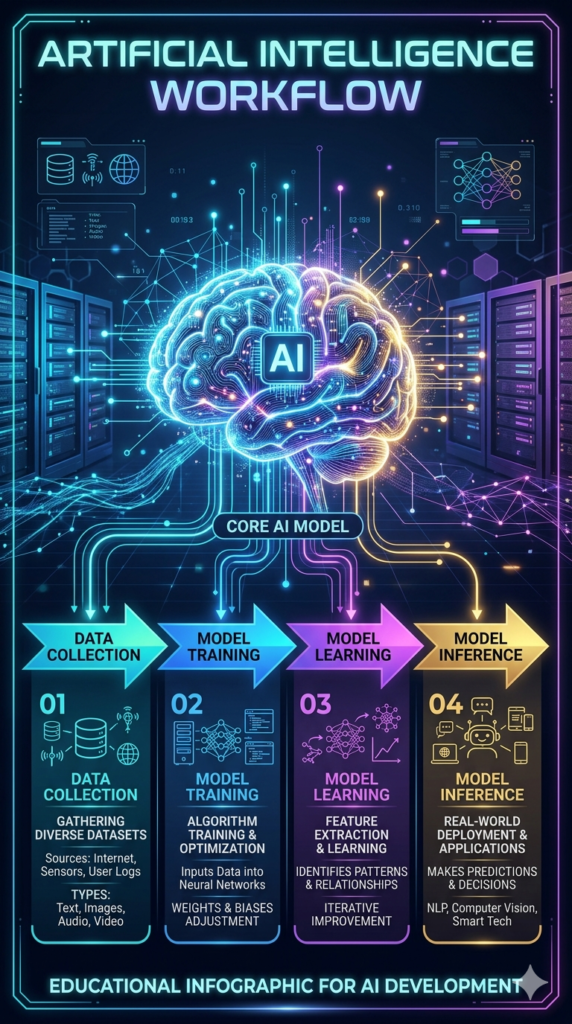
Most AI systems follow four major stages.
Step 1: Data Collection
AI learns from data.
The more high-quality data available, the better an AI system can perform.
Examples of AI training data include:
- Text
- Images
- Audio
- Video
- User Interactions
- Sensor Readings
Step 2: Training
During training, AI systems analyze large datasets and identify patterns.
The system gradually improves its ability to make predictions or decisions.
Training may take days, weeks, or even months depending on the model size.
Step 3: Learning
Using algorithms, AI learns relationships between different pieces of information.
This process allows AI to recognize objects, understand language, and generate responses.
Developers and engineers use specialized AI programming tools to build and train these systems. Learn more in our guide to the Best AI Coding Tools in 2026.
Step 4: Inference
After training, the AI applies what it has learned to new situations.
This stage is called inference.
For example, when you ask ChatGPT a question, the model uses inference to generate an answer based on patterns learned during training.
What Is Machine Learning?
Machine Learning (ML) is a branch of Artificial Intelligence that enables computers to learn from data without being explicitly programmed.
Instead of following fixed rules, machine learning systems improve through experience.
Machine Learning powers many modern technologies, including:
- Recommendation Systems
- Fraud Detection
- Spam Filtering
- Predictive Analytics
- Search Engines
Researchers, students, and professionals increasingly use AI-powered platforms to analyze data and discover insights. Explore our guide to the Best AI Research Tools in 2026.
What Is Deep Learning?
Deep Learning is a specialized area of Machine Learning inspired by the structure of the human brain.
It uses artificial neural networks with multiple layers to process information.
Deep Learning is responsible for many recent AI breakthroughs, including:
- ChatGPT
- Image Generation
- Speech Recognition
- Language Translation
- Autonomous Vehicles
Many modern content creation tools rely on Deep Learning to generate text, images, and videos. Learn more in our guide to the Best AI Tools for Content Creators in 2026.
Machine Learning vs Deep Learning
| Feature | Machine Learning | Deep Learning |
|---|---|---|
| Data Requirement | Moderate | Very High |
| Training Time | Faster | Longer |
| Complexity | Lower | Higher |
| Accuracy | Good | Excellent |
| Computing Power | Moderate | High |
| Human Intervention | More | Less |
What Are Neural Networks?
Neural networks are computer systems inspired by the human brain.
They consist of interconnected nodes called neurons that process information.
Neural networks are the foundation of:
- Deep Learning
- Generative AI
- Image Recognition
- Speech Recognition
- Natural Language Processing
Modern AI systems such as ChatGPT rely heavily on neural network architectures.
Why Deep Learning Changed AI Forever
Before deep learning became popular, AI systems struggled with complex tasks such as image recognition and language understanding.
The rise of powerful GPUs, large datasets, and improved neural network architectures enabled deep learning to achieve remarkable results.
Today, deep learning powers:
- ChatGPT
- Claude
- Gemini
- Midjourney
- Self-driving Vehicles
- Medical Imaging Systems
These advances have transformed AI from a research field into one of the most important technologies in the world.
Core Technologies Behind Artificial Intelligence
Artificial Intelligence is not a single technology. Instead, it is a combination of several technologies working together to enable machines to learn, understand, analyze, and make decisions.
The following technologies form the foundation of modern AI systems.
Machine Learning (ML)
Machine Learning enables computers to learn from data and improve performance without explicit programming.
Applications include:
- Recommendation Systems
- Fraud Detection
- Search Engines
- Customer Analytics
- Predictive Modeling
Machine Learning is considered the backbone of modern AI.
Deep Learning
Deep Learning uses multi-layer neural networks to process information and solve complex problems.
Applications include:
- Image Recognition
- Speech Recognition
- Language Generation
- Autonomous Vehicles
- Medical Diagnostics
Deep Learning powers many of today’s most advanced AI systems.
Natural Language Processing (NLP)
Natural Language Processing enables computers to understand, interpret, and generate human language.
Examples include:
- ChatGPT
- Claude
- Gemini
- Translation Tools
- Voice Assistants
NLP is one of the fastest-growing fields in AI.
Computer Vision
Computer Vision allows machines to analyze and understand visual information.
Applications include:
- Facial Recognition
- Medical Imaging
- Autonomous Vehicles
- Security Systems
- Industrial Inspection
Computer Vision helps machines “see” the world.
Robotics
Robotics combines AI with mechanical systems.
AI-powered robots can:
- Navigate Environments
- Perform Manufacturing Tasks
- Assist Healthcare Professionals
- Deliver Products
- Explore Hazardous Locations
Generative AI
Generative AI creates new content based on existing data.
It can generate:
- Text
- Images
- Videos
- Audio
- Code
Popular examples include:
- ChatGPT
- Midjourney
- Claude
- Gemini
- Sora
Content creators increasingly use these tools for writing, design, and media production. Explore our guide to the Best AI Tools for Content Creators in 2026.
AI-generated videos are also becoming more popular for marketing, education, and entertainment. Learn more in our Best AI Video Generators in 2026 guide.
How AI Technologies Work Together
A modern AI system often combines multiple technologies.
For example, a self-driving car may use:
- Computer Vision to identify objects
- Machine Learning to predict movement
- Deep Learning to improve accuracy
- Robotics to control vehicle actions
Similarly, ChatGPT combines:
- Natural Language Processing
- Deep Learning
- Neural Networks
- Machine Learning
to generate human-like responses.
Top Artificial Intelligence Companies
Several technology companies are leading the AI revolution.
These organizations invest billions of dollars in AI research and development.
OpenAI
OpenAI created ChatGPT and is one of the most influential AI organizations in the world.
Popular Products:
- ChatGPT
- DALL·E
- Sora
Google has invested heavily in AI for decades.
Popular AI Products:
- Gemini
- NotebookLM
- Google AI Studio
Microsoft
Microsoft integrates AI across its ecosystem.
Popular AI Products:
- Microsoft Copilot
- Azure AI
Anthropic
Anthropic focuses on safe and responsible AI development.
Popular Product:
- Claude
Meta
Meta develops open-source AI models and research technologies.
Popular AI Products:
- Llama Models
- Meta AI
NVIDIA
NVIDIA supplies the GPUs that power many modern AI systems.
Without NVIDIA hardware, today’s AI boom would not be possible.
Amazon
Amazon uses AI extensively in:
- E-commerce
- Cloud Computing
- Customer Service
- Logistics
IBM
IBM has contributed to AI research for decades.
Popular AI Platform:
- IBM Watson
Top AI Companies Comparison
| Company | Popular Product | Main Strength |
|---|---|---|
| OpenAI | ChatGPT | Generative AI |
| Gemini | Search & AI | |
| Microsoft | Copilot | Productivity AI |
| Anthropic | Claude | AI Safety |
| Meta | Llama | Open Source AI |
| NVIDIA | GPUs | AI Infrastructure |
| Amazon | AWS AI | Cloud AI |
| IBM | Watson | Enterprise AI |
Most Popular AI Tools Today
AI tools have become accessible to students, businesses, researchers, and content creators. Many users start their AI journey with writing assistants. Explore our Best AI Writing Tools in 2026 guide to discover the most effective tools available today.
Below are some of the most widely used AI platforms.
| Tool | Primary Use |
|---|---|
| ChatGPT | Writing & Research |
| Claude | Long-form Content |
| Gemini | Search & Productivity |
| Perplexity | AI Search |
| Midjourney | Image Generation |
| Canva AI | Graphic Design |
| Copilot | Productivity |
| NotebookLM | Research & Learning |
AI Tools by Category
| Category | Popular Tools |
|---|---|
| Chatbots | ChatGPT, Claude, Gemini |
| Writing | ChatGPT, Claude, Jasper |
| Research | Perplexity, NotebookLM |
| Image Generation | Midjourney, ChatGPT, Leonardo AI |
| Video Generation | Runway, Pika, Sora |
| Coding | GitHub Copilot, Cursor |
| Design | Canva AI, Adobe Firefly |
| Productivity | Copilot, Notion AI |
| Marketing | HubSpot AI, Jasper |
| Education | Khanmigo, NotebookLM |
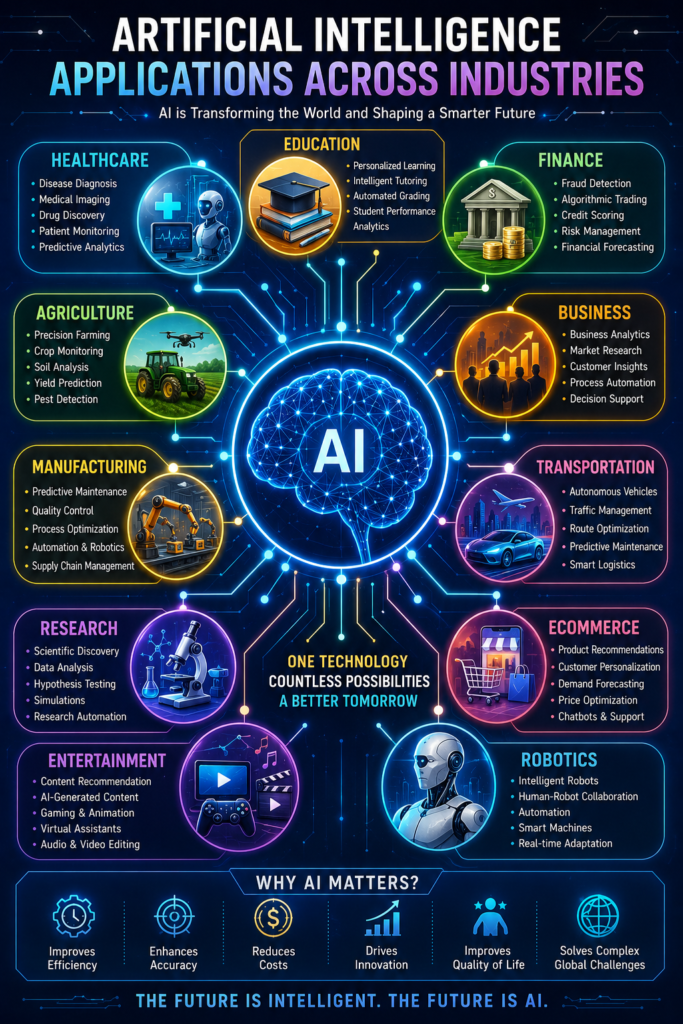
Applications of Artificial Intelligence: What Is Artificial Intelligence Used For?
Artificial Intelligence is transforming nearly every industry.
AI in Education
AI helps students and teachers by:
- Creating lesson plans
- Generating quizzes
- Personalizing learning
- Providing tutoring assistance
- Supporting research
Examples:
- ChatGPT
- NotebookLM
- Khanmigo
Students can explore powerful learning platforms in our Best Free AI Tools for Students in 2026 guide. Teachers can also discover classroom-focused solutions in Best AI Tools for Teachers in 2026.
AI in Healthcare
Healthcare is one of the most promising areas for AI.
AI helps:
- Diagnose diseases
- Analyze medical images
- Predict health risks
- Accelerate drug discovery
AI in Agriculture
Farmers use AI to:
- Monitor crops
- Predict weather conditions
- Improve irrigation
- Detect plant diseases
AI helps increase agricultural productivity while reducing waste.
AI in Banking and Finance
Financial institutions use AI for:
- Fraud detection
- Credit assessment
- Risk management
- Customer service
AI helps improve both security and efficiency.
AI in Business
Businesses use AI for:
- Marketing
- Customer support
- Data analysis
- Automation
- Sales forecasting
AI has become a critical business tool worldwide. Learn more in our Best AI Tools for Small Businesses in 2026 guide.
AI in Manufacturing
Manufacturers use AI to:
- Monitor equipment
- Predict maintenance needs
- Improve quality control
- Optimize production
AI in Transportation
Transportation companies use AI for:
- Route optimization
- Traffic analysis
- Autonomous vehicles
- Fleet management
AI in Defence
Military organizations use AI for:
- Surveillance
- Threat detection
- Intelligence analysis
- Autonomous systems
AI in Scientific Research
Researchers use AI to:
- Analyze large datasets
- Discover patterns
- Accelerate scientific discoveries
- Simulate complex systems
AI is helping scientists solve problems faster than ever before.
AI in Entertainment
AI is increasingly used in:
- Content recommendations
- Video generation
- Music creation
- Gaming
- Animation
Content creators, bloggers, and video producers are increasingly using AI to improve their workflow. Explore our guides on Best AI Tools for Bloggers in 2026 and Best AI Tools for YouTube Creators.
AI Is Everywhere
Whether people realize it or not, Artificial Intelligence is already integrated into daily life.
From smartphones and online shopping to healthcare and scientific research, AI is transforming how the world operates.
The influence of AI will continue to grow as technology becomes more advanced and accessible.
Careers in Artificial Intelligence
Artificial Intelligence is not only transforming industries but also creating entirely new career opportunities. As businesses, governments, and organizations increasingly adopt AI technologies, the demand for skilled professionals continues to grow.
Many experts consider AI one of the most promising career fields of the 21st century.
People from different educational backgrounds can enter AI-related professions, including computer science, mathematics, engineering, business, healthcare, education, and research.
AI Engineer
AI Engineers design, build, and deploy AI systems.
Their responsibilities include:
- Developing AI models
- Creating intelligent applications
- Integrating AI into products
- Improving AI performance
AI Engineers are among the highest-paid technology professionals today.
Machine Learning Engineer
Machine Learning Engineers specialize in developing algorithms that enable computers to learn from data.
Their work includes:
- Building ML models
- Training systems
- Testing performance
- Optimizing predictions
Machine Learning is one of the most in-demand AI specialties.
Data Scientist
Data Scientists analyze large datasets to identify patterns and insights.
They help organizations:
- Make better decisions
- Predict future trends
- Improve business strategies
- Understand customer behavior
Data science is closely connected to AI and machine learning.
AI Research Scientist
Research Scientists focus on advancing AI technology.
Their work involves:
- Developing new algorithms
- Publishing research papers
- Conducting experiments
- Solving complex AI challenges
Many AI breakthroughs originate from research institutions and technology companies.
Prompt Engineer
Prompt Engineering has emerged as a new profession during the generative AI era.
Prompt Engineers specialize in creating effective instructions for AI systems.
They help organizations:
- Improve AI outputs
- Optimize workflows
- Automate business processes
- Generate high-quality content
Many Prompt Engineers and digital marketers also use AI-powered social media tools to create content, schedule posts, and improve audience engagement. Explore our guide to the Best AI Tools for Social Media Managers in 2026.
Robotics Engineer
Robotics Engineers combine artificial intelligence with physical machines.
They design systems used in:
- Manufacturing
- Healthcare
- Logistics
- Defence
- Space Exploration
AI Product Manager
AI Product Managers bridge the gap between business goals and AI technology.
They oversee:
- Product Development
- AI Implementation
- User Requirements
- Business Strategy
AI Ethics Specialist
As AI becomes more powerful, ethical concerns become increasingly important.
AI Ethics Specialists focus on:
- Fairness
- Transparency
- Privacy
- Responsible AI Development
This role is expected to grow significantly in the coming years.
Why AI Skills Are Important
AI literacy is becoming valuable for nearly every profession.
Even individuals who do not work directly in technology can benefit from understanding:
- AI Tools
- AI Applications
- AI Limitations
- AI Opportunities
Future workers who learn how to use AI effectively will likely have a competitive advantage.
AI Applications in Additional Industries
Artificial Intelligence is expanding far beyond traditional technology companies.
Its impact can now be seen in nearly every sector of society.
AI in Law
Legal professionals use AI for:
- Document Review
- Contract Analysis
- Legal Research
- Compliance Monitoring
AI helps lawyers save time while improving accuracy.
AI in Cybersecurity
Cybersecurity systems use AI to:
- Detect Threats
- Identify Suspicious Activities
- Prevent Fraud
- Monitor Networks
AI has become one of the most important tools in modern cybersecurity.
AI in Space Exploration
Space agencies use AI for:
- Satellite Analysis
- Spacecraft Navigation
- Planetary Research
- Mission Planning
AI helps scientists process enormous amounts of space-related data.
AI in Climate Science
Researchers use AI to:
- Monitor Climate Patterns
- Predict Weather Events
- Study Environmental Changes
- Analyze Ecological Systems
AI supports efforts to address global climate challenges.
AI in Retail
Retail businesses use AI to:
- Forecast Demand
- Manage Inventory
- Recommend Products
- Improve Customer Experiences
Many online shopping platforms rely heavily on AI systems.
AI in Ecommerce
Ecommerce companies use AI for:
- Product Recommendations
- Customer Support
- Marketing Automation
- Dynamic Pricing
AI helps businesses increase sales and improve customer satisfaction.
AI in Sports
Sports organizations use AI to:
- Analyze Performance
- Prevent Injuries
- Improve Training
- Develop Strategies
Professional teams increasingly depend on AI-powered analytics.
AI in Government
Governments use AI for:
- Public Services
- Data Analysis
- Traffic Management
- Emergency Response
- Resource Allocation
Responsible implementation is essential to ensure transparency and public trust.
AI in Media and Journalism
Media organizations use AI to:
- Generate Summaries
- Analyze Trends
- Assist Reporting
- Improve Audience Engagement
However, human oversight remains essential to maintain accuracy and credibility.
AI in Entertainment
Entertainment companies use AI to:
- Recommend Content
- Create Music
- Generate Visual Effects
- Produce Games
- Personalize Experiences
AI is transforming how people consume and create entertainment.
AI Industry Growth
Artificial Intelligence has become one of the fastest-growing sectors in the global economy.
Industries investing heavily in AI include:
- Healthcare
- Finance
- Education
- Manufacturing
- Transportation
- Marketing
- Retail
- Research
Many experts believe AI will become one of the most influential technologies in human history, similar to the internet, electricity, and smartphones.
As adoption increases, AI-related careers, businesses, and innovations are expected to expand dramatically over the coming decades.
Top AI Skills to Learn in 2026
- Prompt Engineering
- AI Research Skills
- Machine Learning Basics
- Data Analysis
- AI Content Creation
- AI Automation
- AI-Assisted Coding
- AI Image Generation
- AI Ethics and Governance
- AI Tool Selection and Evaluation
Benefits of Artificial Intelligence
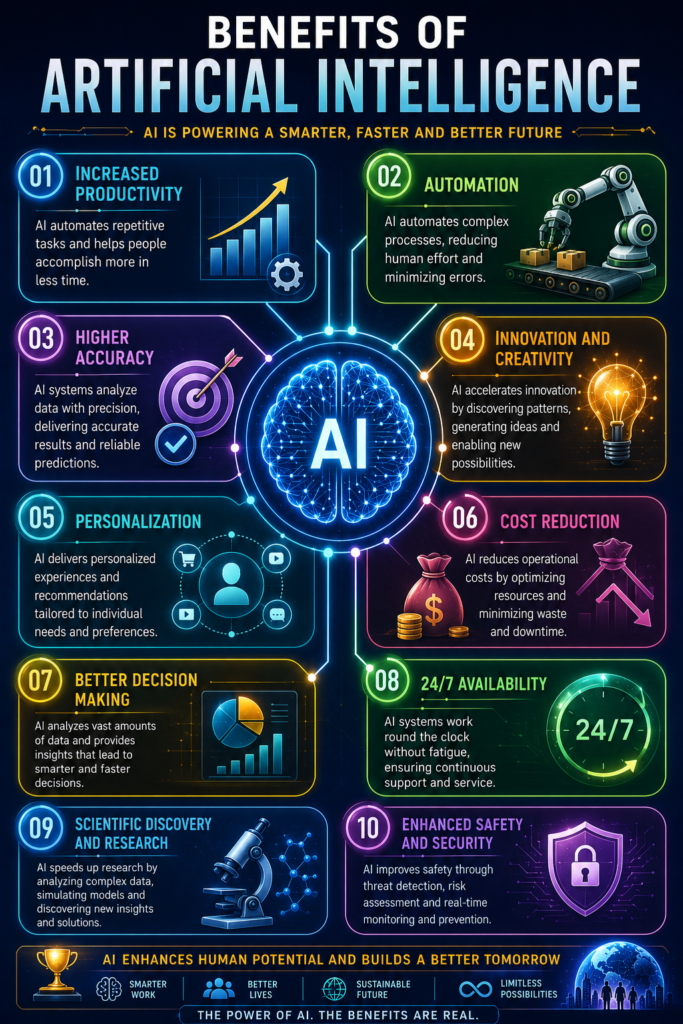
Artificial Intelligence has become one of the most valuable technologies in the modern world.
Governments, businesses, educational institutions, healthcare organizations, and researchers are increasingly adopting AI because of the significant benefits it offers.
AI helps improve productivity, reduce costs, automate repetitive tasks, and solve complex problems more efficiently than traditional methods.
1. Increased Productivity
One of the biggest advantages of AI is its ability to improve productivity.
Tasks that previously required hours can often be completed within minutes using AI-powered systems.
Examples include:
- Content Creation
- Data Analysis
- Customer Support
- Report Generation
- Research Assistance
By automating repetitive work, AI allows people to focus on more important and creative tasks.
2. Automation of Repetitive Tasks
Many jobs involve repetitive activities that consume significant time and effort.
AI can automate:
- Data Entry
- Scheduling
- Email Responses
- Document Processing
- Inventory Management
Automation reduces human workload and improves operational efficiency.
3. Improved Accuracy
Unlike humans, AI systems do not become tired, distracted, or emotionally influenced.
When properly trained, AI can perform certain tasks with extremely high accuracy.
Examples include:
- Medical Diagnosis
- Fraud Detection
- Image Recognition
- Quality Control
This helps reduce errors and improve decision-making.
4. Faster Decision-Making
AI can analyze large volumes of information within seconds.
Organizations use AI to make faster decisions regarding:
- Marketing
- Finance
- Logistics
- Healthcare
- Risk Management
Speed is one of AI’s greatest strengths.
5. Cost Reduction
Businesses use AI to reduce operational costs.
Benefits include:
- Lower Labor Costs
- Reduced Errors
- Improved Efficiency
- Better Resource Utilization
6. Personalized Experiences
AI helps companies deliver personalized experiences.
Examples include:
- Netflix Recommendations
- Amazon Product Suggestions
- Spotify Playlists
- YouTube Recommendations
7. 24/7 Availability
Unlike humans, AI systems can operate continuously.
Examples include:
- AI Chatbots
- Virtual Assistants
- Customer Support Systems
8. Scientific Innovation
AI accelerates research and discovery.
Researchers use AI to:
- Analyze Complex Datasets
- Identify Patterns
- Discover New Medicines
- Study Climate Change
- Advance Space Exploration
AI is helping scientists solve problems faster than ever before.
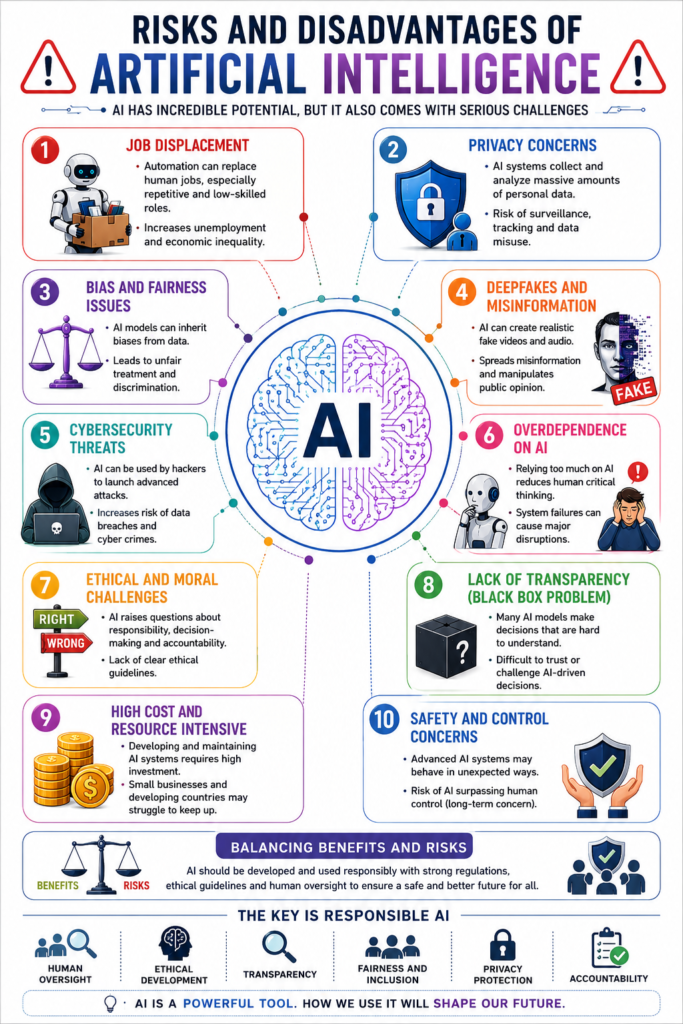
Risks and Disadvantages of Artificial Intelligence
Despite its benefits, Artificial Intelligence also presents challenges and risks that must be carefully managed.
Understanding these risks is essential for responsible AI development and adoption.
1. Job Displacement
One of the most discussed concerns surrounding AI is job displacement.
As AI automates tasks, some traditional jobs may change or disappear.
Industries most affected include:
- Manufacturing
- Customer Support
- Data Entry
- Administrative Work
However, AI is also creating new opportunities in technology, research, and digital industries.
2. Privacy Concerns
AI systems often require large amounts of data.
This raises concerns regarding:
- Personal Privacy
- Data Security
- Surveillance
- Information Misuse
Protecting user data is becoming increasingly important as AI adoption grows.
3. Bias and Fairness Issues
AI systems learn from data.
If training data contains biases, AI may produce unfair or discriminatory outcomes.
This is a major challenge in areas such as:
- Hiring
- Lending
- Law Enforcement
- Healthcare
Developers must ensure AI systems remain fair, transparent, and accountable.
4. Deepfakes and Misinformation
Generative AI can create realistic images, videos, and audio.
While useful in many situations, this technology can also be misused.
Examples include:
- Fake Videos
- Fake News
- Identity Manipulation
- Online Scams
Deepfakes have become one of the most significant AI-related concerns worldwide.
5. Cybersecurity Risks
Cybercriminals can use AI to create more sophisticated attacks.
Potential risks include:
- Automated Hacking
- Phishing Campaigns
- Malware Development
- Social Engineering
Organizations must strengthen cybersecurity measures to address these threats.
6. Overdependence on Technology
Excessive reliance on AI may reduce critical thinking and problem-solving skills.
People should use AI as a tool rather than a replacement for human judgment.
7. Ethical Challenges
Artificial Intelligence raises many important ethical questions:
- Who is responsible for AI decisions?
- Should autonomous weapons be allowed?
- How much personal data should AI access?
- Can AI be trusted in critical situations?
These issues continue to be debated by governments, researchers, businesses, and policymakers around the world.
Balancing Benefits and Risks
Artificial Intelligence offers tremendous opportunities, but responsible development is essential.
The future success of AI will depend on balancing innovation with ethics, transparency, privacy, and human oversight.
AI Benefits vs Risks
| Benefits | Risks |
|---|---|
| Increased Productivity | Job Displacement |
| Automation | Privacy Concerns |
| Better Accuracy | Bias Issues |
| Faster Decisions | Deepfakes |
| Cost Reduction | Cybersecurity Risks |
| Personalization | Overdependence |
| Scientific Progress | Ethical Challenges |
AI and Jobs: Threat or Opportunity?
One of the most common questions people ask is whether Artificial Intelligence will replace human workers.
The answer is more complex than a simple yes or no.
Historically, technological revolutions have changed jobs rather than eliminating work entirely.
Artificial Intelligence is expected to do the same.
Jobs Most Likely to Change
AI may significantly impact:
- Data Entry Operators
- Basic Customer Support Agents
- Routine Administrative Roles
- Simple Content Creation Tasks
- Repetitive Manufacturing Jobs
Many of these roles will evolve rather than disappear completely.
Workers who adapt and learn new skills will likely benefit from the AI transition.
Jobs AI Is Creating
Artificial Intelligence is generating entirely new career opportunities.
Examples include:
- AI Engineer
- Machine Learning Engineer
- Data Scientist
- Prompt Engineer
- AI Researcher
- AI Product Manager
- AI Ethics Specialist
These careers did not exist in the same form a decade ago.
As AI adoption continues to expand, demand for these roles is expected to grow significantly.
Jobs That Remain Strongly Human
Certain professions depend heavily on creativity, empathy, leadership, and human relationships.
Examples include:
- Teachers
- Psychologists
- Doctors
- Entrepreneurs
- Leaders
- Social Workers
- Artists
- Strategic Decision-Makers
AI can assist these professionals but cannot fully replace them.
The Future of Human-AI Collaboration
The future is unlikely to be a competition between humans and AI.
Instead, the most successful individuals and organizations will be those that learn how to work alongside AI effectively.
People who combine human creativity, critical thinking, emotional intelligence, and domain expertise with AI tools will have a significant advantage in the future workforce.
Rather than replacing humanity, Artificial Intelligence is more likely to become a powerful partner that enhances human capabilities.
AI Myths vs Facts
Many misconceptions exist about artificial intelligence.
Understanding the facts helps people make informed decisions.
| Myth | Fact |
|---|---|
| AI can think like humans today | Current AI is not conscious |
| AI will replace all jobs | AI will transform jobs, not eliminate all work |
| AI knows everything | AI can make mistakes |
| AI has emotions | AI does not experience emotions |
| AI is always unbiased | AI can inherit bias from data |
| AI is only for large companies | AI is accessible to individuals and small businesses |
| AI is dangerous by default | Responsible AI can be highly beneficial |
Can AI Replace Humans?
This question is often asked by students, professionals, and business owners.
The reality is that AI is a tool created by humans.
AI can:
- Process Information
- Recognize Patterns
- Generate Content
- Automate Tasks
However, AI cannot fully replicate:
- Human Creativity
- Emotional Intelligence
- Moral Judgment
- Leadership
- Empathy
- Personal Experiences
The future is likely to involve collaboration between humans and AI rather than complete replacement.
The Human-AI Partnership
The most successful individuals and organizations will be those that learn how to work effectively with AI.
Rather than competing with AI, people can use it to:
- Increase Productivity
- Learn Faster
- Improve Creativity
- Solve Problems
- Build Businesses
In many ways, AI is becoming a powerful assistant rather than a replacement for human intelligence.
What Is Artificial Intelligence in Everyday Life?
Many people believe Artificial Intelligence is a technology used only by scientists, researchers, or large technology companies.
In reality, AI has already become an important part of daily life.
Most people interact with AI dozens of times every day, often without realizing it.
From smartphones and social media platforms to online shopping and navigation systems, AI is quietly working behind the scenes to improve user experiences.
AI in Smartphones
Modern smartphones use AI for numerous tasks, including:
- Face Recognition
- Voice Assistants
- Camera Optimization
- Predictive Text
- Language Translation
Features such as Siri, Google Assistant, and smart photography rely heavily on AI technologies.
AI in Social Media
Social media platforms use AI to:
- Recommend Content
- Detect Spam
- Moderate Harmful Content
- Personalize Feeds
- Suggest Connections
Platforms such as Facebook, Instagram, LinkedIn, TikTok, and X use AI algorithms extensively.
AI in Online Shopping
Ecommerce platforms use AI to improve customer experiences.
Examples include:
- Product Recommendations
- Personalized Advertisements
- Dynamic Pricing
- Inventory Management
- Customer Support Chatbots
Companies such as Amazon use AI throughout their operations.
AI in Entertainment
Streaming platforms use AI to recommend movies, music, and videos.
Examples include:
- Netflix Recommendations
- Spotify Playlists
- YouTube Suggestions
These systems analyze user preferences to provide personalized experiences.
AI in Navigation
Navigation applications use AI to:
- Analyze Traffic Conditions
- Predict Travel Times
- Suggest Optimal Routes
- Improve Transportation Efficiency
Google Maps is one of the most widely used examples.
AI in Banking
Banks use AI for:
- Fraud Detection
- Risk Assessment
- Customer Support
- Financial Analysis
AI helps improve both security and customer experiences.
AI in Healthcare
Healthcare organizations use AI to:
- Analyze Medical Images
- Assist Diagnosis
- Predict Health Risks
- Support Treatment Planning
AI is becoming increasingly important in modern medicine.
AI in Education
Students and teachers use AI tools for:
- Learning Support
- Research Assistance
- Content Creation
- Lesson Planning
- Personalized Education
Educational AI adoption continues to grow worldwide.
AI in the Workplace
Organizations use AI for:
- Data Analysis
- Report Generation
- Customer Support
- Project Management
- Workflow Automation
AI is becoming an essential workplace productivity tool.
Why Everyday AI Matters
Understanding everyday AI helps people recognize that Artificial Intelligence is not a distant future technology.
AI is already influencing:
- Communication
- Education
- Business
- Entertainment
- Transportation
- Healthcare
As AI continues to evolve, its presence in everyday life will become even more significant.
For most people, the future of AI has already begun.
Future of Artificial Intelligence
Artificial Intelligence is evolving at an extraordinary pace. What once seemed like science fiction is rapidly becoming reality.
Experts believe AI will influence nearly every aspect of human life during the coming decades, including education, healthcare, transportation, business, communication, entertainment, and scientific research.
The future of AI will likely be defined by more powerful models, increased automation, improved personalization, and closer collaboration between humans and machines.
Artificial General Intelligence (AGI)
One of the most important goals in AI research is the development of Artificial General Intelligence (AGI).
Unlike today’s AI systems, AGI would be capable of:
- Learning Any Intellectual Task
- Understanding Complex Concepts
- Adapting to Unfamiliar Situations
- Reasoning Similarly to Humans
Many leading AI organizations are actively researching AGI, although experts disagree on when it might be achieved.
AI Agents
AI Agents are expected to become increasingly common.
Instead of simply answering questions, future AI systems may:
- Schedule Meetings
- Conduct Research
- Manage Projects
- Complete Online Tasks
- Coordinate Workflows
These systems could function as highly capable digital assistants.
Humanoid Robots
Robotics and AI are becoming increasingly interconnected.
Future humanoid robots may:
- Assist Elderly People
- Support Healthcare Workers
- Perform Dangerous Tasks
- Operate in Factories
- Help During Emergencies
Several companies are already developing advanced humanoid robots.
Personalized AI
Future AI systems will become more personalized.
They may:
- Understand Individual Preferences
- Adapt Learning Experiences
- Improve Customer Service
- Support Healthcare Recommendations
- Enhance Workplace Productivity
Personalized AI could dramatically improve user experiences.
AI in Scientific Discovery
AI is expected to accelerate progress in:
- Medicine
- Climate Science
- Physics
- Space Exploration
- Materials Science
Many researchers believe AI will help solve problems that currently require years of human effort.
The Future of Work
Rather than replacing all workers, AI will likely reshape many professions.
Workers who learn to use AI effectively may gain significant advantages in:
- Productivity
- Creativity
- Decision-Making
- Career Growth
AI literacy is becoming an increasingly valuable skill.
The Long-Term Future of AI
The future of Artificial Intelligence remains uncertain, but its impact is expected to be profound.
Some experts predict that AI will become as transformative as electricity, the internet, and smartphones. Others believe it may eventually surpass human capabilities in certain domains.
Regardless of how quickly AI evolves, one thing is clear: Artificial Intelligence will continue to shape the future of society, business, science, and human innovation for decades to come.
What Is Artificial Intelligence? In simple terms, Artificial Intelligence is the ability of machines to learn, reason, and solve problems. Understanding what is artificial intelligence is becoming increasingly important because AI is transforming education, healthcare, business, research, and everyday life.
Interesting Facts About Artificial Intelligence
Artificial Intelligence has a fascinating history filled with important discoveries and surprising milestones.
Fact 1
The term “Artificial Intelligence” was officially introduced by John McCarthy in 1956.
Fact 2
Alan Turing proposed the famous Turing Test in 1950, six years before the term AI was created.
Fact 3
The Dartmouth Conference of 1956 is widely considered the birthplace of artificial intelligence as a scientific field.
Fact 4
IBM’s Deep Blue became the first computer system to defeat a reigning world chess champion in 1997.
Fact 5
AlphaGo defeated world champion Lee Sedol in 2016, demonstrating the power of modern AI.
Fact 6
ChatGPT became one of the fastest-growing technology products in history after its launch.
Fact 7
Modern AI models are trained using enormous amounts of data and thousands of advanced GPUs.
Fact 8
Many people use AI daily without realizing it through search engines, recommendation systems, navigation apps, and social media platforms.
Fact 9
Artificial General Intelligence (AGI) has not yet been achieved despite decades of research.
Fact 10
AI is already helping doctors diagnose diseases, researchers discover medicines, and scientists study the universe.
Quick AI Facts Table
| AI Fact | Information |
|---|---|
| AI Coined | 1956 |
| Coined By | John McCarthy |
| Turing Test Introduced | 1950 |
| First AI Conference | Dartmouth Conference |
| Father of AI | John McCarthy |
| Famous AI Pioneer | Alan Turing |
| Popular AI Tool | ChatGPT |
| Current AI Leaders | OpenAI, Google, Microsoft, Anthropic |
AI Glossary
The following glossary explains some of the most important terms used in Artificial Intelligence.
| Term | Meaning |
|---|---|
| AI | Artificial Intelligence |
| Algorithm | A set of instructions used to solve problems |
| Machine Learning | AI systems that learn from data |
| Deep Learning | Advanced machine learning using neural networks |
| Neural Network | Brain-inspired computing model |
| NLP | Natural Language Processing |
| Computer Vision | AI that interprets images and videos |
| Robotics | Intelligent machine systems |
| Generative AI | AI that creates new content |
| Prompt | Instruction given to an AI model |
| Dataset | Collection of training data |
| Training | Process of teaching AI models |
| Inference | AI applying learned knowledge |
| Model | Trained AI system |
| LLM | Large Language Model |
| Transformer | Neural network architecture used in modern AI |
| Token | Basic unit processed by language models |
| Chatbot | Conversational AI assistant |
| AI Agent | Autonomous AI assistant |
| AGI | Artificial General Intelligence |
| ASI | Artificial Super Intelligence |
| GPU | Graphics Processing Unit used for AI training |
| CPU | Central Processing Unit |
| Data Science | Extracting insights from data |
| Data Mining | Discovering patterns in datasets |
| Automation | Performing tasks with minimal human input |
| Prediction Model | AI system that forecasts outcomes |
| Recommendation Engine | AI system suggesting products or content |
| Speech Recognition | Converting speech into text |
| Text-to-Speech | Converting text into spoken language |
| Image Recognition | Identifying objects in images |
| Facial Recognition | Identifying people using facial features |
| Computer Graphics | Digital visual content generation |
| Reinforcement Learning | Learning through rewards and penalties |
| Supervised Learning | Learning using labeled data |
| Unsupervised Learning | Learning from unlabeled data |
| Semi-Supervised Learning | Combination of labeled and unlabeled learning |
| Classification | Assigning data into categories |
| Regression | Predicting numerical values |
| Bias | Unfair tendencies in AI outputs |
| Ethics | Moral principles guiding AI development |
| Explainable AI | AI systems whose decisions can be understood |
| Fine-Tuning | Customizing a pre-trained model |
| Hallucination | AI generating incorrect information confidently |
| Vector Database | Database optimized for AI retrieval |
| Embedding | Numerical representation of information |
| Multimodal AI | AI that processes multiple data types |
| Prompt Engineering | Designing effective AI prompts |
| AI Safety | Research focused on safe AI behavior |
| AI Governance | Rules and policies for AI use |
| Synthetic Data | Artificially generated training data |
| Digital Twin | Virtual representation of a real-world object |
| Autonomous System | System operating without direct human control |
| Edge AI | AI running on local devices |
| Cloud AI | AI operating through cloud infrastructure |
| Human-in-the-Loop | Humans involved in AI decision processes |
| Responsible AI | Ethical and trustworthy AI development |
| AI Literacy | Understanding how AI works and its impact |
| Foundation Model | Large model adaptable to many tasks |
| Generative Model | Model capable of creating new content |
| Knowledge Graph | Structured representation of information |
| Transfer Learning | Applying knowledge from one task to another |
| Predictive Analytics | Using AI to forecast future outcomes |
| Intelligent Automation | Combining AI with automation technologies |
Common AI Full Forms
| Abbreviation | Full Form |
|---|---|
| AI | Artificial Intelligence |
| AGI | Artificial General Intelligence |
| ASI | Artificial Super Intelligence |
| ML | Machine Learning |
| DL | Deep Learning |
| NLP | Natural Language Processing |
| NLU | Natural Language Understanding |
| NLG | Natural Language Generation |
| LLM | Large Language Model |
| CV | Computer Vision |
| OCR | Optical Character Recognition |
| TTS | Text To Speech |
| STT | Speech To Text |
| GPU | Graphics Processing Unit |
| CPU | Central Processing Unit |
| API | Application Programming Interface |
| RAG | Retrieval-Augmented Generation |
| GAN | Generative Adversarial Network |
| RL | Reinforcement Learning |
| ANN | Artificial Neural Network |
| CNN | Convolutional Neural Network |
| RNN | Recurrent Neural Network |
| GPT | Generative Pre-trained Transformer |
| BERT | Bidirectional Encoder Representations from Transformers |
| IoT | Internet of Things |
| AIoT | Artificial Intelligence of Things |
| XAI | Explainable Artificial Intelligence |
| MLOps | Machine Learning Operations |
| AutoML | Automated Machine Learning |
| VLM | Vision Language Model |
Understanding the Future of Artificial Intelligence
Artificial Intelligence is one of the most transformative technologies in human history. From its early beginnings in academic research to today’s powerful AI systems, the field has advanced dramatically over the past several decades.
AI is already helping students learn, businesses grow, researchers innovate, and professionals work more efficiently. At the same time, responsible development remains essential to address challenges such as privacy, fairness, security, and ethics.
The future of AI will not simply be about smarter machines. It will be about how humans and intelligent systems work together to solve problems, create opportunities, and improve lives.
For students, professionals, entrepreneurs, and curious learners, understanding Artificial Intelligence is no longer optional—it is becoming an essential skill for navigating the digital world of the future.
Frequently Asked Questions
What is Artificial Intelligence?
Artificial Intelligence is the ability of machines and computer systems to perform tasks that normally require human intelligence, such as learning, reasoning, problem-solving, language understanding, and decision-making.
Who is known as the Father of Artificial Intelligence?
John McCarthy is widely known as the Father of Artificial Intelligence because he coined the term Artificial Intelligence in 1956 and helped establish the field as an academic discipline.
What is the full form of AI?
AI stands for Artificial Intelligence.
When was Artificial Intelligence invented?
The term Artificial Intelligence was officially introduced in 1956 during the Dartmouth Conference, although foundational research began earlier.
What is the Turing Test?
The Turing Test, proposed by Alan Turing in 1950, is a method for evaluating whether a machine can demonstrate intelligent behavior similar to a human.
What are the main types of AI?
The three major types of AI are Artificial Narrow Intelligence (ANI), Artificial General Intelligence (AGI), and Artificial Super Intelligence (ASI).
What is Machine Learning?
Machine Learning is a branch of AI that enables computers to learn from data and improve performance without being explicitly programmed.
What is Deep Learning?
Deep Learning is an advanced form of machine learning that uses neural networks with multiple layers to process information and solve complex problems.
What is Generative AI?
Generative AI refers to AI systems capable of creating new content such as text, images, videos, music, and software code.
Is ChatGPT an AI?
Artificial Intelligence improves productivity, automation, accuracy, efficiency, personalization, decision-making, and innovation across many industries.
What are the risks of Artificial Intelligence?
Potential risks include job displacement, privacy concerns, bias, cybersecurity threats, misinformation, deepfakes, and ethical challenges.
Can AI replace human jobs?
AI can automate some tasks and transform certain jobs, but it is also creating new career opportunities and cannot fully replace human creativity, empathy, and judgment.
Which industries use AI the most?
AI is widely used in education, healthcare, finance, banking, business, manufacturing, transportation, agriculture, research, entertainment, and government services.
What is Artificial General Intelligence (AGI)?
Artificial General Intelligence (AGI) refers to a future AI system capable of performing any intellectual task that a human can perform. AGI has not yet been achieved.
What is the difference between AI and Machine Learning?
AI is the broader field focused on creating intelligent systems, while Machine Learning is a subset of AI that enables systems to learn from data.
What skills are needed for an AI career?
Important AI skills include machine learning, data analysis, programming, prompt engineering, problem-solving, and AI ethics.
Which companies are leading the AI industry?
Major AI leaders include OpenAI, Google, Microsoft, Anthropic, Meta, NVIDIA, Amazon, and IBM.
How is AI used in everyday life?
AI powers search engines, voice assistants, recommendation systems, navigation apps, online shopping platforms, social media feeds, and customer support systems.
What is the future of Artificial Intelligence?
The future of Artificial Intelligence includes AI agents, advanced robotics, personalized AI systems, scientific breakthroughs, and potentially Artificial General Intelligence (AGI).
What was the first Artificial Intelligence program?
Logic Theorist, developed in 1956 by Allen Newell, Herbert A. Simon, and Cliff Shaw, is widely considered the world’s first Artificial Intelligence program. It was designed to prove mathematical theorems and demonstrated that computers could perform logical reasoning tasks, marking an important milestone in AI history.
What was ELIZA in Artificial Intelligence?
ELIZA was one of the earliest AI chatbots, created by Joseph Weizenbaum in 1966. It simulated human conversation using pattern-matching techniques and became an important milestone in the development of conversational AI systems.
What was SHRDLU and why is it important in AI history?
SHRDLU was an early Natural Language Understanding system developed by Terry Winograd in 1970. It could understand and respond to English-language commands in a virtual environment, helping researchers advance human-computer interaction and language processing.