
Introduction
Building a startup is exciting, but it is also one of the most challenging business journeys. Startups often operate with limited budgets, small teams, tight deadlines, and constant pressure to grow quickly.
Fortunately, artificial intelligence is changing the startup landscape. Today, AI tools can help startups automate repetitive tasks, improve productivity, generate content, analyze data, manage customer relationships, create marketing campaigns, and provide customer support without hiring large teams.
Instead of spending thousands of dollars on additional staff, startups can use AI-powered platforms to work smarter and scale faster.
Many entrepreneurs already use the solutions discussed in Best AI Productivity Tools in 2026 and Best AI Tools for Business Automation in 2026 to improve efficiency and reduce operational costs.
In this guide, we will explore the best AI tools for startups in 2026, compare their features, discuss their advantages and limitations, and help founders choose the right tools for sustainable business growth.
Why Startups Are Adopting AI Faster Than Ever
Artificial intelligence provides startups with capabilities that were previously available only to large organizations.
Reduced Operating Costs
AI can automate repetitive tasks and reduce hiring expenses.
Faster Decision-Making
AI analytics help founders make informed business decisions.
Improved Productivity
Small teams can accomplish more work with fewer resources.
Better Customer Experiences
AI-powered personalization improves customer engagement.
Scalable Growth
AI systems can handle increasing workloads without proportional increases in costs.
Competitive Advantage
Startups can compete with larger businesses by leveraging intelligent automation.
These advantages make AI one of the most valuable investments for modern startups.
What Makes a Great AI Tool for Startups?
Not every AI platform is suitable for startup environments.
Before investing in a tool, founders should evaluate several important factors.
Ease of Use
The platform should be easy to implement and manage.
Scalability
The tool should grow alongside the business.
Automation Capabilities
Automation reduces manual workload.
Integration Support
The platform should connect with existing business systems.
Cost Efficiency
Startups must balance functionality with affordability.
Measurable ROI
The tool should provide clear business value and productivity improvements.
Best AI Tools for Startups in 2026
The following AI tools can help startups improve productivity, automate workflows, reduce costs, and accelerate growth.
1. ChatGPT
ChatGPT has become one of the most widely used AI tools among startup founders and entrepreneurs.
From content creation and brainstorming to customer communication and business planning, ChatGPT can support multiple business functions.
Best For
- Content Creation
- Business Planning
- Research
- Customer Communication
Key Features
- AI writing assistance
- Brainstorming support
- Market research
- Coding help
- Business strategy assistance
Pros
- Easy to use
- Highly versatile
- Suitable for multiple departments
Cons
- Requires fact-checking for critical decisions
2. Notion AI
Notion AI combines productivity, documentation, project management, and AI-powered content generation within a single platform.
Many startups use Notion as their central knowledge management system.
Best For
- Documentation
- Team Collaboration
- Project Management
Key Features
- AI writing
- Meeting summaries
- Task management
- Knowledge base creation
- Team collaboration
Pros
- Excellent workspace organization
- Powerful collaboration tools
- Flexible workflows
Cons
- Advanced setups require planning
3. HubSpot AI
HubSpot provides AI-powered CRM, marketing automation, sales management, and customer relationship tools.
Startups can manage customer acquisition and retention from a single platform.
Best For
- Sales
- Marketing
- Customer Management
Key Features
- AI email generation
- CRM automation
- Lead management
- Customer analytics
- Marketing automation
Pros
- Comprehensive business platform
- Excellent CRM features
- Strong reporting capabilities
Cons
- Premium plans can be expensive
4. Jasper
Jasper is a leading AI content creation platform designed for marketers, businesses, and content teams.
Startups often use Jasper to create marketing content at scale.
Best For
- Marketing Content
- Blog Writing
- Advertising Copy
Key Features
- AI content generation
- Brand voice support
- Marketing templates
- SEO-friendly writing
Pros
- Fast content creation
- Marketing-focused features
- Good content quality
Cons
- Requires editing for best results
Businesses that rely heavily on marketing may also benefit from the strategies discussed in Best AI Tools for Marketing in 2026.
5. Zapier AI
Zapier helps startups automate workflows by connecting thousands of business applications.
Its AI-powered automation capabilities reduce repetitive work and improve efficiency.
Best For
- Workflow Automation
- Operations
- Process Management
Key Features
- App integrations
- AI automation
- Workflow creation
- Task automation
Pros
- Saves significant time
- Easy automation setup
- Extensive integrations
Cons
- Complex workflows may require testing
6. Canva AI
Canva AI helps startups create professional graphics, presentations, social media content, and marketing materials.
It is particularly useful for startups without dedicated design teams.
Best For
- Graphic Design
- Marketing Materials
- Presentations
Key Features
- AI image generation
- Magic Design
- Presentation creation
- Social media templates
Pros
- User-friendly interface
- Professional templates
- Affordable pricing
Cons
- Advanced design control is limited
Startups creating visual content can also explore tools featured in Best AI Tools for Graphic Designers in 2026.
7. Perplexity AI
Perplexity AI is an AI-powered research assistant that provides real-time information and cited answers.
Startup founders frequently use it for market research and competitive analysis.
Best For
- Research
- Competitive Analysis
- Business Intelligence
Key Features
- AI-powered search
- Source citations
- Research summaries
- Market analysis
Pros
- Fast information gathering
- Reliable source references
- Easy to use
Cons
- Not a replacement for deep research
8. Claude
Claude is an advanced AI assistant designed to help businesses with writing, analysis, problem-solving, research, and strategic planning.
Many startup founders use Claude to analyze documents, create reports, and support decision-making processes.
Best For
- Business Analysis
- Research
- Strategic Planning
- Documentation
Key Features
- Long-context understanding
- Document analysis
- Content generation
- Business research
- Problem-solving assistance
Pros
- Excellent reasoning capabilities
- Strong document handling
- High-quality outputs
Cons
- Some advanced features require paid plans
9. ClickUp AI
ClickUp AI combines project management and artificial intelligence to help startup teams organize work more efficiently.
The platform helps founders manage tasks, deadlines, projects, and team collaboration from a single dashboard.
Best For
- Team Management
- Project Planning
- Productivity
Key Features
- AI writing assistance
- Task management
- Project tracking
- Workflow automation
- Team collaboration
Pros
- Centralized workspace
- Strong project management features
- Good automation options
Cons
- Learning curve for new users
10. Intercom AI
Intercom uses artificial intelligence to improve customer support and customer communication.
Startups can provide faster support without hiring large customer service teams.
Best For
- Customer Support
- Customer Engagement
- SaaS Businesses
Key Features
- AI customer support
- Automated responses
- Live chat
- Help center management
- Customer insights
Pros
- Improves customer satisfaction
- Reduces support workload
- Easy automation
Cons
- Can become expensive as usage grows
Businesses focused on customer engagement may also benefit from solutions discussed in Best AI Chatbots in 2026.
AI Tools for Startups Comparison Table
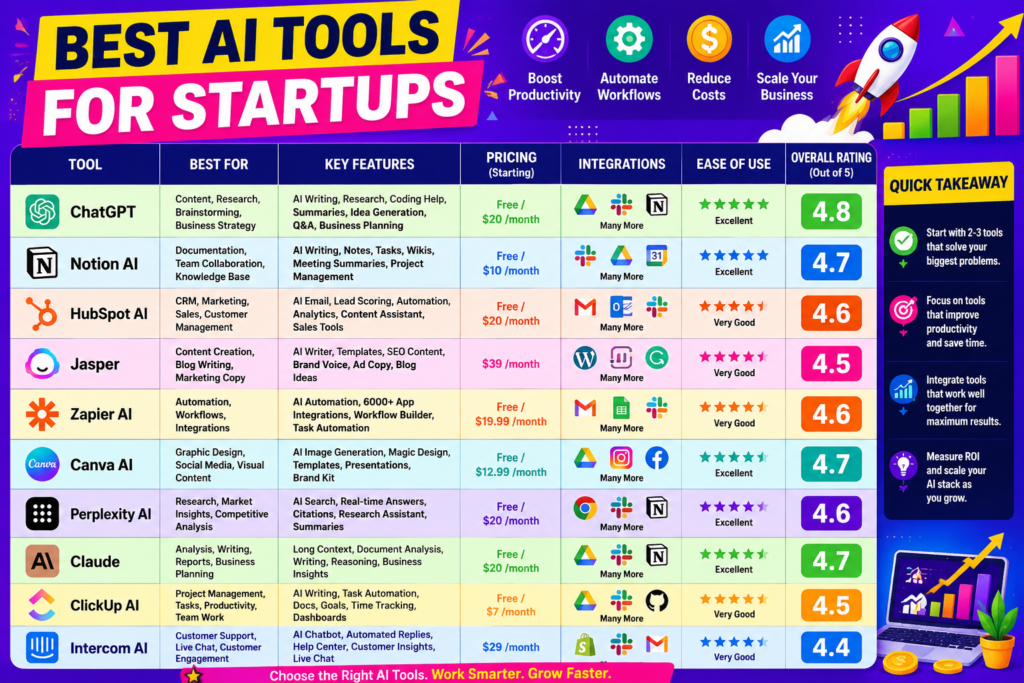
| Tool | Best For | Key Strength |
|---|---|---|
| ChatGPT | General Business Tasks | Versatility |
| Notion AI | Documentation | Team Collaboration |
| HubSpot AI | CRM & Marketing | Customer Management |
| Jasper | Content Marketing | AI Writing |
| Zapier AI | Automation | Workflow Integration |
| Canva AI | Design | Visual Content Creation |
| Perplexity AI | Research | Source-Based Answers |
| Claude | Analysis | Advanced Reasoning |
| ClickUp AI | Productivity | Project Management |
| Intercom AI | Customer Support | Automated Service |
Benefits of AI Tools for Startups
Artificial intelligence provides several important advantages for startup businesses.
Lower Operational Costs
AI helps automate repetitive tasks, reducing the need for additional staffing.
Faster Growth
Startups can scale operations without proportionally increasing expenses.
Improved Productivity
Teams can complete more work in less time.
Better Decision-Making
AI-powered analytics support smarter business decisions.
Enhanced Customer Experiences
Personalized communication improves customer satisfaction and retention.
Competitive Advantage
AI enables startups to compete with larger organizations using limited resources.
Limitations of AI Tools for Startups
While AI offers many benefits, founders should also understand potential challenges.
Dependence on Technology
Over-reliance on AI can create operational risks.
Subscription Costs
Using multiple AI tools can increase monthly expenses.
Learning Curve
Some platforms require training and implementation time.
Data Privacy Concerns
Businesses must protect sensitive customer information.
Human Oversight Is Essential
AI should assist decision-making rather than replace human judgment entirely.
How to Choose the Right AI Tools for Your Startup
Every startup has different priorities and growth objectives.
For Marketing-Focused Startups
Recommended tools:
- ChatGPT
- Jasper
- HubSpot AI
For Productivity and Team Management
Recommended tools:
- Notion AI
- ClickUp AI
For Automation
Recommended tools:
- Zapier AI
For Research and Planning
Recommended tools:
- Claude
- Perplexity AI
For Customer Support
Recommended tools:
- Intercom AI
Founders should prioritize tools that provide measurable value, integrate with existing workflows, and support long-term business growth.
How Startups Can Use AI in Different Business Areas
One of the biggest advantages of artificial intelligence is its versatility. A single startup can use AI across multiple departments to improve efficiency and accelerate growth.
Marketing and Lead Generation
AI tools can help startups:
- Create marketing content
- Generate ad copy
- Build email campaigns
- Optimize SEO
- Analyze customer behavior
Marketing-focused startups often combine solutions from Best AI Tools for Marketing in 2026 with CRM and automation platforms to improve customer acquisition.
Customer Support
AI-powered chatbots and support platforms can provide instant responses to customers.
Benefits include:
- Faster response times
- Reduced support costs
- Improved customer satisfaction
- 24/7 availability
Product Development
Startups can use AI to:
- Analyze user feedback
- Identify product opportunities
- Generate feature ideas
- Improve development workflows
Operations and Administration
AI automation can handle repetitive business processes such as:
- Data entry
- Scheduling
- Report generation
- Workflow management
Research and Competitive Analysis
AI research tools help founders:
- Study competitors
- Analyze industry trends
- Discover market opportunities
- Monitor customer preferences
Common Mistakes Startups Make When Using AI
Many startups invest in AI tools but fail to achieve meaningful results because of poor implementation.
Using Too Many Tools
Founders often subscribe to multiple platforms before understanding their actual requirements.
A small startup can usually achieve excellent results with 3–5 well-selected AI tools.
Ignoring Team Training
Employees should understand how to use AI effectively.
Without proper training, businesses often fail to maximize the value of their AI investments.
Choosing Tools Based Only on Popularity
The most popular platform is not always the best option.
Startups should select tools based on specific business goals and workflows.
Expecting AI to Replace Humans
AI works best as an assistant rather than a complete replacement for human expertise.
Not Measuring ROI
Businesses should track:
- Time savings
- Productivity improvements
- Revenue growth
- Customer satisfaction
These metrics help determine whether an AI investment is delivering value.
AI Adoption Strategy for Startups
Instead of implementing multiple AI tools at once, startups should adopt AI gradually.
Step 1: Identify Business Bottlenecks
Determine which tasks consume the most time and resources.
Step 2: Start with One or Two Tools
Implement a small number of high-impact tools before expanding.
Step 3: Measure Results
Track productivity gains and business outcomes.
Step 4: Automate Repetitive Processes
Focus on activities that occur frequently and require significant manual effort.
Step 5: Scale AI Usage
As the business grows, additional AI tools can be integrated into operations.
This approach minimizes risk while maximizing return on investment.
Real-World Startup Use Cases for AI
AI is no longer limited to large corporations. Many startups use AI from day one.
SaaS Startups
Use AI for:
- Customer support
- Product recommendations
- User onboarding
- Analytics
Ecommerce Startups
Use AI for:
- Product descriptions
- Customer service
- Inventory forecasting
- Marketing automation
Content-Based Businesses
Use AI for:
- Blog writing
- Video scripting
- Social media content
- Email marketing
Education Startups
Use AI for:
- Personalized learning
- Content generation
- Student support
- Assessment tools
Service-Based Businesses
Use AI for:
- Lead generation
- Client communication
- Scheduling
- Proposal creation
The flexibility of AI allows startups in nearly every industry to improve productivity and growth.
Future of AI for Startups
Artificial intelligence is expected to become one of the most important growth drivers for startups over the next decade.
As AI technology continues to evolve, startups will gain access to capabilities that were previously available only to large enterprises with substantial budgets and resources.
Several emerging developments are expected to reshape how startups operate.
AI-Powered Business Operations
Many routine business processes will become increasingly automated through AI.
Tasks such as customer support, scheduling, reporting, data analysis, and workflow management will require less manual intervention.
Personalized Customer Experiences
AI will enable startups to deliver highly personalized experiences based on customer behavior, preferences, and purchasing patterns.
Faster Product Development
AI-assisted coding, testing, and market research will help startups launch products more quickly.
Smarter Decision-Making
Business intelligence systems powered by AI will provide real-time insights that support strategic planning and growth.
Reduced Operational Costs
Automation will allow startups to scale more efficiently while keeping costs under control.
As the technologies discussed in What Is Artificial Intelligence? continue advancing, startups will gain access to increasingly powerful tools and automation capabilities.
AI Trends for Startups in 2026
Several important trends are influencing startup ecosystems worldwide.
Generative AI Adoption
Startups are increasingly using generative AI to create content, designs, code, marketing materials, and business documents.
AI Agents
AI agents are becoming capable of handling complex workflows with minimal human supervision.
Hyper-Automation
Businesses are connecting multiple AI tools to automate entire processes rather than individual tasks.
AI-Powered Customer Support
Startups are deploying intelligent chatbots and virtual assistants to provide round-the-clock support.
Predictive Analytics
AI systems are helping founders identify opportunities and risks before they become significant business challenges.
No-Code and Low-Code AI Solutions
Modern AI platforms allow startups to implement advanced functionality without requiring extensive technical expertise.
These trends suggest that AI will remain a critical competitive advantage for startups throughout the coming years.
Final Thoughts
Artificial intelligence has become an essential resource for modern startups.
From marketing and customer support to automation, research, productivity, and business operations, AI tools help startups accomplish more with limited resources.
ChatGPT, Notion AI, HubSpot AI, Jasper, Zapier AI, Canva AI, Perplexity AI, Claude, ClickUp AI, and Intercom AI are among the best AI tools for startups in 2026.
The ideal combination depends on your business goals, budget, team size, and growth strategy.
Startups that adopt AI strategically can reduce costs, improve efficiency, accelerate growth, and compete more effectively in increasingly competitive markets.
Rather than replacing human creativity and decision-making, AI works best as a powerful business assistant that enables founders and teams to focus on innovation, problem-solving, and long-term success.
Frequently Asked Questions About AI Tools for Startups
What are AI tools for startups?
AI tools for startups are software platforms that use artificial intelligence to automate tasks, improve productivity, support decision-making, enhance customer experiences, and accelerate business growth.
Which AI tool is best for startup founders?
ChatGPT is one of the most versatile AI tools for startup founders because it supports content creation, research, brainstorming, customer communication, and business planning.
Can AI help startups reduce costs?
Yes. AI can automate repetitive tasks, improve operational efficiency, reduce manual workload, and lower hiring costs, helping startups operate more efficiently.
What is the best AI tool for startup marketing?
Jasper, ChatGPT, and HubSpot AI are among the most popular AI tools for startup marketing because they help create content, manage campaigns, and generate leads.
How can startups use AI for customer support?
Startups can use AI chatbots, virtual assistants, and support platforms such as Intercom AI to provide instant responses, improve customer satisfaction, and reduce support costs.
Are AI tools affordable for startups?
Many AI tools offer free plans or affordable starter packages, making them accessible even for early-stage startups with limited budgets.
Can AI replace startup employees?
AI is designed to assist employees rather than completely replace them. The best results are achieved when AI and human expertise work together.
Which AI tool is best for startup productivity?
Notion AI and ClickUp AI are popular productivity tools that help startup teams manage projects, documentation, workflows, and collaboration.
What are the risks of using AI in startups?
Potential risks include data privacy concerns, over-reliance on automation, implementation challenges, subscription costs, and the need for human oversight.
What is the future of AI for startups?
The future of AI for startups includes advanced automation, AI agents, predictive analytics, hyper-personalization, smarter customer support, and more efficient business operations.