
Introduction
The AI Prompt Engineering Guide you are about to read will help you understand how to write better prompts, improve AI responses, and use tools like ChatGPT, Gemini, and Claude more effectively. Why do some people get amazing results from ChatGPT, Gemini, Claude, Midjourney, and other AI tools while others receive generic, disappointing answers?
The difference is often not the AI tool itself.
The difference is the prompt.
This AI Prompt Engineering Guide is designed for beginners, students, creators, marketers, and professionals. A prompt is the instruction you give to an AI system. Think of it as a conversation with an extremely intelligent assistant. If your instructions are vague, the results will be vague. If your instructions are clear, detailed, and structured, the results can be remarkably useful.
This is where Prompt Engineering becomes important.
Prompt Engineering is the skill of designing prompts that help AI generate accurate, relevant, and high-quality outputs. It is one of the most valuable skills in the age of artificial intelligence because it can improve productivity, creativity, learning, marketing, business operations, content creation, programming, and problem-solving.
The good news is that you do not need to be a programmer to become good at Prompt Engineering.
Students use prompts to study faster.
Teachers use prompts to create lesson plans.
Bloggers use prompts to write articles.
Freelancers use prompts to complete projects.
Marketers use prompts to create campaigns.
Business owners use prompts to automate tasks and generate ideas.
In short, anyone who uses AI can benefit from learning Prompt Engineering.
In this complete guide, you will learn:
- What Prompt Engineering is
- Why prompts matter
- How AI understands prompts
- The anatomy of a powerful prompt
- Popular prompt frameworks
- Prompt engineering for ChatGPT, Gemini, Claude, and AI image generators
- Common mistakes to avoid
- 50 ready-to-use prompts
- Advanced prompt techniques used by professionals
By the end of this guide, you will know how to write better prompts for almost any AI tool.
What Is an AI Prompt Engineering Guide?
Prompt Engineering is the process of designing and optimizing instructions given to an artificial intelligence system to produce the desired output.
In simple terms:
Prompt Engineering means learning how to ask AI the right way.
Consider these two examples.
Weak Prompt
Write a blog about artificial intelligence.
Result:
The AI may generate a generic article with little structure or detail.
Better Prompt
Act as an AI educator.
Write a 1500-word beginner-friendly article explaining artificial intelligence.
Use simple language, practical examples, FAQs, and a conclusion.
Result:
The output is usually far more useful, organized, and relevant.
The AI is the same.
The difference is the prompt.
This is why Prompt Engineering has become one of the most important AI skills today.
Why Prompt Engineering Matters
Many people assume that AI automatically knows exactly what they want.
In reality, AI performs best when it receives clear instructions.
Good prompts can help you:
- Generate better content
- Save time
- Improve accuracy
- Reduce editing work
- Get more creative ideas
- Produce higher-quality images
- Improve research results
- Automate repetitive tasks
Bad prompts often create:
- Generic answers
- Incomplete information
- Irrelevant content
- Incorrect assumptions
- Extra editing work
The quality of your AI output is often directly related to the quality of your prompt.
A simple rule to remember:
Better Prompt = Better Output
How AI Actually Understands Prompts
AI does not think like humans.
It analyzes patterns in language and predicts the most likely response based on the instructions it receives.
When you write a prompt, AI looks for clues such as:
Role
Who should the AI act as?
Examples:
- Teacher
- SEO Expert
- Marketing Consultant
- Software Developer
- Graphic Designer
Task
What exactly should the AI do?
Examples:
- Write
- Explain
- Summarize
- Compare
- Analyze
- Generate
Audience
Who is the content for?
Examples:
- Students
- Beginners
- Professionals
- Business Owners
- Marketers
Format
How should the answer appear?
Examples:
- Table
- Step-by-step guide
- Blog post
- Bullet points
- FAQ format
Constraints
What limitations should the AI follow?
Examples:
- 1000 words
- Simple English
- No technical jargon
- SEO optimized
- Include examples
The more useful context you provide, the better the AI can understand your goal.
The Anatomy of a Perfect Prompt
Most people write prompts that are too short, too vague, or missing important information.
As a result, they receive generic responses and assume the AI is not very capable.
In reality, the problem is often the prompt itself.
Professional AI users typically include several important elements in their prompts.
1. Role
Tell the AI who it should act as.
Examples:
- Act as an SEO Expert.
- Act as a University Professor.
- Act as a Digital Marketing Consultant.
- Act as a Professional Resume Writer.
The role provides context and influences the style and depth of the response.
2. Task
Clearly explain what you want the AI to do.
Examples:
- Write a blog article.
- Create a lesson plan.
- Analyze a marketing strategy.
- Generate a product description.
Avoid vague instructions whenever possible.
3. Context
Provide background information.
Examples:
- The article is for beginners.
- The business sells fitness products.
- The audience consists of college students.
- The website focuses on AI tools.
Context helps AI understand the situation more accurately.
4. Audience
Specify who the output is intended for.
Examples:
- Beginners
- Students
- Professionals
- Teachers
- Small Business Owners
The same topic may require completely different explanations for different audiences.
5. Format
Tell AI how you want the output presented.
Examples:
- Table format
- Step-by-step guide
- Bullet points
- FAQ format
- Blog article
6. Constraints
Define limitations and requirements.
Examples:
- 1000 words
- Simple English
- Include examples
- SEO optimized
- Avoid technical jargon
Adding constraints often improves output quality significantly.
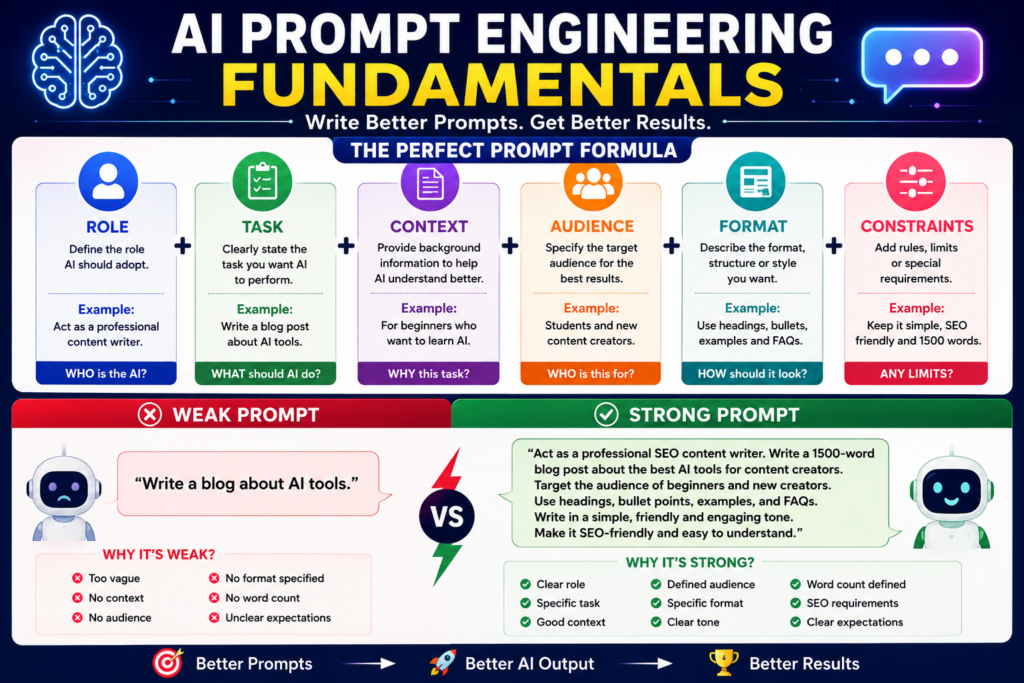
The Perfect Prompt Formula
A simple formula that works for most AI tools is:
Role + Task + Context + Audience + Format + Constraints
Example
Act as an SEO content writer.
Write a beginner-friendly article about artificial intelligence.
The article is for a technology blog.
Target audience: students and beginners.
Use H2 and H3 headings, include FAQs, and write in simple English.
This single prompt will usually outperform dozens of poorly written prompts.
AI Prompt Engineering Guide Frameworks Used by Professionals
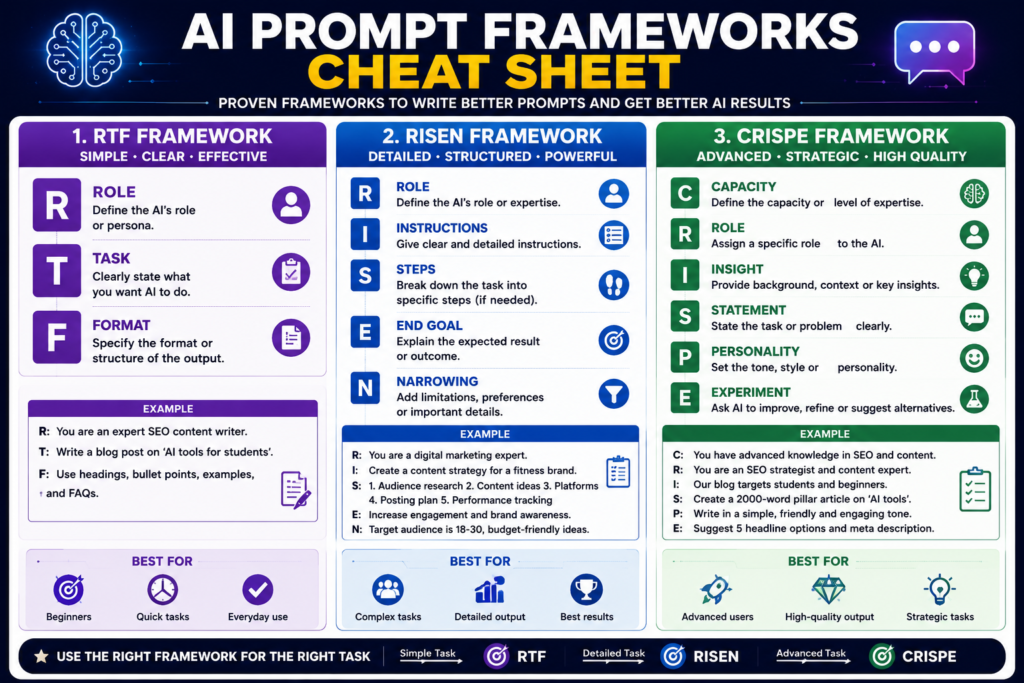
One of the most valuable parts of any AI Prompt Engineering Guide is learning proven prompt frameworks. Professional users often rely on proven frameworks instead of writing prompts randomly.
These frameworks improve consistency and output quality.
RTF Framework
RTF stands for:
| Component | Meaning |
|---|---|
| R | Role |
| T | Task |
| F | Format |
Example:
Role:
SEO Expert
Task:
Write an article about AI tools.
Format:
Table + FAQs + Conclusion
RTF is simple and highly effective for beginners.
RISEN Framework
RISEN stands for:
| Component | Meaning |
|---|---|
| R | Role |
| I | Instructions |
| S | Steps |
| E | End Goal |
| N | Narrowing |
Example:
Role:
Marketing Consultant
Instructions:
Create a social media strategy.
Steps:
Analyze audience, create content plan, suggest posting schedule.
End Goal:
Increase engagement.
Narrowing:
Target small businesses only.
RISEN is excellent for complex business tasks.
CRISPE Framework
CRISPE stands for:
| Component | Meaning |
|---|---|
| C | Capacity |
| R | Role |
| I | Insight |
| S | Statement |
| P | Personality |
| E | Experiment |
This framework is often used by advanced AI users because it creates highly detailed prompts.
Prompt Engineering for ChatGPT
ChatGPT responds best when prompts are detailed and structured. ChatGPT is one of the most widely used AI tools for prompt engineering and content creation.
Weak Prompt
Write a YouTube script.
Strong Prompt
Act as a professional YouTube script writer.
Create a 10-minute YouTube script about AI tools for students.
Use an engaging hook, practical examples, and a strong conclusion.
Why It Works Better
The second prompt provides:
- Role
- Task
- Audience
- Format
- Expectations
As a result, the output is significantly more useful.
To explore more conversational AI tools, see our Best AI Chatbots in 2026 guide.
Prompt Engineering for Gemini
Gemini performs particularly well when prompts include research requirements and comparative analysis. Gemini performs particularly well when prompts include:
- Research requirements
- Comparative analysis
- Detailed explanations
- Structured outputs
Example:
Act as a technology researcher.
Compare ChatGPT, Gemini, and Claude.
Create a comparison table showing features, strengths, weaknesses, and ideal use cases.
If you want to discover more AI-powered research platforms, read our Best AI Research Tools in 2026 guide.
Prompt Engineering for Claude
Claude is known for its strength in long-form writing, analysis, and document processing. Claude often excels at:
- Long-form writing
- Analysis
- Research
- Document processing
Example:
Act as an academic editor.
Review the following research paper and suggest improvements in clarity, structure, and readability.
Prompt Engineering for AI Image Generators
Image prompts require a different approach.
A good image prompt typically includes:
- Subject
- Style
- Lighting
- Colors
- Composition
- Quality
Weak Prompt
Create a lion.
Strong Prompt
Create a majestic lion standing on a rocky mountain during sunrise, cinematic lighting, ultra-detailed fur, golden colors, realistic photography, 8K quality.
The second prompt provides far more information, allowing the AI to generate a better image.
Text Prompts vs Image Prompts
| Feature | Text Prompts | Image Prompts |
|---|---|---|
| Goal | Generate content | Generate visuals |
| Focus | Information | Appearance |
| Structure | Role + Task | Subject + Style |
| Output | Text | Images |
| Examples | Blogs, emails | Posters, artwork |
Understanding this difference is important because many beginners use the same prompting style for both text and image generation.
Prompt Engineering for Midjourney and Leonardo AI
AI image generation tools such as Midjourney and Leonardo AI rely heavily on prompt quality. Unlike text-based AI tools, image generators require visual instructions that describe appearance, style, lighting, composition, and quality.
A high-quality image prompt often includes the following elements:
| Element | Purpose | Examples |
|---|---|---|
| Subject | Main object or scene | Lion, Mountain, Business Office |
| Style | Artistic style | Realistic, Watercolor, Digital Painting |
| Lighting | Visual atmosphere | Cinematic Lighting, Golden Hour, Studio Lighting |
| Camera Angle | Perspective | Close-up, Wide Angle, Aerial View |
| Quality | Output detail level | Ultra Detailed, 8K, High Resolution |
| Aspect Ratio | Image dimensions | 16:9, 1:1, 4:5 |
Example Image Prompt
Create a futuristic smart city at sunset, cinematic lighting, aerial view, realistic architecture, ultra-detailed, 8K quality, vibrant colors, professional digital artwork.
By combining these elements, users can generate more accurate and visually appealing images in tools like Midjourney, Leonardo AI, Microsoft Designer, and other AI image generators.
Prompt Engineering for Students
Students can use prompt engineering to learn faster, understand difficult topics, prepare assignments, and improve exam performance.
Instead of searching for information randomly, students can ask AI to act as a teacher, tutor, or subject expert.
Example Student Prompt
Act as a science teacher.
Explain photosynthesis in simple language suitable for a Class 10 student.
Include examples, key points, and a short quiz.
Benefits for Students
- Faster learning
- Better explanations
- Personalized study support
- Improved exam preparation
- Simplified complex topics
Students interested in AI-powered learning can also explore Best Free AI Tools for Students in 2026 to improve productivity and academic performance.
Prompt Engineering for Teachers
Teachers can use AI to create lesson plans, quizzes, classroom activities, assessments, and educational content.
Example Teacher Prompt
Act as an experienced mathematics teacher.
Create a 45-minute lesson plan on algebra for high school students.
Include learning objectives, classroom activities, examples, and assessment questions.
Benefits for Teachers
- Saves preparation time
- Generates teaching ideas
- Creates educational resources
- Supports lesson planning
- Improves classroom engagement
Prompt engineering helps teachers focus more on teaching and less on repetitive administrative work.
Prompt Engineering for Bloggers
Bloggers are among the biggest beneficiaries of prompt engineering.
A well-written prompt can generate blog outlines, article drafts, FAQs, SEO titles, meta descriptions, and content ideas.
Weak Blogging Prompt
Write an article about AI tools.
Better Blogging Prompt
Act as an SEO content writer.
Write a 2500-word beginner-friendly article about AI tools.
Include H2 and H3 headings, a comparison table, FAQs, and a conclusion.
Use simple English and optimize for search engines.
Benefits for Bloggers
- Faster content creation
- Better article structure
- Improved SEO performance
- Consistent publishing
- More content ideas
Bloggers can combine prompt engineering with techniques discussed in Best AI SEO Tools to create content that performs better in search engines.
Prompt Engineering for Content Creators
Content creators use prompts to generate ideas, scripts, captions, hooks, and content calendars.
Example Creator Prompt
Act as a YouTube strategist.
Generate 20 video ideas about artificial intelligence for beginners.
Include catchy titles and audience benefits.
Benefits for Creators
- Endless content ideas
- Faster script writing
- Improved engagement
- Better audience targeting
- Enhanced creativity
Many creators combine prompt engineering with tools discussed in Best AI Tools for Content Creators in 2026 to improve content quality and production speed.
Prompt Engineering for Freelancers
Freelancers often handle multiple clients, projects, and deadlines.
Prompt engineering helps them complete work more efficiently.
Example Freelancer Prompt
Act as a professional proposal writer.
Create a winning freelance proposal for a client seeking SEO blog writing services.
Keep the tone professional and persuasive.
Benefits for Freelancers
- Faster project completion
- Better proposals
- Improved client communication
- Increased productivity
- More professional outputs
Prompt engineering can help freelancers deliver higher-quality work while saving valuable time.
Prompt Engineering for Marketers
Marketing professionals use prompts to create campaigns, advertisements, emails, landing pages, and audience research reports.
Example Marketing Prompt
Act as a digital marketing consultant.
Create a marketing campaign for a new AI productivity tool.
Include audience targeting, messaging strategy, content ideas, and promotional channels.
Benefits for Marketers
- Campaign planning
- Audience research
- Faster content generation
- Better advertising ideas
- Improved marketing efficiency
Marketing professionals often combine prompt engineering with strategies discussed in Best AI Tools for Email Marketing in 2026 to improve campaign performance and customer engagement.
Prompt Engineering for Business Owners
Business owners use AI to automate tasks, generate ideas, analyze opportunities, and improve decision-making.
Example Business Prompt
Act as a business consultant.
Analyze the strengths, weaknesses, opportunities, and threats of an online education startup.
Provide actionable recommendations.
Benefits for Business Owners
- Better planning
- Faster research
- Improved decision-making
- Business automation
- Productivity improvements
Businesses can combine prompt engineering with solutions featured in Best AI Tools for Business Automation in 2026 to streamline operations and improve efficiency.
Prompt Engineering for Startup Founders
Startup founders often need to perform market research, validate ideas, create business plans, and build growth strategies.
Example Startup Prompt
Act as a startup advisor.
Evaluate my SaaS business idea and identify potential opportunities, risks, competitors, and growth strategies.
Benefits for Startups
- Faster validation
- Market analysis
- Business planning
- Growth strategy development
- Investor preparation
Startup founders frequently use prompt engineering alongside tools featured in Best AI Tools for Startups in 2026 to accelerate decision-making and business growth.
Common Prompt Engineering Mistakes
Many users fail to get good AI outputs because they make avoidable mistakes.
1. Being Too Vague
Bad Example:
Write a blog.
Better Example:
Write a 2000-word beginner-friendly blog about AI tools for students.
2. Providing No Context
AI performs better when it understands the background and purpose of the task.
3. Ignoring the Audience
Content for students should not be written the same way as content for professionals.
4. Forgetting the Desired Format
Always specify whether you want:
- Table
- Article
- Bullet points
- FAQ format
- Step-by-step guide
5. Expecting Perfection from the First Prompt
Professional users often refine prompts several times before achieving the desired output.
6. Not Reviewing AI Outputs
AI-generated content should always be reviewed for accuracy, relevance, and quality.
Prompt Engineering Mistake Summary
- Too Vague → Generic output
- No Context → Inaccurate output
- No Audience → Wrong tone
- No Format → Unstructured response
- No Constraints → Unfocused content
- No Refinement → Lower quality results
The Golden Rule of Prompt Engineering
The more useful information you provide to AI, the better the output is likely to be.
Clear instructions create clear results.
Vague instructions create vague results.
Advanced Prompt Engineering Techniques
Once you understand the basics of prompt engineering, you can use advanced techniques to generate significantly better results.
These methods are commonly used by researchers, marketers, content creators, developers, and AI professionals.
Chain-of-Thought Prompting
Chain-of-Thought prompting encourages AI to explain its reasoning process step by step.
Instead of asking for only the final answer, you ask AI to show how it arrived at the answer.
Example
Normal Prompt:
What is the best marketing strategy for a startup?
Better Prompt:
Act as a startup marketing consultant.
Analyze the situation step by step before recommending a marketing strategy.
Explain the reasoning behind each recommendation.
Benefits
- More detailed answers
- Better reasoning
- Improved problem-solving
- Higher-quality recommendations
Few-Shot Prompting
Few-Shot prompting means providing examples before asking AI to perform a task.
Example
Input:
Product:
AI Writing Tool
Description:
An AI-powered platform that helps bloggers create content faster.
Now create a product description for:
Product:
AI Image Generator
AI learns from the example and often produces more accurate outputs.
Benefits
- Better consistency
- Improved formatting
- More predictable results
- Stronger output quality
Step-by-Step Prompting
Complex tasks often work better when divided into smaller steps.
Weak Prompt
Create a complete business plan.
Better Prompt
Step 1:
Analyze the business idea.
Step 2:
Identify competitors.
Step 3:
Create a marketing plan.
Step 4:
Develop revenue projections.
Breaking tasks into smaller stages often produces better results.
Iterative Prompting
Professional AI users rarely accept the first output.
They improve results by refining prompts repeatedly.
Example:
Version 1:
Write a blog.
Version 2:
Write a beginner-friendly blog.
Version 3:
Write a beginner-friendly SEO article with examples, FAQs, and actionable tips.
Each refinement improves output quality.
Zero-Shot, One-Shot, and Few-Shot Prompting Explained
| Type | Meaning | Example |
|---|---|---|
| Zero-Shot | No example given | Write an article on AI |
| One-Shot | One example given | Example + Task |
| Few-Shot | Multiple examples given | Multiple examples + Task |
Prompt Templates You Can Use for Almost Any Task
The following templates work across multiple AI tools.
Universal Content Writing Template
Act as a professional content writer.
Write a detailed article about [TOPIC].
Target audience: [AUDIENCE]
Tone: [FRIENDLY/PROFESSIONAL]
Length: [WORD COUNT]
Include:
- Introduction
- H2 and H3 headings
- Examples
- FAQs
- Conclusion
Research Template
Act as a research analyst.
Analyze [TOPIC].
Include:
- Key facts
- Current trends
- Opportunities
- Challenges
- Future outlook
Present the information in a structured format.
Marketing Template
Act as a digital marketing consultant.
Create a marketing strategy for [PRODUCT/SERVICE].
Include:
- Target audience
- Content ideas
- Advertising channels
- Email marketing ideas
- Growth recommendations
Learning Template
Act as a teacher.
Explain [TOPIC] in simple language.
Include:
- Definition
- Examples
- Key points
- Quiz questions
- Summary
50 Ready-to-Use AI Prompts
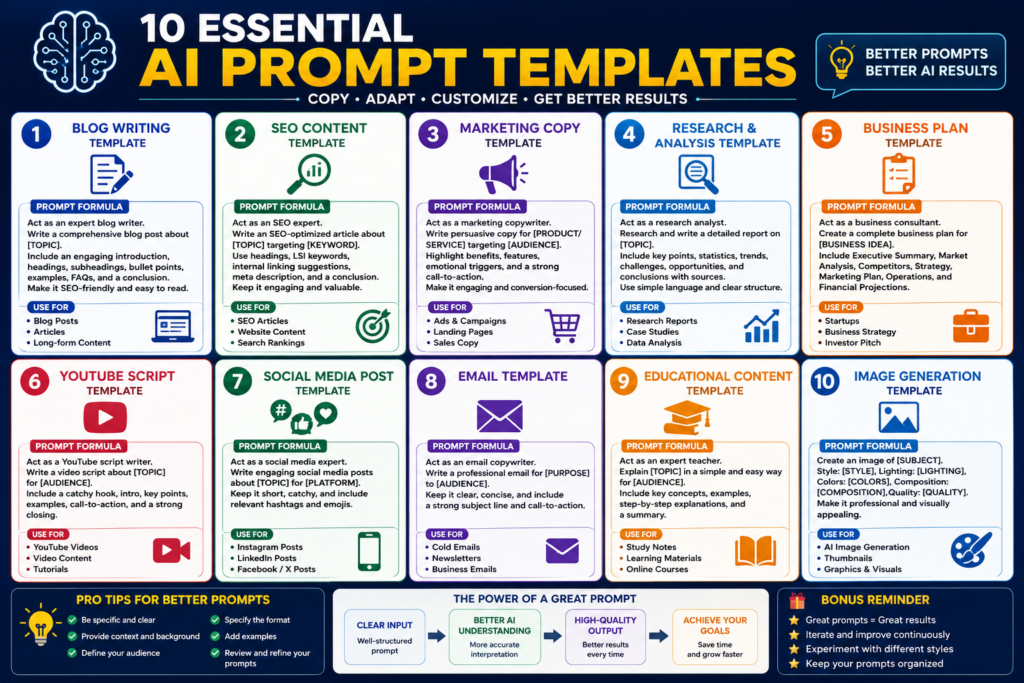
One of the easiest ways to improve AI results is to start with proven prompt templates.
10 Blogging Prompts
- Write a beginner-friendly article about [TOPIC].
- Generate 20 blog post ideas about [NICHE].
- Create an SEO-optimized article outline.
- Write a compelling blog introduction.
- Generate 10 FAQ questions and answers.
- Create a comparison table for [TOPIC].
- Rewrite this article in simpler language.
- Suggest internal linking opportunities.
- Create a meta title and meta description.
- Generate a conclusion with actionable takeaways.
10 Student Prompts
- Explain [TOPIC] like a teacher.
- Create revision notes for [SUBJECT].
- Generate practice questions.
- Create a study timetable.
- Summarize this chapter.
- Explain difficult concepts using examples.
- Generate multiple-choice questions.
- Create flashcards for revision.
- Compare two theories.
- Prepare a quick exam guide.
10 Marketing Prompts
- Create a social media campaign.
- Write Facebook ad copy.
- Generate email subject lines.
- Create customer personas.
- Analyze competitor strategies.
- Generate lead magnet ideas.
- Create a content calendar.
- Suggest growth marketing tactics.
- Write landing page copy.
- Create a customer retention strategy.
10 Business Prompts
- Analyze a business idea.
- Perform a SWOT analysis.
- Create a business plan.
- Generate startup ideas.
- Suggest revenue models.
- Identify growth opportunities.
- Analyze competitors.
- Create a sales strategy.
- Develop a pricing strategy.
- Create an expansion roadmap.
10 AI Image Generation Prompts
- Create a cinematic portrait.
- Design a futuristic cityscape.
- Generate a motivational poster.
- Create a realistic wildlife scene.
- Design a professional book cover.
- Generate a modern business infographic.
- Create a fantasy landscape.
- Design a social media banner.
- Generate a product advertisement image.
- Create a printable educational poster.
These prompt templates can be customized for ChatGPT, Gemini, Claude, Microsoft Designer, Leonardo AI, Midjourney, and many other AI tools.
The Future of Prompt Engineering
Prompt engineering is evolving rapidly as artificial intelligence becomes more powerful and widely adopted. The future of AI Prompt Engineering Guide practices will include AI agents, multimodal prompting, and voice-based interactions.
Today, prompts are primarily text-based instructions. However, the future will involve much more sophisticated interactions between humans and AI systems.
Multimodal Prompting
Future AI systems will understand combinations of:
- Text
- Images
- Audio
- Video
- Documents
Users will be able to provide multiple types of inputs simultaneously to achieve more accurate results.
Voice-Based Prompting
Instead of typing prompts, users will increasingly interact with AI through natural voice conversations.
This will make AI more accessible and easier to use.
AI Agents
AI agents will perform complex tasks independently.
Instead of asking AI to complete a single task, users will assign goals.
For example:
“Create a complete marketing campaign for my business.”
The AI agent may:
- Conduct research
- Generate content
- Create advertisements
- Analyze competitors
- Build reports
with minimal human involvement.
Personalized AI Assistants
Future AI systems will learn user preferences and automatically adapt responses based on individual needs.
Prompt Libraries
Many professionals already maintain collections of successful prompts.
Prompt libraries are expected to become valuable business assets and productivity resources.
Can Prompt Engineering Become a Career?
One of the most common questions people ask is whether prompt engineering can become a profession.
The answer is yes—but not in the way many people imagine.
Most organizations are not hiring people solely to write prompts.
Instead, prompt engineering is becoming a valuable skill that enhances existing careers.
Professionals Who Benefit from Prompt Engineering
- Content Writers
- Bloggers
- SEO Specialists
- Digital Marketers
- Teachers
- Researchers
- Software Developers
- Designers
- Business Consultants
- Entrepreneurs
Why It Matters
People who know how to communicate effectively with AI often:
- Work faster
- Produce better results
- Save time
- Improve productivity
- Gain a competitive advantage
Prompt engineering is likely to become a core digital skill similar to internet research, spreadsheets, or search engine optimization.
AI Prompt Engineering Cheat Sheet
| Goal | Prompt Formula |
|---|---|
| Blog Writing | Role + Topic + Audience + Format |
| SEO Content | Role + Keyword + Structure + FAQs |
| Image Generation | Subject + Style + Lighting + Quality |
| Marketing Campaign | Goal + Audience + Offer + Channels |
| Research | Topic + Scope + Output Format |
| Business Analysis | Role + Context + Objective + Recommendations |
| Learning | Topic + Examples + Quiz + Summary |
| Email Writing | Role + Audience + Purpose + Tone |
| YouTube Script | Topic + Audience + Length + Style |
| Social Media | Platform + Audience + Objective + CTA |
This simple table can be saved, printed, or bookmarked for future reference.
Final Thoughts
Prompt engineering is not about learning complicated technical commands. This AI Prompt Engineering Guide provides a strong foundation for anyone who wants to use artificial intelligence more effectively.
It is about learning how to communicate effectively with artificial intelligence.
Whether you are a student, teacher, blogger, freelancer, marketer, business owner, startup founder, or working professional, the ability to write better prompts can dramatically improve the quality of AI-generated results.
The most successful AI users are not necessarily the people with the most advanced tools.
They are the people who know how to ask better questions.
As AI continues to evolve, prompt engineering will become one of the most valuable skills for productivity, creativity, learning, business growth, and problem-solving.
The sooner you learn it, the greater the advantage you will have in the AI-powered future.
Frequently Asked Questions About Prompt Engineering
What is prompt engineering?
Prompt engineering is the process of designing effective instructions that help AI systems generate accurate, useful, and relevant responses.
Why is prompt engineering important?
Prompt engineering improves the quality of AI outputs by providing clear instructions, context, and expectations.
Do I need coding skills to learn prompt engineering?
No. Most prompt engineering techniques can be learned and applied without programming knowledge.
Can beginners learn prompt engineering?
Yes. Prompt engineering is suitable for beginners and can be learned through practice and experimentation.
Which AI tools use prompt engineering?
ChatGPT, Gemini, Claude, Microsoft Copilot, Leonardo AI, Midjourney, DALL·E, and many other AI tools rely on prompts.
What is a prompt in artificial intelligence?
A prompt is an instruction, question, or request given to an AI system to generate a response.
What is the best prompt engineering framework?
Popular frameworks include RTF, RISEN, and CRISPE. The best framework depends on the task and desired output.
Can prompt engineering improve SEO content creation?
Yes. Well-structured prompts can help generate better article outlines, keyword-focused content, FAQs, and optimized metadata.
How can students use prompt engineering?
Students can use prompt engineering for studying, note-making, exam preparation, research, and understanding complex topics.
How do marketers use prompt engineering?
Marketers use prompts to create campaigns, advertisements, email sequences, customer personas, and content strategies.
Can prompt engineering help businesses?
Yes. Businesses use prompt engineering for research, planning, automation, marketing, customer support, and decision-making.
What are the most common prompt engineering mistakes?
Common mistakes include vague instructions, missing context, ignoring the audience, and failing to specify the desired format.
Is prompt engineering a good career skill?
Yes. Prompt engineering is becoming a valuable skill for content creators, marketers, educators, developers, and business professionals.
What is multimodal prompting?
Multimodal prompting involves combining different input types such as text, images, audio, and video within a single AI interaction.
What is the future of prompt engineering?
The future of prompt engineering includes AI agents, voice prompting, multimodal AI systems, personalized assistants, and advanced automation.