
Introduction
The best AI SEO tools help bloggers, marketers, and businesses improve rankings, increase organic traffic, and streamline optimization tasks. Search Engine Optimization (SEO) is one of the most effective ways to generate long-term organic traffic, attract qualified visitors, and grow an online presence. Whether you run a blog, an ecommerce store, a business website, or a digital marketing agency, SEO plays a critical role in helping people discover your content through search engines.
However, SEO has become increasingly complex. Modern SEO involves keyword research, content planning, on-page optimization, technical audits, competitor analysis, backlink monitoring, user intent analysis, and performance tracking. Managing all these activities manually can be time-consuming and challenging.
This is where Artificial Intelligence is transforming the SEO industry.
AI-powered SEO tools can analyze massive amounts of data, identify opportunities, automate repetitive tasks, and provide actionable recommendations within minutes. Instead of spending hours researching keywords or auditing websites, marketers can use AI to make smarter decisions and focus on strategy.
Today, bloggers use AI to discover content opportunities, marketers use it to optimize campaigns, and businesses use it to improve visibility, generate leads, and increase revenue.
If you are already exploring AI-powered productivity solutions, you may also find value in our Best AI Tools for Marketing in 2026, Best AI Tools for Business Automation in 2026, and Best AI Tools for Freelancers in 2026 guides.
In this comprehensive guide, you will learn:
- What AI SEO tools are
- How AI is changing SEO
- Different categories of AI SEO tools
- The best AI SEO tools available today
- How to choose the right platform
- Common SEO mistakes to avoid
- The future of AI-powered search optimization
By the end of this guide, you will have a clear understanding of how AI can improve your SEO strategy and help you achieve sustainable organic growth.
If you are completely new to artificial intelligence, we recommend starting with our What Is Artificial Intelligence? The Complete Beginner’s Guide to AI before exploring advanced SEO applications.
Understanding SEO in the Age of Artificial Intelligence
Before discussing specific tools, it is important to understand why AI has become so valuable in SEO.
Search engines have evolved significantly over the last decade. Modern algorithms focus on:
- Search intent
- Content quality
- User experience
- Relevance
- Expertise
- Authority
- Trustworthiness
As search engines become more sophisticated, SEO professionals must analyze more data than ever before.
Traditional SEO vs AI-Powered SEO
| Factor | Traditional SEO | AI-Powered SEO |
|---|---|---|
| Keyword Research | Manual Analysis | Automated Insights |
| Content Optimization | Time-Consuming | Real-Time Suggestions |
| Competitor Research | Manual Comparison | Automated Intelligence |
| Technical Audits | Complex Reports | Actionable Recommendations |
| Workflow Speed | Slower | Faster |
| Scalability | Limited | High |
AI does not replace SEO expertise. Instead, it acts as an intelligent assistant that helps professionals work more efficiently and make better decisions.
Why AI Matters for Modern SEO
Consider a website with hundreds of pages.
Manually reviewing every page for keyword opportunities, content gaps, technical issues, and optimization improvements would require significant time and effort.
AI tools can:
- Analyze thousands of keywords
- Identify ranking opportunities
- Recommend content improvements
- Discover competitor weaknesses
- Automate reporting
- Monitor performance trends
This allows SEO professionals to focus on strategy rather than repetitive analysis.
Benefits of Using AI SEO Tools
The growing popularity of AI SEO tools is driven by their ability to deliver measurable benefits. Many of these automation and efficiency improvements are similar to those discussed in our Best AI Productivity Tools in 2026 guide. Many of the best AI SEO tools can automate repetitive SEO tasks and improve productivity.
Key Advantages
| Benefit | Why It Matters |
|---|---|
| Faster Keyword Research | Discover opportunities quickly |
| Better Content Planning | Create more targeted content |
| Improved On-Page SEO | Optimize pages effectively |
| Technical SEO Support | Detect issues faster |
| Competitive Intelligence | Understand competitors |
| Automation | Reduce repetitive work |
| Productivity | Save valuable time |
| Scalability | Manage larger websites |
Better Keyword Discovery
Keyword research remains the foundation of successful SEO.
AI tools can identify:
- Long-tail keywords
- Question-based searches
- Semantic variations
- Content gaps
- Emerging trends
This helps content creators target topics that have a greater chance of ranking.
Improved Content Optimization
Modern AI platforms analyze top-ranking pages and compare them with your content.
These insights help writers:
- Cover important topics
- Improve relevance
- Enhance readability
- Strengthen topical authority
Stronger Competitive Analysis
AI tools make it easier to understand:
- Which keywords competitors rank for
- What content performs best
- Where backlink opportunities exist
- Which topics deserve attention
This information can significantly improve strategic decision-making.
Types of AI SEO Tools
Not every AI SEO tool serves the same purpose.
Understanding the major categories helps users build an effective SEO toolkit.
Keyword Research Tools
These platforms help users identify valuable search opportunities.
Common capabilities include:
- Search volume analysis
- Keyword difficulty scoring
- Intent analysis
- Competitor keyword discovery
- Trend forecasting
Content Optimization Tools
Content optimization platforms analyze existing content and provide recommendations for improvement.
They often focus on:
- Topic coverage
- Semantic relevance
- Keyword usage
- Readability
- Search intent alignment
Technical SEO Tools
Technical SEO tools help identify website issues that may affect rankings.
Common functions include:
- Crawl analysis
- Broken link detection
- Page speed recommendations
- Indexing diagnostics
- Structured data validation
Competitor Analysis Tools
These platforms help users understand market competition.
Typical features include:
- Competitor keyword tracking
- Content gap analysis
- Backlink intelligence
- Ranking comparisons
SEO Automation Tools
Automation platforms streamline routine SEO tasks such as:
- Reporting
- Monitoring
- Notifications
- Workflow management
Best AI SEO Tools for Modern Search Optimization
The AI SEO software market has grown rapidly over the past few years. Today, marketers can choose from dozens of platforms, each specializing in different aspects of search optimization.
Some tools focus on keyword research, while others excel at content optimization, technical SEO, competitor analysis, or workflow automation.
The best strategy is not necessarily to use every tool available. Instead, successful SEO professionals typically combine a few powerful platforms that complement each other.
1. Semrush
Semrush is one of the most comprehensive SEO platforms available. It combines keyword research, competitor analysis, backlink monitoring, site audits, content marketing, and rank tracking into a single ecosystem.
For bloggers, marketers, and businesses looking for an all-in-one solution, Semrush is often the first platform considered.
| Core Feature | Benefit |
|---|---|
| Keyword Research | Discover ranking opportunities |
| Site Audit | Identify technical SEO issues |
| Competitor Analysis | Analyze competing websites |
| Position Tracking | Monitor rankings |
| Backlink Analytics | Evaluate link profiles |
Why SEO Professionals Use Semrush
- Massive keyword database
- Strong competitor intelligence
- Excellent reporting features
- Suitable for agencies and businesses
- Continuous platform updates
Best For
Organizations that need a complete SEO toolkit rather than a single-purpose tool.
2. Ahrefs
Ahrefs is widely recognized for its backlink database and competitive analysis capabilities.
Many SEO professionals rely on Ahrefs to understand why competitors rank well and identify opportunities for link acquisition.
Ahrefs Strengths
| Area | Performance |
|---|---|
| Backlink Analysis | Excellent |
| Competitor Research | Excellent |
| Content Gap Analysis | Very Good |
| Keyword Research | Very Good |
| Technical Audits | Good |
Practical Use Cases
- Finding competitor backlinks
- Discovering content opportunities
- Monitoring website authority
- Tracking keyword rankings
- Auditing website health
One reason Ahrefs remains popular is its ability to reveal hidden opportunities that are difficult to identify manually.
3. Surfer SEO
Surfer SEO focuses primarily on content optimization.
Instead of guessing what Google wants, Surfer analyzes top-ranking pages and provides recommendations based on real search results.
This approach helps writers create content that aligns more closely with search intent and ranking factors.
What Surfer SEO Analyzes
- Content structure
- Keyword usage
- Semantic relevance
- Heading distribution
- Content depth
- Topical coverage
| Advantage | Why It Matters |
|---|---|
| Real-Time Optimization | Improve content while writing |
| NLP-Based Suggestions | Better topical relevance |
| SERP Analysis | Data-driven recommendations |
| Easy Integration | Works with common workflows |
Ideal Users
- Bloggers
- Affiliate marketers
- Content teams
- SEO agencies
4. Frase
Frase combines content research, content briefs, optimization, and AI writing assistance into a single platform.
Many content marketers use Frase to reduce research time and create detailed content outlines quickly.
Typical Frase Workflow
| Step | Function |
|---|---|
| Research | Analyze top-ranking pages |
| Brief Creation | Generate content outline |
| Writing | Create initial draft |
| Optimization | Improve SEO relevance |
| Review | Final content improvements |
Why Frase Is Popular
Content creators often spend more time researching than writing.
Frase helps reduce this workload by automatically collecting and organizing information from top-ranking content.
5. Clearscope
Clearscope focuses heavily on content quality and relevance.
Unlike tools that emphasize keyword frequency, Clearscope helps writers understand the topics, entities, and concepts that should be included within high-quality content.
Key Benefits
| Benefit | Result |
|---|---|
| Better Topic Coverage | Stronger relevance |
| Improved Readability | Better user experience |
| Content Grading | Easier optimization |
| Search Intent Alignment | Improved rankings |
Many enterprise content teams use Clearscope because it balances SEO requirements with user-focused writing.
Comparing the Top AI SEO Platforms
| Tool | Best For | Difficulty | Suitable For |
|---|---|---|---|
| Semrush | Complete SEO | Medium | Businesses & Agencies |
| Ahrefs | Backlinks & Research | Medium | SEO Professionals |
| Surfer SEO | Content Optimization | Easy | Bloggers & Marketers |
| Frase | Content Research | Easy | Writers & Content Teams |
| Clearscope | Content Quality | Easy | Enterprise Content Teams |
At this stage, a common question arises:
Should you invest in expensive SEO software, or can AI assistants such as ChatGPT provide similar value?
The answer depends on your goals, budget, and workflow requirements.
In the next section, we will examine ChatGPT, MarketMuse, Rank Math, NeuronWriter, and other emerging AI SEO tools that are reshaping modern search optimization.
6. ChatGPT
ChatGPT has become one of the most widely used AI tools among bloggers, SEO professionals, affiliate marketers, and content creators.
Although ChatGPT is not a traditional SEO platform like Semrush or Ahrefs, it can significantly improve productivity throughout the SEO process.
How ChatGPT Helps with SEO
| SEO Activity | How ChatGPT Assists |
|---|---|
| Keyword Research | Generates keyword ideas |
| Content Planning | Creates topic clusters |
| Outline Creation | Builds article structures |
| FAQ Generation | Finds common questions |
| Meta Descriptions | Creates optimized descriptions |
| Internal Linking Ideas | Suggests related content |
| Content Refreshing | Updates older articles |
Practical Examples
A blogger can use ChatGPT to:
- Generate article outlines
- Create FAQ sections
- Improve readability
- Develop topic clusters
- Identify content opportunities
However, successful SEO still requires human review, fact-checking, and strategic thinking. For deeper research, fact-checking, and information gathering, see our Best AI Research Tools in 2026 guide.
7. Rank Math
Rank Math has become one of the most popular WordPress SEO plugins.
It helps website owners optimize pages directly inside WordPress without requiring advanced technical knowledge.
Rank Math Features
| Feature | Benefit |
|---|---|
| On-Page SEO Analysis | Improves optimization |
| Schema Markup | Enhances search appearance |
| XML Sitemaps | Better indexing |
| Keyword Tracking | Easier optimization |
| Internal Link Suggestions | Improved site structure |
Why Bloggers Like Rank Math
- Easy setup
- Strong free version
- WordPress integration
- Helpful optimization guidance
For many website owners, Rank Math acts as the operational layer that helps implement recommendations generated by other SEO tools.
8. MarketMuse
MarketMuse focuses on content strategy and topical authority.
Instead of optimizing individual articles only, it helps businesses build comprehensive content ecosystems.
Core Capabilities
| Area | Purpose |
|---|---|
| Content Planning | Strategic topic development |
| Content Scoring | Quality evaluation |
| Gap Analysis | Missing topic discovery |
| Authority Building | Stronger topical relevance |
Best For
- Large websites
- Publishers
- Agencies
- Enterprise SEO teams
MarketMuse is particularly valuable for organizations publishing large volumes of content.
9. NeuronWriter
NeuronWriter combines content optimization with AI-assisted writing and planning.
Many marketers view it as a cost-effective alternative to more expensive optimization platforms.
Strengths of NeuronWriter
| Advantage | Impact |
|---|---|
| Affordable Pricing | Better accessibility |
| Content Optimization | Improved rankings |
| SERP Analysis | Data-driven decisions |
| AI Assistance | Faster workflows |
Suitable Users
- Bloggers
- Affiliate marketers
- Freelancers
- Small businesses
NeuronWriter has become increasingly popular among website owners seeking advanced optimization without enterprise-level pricing.
10. SE Ranking
SE Ranking is an all-in-one SEO platform that offers keyword research, competitor analysis, rank tracking, and website auditing.
Key Features
| Feature | Business Value |
|---|---|
| Rank Tracking | Monitor visibility |
| Website Audits | Identify issues |
| Competitor Analysis | Discover opportunities |
| Keyword Research | Build SEO strategy |
Why Many Businesses Choose SE Ranking
The platform provides a strong balance between functionality and affordability. For growing businesses and agencies, this combination can be particularly attractive. Choosing the best AI SEO tools depends on your budget, goals, and SEO experience.
AI SEO Tools for Bloggers
Bloggers often have different SEO requirements compared to large businesses. Freelancers who manage their own websites and client projects may also benefit from our Best AI Tools for Freelancers in 2026 guide.
Their primary goals usually include:
- Increasing organic traffic
- Growing topical authority
- Creating content efficiently
- Improving rankings
Recommended SEO Stack for Bloggers
| Purpose | Recommended Tool |
|---|---|
| Keyword Research | Semrush |
| Content Optimization | Surfer SEO |
| AI Assistance | ChatGPT |
| WordPress SEO | Rank Math |
| Research | Perplexity AI |
This combination allows bloggers to cover every major aspect of SEO without relying on a single platform. Creative professionals can explore our Best AI Tools for Graphic Designers in 2026 guide to discover AI-powered design and content creation tools.
AI SEO Tools for Affiliate Marketers
Affiliate websites depend heavily on search traffic.
Even small ranking improvements can significantly impact revenue.
Areas Where AI Helps Affiliate SEO
- Keyword clustering
- Product comparison creation
- Competitor analysis
- Content optimization
- Internal linking strategies
- Content gap analysis
Affiliate marketers often benefit from combining Ahrefs, Surfer SEO, ChatGPT, and Rank Math.
AI SEO Tools for Businesses
Businesses typically have different objectives.
Instead of focusing only on traffic, they often prioritize:
- Leads
- Sales
- Brand visibility
- Customer acquisition
Recommended Business SEO Stack
| Business Goal | Suggested Tool |
|---|---|
| Lead Generation | Semrush |
| Content Strategy | MarketMuse |
| Optimization | Surfer SEO |
| Website SEO | Rank Math |
| Automation | ChatGPT |
The best solution depends on business size, industry, and marketing objectives. Business owners interested in automation and growth strategies may also find our Best AI Tools for Small Businesses in 2026 guide useful.
Free vs Paid AI SEO Tools
Many beginners wonder whether free SEO tools are enough.
The answer depends on website goals and competition levels.
| Factor | Free Tools | Paid Tools |
|---|---|---|
| Cost | Free | Subscription Required |
| Features | Limited | Advanced |
| Data Accuracy | Moderate | High |
| Scalability | Limited | Strong |
| Support | Basic | Better Support |
For beginners, free tools often provide sufficient value.
As traffic grows, investing in premium SEO platforms can deliver a stronger return on investment.
How to Choose the Right AI SEO Tool
One of the most common mistakes website owners make is selecting an SEO platform based solely on popularity.
The reality is that the best AI SEO tool depends on your goals, budget, website size, and experience level.
Questions to Ask Before Choosing a Tool
Before investing in any SEO software, ask yourself:
- What is my primary SEO objective?
- Do I need keyword research or content optimization?
- Am I a beginner or an experienced SEO professional?
- What is my monthly budget?
- How many websites will I manage?
Recommended Tools by User Type
| User Type | Recommended Tool |
|---|---|
| Beginner Blogger | Rank Math + ChatGPT |
| Affiliate Marketer | Ahrefs + Surfer SEO |
| Content Creator | Frase + ChatGPT |
| Small Business | Semrush + Rank Math |
| Marketing Agency | Semrush + Ahrefs |
| Enterprise Team | MarketMuse + Semrush |
Single Tool vs Multi-Tool Strategy
Many beginners search for one platform that can do everything.
In practice, most successful SEO professionals combine multiple tools.
For example:
| Task | Recommended Tool |
|---|---|
| Keyword Research | Semrush |
| Competitor Analysis | Ahrefs |
| Content Optimization | Surfer SEO |
| Writing Assistance | ChatGPT |
| WordPress SEO | Rank Math |
This combination creates a more complete SEO workflow.
Common SEO Mistakes That AI Can Help Prevent
Many websites fail to rank not because of poor content but because of avoidable SEO mistakes.
AI tools help identify these issues before they become major problems.
1. Targeting the Wrong Keywords
Many beginners target keywords that are:
- Too competitive
- Too broad
- Low intent
- Difficult to rank
AI-powered keyword tools help discover opportunities that match a website’s authority level.
2. Ignoring Search Intent
A page may contain the right keyword but still fail to rank if it does not satisfy user intent.
Modern AI optimization platforms analyze top-ranking content and identify what users actually expect to see.
3. Publishing Thin Content
Short articles with limited value often struggle to rank.
AI tools help identify:
- Missing topics
- Content gaps
- Relevant entities
- Frequently asked questions
This results in more comprehensive content.
4. Poor Internal Linking
Many websites have valuable content but fail to connect related articles effectively.
Internal linking helps search engines understand topical relationships.
For example, this article can naturally connect with:
- What Is Artificial Intelligence?
- Best AI Tools for Marketing
- Best AI Tools for Business Automation
- Best AI Tools for Freelancers
These connections strengthen topical authority.
5. Ignoring Technical SEO
Technical issues can prevent strong content from performing well.
Common problems include:
- Broken links
- Slow loading pages
- Crawl errors
- Duplicate content
- Missing metadata
Technical SEO tools can identify these issues quickly.
Building an AI-Powered SEO Workflow
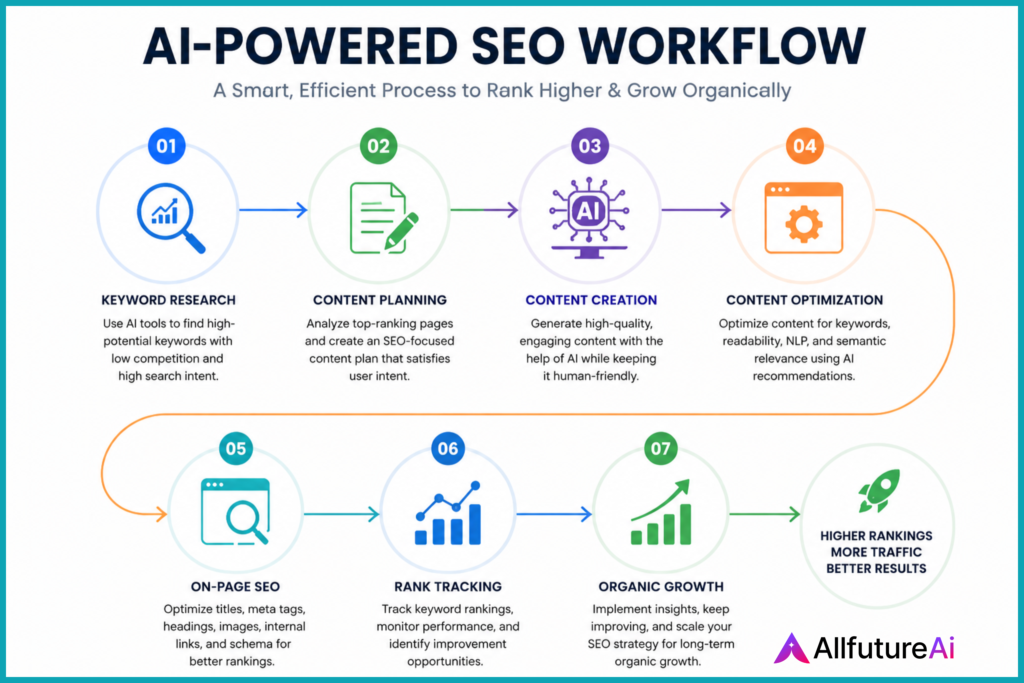
The most successful SEO professionals do not rely on AI randomly.
Instead, they build repeatable workflows.
Example SEO Workflow
Step 1: Keyword Research
Use:
- Semrush
- Ahrefs
- SE Ranking
Goal:
Identify high-potential keyword opportunities.
Step 2: Content Planning
Use:
- ChatGPT
- MarketMuse
- Frase
Goal:
Develop comprehensive content structures. Marketers looking to expand their traffic strategy should also explore our Best AI Tools for Marketing in 2026 guide.
Step 3: Content Creation
Use:
- ChatGPT
- Frase
Goal:
Accelerate drafting and research.
Step 4: Content Optimization
Use:
- Surfer SEO
- Clearscope
- NeuronWriter
Goal:
Improve relevance and topical coverage.
Step 5: On-Page SEO
Use:
- Rank Math
Goal:
Implement SEO best practices.
Step 6: Monitoring and Improvement
Use:
- Semrush
- Ahrefs
Goal:
Track rankings and identify opportunities.
Many SEO teams also use automation strategies covered in our Best AI Tools for Business Automation in 2026 guide.
Why Workflows Matter
Individual tools are useful.
However, a structured workflow produces more consistent SEO results than relying on isolated features.
The Future of AI SEO
Artificial intelligence is expected to become even more influential in search optimization.
As search engines evolve, SEO professionals will increasingly rely on AI to understand user behavior, identify opportunities, and improve content quality.
Emerging Trends
| Trend | Impact |
|---|---|
| Predictive SEO | Identify opportunities earlier |
| Real-Time Optimization | Faster content improvements |
| AI Search Experiences | New visibility challenges |
| Personalized Search | Greater relevance requirements |
| Automation | Reduced manual workload |
Will AI Replace SEO Experts?
This is one of the most common questions in digital marketing.
The answer is no.
AI can automate many tasks, but successful SEO still requires:
- Strategy
- Creativity
- Audience understanding
- Decision-making
- Business knowledge
The future belongs to professionals who learn how to combine human expertise with AI capabilities.
The Growing Importance of Topical Authority
Search engines increasingly reward websites that demonstrate expertise across an entire subject area.
This means building content clusters rather than isolated articles.
For example, a website focused on AI can strengthen authority by covering:
- AI Basics
- AI Marketing
- AI Chatbots
- AI Business Automation
- AI SEO Tools
- AI Productivity
Together, these topics create a stronger signal of expertise than a single article alone.
AI SEO Tools for Different Types of Websites
Not every website has the same SEO goals. A personal blog, an ecommerce store, a local business website, and a digital marketing agency all require different SEO strategies.
Understanding which AI SEO tools work best for specific website types can help businesses achieve better results while avoiding unnecessary expenses. Businesses using conversational AI may also benefit from our Best AI Chatbots in 2026 article.
AI SEO Tools for Bloggers
Bloggers typically focus on:
- Organic traffic growth
- Content creation
- Topic authority
- Audience building
Recommended SEO Stack for Bloggers
| Purpose | Recommended Tool |
|---|---|
| Keyword Research | Semrush |
| Content Planning | ChatGPT |
| Content Optimization | Surfer SEO |
| WordPress SEO | Rank Math |
| Research | Perplexity AI |
Bloggers benefit most from tools that help create high-quality content consistently.
AI SEO Tools for Affiliate Websites
Affiliate marketers rely heavily on search traffic and conversion-focused content.
Their priorities usually include:
- Product reviews
- Comparison articles
- Commercial keywords
- Competitor analysis
Recommended Affiliate SEO Stack
| Purpose | Recommended Tool |
|---|---|
| Competitor Research | Ahrefs |
| Keyword Research | Semrush |
| Content Optimization | Surfer SEO |
| AI Writing Support | ChatGPT |
| SEO Management | Rank Math |
Affiliate websites often gain the most value from keyword research and content optimization platforms.
AI SEO Tools for Ecommerce Stores
Ecommerce SEO presents unique challenges because websites often contain:
- Hundreds of products
- Category pages
- Product descriptions
- Technical SEO requirements
Recommended Ecommerce SEO Stack
| Purpose | Recommended Tool |
|---|---|
| Site Audits | Semrush |
| Technical SEO | Ahrefs |
| Product Content | ChatGPT |
| Optimization | Clearscope |
| Reporting | SE Ranking |
AI can help ecommerce businesses optimize large volumes of content more efficiently.
AI SEO Tools for Local Businesses
Local businesses depend on visibility within specific geographic regions.
Examples include:
- Restaurants
- Clinics
- Consultants
- Law firms
- Service providers
Recommended Local SEO Stack
| Purpose | Recommended Tool |
|---|---|
| Local Keyword Research | Semrush |
| Content Creation | ChatGPT |
| Website SEO | Rank Math |
| Competitor Analysis | Ahrefs |
Local businesses often benefit from combining AI-driven content creation with strong local SEO practices.
AI SEO Tools for Agencies
Marketing agencies manage multiple clients simultaneously.
As a result, scalability becomes a major consideration.
Recommended Agency SEO Stack
| Purpose | Recommended Tool |
|---|---|
| Client Management | Semrush |
| Competitor Analysis | Ahrefs |
| Content Optimization | Surfer SEO |
| Strategy | MarketMuse |
| Reporting | SE Ranking |
Agencies typically require more advanced reporting and workflow capabilities than individual website owners.
Free AI SEO Tools vs Paid AI SEO Tools
A common question among beginners is whether free tools are sufficient.
The answer depends on the level of competition and growth objectives.
Advantages of Free Tools
| Benefit | Explanation |
|---|---|
| No Cost | Suitable for beginners |
| Easy Access | Quick setup |
| Learning Opportunity | Understand SEO fundamentals |
| Low Risk | No financial commitment |
Advantages of Paid Tools
| Benefit | Explanation |
|---|---|
| Better Data | More accurate insights |
| Advanced Features | Greater optimization capabilities |
| Scalability | Supports larger websites |
| Competitive Intelligence | Deeper market analysis |
When Should You Upgrade?
Consider investing in premium SEO software when:
- Traffic is increasing
- Content production is growing
- Competition becomes stronger
- SEO becomes a significant traffic source
For many website owners, the transition from free tools to professional platforms occurs naturally as the website expands.
Should You Use Multiple AI SEO Tools?
One of the biggest misconceptions in SEO is that a single tool can solve every problem.
In reality, different platforms excel in different areas.
Example Professional SEO Stack
| Task | Tool |
|---|---|
| Keyword Research | Semrush |
| Backlink Analysis | Ahrefs |
| Content Optimization | Surfer SEO |
| Content Planning | ChatGPT |
| WordPress SEO | Rank Math |
| Strategy | MarketMuse |
This approach allows businesses to leverage the strengths of each platform rather than relying on one solution for everything.
The Best Combination for Most Website Owners
For most bloggers, marketers, and small businesses, the following combination is often sufficient:
- ChatGPT
- Semrush
- Surfer SEO
- Rank Math
This setup covers research, planning, optimization, and implementation while remaining manageable and cost-effective.
Real-World Applications of AI SEO Tools
Understanding features is important, but the real value of AI SEO tools becomes clear when we see how they are used in practical situations.
Whether you are a blogger, marketer, freelancer, agency owner, or business operator, AI can help solve real SEO challenges.
Scenario 1: Finding Low-Competition Keywords
A new blogger often struggles to compete against established websites.
Instead of manually analyzing hundreds of keywords, AI-powered tools can identify:
- Low-competition keywords
- Long-tail opportunities
- Question-based searches
- Emerging trends
This allows new websites to target topics with a realistic chance of ranking.
Scenario 2: Building Topic Clusters
Modern SEO is no longer about publishing random articles.
Successful websites create topic clusters that demonstrate expertise.
For example, a website focused on AI may create content around:
| Main Topic | Supporting Topics |
|---|---|
| AI SEO Tools | Keyword Research |
| AI SEO Tools | Content Optimization |
| AI SEO Tools | Technical SEO |
| AI SEO Tools | Link Building |
| AI SEO Tools | SEO Automation |
AI tools help identify related topics and create a logical content structure.
Scenario 3: Updating Old Content
Many websites have valuable articles that gradually lose rankings.
AI tools help identify:
- Outdated information
- Missing keywords
- Content gaps
- Weak sections
Updating existing content is often faster and more effective than creating entirely new articles.
Scenario 4: Competitor Analysis
One of the fastest ways to improve SEO is learning from successful competitors.
AI-powered analysis can reveal:
- Top-performing pages
- Ranking keywords
- Content gaps
- Backlink opportunities
This information helps marketers make more informed decisions.
Scenario 5: Scaling Content Production
As websites grow, content production becomes increasingly challenging.
AI helps streamline:
- Research
- Outlining
- Content planning
- Optimization
- Internal linking
This allows businesses to publish more content without sacrificing quality.
Best Practices for Using AI SEO Tools Effectively
AI can significantly improve SEO performance, but results depend on how the tools are used.
Focus on Search Intent
Many website owners focus exclusively on keywords.
However, search engines increasingly prioritize user intent.
Before creating content, ask:
- What problem is the user trying to solve?
- What information are they expecting?
- What type of content ranks currently?
AI can help analyze intent, but human judgment remains essential.
Use AI as an Assistant, Not a Replacement
AI is most effective when it supports human expertise.
The strongest SEO strategies combine:
- Human creativity
- Industry knowledge
- Audience understanding
- AI-driven insights
This combination typically produces better results than relying solely on automation.
Prioritize Content Quality
Search engines reward content that provides genuine value.
When using AI:
- Verify facts
- Add unique insights
- Include practical examples
- Improve readability
- Enhance user experience
Quality should always remain the primary objective.
Build Topical Authority
Publishing one article on a topic is rarely enough.
AI tools can help identify related subjects that strengthen authority.
Examples for an AI-focused website include:
- AI Marketing
- AI Chatbots
- AI Business Automation
- AI Productivity Tools
- AI SEO Tools
- AI Research Tools
Together, these topics create a stronger expertise signal.
Monitor and Improve Continuously
SEO is an ongoing process rather than a one-time task.
Successful websites regularly:
- Update content
- Track rankings
- Analyze competitors
- Improve internal linking
- Expand content clusters
AI tools make these activities more efficient and scalable.
The Future of Search Optimization in an AI-Driven World
The relationship between artificial intelligence and search optimization will continue to evolve.
Search engines are becoming more sophisticated, user expectations are increasing, and competition for visibility continues to grow.
Future SEO professionals will need to focus on:
- User intent
- Topical authority
- Content quality
- Technical excellence
- Strategic use of AI
The websites that succeed will not necessarily be those using the most tools, but those using the right tools effectively.
As AI technology advances, SEO will become less about repetitive tasks and more about strategy, creativity, and delivering value to users.
Businesses, bloggers, and marketers who embrace AI responsibly will be better positioned to build sustainable organic growth and maintain a competitive advantage in search results.
Building Long-Term Organic Growth with AI SEO Tools
Search engine optimization continues to be one of the most valuable digital marketing strategies for bloggers, businesses, marketers, and content creators. While SEO has become more competitive and data-driven, artificial intelligence is making it easier to identify opportunities, optimize content, and improve decision-making.
The best AI SEO tools do more than automate tasks. They help users understand search intent, uncover content gaps, analyze competitors, improve technical performance, and create more effective content strategies. Whether you are managing a personal blog, an affiliate website, a local business, or a large organization, AI can significantly improve efficiency and productivity.
However, successful SEO still requires human expertise. AI can provide recommendations and insights, but strategic thinking, creativity, audience understanding, and high-quality content remain essential. The most effective approach is to combine AI-powered tools with a strong understanding of SEO fundamentals.
For beginners, tools such as ChatGPT and Rank Math provide an accessible starting point. As websites grow, platforms like Semrush, Ahrefs, Surfer SEO, MarketMuse, and Clearscope can help scale SEO efforts and improve performance.
The future of SEO will increasingly involve collaboration between human expertise and artificial intelligence. Those who learn how to use AI strategically will be better positioned to build authority, attract organic traffic, and achieve sustainable long-term growth.
Rather than searching for a single perfect tool, focus on building an SEO system that combines research, optimization, analysis, and continuous improvement. With the right strategy and the right AI SEO tools, businesses and creators can compete more effectively and build lasting visibility in search engines. If you are building an AI-powered workflow, start with our Best AI Tools in 2026: Complete Guide for Beginners to explore the broader AI ecosystem.
Frequently Asked Questions About AI SEO Tools
What are AI SEO tools?
AI SEO tools are software platforms that use artificial intelligence to assist with keyword research, content optimization, competitor analysis, technical SEO, and search performance improvement.
What is the best AI SEO tool for beginners?
For beginners, ChatGPT and Rank Math are excellent starting points because they are easy to use and help with content creation, optimization, and SEO implementation.
Which AI SEO tool is best for keyword research?
Semrush and Ahrefs are among the best tools for keyword research because they provide search volume data, keyword difficulty analysis, competitor insights, and ranking opportunities.
Can AI improve SEO rankings?
AI can help improve SEO rankings by identifying optimization opportunities, improving content quality, analyzing competitors, and streamlining SEO workflows. However, rankings still depend on content quality, authority, and user experience.
Can ChatGPT be used for SEO?
Yes. ChatGPT can assist with keyword ideas, content outlines, FAQs, meta descriptions, content planning, topic clustering, and SEO research. It works best when combined with dedicated SEO tools.
Are free AI SEO tools enough for bloggers?
Many bloggers can start successfully with free AI SEO tools. As traffic and competition increase, premium tools often provide better data, advanced features, and greater scalability.
What is the difference between AI SEO tools and traditional SEO tools?
Traditional SEO tools mainly provide data and reports, while AI SEO tools can analyze information, generate recommendations, identify opportunities, and automate parts of the optimization process.
Which AI SEO tool is best for content optimization?
Surfer SEO, Clearscope, Frase, and NeuronWriter are among the most popular AI content optimization tools because they analyze top-ranking pages and provide actionable recommendations.
Do businesses need multiple AI SEO tools?
Not always. Small businesses can often achieve good results with a combination of ChatGPT, Rank Math, and one professional SEO platform. Larger organizations may benefit from multiple specialized tools.
Can AI replace SEO experts?
No. AI can automate repetitive tasks and provide valuable insights, but SEO still requires strategic thinking, creativity, audience understanding, and decision-making skills.
Which AI SEO tool is best for WordPress websites?
Rank Math is one of the most popular SEO plugins for WordPress websites because it provides on-page optimization, schema support, XML sitemaps, and SEO recommendations directly within WordPress.
How do AI SEO tools help bloggers and marketers?
AI SEO tools help bloggers and marketers discover keywords, optimize content, analyze competitors, improve technical SEO, automate repetitive tasks, and develop more effective content strategies.