
Future of Artificial Intelligence is one of the most discussed topics of the 21st century. From AI-powered assistants and intelligent robots to advanced healthcare systems and scientific discoveries, artificial intelligence is expected to transform nearly every aspect of human life in the coming decades.
Imagine waking up in a world where your AI assistant has already organized your schedule, summarized important news, prepared your study plan, and even reminded you about your health goals.
🚗 Your car drives itself.
🏥 Your doctor detects diseases before symptoms appear.
🎓 Your teacher uses AI to create personalized lessons.
🔬 Scientists discover new medicines with the help of intelligent machines.
This may sound like science fiction, but many of these developments are already beginning to appear around us.
Artificial Intelligence has evolved rapidly over the last decade. What started as simple computer programs has now become a technology capable of generating text, images, videos, music, software code, and scientific discoveries.
💡 Did You Know?
AI technology is advancing faster than many previous technological revolutions, including personal computers and the early internet.
The question is no longer whether AI will change the world.
The real question is:
How will the future of artificial intelligence transform our lives, careers, education, businesses, and society?
This may sound like science fiction, but many of these developments are already beginning to appear around us.
Artificial Intelligence has evolved rapidly over the last decade. What started as simple computer programs has now become a technology capable of generating text, images, videos, music, software code, and scientific discoveries.
The question is no longer whether AI will change the world.
The real question is:
How will the future of artificial intelligence transform our lives, careers, education, businesses, and society?
In this article, we explore the future of artificial intelligence, the technologies shaping tomorrow, the countries leading AI development, the researchers driving innovation, and the skills people should learn to prepare for the AI-powered future.
Why Is AI Advancing So Fast?
Artificial intelligence is progressing faster today than at any other time in history.
Several factors are responsible for this rapid growth:
- Powerful computer hardware
- Massive amounts of digital data
- Advanced machine learning algorithms
- Cloud computing
- Global investment in AI research
Organizations such as OpenAI, Google DeepMind, Anthropic, Microsoft, Meta, NVIDIA, and IBM are investing billions of dollars into artificial intelligence development.
These companies are competing to create smarter, safer, and more capable AI systems.
💡 Did You Know?
Modern AI models can process billions of pieces of information and perform tasks that would have been considered impossible just a few years ago.
From AI Assistants to AI Agents
Today’s AI systems mostly respond to user instructions.
You ask a question.
The AI provides an answer.
However, the next major step in the future of artificial intelligence is the rise of AI Agents.
AI Agents are systems capable of performing tasks with minimal human supervision.
Future AI agents may:
- Manage schedules
- Book travel arrangements
- Conduct research
- Analyze business data
- Create reports
- Coordinate projects
- Communicate with other AI systems
Many experts believe AI Agents could become as common as smartphones during the next decade.
This transition may represent one of the biggest technological shifts since the rise of the internet.
💡 Did You Know?
Several leading AI companies are already developing autonomous AI agents capable of completing multi-step tasks without constant user guidance.
Future of Artificial Intelligence and AI Agents
One of the most important developments in the future of artificial intelligence is the rise of AI Agents.
Unlike today’s AI assistants, which mainly answer questions and follow instructions, AI Agents are designed to perform tasks independently and make decisions based on goals.
Future AI Agents may be able to:
📅 Manage schedules and appointments
✈️ Book flights and hotels
📊 Analyze business reports
📧 Respond to emails
📝 Create documents and presentations
🔍 Conduct research automatically
Many experts believe AI Agents could become digital co-workers that help people complete complex tasks more efficiently.
💡 Did You Know?
Several leading AI companies are already testing AI Agents that can perform multi-step tasks with minimal human supervision.
Future of Artificial Intelligence and Artificial General Intelligence (AGI)
Artificial General Intelligence, commonly known as AGI, is considered one of the most ambitious goals in AI research.
AGI refers to an AI system capable of performing most intellectual tasks at a level similar to humans.
Today’s AI systems are highly specialized.
For example:
🎨 Image generators create images.
💬 Chatbots answer questions.
🎵 Music generators create music.
However, AGI would be able to learn and perform many different tasks without being limited to a single area.
Researchers around the world continue to debate when AGI might become reality. Some experts believe it could emerge within decades, while others think it may take much longer.
🌍 Global AI Fact
Organizations such as OpenAI, Google DeepMind, Anthropic, and Microsoft are investing heavily in advanced AI research that may contribute to future AGI development.
Future of Artificial Intelligence and Humanoid Robots
When people think about the future of artificial intelligence, they often imagine intelligent robots working alongside humans.
Humanoid robots are machines designed to resemble human beings and perform physical tasks in real-world environments.
Potential future applications include:
🏭 Factory automation
🏥 Healthcare assistance
🏠 Household support
🚒 Disaster response
🚀 Space exploration
Several companies are already developing advanced humanoid robots.
Some of the most notable examples include:
• Tesla Optimus (United States)
• Figure AI (United States)
• Boston Dynamics Robots (United States)
• Toyota Robotics Research (Japan)
• Honda Robotics Programs (Japan)
Countries such as the United States, Japan, South Korea, and China are investing heavily in robotics and automation technologies.
💡 Did You Know?
Japan has been a global leader in robotics research for decades and continues to develop advanced robots to support its aging population.
Researchers and Innovators Shaping the Future of Artificial Intelligence
The future of artificial intelligence is being shaped by researchers, engineers, entrepreneurs, and scientists around the world.
Some of the most influential figures include:
🧠 Geoffrey Hinton (Canada)
Known as one of the pioneers of deep learning.
🧠 Yann LeCun (France / United States)
Chief AI Scientist at Meta and a leading researcher in machine learning.
🧠 Yoshua Bengio (Canada)
One of the world’s most respected AI researchers.
🧠 Demis Hassabis (United Kingdom)
CEO of Google DeepMind and a key figure behind AlphaGo and advanced AI research.
🧠 Sam Altman (United States)
CEO of OpenAI and a major contributor to the growth of generative AI.
🧠 Jensen Huang (United States)
CEO of NVIDIA, whose GPUs power many of today’s advanced AI systems.
Their research and innovations are helping define the next chapter of AI development.
Future of Artificial Intelligence in Education
Education is expected to become one of the biggest beneficiaries of artificial intelligence.
Future AI systems may provide personalized learning experiences for every student. Instead of teaching an entire classroom in the same way, AI could adapt lessons according to individual strengths, weaknesses, interests, and learning speed.
Future educational applications may include:
🎓 Personalized learning paths
📚 AI-powered tutors available 24/7
📝 Automated assessments and feedback
🌎 Real-time language translation
🎯 Customized study plans
Many of these technologies are already beginning to appear in schools and universities. Readers interested in this topic can also explore AI in Education.
💡 Did You Know?
Researchers believe AI-powered tutoring systems could help make high-quality education more accessible to students worldwide.
Future of Artificial Intelligence in Healthcare
Healthcare is another field where the future of artificial intelligence could have a profound impact.
AI is already helping doctors analyze medical images, identify diseases, and support clinical decision-making.
In the future, AI may help:
🏥 Detect diseases earlier
💊 Accelerate drug discovery
🧬 Analyze genetic data
📈 Predict health risks
🤖 Assist in robotic surgeries
Scientists around the world are using AI to study cancer, Alzheimer’s disease, rare genetic disorders, and many other medical conditions.
💡 Did You Know?
AI-assisted drug discovery has already helped researchers identify potential new medicines faster than traditional research methods.
Future of Artificial Intelligence in Business and Work
The future of artificial intelligence will significantly influence how businesses operate.
Rather than replacing all workers, AI is expected to automate repetitive tasks and allow people to focus on creativity, strategy, leadership, and problem-solving.
Future business applications may include:
📊 Advanced data analysis
📧 Automated communication
📈 Business forecasting
🤝 Customer support automation
💼 Intelligent virtual assistants
Companies that successfully combine human expertise with AI tools may gain significant competitive advantages.
People who want to understand today’s AI landscape can also explore Best AI Tools in 2026: Complete Guide for Beginners.
💡 Did You Know?
Many organizations now view AI skills as an important part of future workforce development and professional growth.
Future Jobs: Which Careers May Grow and Which May Change?
One of the most common questions about the future of artificial intelligence is whether AI will replace jobs.
The reality is more complex.
Throughout history, new technologies have eliminated some jobs while creating entirely new industries and opportunities.
Careers Likely to Grow
✅ AI Engineers
✅ Data Scientists
✅ Robotics Specialists
✅ AI Safety Researchers
✅ Cybersecurity Experts
✅ Healthcare Technology Professionals
✅ AI Trainers and Prompt Engineers
Careers Likely to Change Significantly
🔄 Administrative Support Roles
🔄 Basic Data Entry Jobs
🔄 Repetitive Manufacturing Tasks
🔄 Routine Customer Service Operations
In many cases, workers who learn to use AI effectively may have better opportunities than those who ignore technological change.
Readers interested in developing future-ready AI skills can also explore the AI Prompt Engineering Guide.
💡 Did You Know?
The World Economic Forum and other organizations predict that AI will create millions of new jobs while transforming many existing professions.
Future of Artificial Intelligence in Transportation
Transportation systems are expected to become safer, smarter, and more efficient through artificial intelligence.
Future developments may include:
🚗 Self-driving vehicles
🚚 Autonomous delivery systems
🚦 Intelligent traffic management
✈️ AI-assisted aviation systems
🚢 Smart shipping networks
Countries such as the United States, China, Germany, Japan, and South Korea are investing heavily in transportation technologies powered by AI.
💡 Did You Know?
Modern autonomous vehicles use cameras, sensors, machine learning models, and advanced computing systems to understand and navigate their surroundings.
Future of Artificial Intelligence in Agriculture
Agriculture has supported human civilization for thousands of years, and AI may play an important role in its future.
Farmers are beginning to use AI for:
🌾 Crop monitoring
🚜 Smart farming equipment
💧 Water management
🐄 Livestock monitoring
📊 Yield prediction
These technologies may help improve food production while reducing waste and environmental impact.
💡 Did You Know?
AI-powered agricultural systems can analyze weather patterns, soil conditions, and crop health to support better farming decisions.
Countries Leading the Future of Artificial Intelligence
The future of artificial intelligence is not being shaped by a single company or country. It is a global effort involving governments, universities, research laboratories, and technology organizations.
Several countries are investing heavily in AI research, education, infrastructure, and innovation.
🇺🇸 United States
The United States is home to many of the world’s leading AI organizations, including OpenAI, Google, Microsoft, NVIDIA, Meta, Anthropic, and IBM.
Major strengths include:
- Advanced AI research
- AI startups
- Cloud computing
- Semiconductor technology
🇨🇳 China
China has made artificial intelligence a national priority.
The country is investing heavily in:
- Smart cities
- Facial recognition
- Autonomous vehicles
- Industrial automation
🇬🇧 United Kingdom
The United Kingdom is known for world-class AI research institutions and organizations such as Google DeepMind.
🇨🇦 Canada
Canada played an important role in the development of modern deep learning and remains a major center for AI research.
🇮🇳 India
India is rapidly expanding AI adoption across education, healthcare, agriculture, finance, and digital services.
🌍 Global AI Fact
The United States, China, the United Kingdom, Canada, and India are among the most active countries investing in artificial intelligence research, talent development, and innovation.
Breakthrough Research Shaping the Future of Artificial Intelligence
The future of artificial intelligence depends on continuous scientific discoveries and technological breakthroughs.
Several research areas are expected to shape the next generation of AI systems.
🧠 Deep Learning
Deep learning has powered many recent AI advances, including image recognition, speech recognition, and generative AI systems.
🤖 AI Agents
Researchers are developing AI systems capable of planning, reasoning, and completing complex tasks with limited human guidance.
🏃 Autonomous Systems
Autonomous vehicles, drones, and robotic systems are becoming increasingly intelligent and independent.
⚛ Quantum AI
Scientists are exploring how quantum computing may accelerate future AI capabilities.
🔗 Brain-Computer Interfaces
Researchers are studying technologies that may allow direct communication between the human brain and computers.
🌍 Global AI Fact
NVIDIA‘s advanced AI chips power many of the world’s most sophisticated artificial intelligence systems, research laboratories, and data centers.
Skills Students Should Learn for the AI-Powered Future
One of the best ways to prepare for the future of artificial intelligence is to develop skills that complement AI rather than compete with it.
Future-ready skills include:
💻 Digital Literacy
🧠 Critical Thinking
📊 Data Analysis
🎨 Creativity
🗣 Communication Skills
🤝 Collaboration
🔍 Research Skills
⚡ Problem Solving
✍ Prompt Engineering
The ability to work effectively with AI systems may become one of the most valuable skills of the coming decades.
Readers who want to strengthen these skills can also explore the AI Prompt Engineering Guide and What Is Artificial Intelligence?
💡 Did You Know?
Many employers now consider AI literacy an important workplace skill, similar to computer literacy and internet literacy in previous decades.
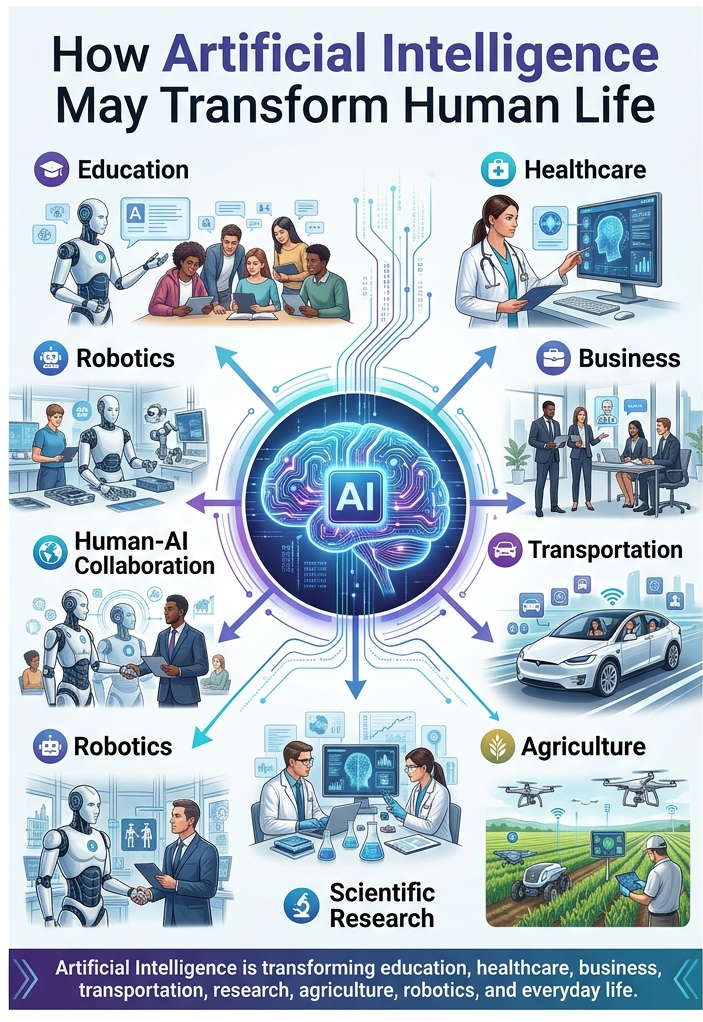
Benefits of the Future of Artificial Intelligence
Artificial intelligence has the potential to improve many aspects of human life.
Potential benefits include:
✅ Better healthcare
✅ Faster scientific discoveries
✅ Improved education
✅ Increased productivity
✅ Smarter transportation
✅ More efficient agriculture
✅ Enhanced accessibility for people with disabilities
✅ Better disaster prediction and response
🚀 Future Prediction
Future AI systems may help solve some of humanity’s most complex challenges, including disease detection, climate monitoring, and resource management.
Risks and Challenges of the Future of Artificial Intelligence
While AI offers significant opportunities, it also presents important challenges.
Potential concerns include:
⚠ Privacy issues
⚠ Job displacement
⚠ Deepfakes and misinformation
⚠ Cybersecurity threats
⚠ Algorithmic bias
⚠ Ethical concerns
Governments, researchers, and technology companies continue to work on AI safety and responsible development.
⚠ AI Challenge
The greatest challenge may not be creating more powerful AI systems but ensuring they remain safe, ethical, transparent, and beneficial for humanity.
Future of Artificial Intelligence Timeline
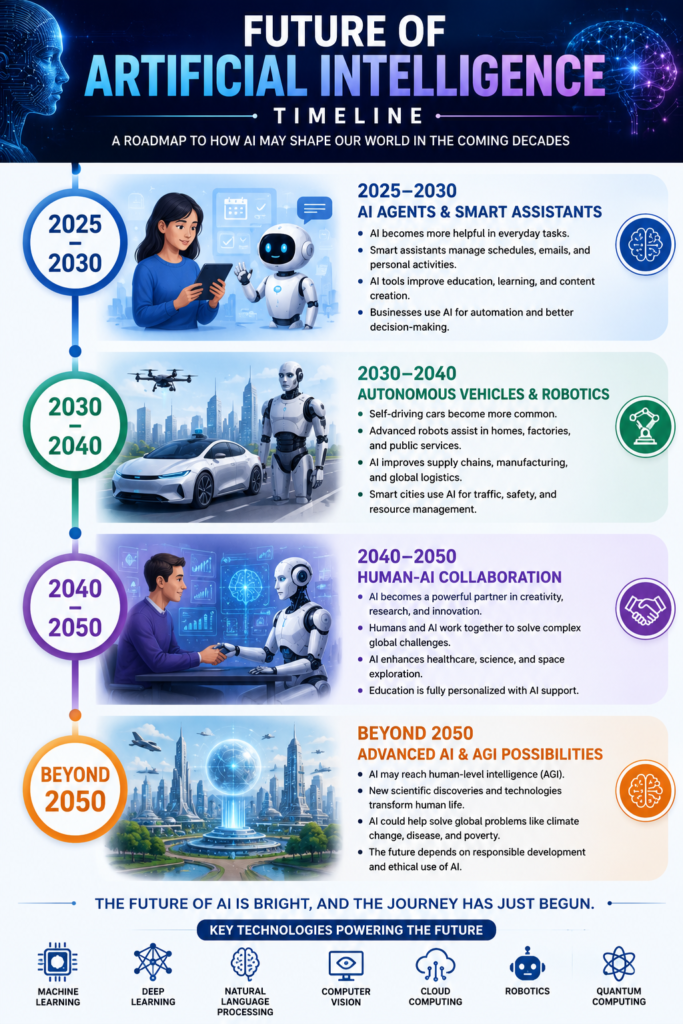
| Period | Expected Development |
|---|---|
| 2025–2030 | Wider adoption of AI assistants and AI agents |
| 2030–2040 | Growth of autonomous systems and advanced robotics |
| 2040–2050 | Greater human-AI collaboration across industries |
| Beyond 2050 | Possible emergence of highly advanced AI systems and AGI-like capabilities |
🌍 Global AI Fact
Several countries have already launched national AI strategies to strengthen education, healthcare, defense, business, and scientific research.
The Future Is Not AI Alone—It Is Human and AI Together
The future of artificial intelligence is not simply about machines becoming smarter. It is about how humans and intelligent systems work together to solve problems, create innovations, and improve quality of life.
Artificial intelligence may transform education, healthcare, transportation, business, scientific research, and everyday activities. However, human creativity, judgment, ethics, empathy, and leadership will remain essential.
The most successful individuals and organizations of the future may not be those that compete against AI, but those that learn how to use it effectively.
As artificial intelligence continues to evolve, one thing is becoming increasingly clear:
The future belongs not only to intelligent machines, but to people who know how to work alongside them.
What is the future of artificial intelligence?
The future of artificial intelligence refers to how AI technologies may evolve and influence education, healthcare, business, transportation, scientific research, and everyday life. Experts believe AI will become more capable, accessible, and integrated into daily activities over the coming decades.
Will artificial intelligence replace human jobs in the future?
Artificial intelligence is expected to automate some repetitive tasks, but it is also likely to create new careers and industries. Throughout history, technological advancements have changed the nature of work rather than eliminating the need for human skills. People who learn to work with AI may have better opportunities in the future job market.
What is Artificial General Intelligence (AGI)?
Artificial General Intelligence (AGI) refers to a hypothetical AI system capable of performing most intellectual tasks at a human level. Unlike today’s AI, which is designed for specific tasks, AGI would be able to learn, reason, adapt, and solve a wide variety of problems across different domains.
Which countries are leading artificial intelligence development?
The United States, China, the United Kingdom, Canada, Japan, South Korea, and India are among the leading countries in artificial intelligence research and innovation. These nations invest heavily in AI education, research laboratories, startups, computing infrastructure, and technological development.
How will artificial intelligence change education in the future?
Artificial intelligence may make education more personalized by adapting lessons to individual learning styles and abilities. Future AI systems could provide intelligent tutoring, automated feedback, language translation, customized study plans, and improved access to learning resources worldwide.
How is artificial intelligence helping healthcare?
Artificial intelligence is helping healthcare professionals analyze medical images, identify diseases, discover new medicines, and support clinical decision-making. In the future, AI may assist with early disease detection, personalized treatments, robotic surgeries, and advanced medical research.
What skills should students learn for an AI-powered future?
Students should focus on digital literacy, critical thinking, problem-solving, communication, creativity, data analysis, research skills, and AI literacy. Understanding how to use AI tools effectively may become as important as computer literacy is today.
Can artificial intelligence become smarter than humans?
This remains one of the most debated questions in AI research. Some experts believe future AI systems could exceed human performance in many specialized tasks, while others argue that human intelligence, creativity, consciousness, and judgment are far more complex than current AI capabilities.
What are AI Agents and why are they important?
AI Agents are advanced AI systems designed to perform tasks with minimal human supervision. They may manage schedules, conduct research, analyze information, communicate with other systems, and complete multi-step activities. Many experts consider AI Agents to be a major part of the future of artificial intelligence.
Will artificial intelligence improve human life?
Artificial intelligence has the potential to improve healthcare, education, transportation, scientific research, business productivity, and accessibility. However, its long-term impact will depend on how responsibly it is developed, regulated, and used by individuals, organizations, and governments around the world.