
Artificial Intelligence is transforming education, business, healthcare, research, and everyday life. However, AI comes with its own vocabulary that can be confusing for beginners. Terms such as Machine Learning, Neural Networks, LLMs, AGI, and Generative AI are often used without explanation.
This complete AI glossary brings together 100 essential AI terms in one place. Whether you are a student, teacher, researcher, professional, or simply curious about AI, this guide will help you understand the language of artificial intelligence in a simple and practical way.
This AI Glossary is designed to help beginners, students, teachers, professionals, and researchers understand the most important artificial intelligence terms in a simple and practical way. In this AI Glossary, you will learn 100 essential artificial intelligence terms explained with definitions, examples, history, and real-world applications.
This AI Glossary serves as a practical reference guide that readers can revisit whenever they encounter new AI concepts, tools, or technologies.
This AI Glossary is designed as a complete reference guide for anyone learning Artificial Intelligence.
Unlike a traditional dictionary, this AI Glossary explains each term with definitions, examples, history, and real-world applications.
💡 Did You Know?
The term “Artificial Intelligence” was officially introduced in 1956 at the Dartmouth Summer Research Project, an event widely considered the birthplace of modern AI.
🌍 Global AI Fact
More than 75% of organizations worldwide are experimenting with or actively using AI technologies in some form.
AI Glossary: AI Fundamentals
🤖 1. Artificial Intelligence (AI)
Definition
Artificial Intelligence (AI) is a branch of computer science that enables machines to perform tasks that normally require human intelligence, such as learning, reasoning, problem-solving, and decision-making.
Simple Explanation
AI allows computers and machines to think, learn, and perform tasks in ways that resemble human intelligence.
Example
ChatGPT answering questions, Google Maps finding the best route, and Netflix recommending movies are examples of AI in action.
Why It Matters
AI is the foundation of modern intelligent systems and is transforming industries such as healthcare, education, finance, manufacturing, and transportation.
Origin / History
- The term Artificial Intelligence was introduced by American computer scientist John McCarthy in 1956 during the Dartmouth Summer Research Project held in New Hampshire, United States.
- The conference brought together leading researchers including Marvin Minsky, Claude Shannon, and Nathan Rochester, who believed machines could simulate aspects of human intelligence.
- This event is widely regarded as the birth of modern AI research.
- John McCarthy is often called the “Father of Artificial Intelligence.”
💡 Did You Know?
The Dartmouth Conference of 1956 is widely considered the birth of modern AI research.
🚀 AI in Real Life
Virtual assistants, recommendation systems, self-driving vehicles, and medical diagnostic tools all rely on AI.
🧠 2. Machine Learning (ML)
Definition
Machine Learning is a subset of AI that allows computers to learn from data and improve their performance without being explicitly programmed.
Simple Explanation
Instead of following fixed instructions, a machine learns patterns from data and becomes better over time.
Example
Email spam filters learn which messages are spam based on previous examples.
Why It Matters
Machine Learning powers many modern AI applications, including recommendation systems, fraud detection, and language translation.
Origin / History
- Machine Learning gained recognition through the work of American researcher Arthur Samuel at IBM in 1959.
- Samuel developed a self-learning checkers program that improved through experience rather than relying solely on fixed instructions.
- His pioneering work helped establish Machine Learning as a distinct branch of Artificial Intelligence.
- Arthur Samuel is widely recognized as one of the “Pioneers of Machine Learning.”
🧠 Research Insight
Arthur Samuel’s checkers-playing program is considered one of the earliest examples of machine learning.
🚀 AI in Real Life
Amazon product recommendations and YouTube video suggestions are powered by Machine Learning.
⚡ 3. Deep Learning
Definition
Deep Learning is a specialized area of Machine Learning that uses multi-layered neural networks to learn complex patterns from large amounts of data.
Simple Explanation
Deep Learning teaches computers to learn in a way that resembles how the human brain processes information.
Example
Facial recognition systems and voice assistants use Deep Learning models.
Why It Matters
Deep Learning has enabled major breakthroughs in image recognition, speech recognition, and generative AI.
Origin / History
- The foundations of Deep Learning can be traced back to neural network research conducted during the 1940s in the United States.
- The field gained worldwide attention through the work of Geoffrey Hinton, a British-Canadian computer scientist whose research helped revive interest in deep neural networks.
- Hinton’s work at the University of Toronto (Canada) played a major role in advancing modern Deep Learning.
- Geoffrey Hinton is widely known as the “Godfather of Deep Learning.” The success of the ImageNet Challenge (2012) accelerated the Deep Learning revolution.
💡 Did You Know?
The deep learning revolution accelerated dramatically after the success of the ImageNet competition in 2012.
🚀 AI in Real Life
ChatGPT, image generators, and voice assistants all depend heavily on Deep Learning.
🔗 4. Neural Network
Definition
A Neural Network is a computing system inspired by the structure and functioning of the human brain.
Simple Explanation
It consists of interconnected nodes (artificial neurons) that process and learn information.
Example
Image recognition systems use neural networks to identify objects in photographs.
Why It Matters
Neural Networks are the core technology behind modern AI systems.
Origin / History
- The first mathematical model of an artificial neural network was proposed in 1943 by Warren McCulloch and Walter Pitts in the United States.
- Their research attempted to mimic the behavior of biological neurons found in the human brain.
- This pioneering work laid the foundation for modern neural networks and Deep Learning systems.
- Today, Neural Networks power technologies such as ChatGPT, image generation, speech recognition, and computer vision.
🧠 Research Insight
Modern AI breakthroughs would not be possible without advances in neural network architectures.
🚀 AI in Real Life
Speech recognition, translation tools, and AI image generation rely on neural networks.
🎯 5. Algorithm
Definition
An algorithm is a set of rules or instructions used to solve a problem or perform a task.
Simple Explanation
An algorithm is like a recipe that tells a computer exactly what steps to follow.
Example
A search engine algorithm determines which results appear first.
Why It Matters
Algorithms are the foundation of all computer programs and AI systems.
Origin / History
- The word “Algorithm” comes from the name of Muhammad ibn Musa al-Khwarizmi, a Persian mathematician and scholar who lived during the ninth century.
- Al-Khwarizmi worked at the House of Wisdom in Baghdad, one of the most important centers of learning in the medieval Islamic world.
- His mathematical writings introduced systematic problem-solving methods that later influenced algebra, calculation, and computer science.
- Because of his contributions, Al-Khwarizmi is regarded as one of the founding figures of algorithmic thinking.
💡 Did You Know?
The word “algorithm” comes from the Latinized name of Al-Khwarizmi.
🚀 AI in Real Life
Algorithms help social media platforms recommend content and organize information.
📚 6. Training Data
Definition
Training Data is the collection of examples used to teach an AI model how to perform a specific task.
Simple Explanation
Just as students learn from books and practice exercises, AI systems learn from training data. The better the training data, the better the AI model performs.
Example
Thousands of images of cats and dogs can be used to train an AI model to recognize different animals.
Why It Matters
Training data is one of the most important components of any AI system. Poor-quality training data often leads to poor AI performance.
Origin / History
- The concept of Training Data emerged from early Machine Learning and pattern recognition research conducted during the 1950s and 1960s.
- Researchers in the United States and Europe discovered that AI systems learn more effectively when provided with large amounts of high-quality examples.
- The importance of training data increased dramatically with the rise of Big Data and Deep Learning during the 2000s.
- Today, training data is considered one of the most valuable resources in AI development.
💡 Did You Know?
Many leading AI models are trained on billions of data points collected from books, websites, images, and other sources.
🚀 AI in Real Life
Training data helps power facial recognition systems, recommendation engines, language models, and autonomous vehicles.
🗂️ 7. Dataset
Definition
A Dataset is a structured collection of data used to train, test, or evaluate AI models.
Simple Explanation
A dataset is like a digital library that stores information for AI systems to learn from.
Example
The ImageNet dataset contains millions of labeled images that researchers use to train computer vision systems.
Why It Matters
Without datasets, AI systems would have no information to learn from.
Origin / History
- Datasets have been used in scientific research and statistics for more than a century, but their importance increased significantly with the growth of Artificial Intelligence.
- A major breakthrough came with the release of ImageNet by researchers at Stanford University (United States) in 2009.
- ImageNet provided millions of labeled images for training AI systems and became one of the most influential datasets in AI history.
- The project played a crucial role in accelerating modern Computer Vision and Deep Learning research.
💡 Did You Know?
ImageNet played a major role in the deep learning revolution and contains millions of categorized images.
🧠 Research Insight
Many AI breakthroughs were achieved because researchers gained access to larger and better-quality datasets.
🚀 AI in Real Life
Datasets are used to train chatbots, recommendation systems, translation tools, and healthcare AI applications.
🤖 8. Model
Definition
An AI Model is a trained system that has learned patterns from data and can make predictions, decisions, or generate content.
Simple Explanation
A model is the final product created after an AI system learns from training data.
Example
ChatGPT is built on a large language model that has been trained on vast amounts of text data.
Why It Matters
The model is the component that actually performs useful tasks for users.
Origin / History
- The concept of a model originated in mathematics and statistics, where researchers used mathematical representations to describe real-world phenomena.
- During the late twentieth century, computer scientists adapted these ideas for Machine Learning and Artificial Intelligence.
- Advances in computing power enabled researchers to create increasingly complex AI models capable of learning from massive datasets.
- Modern AI models can contain billions or even trillions of parameters, powering systems such as ChatGPT and other Large Language Models.
🧠 Research Insight
Large Language Models (LLMs) are among the most advanced AI models ever created.
🚀 AI in Real Life
AI models power search engines, virtual assistants, recommendation systems, and content generation tools.
⚡ 9. Inference
Definition
Inference is the process of using a trained AI model to make predictions or generate outputs from new data.
Simple Explanation
Inference occurs when AI applies what it has already learned to answer questions or perform tasks.
Example
When ChatGPT responds to a question, it is performing inference.
Why It Matters
Inference is the stage where users actually experience the benefits of AI.
Origin / History
- The term Inference has its roots in logic and statistics, disciplines that have been studied for centuries across Europe and North America.
- Machine Learning researchers adopted the term to describe the process of applying a trained model to new data.
- As AI systems became more widespread, inference became a critical part of real-world AI deployment.
- Today, billions of AI inference operations occur daily across search engines, recommendation systems, chatbots, and mobile applications.
💡 Did You Know?
Most AI applications spend far more time performing inference than training.
🚀 AI in Real Life
Every AI recommendation, translation, voice command, and chatbot response involves inference.
🔄 10. Automation
Definition
Automation is the use of technology to perform tasks with little or no human intervention.
Simple Explanation
Automation allows machines and software to complete repetitive work automatically.
Example
Email filtering, customer support chatbots, and invoice processing systems are common examples of automation.
Why It Matters
Automation saves time, reduces errors, improves productivity, and lowers operational costs.
Origin / History
- The origins of Automation can be traced to the Industrial Revolution in Europe during the eighteenth and nineteenth centuries.
- The concept expanded significantly during the twentieth century with the rise of computers and industrial control systems.
- Organizations in countries such as the United States, Germany, and Japan played a major role in advancing automation technologies.
- In the twenty-first century, Artificial Intelligence has transformed automation by enabling machines to learn, adapt, and make decisions with minimal human intervention.
💡 Did You Know?
AI-powered automation is one of the fastest-growing technology sectors in the world.
🚀 AI in Real Life
Businesses use AI automation for customer service, marketing, logistics, cybersecurity, and data analysis.
AI Glossary: Machine Learning Concepts
🎓 11. Supervised Learning
Definition
Supervised Learning is a machine learning approach in which an AI model learns from labeled data containing both inputs and correct outputs.
Simple Explanation
The AI learns from examples where the correct answer is already known.
Example
An email spam filter learns from emails that have already been marked as “spam” or “not spam.”
Why It Matters
Supervised Learning is one of the most widely used machine learning techniques and powers many AI applications.
Origin / History
- The foundations of Supervised Learning emerged from statistical modeling and pattern recognition research conducted primarily in the United States during the mid-twentieth century.
- Important contributions came from researchers working at institutions such as Bell Labs, Stanford University, and MIT.
- The approach became widely adopted during the 1980s and 1990s as larger digital datasets became available.
- Today, Supervised Learning is one of the most widely used Machine Learning techniques in the world.
💡 Did You Know?
Most commercial AI systems rely heavily on supervised learning.
🚀 AI in Real Life
Fraud detection, medical diagnosis, and image classification often use supervised learning.
🔍 12. Unsupervised Learning
Definition
Unsupervised Learning is a machine learning technique where AI learns patterns from unlabeled data without predefined answers.
Simple Explanation
The AI explores data on its own and discovers hidden relationships or groups.
Example
An online store grouping customers based on purchasing behavior.
Why It Matters
It helps organizations discover insights that humans may overlook.
Origin / History
- Unsupervised Learning evolved from research in statistics, clustering, and pattern recognition during the twentieth century.
- Scientists sought methods that could discover hidden structures in data without requiring predefined answers.
- Significant advances were made in research centers across the United States, Europe, and Japan.
- The growth of Big Data during the 2000s greatly increased the importance of Unsupervised Learning.
🧠 Research Insight
Clustering is one of the most common unsupervised learning techniques.
🚀 AI in Real Life
Customer segmentation, recommendation systems, and market analysis use unsupervised learning.
🎮 13. Reinforcement Learning
Definition
Reinforcement Learning is a machine learning method in which an AI agent learns through rewards and penalties.
Simple Explanation
The AI learns by trial and error, improving its actions based on feedback.
Example
An AI learning to play chess by winning or losing games.
Why It Matters
It enables AI systems to make decisions in complex environments.
Origin / History
- Reinforcement Learning was inspired by behavioral psychology, particularly studies on reward-based learning conducted during the twentieth century.
- Major theoretical contributions were made by Richard Sutton and Andrew Barto, who are considered pioneers of Reinforcement Learning.
- Their influential book, Reinforcement Learning: An Introduction (1998), helped establish the field.
- Reinforcement Learning gained worldwide attention after DeepMind (United Kingdom) developed AlphaGo, which defeated world champion Lee Sedol in 2016.
💡 Did You Know?
AlphaGo’s historic victory over world champion Lee Sedol in 2016 used reinforcement learning techniques.
🚀 AI in Real Life
Robotics, self-driving vehicles, and game-playing AI rely on reinforcement learning.
Reinforcement Learning is expected to play a major role in the Future of Artificial Intelligence, especially in autonomous systems and intelligent AI agents.
📊 14. Classification
Definition
Classification is a machine learning task that assigns data into predefined categories.
Simple Explanation
The AI decides which group something belongs to.
Example
Determining whether an email is spam or not spam.
Why It Matters
Classification is essential for prediction, detection, and decision-making systems.
Origin / History
- Classification techniques originated from statistics and decision theory research conducted during the nineteenth and twentieth centuries.
- Early developments came from mathematicians and statisticians working in Europe and North America.
- As computers became more powerful, classification methods evolved into a core component of Machine Learning.
- Today, classification is widely used in healthcare, finance, cybersecurity, and Artificial Intelligence applications.
🚀 AI in Real Life
Medical diagnosis systems classify diseases based on symptoms and test results.
📈 15. Regression
Definition
Regression is a machine learning technique used to predict numerical values.
Simple Explanation
Instead of choosing a category, the AI predicts a number.
Example
Predicting future house prices based on historical market data.
Why It Matters
Regression helps businesses forecast trends and make informed decisions.
Origin / History
- Regression analysis was introduced by British scientist Sir Francis Galton during the late nineteenth century.
- His research on heredity and population studies led to the concept known as Regression Toward the Mean.
- Later, statisticians expanded regression techniques into powerful predictive tools.
- Regression remains one of the foundational methods of modern statistics and Machine Learning.
🧠 Research Insight
Linear Regression remains one of the most widely taught machine learning algorithms.
🚀 AI in Real Life
Weather forecasting, stock market analysis, and sales prediction often use regression models.
🧩 16. Feature
Definition
A Feature is an individual measurable property or characteristic used by an AI model.
Simple Explanation
Features are pieces of information that help AI make decisions.
Example
In a house-price prediction model, features may include size, location, and number of rooms.
Why It Matters
The quality of features strongly influences AI performance.
Origin / History
- The concept of Features emerged from early research in statistics, pattern recognition, and Machine Learning.
- Researchers discovered that selecting the right characteristics from data significantly improved prediction accuracy.
- Feature engineering became a major discipline during the 1980s and 1990s as Machine Learning systems became more sophisticated.
- Although Deep Learning automates many feature-selection tasks today, features remain a fundamental part of AI development.
🚀 AI in Real Life
Banks use customer features such as income and credit history to assess risk.
🏷️ 17. Label
Definition
A Label is the correct answer or outcome associated with a training example.
Simple Explanation
Labels tell AI what the right answer should be.
Example
An image labeled as “cat” helps AI learn cat recognition.
Why It Matters
Labels are essential for supervised learning systems.
Origin / History
- Data labeling became important as researchers developed Supervised Learning systems that required known answers during training.
- Early labeling efforts were performed manually by researchers and domain experts.
- The rise of large AI datasets during the 2000s and 2010s created a global data-labeling industry.
- Today, millions of labeled examples are used to train modern AI systems across healthcare, finance, education, and technology.
💡 Did You Know?
Large AI projects often require millions of labeled examples.
🚀 AI in Real Life
Data labeling supports image recognition, speech recognition, and chatbot training.
Many of the tools discussed in our Best AI Research Tools in 2026 guide depend on highly accurate AI models to deliver reliable results.
🎯 18. Accuracy
Definition
Accuracy measures how often an AI model produces correct results.
Simple Explanation
It shows how successful the AI is at making predictions.
Example
If an AI correctly identifies 95 out of 100 images, its accuracy is 95%.
Why It Matters
Accuracy is one of the most important metrics used to evaluate AI performance.
Origin / History
- Accuracy has long been used in statistics, scientific research, and data analysis to evaluate performance.
- Machine Learning researchers adopted accuracy as one of the primary metrics for measuring AI effectiveness.
- As AI systems became more complex, researchers developed additional evaluation metrics to complement accuracy.
- Despite these advances, accuracy remains one of the most widely recognized AI performance indicators.
🧠 Research Insight
High accuracy alone does not always mean an AI system is reliable or fair.
🚀 AI in Real Life
Accuracy is used to evaluate medical AI systems, fraud detection tools, and recommendation engines.
⚖️ 19. Bias
Definition
Bias refers to systematic errors or unfair preferences in AI systems.
Simple Explanation
Bias occurs when AI consistently favors certain outcomes or groups over others.
Example
A hiring AI trained on biased historical data may unfairly favor specific candidates.
Why It Matters
Bias can lead to unfair, inaccurate, or discriminatory decisions.
Origin / History
- The concept of Bias has existed in statistics and social sciences for many decades.
- AI Bias became a major research topic during the 2010s as Artificial Intelligence systems began influencing hiring, finance, healthcare, and law enforcement.
- Researchers from organizations such as Google, Microsoft, MIT, and Stanford University highlighted the risks of biased training data.
- Reducing bias is now considered one of the most important goals of Responsible AI development.
💡 Did You Know?
Reducing bias is one of the biggest challenges in responsible AI development.
🚀 AI in Real Life
Governments and organizations increasingly audit AI systems for bias and fairness.
If you are new to this topic, our What Is Artificial Intelligence? guide explains why fairness and bias have become important concerns in modern AI systems.
📉 20. Overfitting
Definition
Overfitting occurs when an AI model learns training data too well and performs poorly on new data.
Simple Explanation
The AI memorizes instead of truly learning.
Example
A student memorizing answers for one exam but failing to understand the subject.
Why It Matters
Overfitting reduces an AI model’s ability to perform effectively in real-world situations.
Origin / History
- Overfitting was identified as a challenge during the early development of Machine Learning and statistical modeling.
- Researchers observed that some models performed exceptionally well on training data but failed when exposed to new information.
- The problem became more significant as AI models grew larger and more complex.
- Modern techniques such as Regularization, Cross-Validation, and Dropout are widely used to reduce overfitting and improve generalization.
🧠 Research Insight
Techniques such as regularization and cross-validation help reduce overfitting.
🚀 AI in Real Life
Preventing overfitting is essential when building healthcare, finance, and autonomous driving systems.
🔗 Related Guide
If you want to understand how AI systems learn from prompts and instructions, explore our AI Prompt Engineering Guide.
AI Glossary: NLP & Language Models
💬 21. Natural Language Processing (NLP)
Definition
Natural Language Processing (NLP) is a branch of AI that enables computers to understand, interpret, and generate human language.
Simple Explanation
NLP helps machines communicate with people using natural languages such as English, Hindi, Spanish, or Chinese.
Example
ChatGPT, Google Translate, and virtual assistants use NLP to understand user input.
Why It Matters
NLP makes human-computer interaction easier and more natural.
Origin / History
- Natural Language Processing research began during the 1950s in the United States, when scientists started exploring how computers could understand human language.
- Important contributions came from researchers at institutions such as MIT, Stanford University, and Carnegie Mellon University.
- Early work focused on machine translation, particularly between English and Russian during the Cold War era.
- NLP became one of the fastest-growing areas of Artificial Intelligence with the rise of Machine Learning and Large Language Models.
💡 Did You Know?
The famous Turing Test, proposed in 1950, inspired many early NLP research projects.
🚀 AI in Real Life
Voice assistants, translation tools, chatbots, and email filters use NLP technology.
🤖 22. Large Language Model (LLM)
Definition
A Large Language Model (LLM) is an AI model trained on enormous amounts of text data to understand and generate human language.
Simple Explanation
LLMs learn language patterns from books, articles, websites, and conversations.
Example
ChatGPT, Claude, Gemini, and other advanced AI assistants are based on LLM technology.
Why It Matters
LLMs have revolutionized content creation, research, education, and customer support.
Origin / History
- The foundations of Large Language Models were established through advances in Natural Language Processing, Deep Learning, and Neural Networks.
- A major breakthrough came in 2017 when researchers at Google (United States) introduced the Transformer architecture in the paper Attention Is All You Need.
- This innovation enabled AI systems to process language more efficiently and accurately.
- Modern LLMs such as ChatGPT, Claude, and Gemini are built upon the Transformer architecture.
🧠 Research Insight
Modern LLMs contain billions or even trillions of parameters.
🚀 AI in Real Life
LLMs help users write emails, summarize documents, answer questions, and generate content.
📝 23. Prompt
Definition
A Prompt is the instruction, question, or input provided to an AI system.
Simple Explanation
A prompt tells the AI what you want it to do.
Example
“Write a blog post about Artificial Intelligence.”
Why It Matters
The quality of a prompt often determines the quality of the AI’s response.
Origin / History
- The concept of prompts has existed in computing for decades as a way for users to communicate with software systems.
- Prompting became especially important with the rise of Generative AI and Large Language Models during the early 2020s.
- Researchers discovered that carefully written prompts could significantly improve AI-generated results.
- Today, prompting is considered one of the most important skills for effectively using AI systems.
🚀 AI in Real Life
People use prompts to generate text, images, videos, code, and research summaries.
🔗 Related Guide
Learn advanced prompting techniques in our AI Prompt Engineering Guide.
🎯 24. Prompt Engineering
Definition
Prompt Engineering is the practice of designing effective prompts to achieve better AI outputs.
Simple Explanation
It involves learning how to communicate clearly with AI systems.
Example
Adding detailed instructions often improves AI-generated content.
Why It Matters
Prompt engineering can significantly improve accuracy and usefulness.
Origin / History
- Prompt Engineering emerged as a specialized discipline during the rapid growth of Generative AI in the 2020s.
- Researchers and AI practitioners found that the structure and wording of prompts could dramatically affect output quality.
- Companies such as OpenAI, Google, Anthropic, and Microsoft contributed to the development of prompt-engineering best practices.
- Prompt Engineering is now recognized as an important skill in content creation, software development, research, and business automation.
💡 Did You Know?
Prompt engineering has become a valuable professional skill in many industries.
🚀 AI in Real Life
Businesses use prompt engineering to improve customer support, marketing, and content creation.
🔠 25. Token
Definition
A Token is a unit of text processed by an AI model.
Simple Explanation
Tokens can be words, parts of words, characters, or symbols.
Example
The sentence “AI is amazing” may be divided into multiple tokens before processing.
Why It Matters
AI systems process tokens rather than complete sentences.
Origin / History
- The concept of tokenization originated in linguistics and computer science long before modern Artificial Intelligence.
- Researchers developed tokenization techniques to break language into smaller units that computers could process efficiently.
- The importance of tokens increased significantly with the development of Transformer-based language models.
- Today, tokens serve as the fundamental building blocks used by Large Language Models to understand and generate text.
🧠 Research Insight
Token limits influence how much information an AI model can process at one time.
🚀 AI in Real Life
Every interaction with ChatGPT or other AI assistants involves token processing.
📖 26. Context Window
Definition
A Context Window is the amount of information an AI model can remember and process during a conversation or task.
Simple Explanation
It is the AI’s temporary working memory while responding to users.
Example
If a chatbot can remember the previous 100 pages of conversation, those pages are within its context window.
Why It Matters
A larger context window allows AI systems to understand longer documents, conversations, and complex instructions.
Origin / History
- The idea of a Context Window emerged from research into memory and information processing in Artificial Intelligence systems.
- Early language models could only process limited amounts of information at one time due to computational constraints.
- Advances in Transformer architectures during the 2010s and 2020s dramatically increased context-window capacity.
- Modern AI models can process hundreds of thousands of tokens, enabling analysis of lengthy conversations and documents.
💡 Did You Know?
Some modern AI models can analyze entire books or lengthy reports within a single context window.
🚀 AI in Real Life
Researchers, students, and businesses use large-context AI models to analyze long documents efficiently.
⚙️ 27. Fine-Tuning
Definition
Fine-Tuning is the process of further training a pre-trained AI model on specialized data to improve its performance for specific tasks.
Simple Explanation
Instead of building a model from scratch, developers teach an existing model additional skills.
Example
A general AI model can be fine-tuned using medical data to become better at healthcare-related tasks.
Why It Matters
Fine-tuning helps organizations create customized AI solutions more efficiently.
Origin / History
- Fine-Tuning evolved from the concept of Transfer Learning, which became popular in Machine Learning research during the late twentieth century.
- Researchers discovered that pre-trained models could be adapted to specialized tasks using smaller datasets.
- This approach reduced training costs and improved efficiency across many AI applications.
- Fine-Tuning is now widely used in healthcare, finance, education, cybersecurity, and enterprise AI systems.
🧠 Research Insight
Fine-tuning often requires significantly less data and computing power than training a model from scratch.
🚀 AI in Real Life
Banks, hospitals, and businesses use fine-tuned AI models for industry-specific applications.
⚠️ 28. Hallucination
Definition
Hallucination occurs when an AI system generates information that appears correct but is actually false or misleading.
Simple Explanation
The AI sounds confident but provides an incorrect answer.
Example
A chatbot inventing a book title, research paper, or historical event that does not exist.
Why It Matters
Hallucinations can reduce trust and lead to misinformation if outputs are not verified.
Origin / History
- The term Hallucination became widely used during the rise of Generative AI and Large Language Models in the 2020s.
- Researchers observed that AI systems could sometimes generate convincing but incorrect information.
- Organizations such as OpenAI, Google DeepMind, Anthropic, and Microsoft actively study methods to reduce hallucinations.
- AI hallucination remains one of the most important challenges in trustworthy and reliable AI development.
💡 Did You Know?
Even advanced AI systems can occasionally hallucinate facts, dates, or references.
🚀 AI in Real Life
Professionals often verify AI-generated content before using it in reports, research, or business decisions.
💬 29. Chatbot
Definition
A Chatbot is an AI-powered software application that interacts with users through text or voice conversations.
Simple Explanation
A chatbot is a digital assistant designed to answer questions and perform tasks.
Example
ChatGPT, customer support bots, and virtual banking assistants are examples of chatbots.
Why It Matters
Chatbots improve accessibility, customer service, and productivity.
Origin / History
- One of the earliest chatbots, ELIZA, was developed in 1966 by Joseph Weizenbaum at MIT (United States).
- ELIZA simulated conversation using simple pattern-matching techniques and demonstrated how humans could interact with machines through language.
- Chatbot technology advanced significantly with the development of NLP, Machine Learning, and Large Language Models.
- Modern AI chatbots can understand context, generate detailed responses, and perform complex tasks.
🧠 Research Insight
The evolution from rule-based chatbots to AI-powered chatbots represents one of the biggest advances in human-computer interaction.
🚀 AI in Real Life
Organizations use chatbots for customer support, education, healthcare, and e-commerce.
🔗 Related Guide
Explore our Best AI Chatbots in 2026 guide to discover the most popular AI chatbots available today.
🤝 30. Conversational AI
Definition
Conversational AI refers to technologies that enable machines to engage in natural, human-like conversations.
Simple Explanation
It combines AI, NLP, machine learning, and speech technologies to communicate effectively with users.
Example
Voice assistants such as Siri, Alexa, and Google Assistant use conversational AI.
Why It Matters
Conversational AI makes technology easier and more accessible for people of all skill levels.
Origin / History
- Conversational AI evolved through decades of research in Natural Language Processing, speech recognition, and Machine Learning.
- Major contributions came from technology companies such as IBM, Google, Microsoft, Amazon, and OpenAI.
- The emergence of Large Language Models dramatically improved the ability of AI systems to hold natural conversations.
- Today, Conversational AI powers virtual assistants, customer support platforms, educational tools, and enterprise applications worldwide.
💡 Did You Know?
Millions of customer service interactions worldwide are now handled by conversational AI systems every day.
🚀 AI in Real Life
Conversational AI is used in banking, healthcare, travel, education, and customer support.
🔗 Related Guide
Many of the tools featured in our Best AI Tools in 2026 guide use conversational AI to improve user experiences.
AI Glossary: Generative AI Terms
🎨 31. Generative AI
Definition
Generative AI is a type of artificial intelligence that can create new content such as text, images, videos, music, and code.
Simple Explanation
Instead of only analyzing information, Generative AI can generate entirely new content based on what it has learned.
Example
ChatGPT writing an article, Midjourney creating artwork, or AI generating videos from text prompts.
Why It Matters
Generative AI is transforming content creation, education, marketing, entertainment, and software development.
Origin / History
- The foundations of Generative AI emerged from advances in Machine Learning, Neural Networks, and Deep Learning research during the late twentieth century.
- Major breakthroughs occurred through the development of technologies such as GANs (2014) and Transformer models (2017).
- The field gained global attention after the public release of ChatGPT by OpenAI in 2022.
- Today, Generative AI can create text, images, videos, music, code, and other forms of digital content.
💡 Did You Know?
Generative AI can create text, images, music, videos, computer code, and even 3D models.
🚀 AI in Real Life
Businesses use Generative AI for content creation, customer support, advertising, and product design.
🖼️ 32. Text-to-Image
Definition
Text-to-Image technology converts written descriptions into AI-generated images.
Simple Explanation
Users simply describe an image in words, and AI creates the visual artwork.
Example
Typing “A futuristic city at sunset with flying cars” into an AI image generator.
Why It Matters
It allows anyone to create professional-quality images without advanced design skills.
Origin / History
- Text-to-Image technology evolved from research in Computer Vision, Deep Learning, and image generation.
- Major advances came from organizations such as OpenAI, Google, Stability AI, and Midjourney during the early 2020s.
- Diffusion-based models dramatically improved image quality and realism.
- Text-to-Image systems have transformed digital art, marketing, education, and content creation.
🧠 Research Insight
Modern text-to-image systems can generate highly realistic images within seconds.
🚀 AI in Real Life
Graphic designers, marketers, educators, and content creators use text-to-image tools daily.
🔗 Related Guide
Learn more in our Best AI Image Generators in 2026 article.
🎥 33. Text-to-Video
Definition
Text-to-Video AI generates videos from written descriptions.
Simple Explanation
Users describe a scene, and AI creates a video based on those instructions.
Example
Creating a short promotional video by entering a text prompt.
Why It Matters
It significantly reduces video production time and costs.
Origin / History
- Text-to-Video technology emerged from the combination of Computer Vision, Generative AI, and video-processing research.
- Significant progress was made by companies such as OpenAI, Google DeepMind, Runway, and Meta.
- Advances in generative models during the 2020s enabled AI to create realistic video sequences from text descriptions.
- Text-to-Video AI is rapidly transforming filmmaking, advertising, training, and social media content production.
💡 Did You Know?
Some modern AI video tools can create realistic video clips from a single sentence.
🚀 AI in Real Life
Businesses use text-to-video AI for marketing, training, and social media content.
🔗 Related Guide
Explore our Best AI Video Generators in 2026 guide.
🌌 34. Diffusion Model
Definition
A Diffusion Model is an AI system that creates content by gradually removing noise from random data until a meaningful output appears.
Simple Explanation
The AI starts with random noise and slowly transforms it into an image or other content.
Example
Many AI image generators use diffusion models to create realistic artwork.
Why It Matters
Diffusion models are responsible for many of today’s most impressive AI-generated images.
Origin / History
- Diffusion Models originated from academic research into probabilistic modeling and generative processes.
- Important breakthroughs were achieved by researchers at institutions including Stanford University, UC Berkeley, and major AI laboratories.
- The technology became widely known after powering image-generation systems such as Stable Diffusion and DALL·E.
- Diffusion Models are now considered one of the most important advances in modern Generative AI.
🧠 Research Insight
Diffusion models currently power many leading AI image-generation platforms.
🚀 AI in Real Life
Artists, marketers, and businesses use diffusion-powered tools to generate creative content.
👥 35. GAN (Generative Adversarial Network)
Definition
A GAN is an AI architecture where two neural networks compete against each other to generate realistic content.
Simple Explanation
One AI creates content while another AI tries to detect mistakes. Through competition, both improve.
Example
Generating realistic human faces that do not actually exist.
Why It Matters
GANs played a major role in advancing AI-generated media.
Origin / History
- GANs were introduced in 2014 by Ian Goodfellow and his colleagues while conducting research at the University of Montreal, Canada.
- The architecture uses two competing neural networks that continuously improve through adversarial training.
- GANs revolutionized AI-generated images and synthetic media by producing highly realistic outputs.
- Ian Goodfellow is widely recognized as the inventor of Generative Adversarial Networks (GANs).
💡 Did You Know?
Many AI-generated faces online are created using GAN technology.
🚀 AI in Real Life
GANs are used in image enhancement, art generation, medical imaging, and entertainment.
🎭 36. AI Art
Definition
AI Art refers to artwork created or enhanced using artificial intelligence systems.
Simple Explanation
AI helps generate paintings, illustrations, digital art, and creative designs.
Example
Creating fantasy artwork using an AI image generator.
Why It Matters
AI Art makes creative tools accessible to people without formal artistic training.
Origin / History
- Experiments in AI-generated art began decades ago, but significant progress occurred with advances in Deep Learning and Generative AI.
- Researchers and artists in the United States, Europe, Japan, and Canada contributed to the development of AI-assisted creativity.
- The emergence of image-generation systems such as Midjourney, DALL·E, and Stable Diffusion accelerated public adoption.
- AI Art has sparked global discussions about creativity, ownership, copyright, and the future of artistic expression.
🧠 Research Insight
AI Art continues to raise important discussions about creativity, ownership, and copyright.
🚀 AI in Real Life
Businesses use AI-generated artwork for advertising, branding, and content creation.
🧑💻 37. AI Avatar
Definition
An AI Avatar is a digital human representation generated or controlled using artificial intelligence.
Simple Explanation
AI avatars can speak, present information, and interact with users.
Example
Virtual presenters used in training videos and online education.
Why It Matters
AI avatars improve communication and content delivery.
Origin / History
- AI Avatars evolved from research in computer graphics, facial animation, speech synthesis, and Artificial Intelligence.
- Major developments were driven by technology companies in the United States, South Korea, Japan, and China.
- Advances in Generative AI enabled avatars to mimic realistic facial expressions, gestures, and speech patterns.
- AI Avatars are increasingly used in education, customer support, marketing, and virtual presentations.
💡 Did You Know?
Some AI avatars can mimic facial expressions and voice patterns in real time.
🚀 AI in Real Life
Companies use AI avatars for customer support, training, and marketing campaigns.
🎬 38. Synthetic Media
Definition
Synthetic Media refers to digital content that is partially or entirely generated by artificial intelligence.
Simple Explanation
AI creates media instead of humans producing it manually.
Example
AI-generated videos, images, voices, and virtual characters.
Why It Matters
Synthetic media is reshaping entertainment, education, advertising, and communication.
Origin / History
- Synthetic Media emerged through advances in Generative AI, Deep Learning, and digital content creation technologies.
- The field expanded rapidly after the development of GANs and diffusion-based models.
- Researchers and technology companies worldwide contributed to making AI-generated content more realistic and accessible.
- Synthetic Media now includes AI-generated images, videos, voices, virtual humans, and interactive digital experiences.
🧠 Research Insight
Synthetic media technologies continue to improve in realism and quality every year.
🚀 AI in Real Life
Organizations use synthetic media for training simulations, virtual influencers, and content creation.
🌐 39. Multimodal AI
Definition
Multimodal AI can understand and generate multiple forms of information such as text, images, audio, and video.
Simple Explanation
Instead of working with only text or images, the AI can process several types of data simultaneously.
Example
An AI that can analyze an image and answer questions about it.
Why It Matters
Multimodal AI enables more natural and powerful human-computer interaction.
Origin / History
- Multimodal AI developed from efforts to combine multiple forms of information such as text, images, audio, and video.
- Researchers at organizations including Google, OpenAI, DeepMind, and Meta played major roles in advancing multimodal systems.
- Breakthroughs during the 2020s enabled AI models to process and generate different types of content simultaneously.
- Multimodal AI is considered a major step toward more human-like Artificial Intelligence.
💡 Did You Know?
Many next-generation AI assistants are built as multimodal systems.
🚀 AI in Real Life
Multimodal AI supports healthcare diagnostics, education, customer support, and accessibility tools.
🚀 40. Creativity AI
Definition
Creativity AI refers to artificial intelligence systems designed to assist or enhance creative processes.
Simple Explanation
AI helps people generate ideas, designs, stories, music, and artwork.
Example
Using AI to brainstorm marketing slogans or create original illustrations.
Why It Matters
Creativity AI expands human creativity and speeds up creative workflows.
Origin / History
- Creativity AI emerged from research exploring how Artificial Intelligence could assist human creativity rather than simply automate tasks.
- Advances in Generative AI enabled systems to create artwork, music, stories, designs, and marketing content.
- Researchers from universities and technology companies worldwide continue studying AI-assisted creativity.
- Today, Creativity AI is viewed as a powerful collaboration tool that enhances innovation across creative industries.
🧠 Research Insight
Researchers increasingly view AI as a creative collaborator rather than a replacement for human creativity.
🚀 AI in Real Life
Writers, designers, musicians, educators, and marketers use Creativity AI to improve productivity and innovation.
🔗 Related Guide
Many Creativity AI tools are featured in our Best AI Tools for Content Creators in 2026 guide.
AI Glossary: Computer Vision Terms
👁️ 41. Computer Vision
Definition
Computer Vision is a branch of AI that enables machines to interpret, analyze, and understand visual information from images and videos.
Simple Explanation
Computer Vision allows computers to “see” and understand what is happening in pictures and videos.
Example
A smartphone identifying faces in photos uses computer vision technology.
Why It Matters
It helps machines perform tasks that traditionally required human eyesight and interpretation.
Origin / History
- Computer Vision research began in the United States during the 1960s, when scientists started exploring how computers could interpret visual information.
- Important contributions came from Larry Roberts, who is widely regarded as one of the pioneers of Computer Vision.
- Early research was conducted at institutions such as MIT and other leading American universities.
- Breakthroughs in Deep Learning, particularly after the ImageNet Challenge (2012), dramatically improved Computer Vision accuracy and real-world applications.
💡 Did You Know?
Modern computer vision systems can identify thousands of different objects within seconds.
🚀 AI in Real Life
Computer Vision is used in healthcare, security systems, autonomous vehicles, and retail stores.
🖼️ 42. Image Recognition
Definition
Image Recognition is the ability of AI systems to identify and classify objects, people, places, or patterns within images.
Simple Explanation
AI examines a picture and determines what it contains.
Example
Google Photos automatically grouping pictures of the same person.
Why It Matters
Image recognition powers many modern visual AI applications.
Origin / History
- Image Recognition evolved from Computer Vision and pattern recognition research conducted during the twentieth century.
- Significant progress was made by researchers at institutions including Stanford University, MIT, and Carnegie Mellon University.
- A major breakthrough occurred with the creation of ImageNet (2009) by Fei-Fei Li and her research team at Stanford University.
- Modern Image Recognition systems can identify thousands of objects with accuracy that often rivals human performance.
🧠 Research Insight
ImageNet competitions played a major role in advancing image recognition accuracy.
🚀 AI in Real Life
Image recognition is used in social media platforms, healthcare diagnostics, and e-commerce.
🔗 Related Guide
Many tools featured in our Best AI Image Generators in 2026 guide rely on advanced computer vision technologies.
🎯 43. Object Detection
Definition
Object Detection is an AI technique that identifies and locates multiple objects within an image or video.
Simple Explanation
The AI not only recognizes objects but also determines where they are located.
Example
A self-driving car identifying pedestrians, traffic lights, and vehicles simultaneously.
Why It Matters
Object detection enables machines to interact safely with the physical world.
Origin / History
- Object Detection emerged from Computer Vision research focused on identifying and locating objects within images.
- Major advances occurred through Deep Learning architectures such as R-CNN (2014), Faster R-CNN (2015), and YOLO (2016).
- Researchers from institutions including UC Berkeley, Facebook AI Research, and University of Washington contributed significantly to the field.
- Today, Object Detection is a core technology in autonomous vehicles, robotics, surveillance, and smart manufacturing.
💡 Did You Know?
Modern object detection systems can identify dozens of objects in real time.
🚀 AI in Real Life
Object detection is widely used in surveillance, autonomous vehicles, manufacturing, and robotics.
😀 44. Facial Recognition
Definition
Facial Recognition is a computer vision technology that identifies or verifies individuals using facial features.
Simple Explanation
The AI compares facial characteristics to determine a person’s identity.
Example
Unlocking a smartphone using Face ID technology.
Why It Matters
Facial recognition improves convenience and security while also raising privacy concerns.
Origin / History
- Facial Recognition research began during the 1960s in the United States through experiments led by Woodrow W. Bledsoe, often considered one of the pioneers of facial recognition technology.
- Early systems relied on manually measuring facial features and distances between key facial points.
- Advances in Machine Learning and Deep Learning during the 2000s and 2010s dramatically improved recognition accuracy.
- Facial Recognition is now widely used in smartphones, airports, banking systems, and security applications worldwide.
🧠 Research Insight
Facial recognition accuracy has improved dramatically over the past decade.
🚀 AI in Real Life
Facial recognition is used in airports, smartphones, banking, and security systems.
📄 45. OCR (Optical Character Recognition)
Definition
OCR is a technology that converts printed or handwritten text from images into editable digital text.
Simple Explanation
OCR allows computers to read text from photographs and scanned documents.
Example
Scanning a printed page and converting it into an editable Word document.
Why It Matters
OCR saves time and reduces manual data entry.
Origin / History
- Optical Character Recognition research began during the early twentieth century as scientists explored methods for converting printed text into machine-readable information.
- Important advances were made by Ray Kurzweil, an American inventor who developed one of the first practical OCR systems during the 1970s.
- Kurzweil’s work helped improve accessibility tools for visually impaired individuals and accelerated document digitization.
- Modern OCR systems use Artificial Intelligence and Deep Learning to recognize printed and handwritten text with high accuracy.
💡 Did You Know?
Advanced OCR systems can recognize multiple languages and handwriting styles.
🚀 AI in Real Life
OCR is used in document digitization, banking, education, and government services.
🔗 Related Guide
Many AI productivity tools discussed in our Best AI Productivity Tools in 2026 article include OCR capabilities.
✂️ 46. Image Segmentation
Definition
Image Segmentation is the process of dividing an image into multiple meaningful sections or regions.
Simple Explanation
The AI separates different objects within an image.
Example
Identifying roads, vehicles, pedestrians, and buildings separately in a street image.
Why It Matters
Segmentation helps AI understand images with greater precision.
Origin / History
- Image Segmentation emerged from Computer Vision research aimed at dividing images into meaningful regions for analysis.
- Early methods were based on mathematical image-processing techniques developed during the twentieth century.
- Significant improvements occurred after the adoption of Deep Learning models such as U-Net (2015) and Mask R-CNN (2017).
- Today, Image Segmentation is widely used in healthcare, autonomous driving, satellite imaging, and industrial inspection systems.
🚀 AI in Real Life
Medical imaging systems use segmentation to identify tumors and abnormalities.
📏 47. Edge Detection
Definition
Edge Detection is a computer vision technique used to identify boundaries between objects in an image.
Simple Explanation
The AI finds where one object ends and another begins.
Example
Detecting the outline of a vehicle in a traffic image.
Why It Matters
Edge detection helps improve image analysis and object recognition.
Origin / History
- Edge Detection became an important area of digital image processing research during the 1960s and 1970s.
- One of the most influential developments was the Canny Edge Detector, introduced by John F. Canny in 1986.
- The technique helped computers identify boundaries between objects within images.
- Edge Detection remains a fundamental component of many Computer Vision and image-analysis systems.
🧠 Research Insight
Many advanced computer vision systems still rely on edge information.
🚀 AI in Real Life
Edge detection is used in robotics, manufacturing, and quality inspection systems.
🎬 48. Video Analytics
Definition
Video Analytics uses AI to analyze video footage and extract meaningful information automatically.
Simple Explanation
The AI watches videos and identifies important events or patterns.
Example
A security system automatically detecting suspicious behavior.
Why It Matters
It reduces the need for constant human monitoring.
Origin / History
- Video Analytics developed from the combination of Computer Vision, surveillance technology, and Artificial Intelligence research.
- Significant advances occurred during the 2000s as computing power enabled real-time video processing.
- Major contributions came from technology companies, research institutions, and security organizations worldwide.
- Modern Video Analytics systems can automatically detect events, behaviors, objects, and patterns across large volumes of video footage.
💡 Did You Know?
Modern video analytics systems can process thousands of hours of footage automatically.
🚀 AI in Real Life
Retail stores, airports, and smart cities use video analytics extensively.
🏃 49. Pose Estimation
Definition
Pose Estimation is an AI technique used to identify and track human body positions and movements.
Simple Explanation
The AI determines how a person’s body is positioned.
Example
Fitness apps analyzing exercise posture through a smartphone camera.
Why It Matters
Pose estimation enables advanced motion analysis and human-computer interaction.
Origin / History
- Pose Estimation emerged from research in Computer Vision and human motion analysis during the late twentieth century.
- Important breakthroughs came from researchers at institutions such as Carnegie Mellon University and Google Research.
- Deep Learning models introduced during the 2010s dramatically improved the accuracy of human pose tracking.
- Pose Estimation is now widely used in sports analytics, fitness applications, healthcare, robotics, and gaming.
🚀 AI in Real Life
Sports analytics, healthcare, gaming, and fitness applications use pose estimation.
👓 50. Visual AI
Definition
Visual AI refers to AI systems designed to process, analyze, and understand visual information.
Simple Explanation
It combines computer vision technologies to help machines interpret visual data.
Example
An AI system that analyzes images, videos, and live camera feeds simultaneously.
Why It Matters
Visual AI enables intelligent automation across many industries.
Origin / History
- Visual AI evolved from decades of research in Computer Vision, Machine Learning, and image processing.
- Advances made by organizations such as Google, Microsoft, Meta, and OpenAI expanded the capabilities of visual understanding systems.
- The rise of Deep Learning during the 2010s transformed Visual AI into one of the fastest-growing areas of Artificial Intelligence.
- Today, Visual AI powers applications ranging from medical diagnosis and manufacturing to autonomous vehicles and smart cities.
🧠 Research Insight
Visual AI is one of the fastest-growing segments of the AI industry.
🚀 AI in Real Life
Visual AI powers healthcare diagnostics, smart manufacturing, autonomous vehicles, and advanced security systems.
🔗 Related Guide
Many design-focused applications featured in our Best AI Tools for Graphic Designers in 2026 guide use Visual AI technologies.
AI Glossary: Advanced AI Technologies
🤖 51. AGI (Artificial General Intelligence)
Definition
Artificial General Intelligence (AGI) refers to a hypothetical AI system capable of understanding, learning, and performing any intellectual task that a human can perform.
Simple Explanation
AGI would be an AI that can think, learn, reason, and adapt across many different subjects like a human being.
Example
A future AI system that could act as a scientist, teacher, doctor, programmer, and researcher without requiring separate training for each task.
Why It Matters
AGI could transform nearly every aspect of society by performing a wide range of cognitive tasks with human-level capability.
Origin / History
- The concept of AGI emerged from the original goals of Artificial Intelligence research during the 1950s in the United States.
- Researchers such as John McCarthy, Marvin Minsky, Allen Newell, and Herbert Simon believed machines could eventually achieve human-level intelligence.
- The term Artificial General Intelligence (AGI) became popular during the 1990s and 2000s to distinguish human-like intelligence from task-specific AI systems.
- Organizations such as OpenAI, DeepMind, and Anthropic actively conduct research related to AGI development.
💡 Did You Know?
The original vision of AI researchers in the 1950s was not Narrow AI but machines capable of general human-level intelligence.
🚀 AI in Real Life
Current AI systems such as ChatGPT and Gemini are examples of Narrow AI, not AGI, because they are designed for specific tasks.
🚀 52. ASI (Artificial Superintelligence)
Definition
Artificial Superintelligence (ASI) refers to a theoretical AI system that surpasses human intelligence in virtually every field.
Simple Explanation
ASI would be smarter than the most intelligent humans in science, creativity, reasoning, and decision-making.
Example
An AI capable of solving scientific mysteries, designing advanced technologies, and making discoveries beyond current human capabilities.
Why It Matters
ASI could potentially revolutionize medicine, education, energy, and scientific research while also creating significant safety challenges.
Origin / History
- The concept of machine superintelligence was explored by mathematician Irving John Good in 1965.
- Good proposed the idea of an “Intelligence Explosion,” where highly intelligent machines could repeatedly improve themselves.
- The subject gained worldwide attention through philosopher Nick Bostrom and his influential book Superintelligence (2014).
- Artificial Superintelligence remains a theoretical concept and has not yet been achieved.
🧠 Research Insight
Many AI safety researchers focus on ensuring that future advanced AI systems remain aligned with human values.
🚀 AI in Real Life
Although ASI does not yet exist, discussions about AI safety and alignment are often based on the possibility of future superintelligent systems.
🧠 53. Expert System
Definition
An Expert System is an AI program designed to imitate the decision-making abilities of a human expert in a specific domain.
Simple Explanation
It uses a collection of rules and knowledge to solve specialized problems like an experienced professional.
Example
A medical diagnosis system recommending treatments based on symptoms and test results.
Why It Matters
Expert Systems were among the first successful commercial applications of Artificial Intelligence.
Origin / History
- Expert Systems became one of the most successful AI technologies during the 1970s and 1980s.
- One of the earliest examples was DENDRAL, developed at Stanford University (United States) to assist scientific research.
- Another influential system, MYCIN, helped doctors diagnose bacterial infections and recommend treatments.
- Expert Systems demonstrated that Artificial Intelligence could provide practical value in real-world decision-making.
💡 Did You Know?
Before Machine Learning became dominant, Expert Systems were considered the most successful form of Artificial Intelligence.
🚀 AI in Real Life
Modern decision-support systems in healthcare, finance, and engineering still use concepts pioneered by Expert Systems.
🌐 54. Knowledge Graph
Definition
A Knowledge Graph is a structured representation of information that shows relationships between people, places, objects, and concepts.
Simple Explanation
It organizes knowledge like a network, helping AI understand how different pieces of information are connected.
Example
Google displaying information about a famous person, place, or organization directly in search results.
Why It Matters
Knowledge Graphs improve search engines, recommendation systems, and AI reasoning capabilities.
Origin / History
- The concept evolved from research in databases, semantic networks, and knowledge representation.
- Researchers working on the Semantic Web helped develop many of the principles behind modern Knowledge Graphs.
- The term gained widespread recognition after the launch of the Google Knowledge Graph in 2012.
- Today, Knowledge Graphs help AI systems connect facts and understand context more effectively.
🧠 Research Insight
Knowledge Graphs are increasingly used to improve factual accuracy and reduce misinformation in AI systems.
🚀 AI in Real Life
Search engines, virtual assistants, recommendation platforms, and enterprise AI applications rely heavily on Knowledge Graphs.
🤖 55. Robotics
Definition
Robotics is the branch of technology that focuses on designing, building, and operating robots.
Simple Explanation
Robotics combines machines, sensors, software, and AI to perform tasks automatically.
Example
Industrial robots assembling vehicles in automobile manufacturing plants.
Why It Matters
Robots can perform dangerous, repetitive, or highly precise tasks more efficiently than humans.
Origin / History
- The word “Robot” was introduced by Czech writer Karel Čapek in his play R.U.R. (1920).
- Modern robotics research expanded rapidly during the 1950s and 1960s in the United States, Japan, and Europe.
- American inventor George Devol created Unimate (1954), recognized as the world’s first industrial robot.
- Robotics became one of the most important fields combining engineering, automation, and Artificial Intelligence.
💡 Did You Know?
Japan is considered one of the world’s leading countries in robotics research and industrial robot deployment.
🚀 AI in Real Life
Robots are used in manufacturing, healthcare, agriculture, logistics, military operations, and space exploration.
⚙️ 56. Autonomous System
Definition
An Autonomous System is a system capable of performing tasks and making decisions without continuous human intervention.
Simple Explanation
It can operate on its own by sensing its environment, processing information, and taking appropriate actions.
Example
A self-driving car navigating roads and traffic conditions without a human driver.
Why It Matters
Autonomous Systems improve efficiency, reduce human workload, and enable advanced automation across industries.
Origin / History
- The concept of autonomous systems evolved from research in control systems, robotics, and Artificial Intelligence during the twentieth century.
- Significant advancements were made by organizations such as NASA, DARPA, and leading robotics laboratories worldwide.
- The development of autonomous vehicles accelerated during the 2000s and 2010s through advances in sensors, computing power, and AI.
- Today, Autonomous Systems are used in transportation, defense, manufacturing, and space exploration.
💡 Did You Know?
NASA’s Mars rovers are examples of autonomous systems capable of making certain decisions without direct human control.
🚀 AI in Real Life
Autonomous drones, warehouse robots, and self-driving vehicles all rely on autonomous system technologies.
🌐 57. Digital Twin
Definition
A Digital Twin is a virtual representation of a physical object, process, or system that mirrors its real-world counterpart.
Simple Explanation
It acts like a digital copy that helps monitor, analyze, and improve real-world performance.
Example
A factory creating a virtual model of its production line to predict equipment failures.
Why It Matters
Digital Twins help organizations reduce costs, improve efficiency, and make better decisions.
Origin / History
- The concept of Digital Twins originated from engineering and simulation research during the early 2000s.
- Michael Grieves is widely recognized for introducing the Digital Twin concept while working on product lifecycle management.
- Organizations such as NASA adopted similar ideas to monitor and simulate complex systems.
- Advances in IoT, cloud computing, and Artificial Intelligence accelerated Digital Twin adoption worldwide.
🧠 Research Insight
Digital Twins are increasingly being combined with AI to predict failures before they occur.
🚀 AI in Real Life
Digital Twins are used in manufacturing, healthcare, smart cities, aviation, and energy management.
🐜 58. Swarm Intelligence
Definition
Swarm Intelligence is an AI approach inspired by the collective behavior of groups such as ants, bees, birds, and fish.
Simple Explanation
Many simple agents work together to solve complex problems without central control.
Example
Delivery drones coordinating routes efficiently using swarm-based algorithms.
Why It Matters
Swarm Intelligence helps solve optimization, routing, and coordination problems efficiently.
Origin / History
- Swarm Intelligence emerged from studies of collective animal behavior during the 1980s and 1990s.
- Important contributions came from researchers such as Marco Dorigo, who developed the Ant Colony Optimization (ACO) algorithm in the early 1990s.
- Scientists observed how insects and animals could solve complex problems through cooperation.
- Swarm Intelligence became an important field within Artificial Intelligence and optimization research.
💡 Did You Know?
Ant colonies often find the shortest path to food sources without any central leader.
🚀 AI in Real Life
Swarm Intelligence is used in logistics, robotics, telecommunications, and transportation planning.
📡 59. Edge AI
Definition
Edge AI refers to Artificial Intelligence systems that process data directly on local devices rather than sending it to distant cloud servers.
Simple Explanation
AI runs on the device itself, making decisions faster and reducing internet dependence.
Example
A security camera detecting suspicious activity without sending video to the cloud.
Why It Matters
Edge AI improves speed, privacy, reliability, and real-time decision-making.
Origin / History
- Edge AI evolved from advances in edge computing, embedded systems, and Machine Learning.
- The technology gained momentum during the 2010s as processors became more powerful and energy-efficient.
- Companies such as Intel, NVIDIA, Qualcomm, and Google played major roles in advancing Edge AI hardware and software.
- Edge AI became increasingly important as billions of IoT devices required intelligent local processing.
🧠 Research Insight
Edge AI significantly reduces latency because data processing happens close to the source.
🚀 AI in Real Life
Smartphones, smart cameras, wearable devices, and industrial sensors commonly use Edge AI.
🔍 60. Explainable AI (XAI)
Definition
Explainable AI (XAI) refers to methods and technologies that make AI decisions understandable and transparent to humans.
Simple Explanation
XAI helps people understand why an AI system made a particular decision.
Example
A healthcare AI explaining why it predicted a specific medical condition.
Why It Matters
Transparency builds trust, improves accountability, and supports responsible AI deployment.
Origin / History
- Explainable AI emerged as a major research field during the 2010s as AI systems became increasingly complex.
- The field received significant support from organizations such as DARPA (United States) through the Explainable Artificial Intelligence Program launched in 2017.
- Researchers recognized that black-box AI models could create trust and accountability challenges.
- Today, Explainable AI is considered a key component of Responsible AI and AI Governance.
🧠 Research Insight
Many regulations and ethical AI frameworks encourage the use of explainable and transparent AI systems.
🚀 AI in Real Life
Explainable AI is widely used in healthcare, finance, law, insurance, and government decision-support systems.
AI Glossary: Data & Analytics
📊 61. Big Data
Definition
Big Data refers to extremely large and complex datasets that cannot be efficiently processed using traditional data management tools.
Simple Explanation
Big Data means huge amounts of information generated every second from websites, apps, sensors, and digital devices.
Example
Social media platforms processing billions of posts, images, and videos daily.
Why It Matters
Big Data helps organizations discover patterns, improve decision-making, and power Artificial Intelligence systems.
Origin / History
- The concept of Big Data gained popularity during the early 2000s as internet usage and digital information grew rapidly.
- Analyst Doug Laney introduced the famous 3Vs of Big Data (Volume, Velocity, and Variety) in 2001.
- Companies such as Google, Yahoo, and Amazon developed technologies capable of handling massive datasets.
- Big Data became a foundational component of modern Artificial Intelligence and data-driven business strategies.
💡 Did You Know?
More than 300 million terabytes of data are generated worldwide every day.
🚀 AI in Real Life
Big Data powers recommendation systems, fraud detection, healthcare analytics, and smart city applications.
⛏️ 62. Data Mining
Definition
Data Mining is the process of discovering patterns, trends, and useful information from large datasets.
Simple Explanation
It helps find hidden insights within large amounts of data.
Example
A retailer analyzing customer purchases to identify buying habits.
Why It Matters
Data Mining helps organizations make smarter decisions and uncover valuable opportunities.
Origin / History
- Data Mining emerged from research in statistics, database systems, and Artificial Intelligence during the late twentieth century.
- Significant contributions came from researchers working in the United States, Europe, and Japan.
- The field gained widespread adoption during the 1990s as organizations collected increasing amounts of digital information.
- Data Mining became one of the key technologies behind business intelligence and predictive analytics.
🧠 Research Insight
Many Machine Learning techniques originated from Data Mining research.
🚀 AI in Real Life
Banks, retailers, healthcare providers, and governments use Data Mining to analyze large datasets.
🔬 63. Data Science
Definition
Data Science is an interdisciplinary field that combines statistics, programming, mathematics, and domain expertise to extract insights from data.
Simple Explanation
It helps turn raw data into useful knowledge and predictions.
Example
A company analyzing customer behavior to improve products and services.
Why It Matters
Data Science helps organizations make evidence-based decisions and develop intelligent systems.
Origin / History
- The term Data Science gained widespread recognition during the 1990s and early 2000s.
- Contributions from statisticians such as William S. Cleveland helped define the discipline.
- The rapid growth of Big Data accelerated demand for Data Science professionals worldwide.
- Today, Data Science serves as one of the core foundations of Artificial Intelligence and Machine Learning.
💡 Did You Know?
Data Scientist is often listed among the world’s most in-demand technology careers.
🚀 AI in Real Life
Data Science is used in healthcare, finance, education, marketing, sports, and scientific research.
🏷️ 64. Data Annotation
Definition
Data Annotation is the process of adding labels, tags, or descriptions to data so AI systems can understand it.
Simple Explanation
Humans identify and label information that AI will later learn from.
Example
Marking cars, roads, and pedestrians in images used to train self-driving vehicles.
Why It Matters
High-quality annotated data is essential for training accurate AI models.
Origin / History
- Data Annotation became increasingly important as Machine Learning systems required labeled datasets for training.
- The rise of Computer Vision and Natural Language Processing accelerated the demand for large-scale annotation projects.
- During the 2000s and 2010s, dedicated data-labeling companies emerged worldwide.
- Today, Data Annotation is considered one of the most critical steps in AI development.
🧠 Research Insight
Many AI failures can be traced to poor-quality training and annotation data.
🚀 AI in Real Life
Data Annotation is used to train chatbots, autonomous vehicles, medical AI systems, and recommendation engines.
🏷️ 65. Data Labeling
Definition
Data Labeling is the process of assigning meaningful tags or categories to data for Machine Learning training.
Simple Explanation
It tells AI what each piece of data represents.
Example
Labeling emails as “Spam” or “Not Spam.”
Why It Matters
Without labeled data, many supervised Machine Learning systems cannot learn effectively.
Origin / History
- Data Labeling evolved alongside Supervised Learning and Artificial Intelligence research.
- Early datasets were labeled manually by researchers and subject-matter experts.
- The growth of AI applications during the 2010s created a global demand for labeled datasets.
- Data Labeling remains a fundamental requirement for many modern AI systems.
💡 Did You Know?
Millions of images, videos, and text samples are labeled every day to train AI models.
🚀 AI in Real Life
Data Labeling supports spam filters, image recognition, language translation, and medical diagnosis systems.
📋 66. Structured Data
Definition
Structured Data is data that is organized in a predefined format, making it easy for computers to store, search, and analyze.
Simple Explanation
It is data arranged in rows and columns with a clear structure.
Example
A spreadsheet containing employee names, IDs, salaries, and departments.
Why It Matters
Structured Data enables efficient analysis, reporting, and Machine Learning applications.
Origin / History
- Structured Data has been used in databases and information systems since the early days of computing.
- The development of Relational Databases by Edgar F. Codd at IBM in 1970 revolutionized structured data management.
- Businesses rapidly adopted structured databases during the 1970s and 1980s.
- Today, Structured Data remains the foundation of most business information systems.
💡 Did You Know?
Most banking and financial systems rely heavily on structured data for transactions and reporting.
🚀 AI in Real Life
Structured Data is used in banking, healthcare records, inventory management, and customer databases.
📂 67. Unstructured Data
Definition
Unstructured Data refers to information that does not follow a predefined format or database structure.
Simple Explanation
It includes data such as text, images, videos, audio files, emails, and social media posts.
Example
Photos stored on a smartphone or customer reviews posted online.
Why It Matters
Most of the world’s data is unstructured, making it a valuable source of insights for AI systems.
Origin / History
- The term Unstructured Data became popular as digital content expanded rapidly during the 1990s and 2000s.
- The growth of the internet, smartphones, and social media generated massive amounts of unstructured information.
- Advances in Natural Language Processing, Computer Vision, and Deep Learning made it possible to analyze this data effectively.
- Today, Unstructured Data represents the majority of global digital information.
🧠 Research Insight
Experts estimate that more than 80% of the world’s data is unstructured.
🚀 AI in Real Life
AI analyzes unstructured data in emails, videos, social media posts, medical images, and customer feedback.
📈 68. Predictive Analytics
Definition
Predictive Analytics uses historical data, statistical techniques, and Machine Learning to forecast future outcomes.
Simple Explanation
It helps predict what is likely to happen next based on past information.
Example
An online retailer predicting which products customers are most likely to purchase.
Why It Matters
Predictive Analytics helps organizations make proactive and data-driven decisions.
Origin / History
- Predictive Analytics evolved from statistics, data mining, and forecasting research conducted during the twentieth century.
- Businesses began using predictive models extensively during the 1990s as data collection increased.
- The rise of Machine Learning significantly improved prediction accuracy and scalability.
- Today, Predictive Analytics is one of the most widely used applications of Artificial Intelligence.
💡 Did You Know?
Airlines use predictive analytics to forecast ticket demand and optimize pricing.
🚀 AI in Real Life
Predictive Analytics is used in healthcare, marketing, finance, retail, and weather forecasting.
🔄 69. Data Pipeline
Definition
A Data Pipeline is a series of processes that collect, move, transform, and prepare data for analysis or AI applications.
Simple Explanation
It acts like a delivery system that moves data from one place to another.
Example
A company collecting website data, cleaning it, and sending it to a dashboard for analysis.
Why It Matters
Data Pipelines ensure that accurate and up-to-date information is available when needed.
Origin / History
- Data Pipelines evolved from data integration and ETL (Extract, Transform, Load) processes developed during the late twentieth century.
- As organizations generated larger datasets, automated pipeline systems became increasingly important.
- Cloud computing platforms accelerated the adoption of modern Data Pipeline architectures during the 2010s.
- Today, Data Pipelines are essential components of Big Data and Artificial Intelligence systems.
🧠 Research Insight
Many AI projects fail because of poor data pipelines rather than poor algorithms.
🚀 AI in Real Life
Data Pipelines support recommendation systems, business dashboards, fraud detection, and AI training systems.
📊 70. Business Intelligence (BI)
Definition
Business Intelligence (BI) refers to technologies and processes used to analyze business data and support decision-making.
Simple Explanation
BI helps organizations turn data into useful insights.
Example
A dashboard showing sales performance, customer trends, and financial reports.
Why It Matters
Business Intelligence enables organizations to make informed strategic decisions.
Origin / History
- The term Business Intelligence was popularized by Howard Dresner of Gartner in 1989.
- BI evolved from management reporting and decision-support systems used by businesses during the twentieth century.
- Advances in databases, analytics, and visualization tools accelerated BI adoption worldwide.
- Modern Business Intelligence increasingly incorporates Artificial Intelligence and Machine Learning capabilities.
💡 Did You Know?
Business Intelligence tools are used by organizations of all sizes, from startups to multinational corporations.
🚀 AI in Real Life
Business Intelligence helps companies monitor performance, identify trends, and improve decision-making.
AI Glossary: AI Ethics & Security
⚖️ 71. AI Ethics
Definition
AI Ethics refers to the principles and guidelines that ensure Artificial Intelligence is developed and used responsibly.
Simple Explanation
It focuses on making sure AI benefits people while avoiding harm and unfair outcomes.
Example
Ensuring that an AI hiring system treats all applicants fairly regardless of gender, race, or background.
Why It Matters
AI Ethics helps build trust, accountability, and fairness in AI systems.
Origin / History
- Concerns about the ethical use of intelligent machines emerged alongside Artificial Intelligence research during the 1950s and 1960s.
- As AI systems became more powerful, researchers and policymakers began studying issues such as fairness, privacy, and accountability.
- Organizations including the European Union, UNESCO, IEEE, and major technology companies developed ethical AI guidelines during the 2010s and 2020s.
- AI Ethics is now considered a fundamental part of responsible AI development worldwide.
💡 Did You Know?
UNESCO adopted the world’s first global standard on AI ethics in 2021.
🚀 AI in Real Life
AI Ethics influences healthcare systems, hiring platforms, financial services, and government decision-making tools.
⚠️ 72. AI Bias
Definition
AI Bias occurs when an AI system produces unfair, prejudiced, or inaccurate outcomes due to biased training data or design choices.
Simple Explanation
The AI learns unfair patterns and may treat some groups differently from others.
Example
A hiring algorithm favoring certain applicants because historical training data contained bias.
Why It Matters
Bias can lead to discrimination, unfair decisions, and reduced trust in AI systems.
Origin / History
- AI Bias became a major research topic during the 2010s as AI systems began influencing hiring, finance, healthcare, and law enforcement.
- Researchers from organizations such as Google, Microsoft, MIT, and Stanford University highlighted the risks of biased datasets.
- Several high-profile cases revealed that AI systems could unintentionally reproduce human biases.
- Reducing bias is now one of the primary goals of Responsible AI development.
🧠 Research Insight
Many AI researchers consider bias mitigation one of the most important challenges in trustworthy AI.
🚀 AI in Real Life
Organizations regularly audit AI systems to identify and reduce potential biases.
🤝 73. Fairness
Definition
Fairness in AI means ensuring that AI systems treat individuals and groups equitably without unjust discrimination.
Simple Explanation
AI should provide equal opportunities and avoid unfair treatment.
Example
A loan approval system evaluating applicants using consistent criteria regardless of personal characteristics.
Why It Matters
Fairness helps prevent discrimination and promotes trust in AI technologies.
Origin / History
- Fairness research originated in fields such as law, ethics, social sciences, and statistics.
- The concept became increasingly important in Artificial Intelligence during the 2010s.
- Researchers developed mathematical frameworks to measure fairness in AI decision-making.
- Today, fairness is considered a core principle of Responsible AI and AI Governance.
💡 Did You Know?
Different definitions of fairness can sometimes conflict, making fairness research a complex field.
🚀 AI in Real Life
Fairness assessments are commonly used in hiring, lending, insurance, and education systems.
🔍 74. Transparency
Definition
Transparency refers to the ability to understand how an AI system operates and makes decisions.
Simple Explanation
People should be able to know how and why an AI reached a particular conclusion.
Example
An AI system explaining which factors influenced a loan approval decision.
Why It Matters
Transparency increases trust, accountability, and responsible AI adoption.
Origin / History
- Transparency has long been a principle in governance, science, and public policy.
- The concept gained importance in AI as machine learning systems became increasingly complex.
- Researchers and regulators emphasized transparency to improve public trust in AI technologies.
- Transparency is now a key requirement in many AI regulations and ethical frameworks.
🧠 Research Insight
Transparent AI systems are often easier to audit, improve, and regulate.
🚀 AI in Real Life
Banks, hospitals, and government agencies increasingly require transparent AI systems.
🛡️ 75. Responsible AI
Definition
Responsible AI refers to the practice of developing and deploying AI systems in a safe, ethical, fair, and accountable manner.
Simple Explanation
It ensures AI is used in ways that benefit society while minimizing risks.
Example
A company testing its AI systems for bias, privacy risks, and security vulnerabilities before deployment.
Why It Matters
Responsible AI helps prevent harmful outcomes and promotes long-term trust in AI technology.
Origin / History
- Responsible AI emerged as a formal discipline during the 2010s.
- Technology companies including Microsoft, Google, IBM, and OpenAI developed Responsible AI frameworks.
- Governments and international organizations also introduced policies encouraging ethical AI development.
- Responsible AI has become one of the most important topics in modern AI governance.
💡 Did You Know?
Many major AI companies now publish Responsible AI principles and governance policies.
🚀 AI in Real Life
Responsible AI practices are used in healthcare, finance, education, and public-sector applications.
🏛️ 76. AI Governance
Definition
AI Governance refers to the policies, frameworks, and processes used to manage the development, deployment, and oversight of Artificial Intelligence systems.
Simple Explanation
It ensures that AI is used responsibly, safely, and according to established rules and standards.
Example
A company creating internal policies to review AI systems before they are released to the public.
Why It Matters
AI Governance helps organizations reduce risks, maintain compliance, and build public trust.
Origin / History
- AI Governance emerged as a major topic during the 2010s as Artificial Intelligence systems became more powerful and widely adopted.
- Governments, regulators, and international organizations began developing frameworks to oversee AI development and deployment.
- Organizations such as the European Union, OECD, UNESCO, and NIST introduced AI governance guidelines and recommendations.
- AI Governance is now considered essential for balancing innovation, safety, accountability, and public trust.
💡 Did You Know?
The European Union AI Act is one of the world’s first comprehensive AI regulatory frameworks.
🚀 AI in Real Life
Governments, banks, healthcare providers, and technology companies use AI Governance frameworks to manage AI risks and compliance.
🛡️ 77. AI Safety
Definition
AI Safety refers to the field of research focused on ensuring that AI systems operate reliably, securely, and in alignment with human intentions.
Simple Explanation
It aims to prevent AI systems from causing unintended harm.
Example
Testing a self-driving car extensively before allowing it to operate on public roads.
Why It Matters
AI Safety helps reduce risks associated with powerful AI technologies.
Origin / History
- AI Safety became an important research area as AI systems grew increasingly capable during the 2000s and 2010s.
- Researchers from organizations such as OpenAI, DeepMind, Anthropic, and leading universities began studying long-term AI risks.
- Concerns about advanced AI systems accelerated interest in safety, alignment, and control mechanisms.
- Today, AI Safety is one of the most active research fields in Artificial Intelligence.
🧠 Research Insight
Many experts consider AI Safety one of the most important challenges facing future AI development.
🚀 AI in Real Life
AI Safety practices are used in autonomous vehicles, healthcare systems, aviation, and critical infrastructure.
⚔️ 78. Adversarial Attack
Definition
An Adversarial Attack is a technique used to manipulate an AI system by providing misleading or carefully crafted inputs.
Simple Explanation
Small changes can trick an AI into making incorrect decisions.
Example
A modified image causing an AI system to misidentify a stop sign.
Why It Matters
Adversarial Attacks expose security weaknesses in AI systems.
Origin / History
- Research on Adversarial Attacks gained attention in 2013–2014 when researchers discovered vulnerabilities in Deep Learning models.
- Important contributions came from researchers such as Ian Goodfellow, who demonstrated how small input modifications could fool AI systems.
- Security experts began studying methods to defend against adversarial examples.
- Adversarial robustness remains a major area of AI security research.
💡 Did You Know?
Humans may see no difference between an original image and an adversarial image, while an AI system may be completely fooled.
🚀 AI in Real Life
Adversarial security testing is used in cybersecurity, autonomous vehicles, facial recognition, and defense systems.
🔒 79. Privacy-Preserving AI
Definition
Privacy-Preserving AI refers to techniques that allow AI systems to learn from data while protecting personal and sensitive information.
Simple Explanation
It helps AI use data without exposing private details.
Example
A hospital training an AI model without sharing patient records publicly.
Why It Matters
Privacy protection is essential for responsible and trustworthy AI.
Origin / History
- Privacy-Preserving AI evolved from research in cryptography, data security, and machine learning.
- Growing concerns about personal data protection increased interest in privacy-focused AI techniques during the 2010s.
- Methods such as Federated Learning, Differential Privacy, and Homomorphic Encryption became important research areas.
- Privacy-Preserving AI is now a key component of responsible AI development.
🧠 Research Insight
Many modern AI systems use privacy-enhancing technologies to comply with data-protection regulations.
🚀 AI in Real Life
Privacy-Preserving AI is used in healthcare, finance, mobile devices, and cloud-based AI services.
🔍 80. Explainability
Definition
Explainability refers to the ability of humans to understand how and why an AI system reaches a particular decision.
Simple Explanation
It helps people understand the reasoning behind AI outputs.
Example
A loan approval AI explaining which factors influenced its recommendation.
Why It Matters
Explainability improves transparency, accountability, and trust in AI systems.
Origin / History
- Explainability gained importance as Machine Learning and Deep Learning models became increasingly complex.
- Researchers recognized that “black-box” AI systems could create challenges in regulated industries.
- Organizations such as DARPA, NIST, and leading universities supported research into explainable AI methods.
- Explainability is now considered a fundamental requirement for trustworthy and responsible AI.
💡 Did You Know?
Many industries require AI decisions to be explainable before they can be used in critical applications.
🚀 AI in Real Life
Explainability is widely used in healthcare, banking, insurance, legal services, and government systems.
AI Glossary: Real-World AI Applications
⭐ 81. Recommendation System
Definition
A Recommendation System is an AI technology that suggests products, services, content, or information based on user preferences and behavior.
Simple Explanation
It helps users discover things they are likely to enjoy or need.
Example
Netflix recommending movies or Amazon suggesting products based on previous activity.
Why It Matters
Recommendation Systems improve user experience and increase engagement.
Origin / History
- Recommendation Systems emerged from research in information filtering and data mining during the 1990s.
- Early recommendation engines were developed by researchers at institutions such as the University of Minnesota.
- Companies including Amazon, Netflix, and YouTube popularized recommendation technologies on a global scale.
- Today, Recommendation Systems are among the most widely used applications of Artificial Intelligence.
💡 Did You Know?
More than 80% of content watched on Netflix is influenced by recommendations.
🚀 AI in Real Life
Recommendation Systems are used in e-commerce, streaming platforms, online learning, and social media.
🎙️ 82. Virtual Assistant
Definition
A Virtual Assistant is an AI-powered software application that performs tasks or provides information through voice or text interactions.
Simple Explanation
It acts as a digital helper that responds to questions and commands.
Example
Siri, Google Assistant, Alexa, and Microsoft Copilot.
Why It Matters
Virtual Assistants improve productivity and simplify daily tasks.
Origin / History
- Virtual Assistants evolved from speech recognition and Natural Language Processing research.
- One of the earliest breakthroughs was IBM Shoebox (1962), which could recognize spoken digits.
- Major advancements came with Apple Siri (2011), Google Assistant (2016), and Amazon Alexa (2014).
- Modern assistants use Large Language Models and Generative AI to provide more natural interactions.
🧠 Research Insight
Virtual Assistants continue to improve as AI models become more conversational and context-aware.
🚀 AI in Real Life
People use Virtual Assistants for scheduling, navigation, reminders, and information retrieval.
🎤 83. Speech Recognition
Definition
Speech Recognition is a technology that converts spoken language into text or machine-readable commands.
Simple Explanation
It enables computers to understand what people say.
Example
Voice typing in Google Docs or dictating messages on a smartphone.
Why It Matters
Speech Recognition makes technology more accessible and efficient.
Origin / History
- Speech Recognition research began during the 1950s in the United States.
- Bell Laboratories developed one of the earliest speech-recognition systems known as Audrey (1952).
- Significant improvements occurred through Machine Learning and Deep Learning technologies.
- Modern systems can recognize speech with remarkable accuracy across multiple languages.
💡 Did You Know?
Modern speech-recognition systems can achieve accuracy levels close to human transcription in many situations.
🚀 AI in Real Life
Speech Recognition powers voice assistants, call centers, transcription services, and accessibility tools.
🔊 84. Text-to-Speech (TTS)
Definition
Text-to-Speech is a technology that converts written text into spoken audio.
Simple Explanation
It allows computers to read text aloud.
Example
GPS navigation systems providing spoken directions.
Why It Matters
Text-to-Speech improves accessibility and communication.
Origin / History
- Early speech-synthesis experiments began during the 1930s and 1940s.
- Significant advancements occurred through research at Bell Labs and other institutions.
- Modern AI-powered TTS systems use Deep Learning to generate highly natural voices.
- Today’s systems can mimic human speech with impressive realism.
🧠 Research Insight
Recent AI voice models can reproduce natural intonation, emotion, and speaking styles.
🚀 AI in Real Life
Text-to-Speech is used in audiobooks, accessibility software, virtual assistants, and customer support.
🚗 85. Autonomous Vehicle
Definition
An Autonomous Vehicle is a vehicle capable of sensing its environment and operating without direct human control.
Simple Explanation
It can drive itself using cameras, sensors, Artificial Intelligence, and real-time decision-making systems.
Example
A self-driving car navigating roads, traffic signals, and pedestrians without human intervention.
Why It Matters
Autonomous Vehicles have the potential to improve road safety, reduce traffic congestion, and increase transportation efficiency.
Origin / History
- Research on autonomous vehicles began during the 1980s in the United States, Germany, and Japan.
- Major advancements came through projects funded by DARPA (Defense Advanced Research Projects Agency).
- The DARPA Grand Challenge (2004–2007) accelerated innovation in self-driving technologies.
- Companies such as Waymo, Tesla, and Cruise continue to advance autonomous driving systems.
💡 Did You Know?
Modern autonomous vehicles process millions of data points every second while driving.
🚀 AI in Real Life
Autonomous driving technology is being used in cars, delivery vehicles, agricultural equipment, and robotic taxis.
🏭 86. Smart Manufacturing
Definition
Smart Manufacturing uses Artificial Intelligence, automation, sensors, and data analytics to improve production processes.
Simple Explanation
Factories use AI and connected technologies to operate more efficiently and intelligently.
Example
A factory using AI to monitor machines and optimize production schedules automatically.
Why It Matters
Smart Manufacturing improves productivity, quality, and operational efficiency.
Origin / History
- Smart Manufacturing evolved from industrial automation and computer-integrated manufacturing systems.
- The concept gained momentum with the rise of Industry 4.0 in Germany during the early 2010s.
- Technologies such as IoT, AI, robotics, and cloud computing accelerated adoption worldwide.
- Today, Smart Manufacturing is transforming factories into highly connected and intelligent environments.
🧠 Research Insight
AI-driven manufacturing systems can significantly reduce downtime and production costs.
🚀 AI in Real Life
Manufacturers use Smart Manufacturing for predictive maintenance, quality control, and supply-chain optimization.
🔧 87. Predictive Maintenance
Definition
Predictive Maintenance uses AI and data analysis to predict when equipment is likely to fail.
Simple Explanation
It helps fix machines before they break down.
Example
An airline monitoring engine performance to detect problems before a failure occurs.
Why It Matters
Predictive Maintenance reduces downtime, maintenance costs, and unexpected failures.
Origin / History
- Predictive Maintenance developed from industrial maintenance and reliability engineering practices.
- The availability of sensors and connected devices during the 2000s and 2010s enabled continuous equipment monitoring.
- Artificial Intelligence and Machine Learning improved the ability to forecast failures accurately.
- Predictive Maintenance is now a key component of Industry 4.0 initiatives.
💡 Did You Know?
Predictive Maintenance can reduce maintenance costs by up to 30% in some industries.
🚀 AI in Real Life
Airlines, manufacturing plants, railways, and energy companies widely use Predictive Maintenance systems.
🏥 88. Healthcare AI
Definition
Healthcare AI refers to the use of Artificial Intelligence technologies in medicine, healthcare services, and clinical decision-making.
Simple Explanation
AI helps doctors, hospitals, and researchers improve healthcare outcomes.
Example
AI systems analyzing medical images to detect diseases such as cancer.
Why It Matters
Healthcare AI can improve diagnosis, treatment, efficiency, and patient care.
Origin / History
- Healthcare AI evolved from medical expert systems developed during the 1970s and 1980s.
- Early systems such as MYCIN demonstrated the potential of AI-assisted diagnosis.
- Advances in Machine Learning and Deep Learning dramatically improved medical image analysis and predictive healthcare.
- Today, Healthcare AI is one of the fastest-growing areas of Artificial Intelligence.
🧠 Research Insight
AI systems can sometimes detect certain medical conditions earlier than traditional methods.
🚀 AI in Real Life
Healthcare AI is used in diagnostics, drug discovery, medical imaging, patient monitoring, and hospital management.
💳 89. FinTech AI
Definition
FinTech AI refers to the use of Artificial Intelligence in financial technology applications.
Simple Explanation
AI helps banks and financial companies provide smarter and faster services.
Example
An AI system detecting fraudulent credit card transactions in real time.
Why It Matters
FinTech AI improves security, efficiency, and customer experiences in financial services.
Origin / History
- Financial institutions began using advanced analytics and automated decision systems during the late twentieth century.
- The rise of Machine Learning during the 2000s and 2010s significantly expanded AI applications in finance.
- Banks and technology companies invested heavily in fraud detection, risk analysis, and algorithmic trading systems.
- FinTech AI is now a major driver of innovation in the global financial industry.
💡 Did You Know?
Many financial transactions are evaluated by AI systems within milliseconds.
🚀 AI in Real Life
FinTech AI is used for fraud detection, credit scoring, customer support, investment analysis, and digital banking.
🤝 90. AI Copilot
Definition
An AI Copilot is an intelligent assistant designed to help users complete tasks, make decisions, and improve productivity.
Simple Explanation
It works alongside humans as a digital partner rather than replacing them.
Example
Microsoft Copilot helping users write documents, analyze data, and create presentations.
Why It Matters
AI Copilots increase productivity and make complex tasks easier to perform.
Origin / History
- The concept of AI Copilots evolved from virtual assistants, recommendation systems, and productivity software.
- Advances in Large Language Models and Generative AI during the 2020s enabled highly capable AI assistants.
- Products such as GitHub Copilot (2021) and Microsoft Copilot (2023) popularized the term.
- AI Copilots represent one of the fastest-growing categories of AI-powered productivity tools.
🧠 Research Insight
AI Copilots are designed to augment human capabilities rather than fully automate work.
🚀 AI in Real Life
AI Copilots assist with writing, coding, research, data analysis, customer support, and business productivity.
AI Glossary: Future of AI
🤖 91. Agentic AI
Definition
Agentic AI refers to AI systems that can independently plan, reason, make decisions, and take actions to achieve specific goals.
Simple Explanation
Instead of simply answering questions, Agentic AI can actively perform tasks and solve problems on its own.
Example
An AI assistant that books meetings, sends emails, conducts research, and manages projects without constant human instructions.
Why It Matters
Agentic AI represents a major step toward more autonomous and capable AI systems.
Origin / History
- Agentic AI emerged from advances in Large Language Models, Reinforcement Learning, and autonomous decision-making systems.
- The concept gained significant attention during the 2020s as AI systems became capable of planning and executing multi-step tasks.
- Research organizations such as OpenAI, Google DeepMind, Anthropic, and Microsoft have contributed to its development.
- Agentic AI is considered one of the most important directions for the future of Artificial Intelligence.
💡 Did You Know?
Many experts believe Agentic AI could become the next major evolution beyond today’s chat-based AI systems.
🚀 AI in Real Life
Agentic AI can automate business workflows, research tasks, scheduling, customer support, and digital operations.
🧠 92. AI Agent
Definition
An AI Agent is an intelligent software system that can perceive information, make decisions, and take actions to achieve specific objectives.
Simple Explanation
It acts like a digital worker that can perform tasks independently.
Example
An AI assistant that researches information, writes reports, and communicates with other software tools.
Why It Matters
AI Agents can automate complex workflows and improve productivity.
Origin / History
- The concept of intelligent agents emerged from Artificial Intelligence research during the 1980s and 1990s.
- Researchers such as Stuart Russell and Peter Norvig helped popularize agent-based AI models.
- Advances in Machine Learning and Large Language Models expanded the capabilities of modern AI Agents.
- Today, AI Agents are becoming central to next-generation AI applications.
🧠 Research Insight
Many researchers view AI Agents as a critical building block for future AGI systems.
🚀 AI in Real Life
AI Agents are used in customer service, software development, business automation, and personal productivity tools.
🤝 93. Multi-Agent System
Definition
A Multi-Agent System consists of multiple intelligent agents that interact and cooperate to solve problems.
Simple Explanation
Several AI agents work together like a team to achieve a shared goal.
Example
A group of AI agents managing supply chains, logistics, and inventory simultaneously.
Why It Matters
Multi-Agent Systems can solve complex problems more efficiently than a single AI system.
Origin / History
- Multi-Agent Systems emerged as a research field during the 1980s and 1990s.
- Researchers explored how intelligent agents could communicate, coordinate, and cooperate.
- Universities and research institutions worldwide contributed to the development of agent-based systems.
- Multi-Agent Systems are now widely used in simulation, robotics, and distributed AI environments.
💡 Did You Know?
Swarm robotics often relies on Multi-Agent System principles.
🚀 AI in Real Life
Multi-Agent Systems are used in logistics, robotics, traffic management, and smart-grid technologies.
👨💻 94. Human-AI Collaboration
Definition
Human-AI Collaboration refers to humans and AI systems working together to achieve better outcomes than either could achieve alone.
Simple Explanation
People and AI combine their strengths to solve problems more effectively.
Example
A doctor using AI recommendations to improve medical diagnosis and treatment decisions.
Why It Matters
Human-AI Collaboration enhances productivity, creativity, and decision-making.
Origin / History
- Human-computer collaboration research dates back to the 1960s.
- Computer scientist J.C.R. Licklider proposed the concept of Man-Computer Symbiosis in 1960.
- The idea evolved alongside advances in computing, Machine Learning, and Artificial Intelligence.
- Modern AI systems increasingly focus on assisting humans rather than replacing them.
🧠 Research Insight
Studies often show that human-AI teams outperform either humans or AI working alone.
🚀 AI in Real Life
Human-AI Collaboration is used in healthcare, education, finance, design, and scientific research.
🎯 95. AI Alignment
Definition
AI Alignment is the process of ensuring that AI systems act according to human values, goals, and intentions.
Simple Explanation
It focuses on making sure AI does what humans actually want it to do.
Example
Training an AI assistant to provide helpful and safe responses while avoiding harmful actions.
Why It Matters
AI Alignment is considered essential for the safe development of advanced AI systems.
Origin / History
- AI Alignment emerged as a significant research topic during the 2000s and 2010s.
- Researchers recognized that highly capable AI systems might not always behave as intended.
- Organizations such as OpenAI, DeepMind, Anthropic, and leading universities actively study alignment challenges.
- AI Alignment is now one of the most important fields in long-term AI safety research.
💡 Did You Know?
Many AI researchers consider Alignment one of the biggest challenges in developing AGI safely.
🚀 AI in Real Life
Alignment techniques are used to improve chatbot safety, recommendation systems, and AI decision-making.
🌐 96. Artificial Consciousness
Definition
Artificial Consciousness refers to the hypothetical concept of creating machines that possess awareness, self-understanding, and subjective experiences similar to human consciousness.
Simple Explanation
It is the idea of an AI that is truly aware of itself and its surroundings.
Example
A future AI capable of understanding its own existence, emotions, and experiences.
Why It Matters
Artificial Consciousness could fundamentally change how humans understand intelligence, consciousness, and the nature of life itself.
Origin / History
- The concept originated from research in philosophy, cognitive science, neuroscience, and Artificial Intelligence.
- Thinkers such as Alan Turing, John Searle, and David Chalmers contributed to discussions about machine consciousness.
- Researchers continue debating whether consciousness can be replicated through computational systems.
- Artificial Consciousness remains a theoretical concept with no confirmed implementation.
💡 Did You Know?
Scientists still do not fully understand how human consciousness works.
🚀 AI in Real Life
No conscious AI currently exists, but research continues in neuroscience and cognitive computing.
⚛️ 97. Quantum AI
Definition
Quantum AI combines Artificial Intelligence with Quantum Computing to solve complex problems more efficiently.
Simple Explanation
It uses the power of quantum computers to improve AI performance and problem-solving capabilities.
Example
A quantum-powered AI system optimizing complex logistics networks.
Why It Matters
Quantum AI could dramatically accelerate scientific discovery, optimization, and machine learning.
Origin / History
- Quantum AI emerged from the intersection of Quantum Computing and Artificial Intelligence research.
- Early theoretical work began during the 1980s and 1990s as quantum computing developed.
- Organizations such as IBM, Google, Microsoft, and D-Wave have invested heavily in Quantum AI research.
- Although still in its early stages, Quantum AI is considered one of the most promising future technologies.
🧠 Research Insight
Quantum computers may eventually solve certain problems that are impractical for classical computers.
🚀 AI in Real Life
Quantum AI is being explored for drug discovery, financial modeling, optimization, and scientific research.
🚀 98. AI Singularity
Definition
AI Singularity refers to a hypothetical future point where Artificial Intelligence surpasses human intelligence and begins improving itself rapidly.
Simple Explanation
It is the moment when AI becomes smarter than humans and advances beyond human control or prediction.
Example
A superintelligent AI continuously redesigning itself to become increasingly intelligent.
Why It Matters
The Singularity could dramatically reshape civilization, technology, economics, and society.
Origin / History
- The concept was influenced by mathematician John von Neumann during the mid-twentieth century.
- Computer scientist Vernor Vinge popularized the technological singularity concept in 1993.
- Futurist Ray Kurzweil further expanded the idea through his writings and predictions.
- The AI Singularity remains a topic of debate among scientists, technologists, and philosophers.
💡 Did You Know?
Ray Kurzweil has predicted that technological singularity could occur during the twenty-first century.
🚀 AI in Real Life
Although the Singularity has not occurred, discussions about AGI and AI Safety are closely related to this concept.
💼 99. Future of Work
Definition
The Future of Work refers to how technology, automation, and Artificial Intelligence will transform jobs, workplaces, and employment patterns.
Simple Explanation
It examines how people and AI will work together in the coming decades.
Example
AI assistants helping employees automate repetitive tasks and focus on higher-value work.
Why It Matters
Understanding the Future of Work helps individuals, businesses, and governments prepare for technological change.
Origin / History
- Discussions about automation and employment have existed since the Industrial Revolution.
- Interest increased significantly with advances in robotics, automation, and Artificial Intelligence.
- Organizations such as the World Economic Forum (WEF) regularly publish reports on future workforce trends.
- AI is expected to transform many jobs while also creating entirely new career opportunities.
🧠 Research Insight
Most experts believe AI will change jobs rather than eliminate all human work.
🚀 AI in Real Life
AI is already transforming customer service, healthcare, education, software development, and business operations.
🌟 100. Superintelligence
Definition
Superintelligence refers to an intelligence that greatly exceeds the cognitive abilities of the smartest humans in virtually every domain.
Simple Explanation
It describes an intelligence far beyond human capabilities.
Example
A future AI capable of solving scientific, technological, and societal challenges that humans cannot solve alone.
Why It Matters
Superintelligence could produce extraordinary benefits while also creating significant risks if not managed carefully.
Origin / History
- Discussions about superhuman machine intelligence can be traced to Alan Turing’s work in the 1950s.
- Mathematician Irving John Good introduced the concept of an Intelligence Explosion in 1965.
- Philosopher Nick Bostrom popularized modern discussions through his book Superintelligence (2014).
- Superintelligence remains one of the most important topics in long-term AI research and AI safety.
💡 Did You Know?
Many AI safety researchers study Superintelligence decades before it may become technically possible.
🚀 AI in Real Life
No Superintelligence currently exists, but research on AI Alignment and AI Safety is heavily influenced by this possibility.
Final Thoughts: Why This AI Glossary Matters
This AI Glossary brings together 100 essential AI terms in one comprehensive resource. Whether you are a beginner, student, teacher, researcher, or professional, this AI Glossary helps you understand the language of modern Artificial Intelligence.
From Machine Learning and Deep Learning to Generative AI, Computer Vision, AI Ethics, and Future AI technologies, this AI Glossary covers the most important concepts shaping today’s AI landscape.
As Artificial Intelligence continues to evolve, keeping an updated AI Glossary can help you learn faster, understand new technologies, and stay informed about emerging trends.
If you are new to AI, bookmark this AI Glossary and use it as a reference guide whenever you encounter unfamiliar AI terms or concepts.
Whether you are a student, teacher, or professional, this AI Glossary can serve as a long-term learning resource.
Keep this AI Glossary bookmarked as new AI technologies continue to emerge.
A well-structured AI Glossary makes it easier to understand the rapidly changing world of Artificial Intelligence.
Key Takeaways
✔ This AI Glossary explains 100 essential AI terms in simple language.
✔ The AI Glossary covers AI Fundamentals, Machine Learning, NLP, Generative AI, Computer Vision, Data Analytics, AI Ethics, and Future AI concepts.
✔ Understanding this AI Glossary can help students, professionals, researchers, and businesses navigate the rapidly evolving AI world.
✔ AI literacy is becoming increasingly important, and a strong AI Glossary provides an excellent foundation for continuous learning.
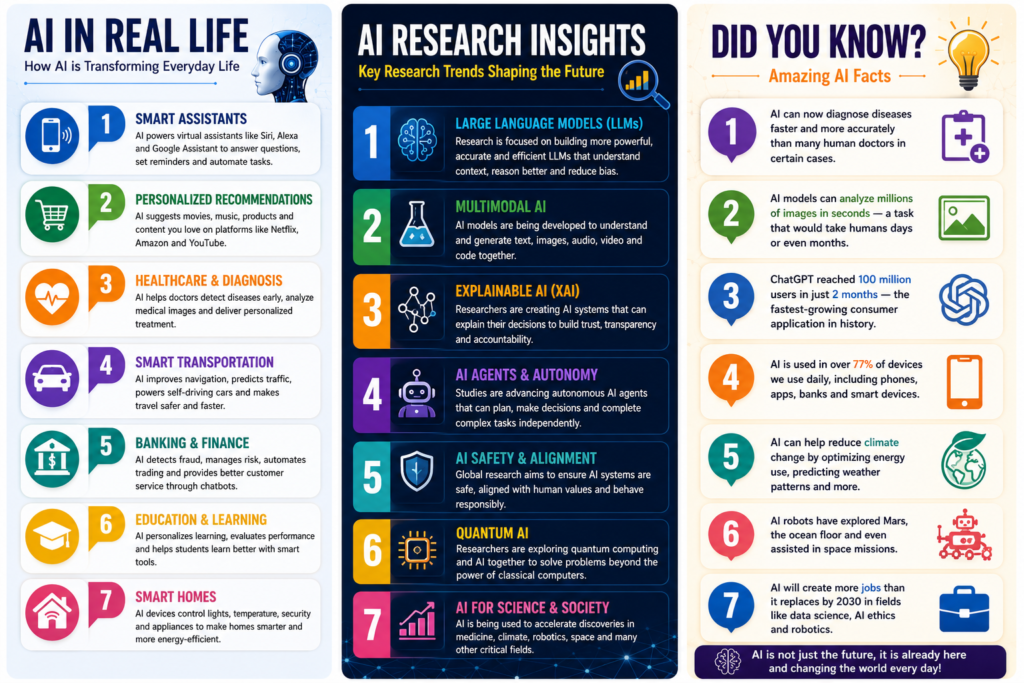
🌍 Global AI Fact
Artificial Intelligence is expected to contribute trillions of dollars to the global economy over the coming decades, making AI knowledge and AI literacy more valuable than ever before.
🚀 AI in Real Life
The concepts explained in this AI Glossary already power tools such as ChatGPT, virtual assistants, recommendation systems, healthcare applications, self-driving vehicles, and business automation platforms.
🌍 Global AI Fact
According to industry reports, AI is expected to contribute trillions of dollars to the global economy over the coming decades, making AI literacy an increasingly valuable skill.
🚀 AI in Real Life
From ChatGPT and virtual assistants to recommendation systems and self-driving vehicles, AI is already influencing how people learn, work, communicate, and make decisions every day.
What is an AI Glossary?
An AI Glossary is a collection of Artificial Intelligence terms and definitions that helps readers understand AI concepts, technologies, tools, and applications in a simple and organized way.
Why is an AI Glossary important?
An AI Glossary helps students, professionals, researchers, and beginners understand complex AI terminology without needing advanced technical knowledge.
What are the most important AI terms to know?
Some of the most important AI terms include Artificial Intelligence, Machine Learning, Deep Learning, Neural Networks, Large Language Models (LLMs), Generative AI, Computer Vision, AI Ethics, and AI Agents.
What is the difference between AI and Machine Learning?
Artificial Intelligence is the broader field of creating intelligent systems, while Machine Learning is a subset of AI that enables computers to learn from data and improve performance without explicit programming.
What is a Large Language Model (LLM)?
A Large Language Model (LLM) is an AI system trained on massive amounts of text data to understand, generate, summarize, and respond to human language. Examples include ChatGPT, Gemini, and Claude.
What is Generative AI?
Generative AI is a type of Artificial Intelligence that can create new content such as text, images, videos, music, and code based on patterns learned from training data.
Is this AI Glossary suitable for beginners?
Yes. This AI Glossary explains AI terms using simple definitions, practical examples, historical background, and real-world applications, making it suitable for beginners and students.
How can students use an AI Glossary?
Students can use an AI Glossary as a quick reference guide for assignments, projects, competitive exams, research work, and learning Artificial Intelligence concepts more effectively.
What is the best way to learn AI terminology?
The best way to learn AI terminology is to study definitions, examples, and real-world applications regularly while exploring AI tools and technologies through practical use.
How often should I update my AI knowledge?
Because Artificial Intelligence evolves rapidly, it is a good idea to update your AI knowledge regularly and stay informed about new technologies, tools, and industry developments.