
Welcome to this collection of 500 AI one-liners, specially prepared for students, teachers, beginners and technology enthusiasts. Whether you are preparing for an exam, creating classroom study material or revising important concepts for a technology interview, these short Artificial Intelligence notes will help you learn faster without reading lengthy explanations.
Artificial intelligence is already used in smartphones, search engines, hospitals, banks, schools, businesses and many other areas of everyday life. However, understanding AI can sometimes feel difficult because the subject includes many technical terms and rapidly developing technologies.
These AI one-liners explain important concepts in simple and easy-to-understand language. Each point is limited to one or two short lines, making the collection useful for quick reading, learning and revision. Together, these AI One-Liners provide a structured way to understand both basic and advanced artificial intelligence topics.
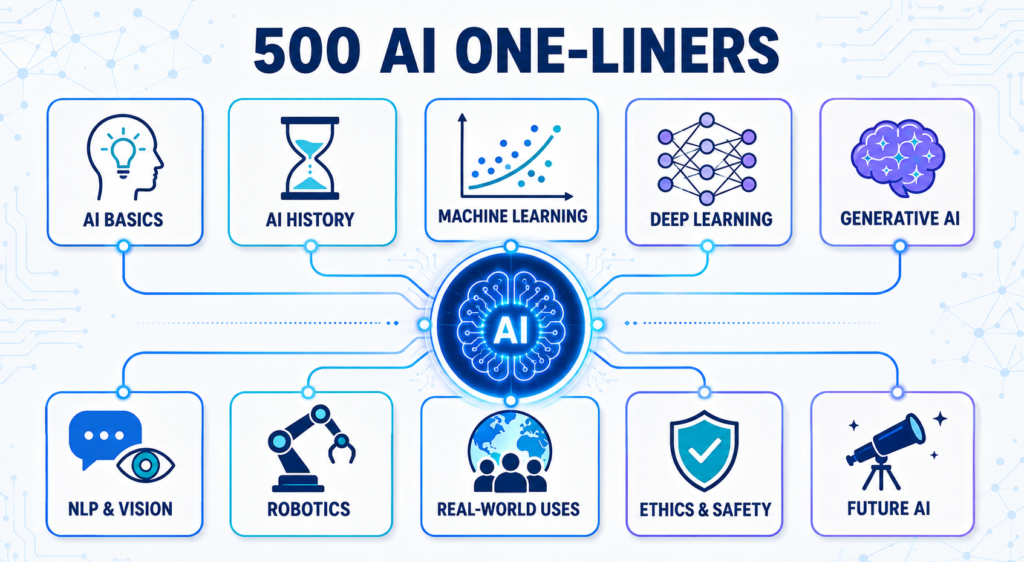
The guide covers AI basics, history, machine learning, deep learning, generative AI, robotics, popular tools, real-world applications, benefits, limitations, ethics and the future of intelligent technology.
Let us begin these AI One-Liners with the basic concepts that form the foundation of artificial intelligence.
AI One-Liners About Artificial Intelligence Basics
1. Artificial intelligence is the ability of a computer system to perform tasks that normally require human intelligence.
2. AI systems can analyse information, recognise patterns, make predictions and assist with decision-making.
3. Artificial intelligence does not mean that a machine thinks or feels exactly like a human being.
4. Most AI systems work by processing data and following patterns learned during training.
5. AI is a broad field that includes machine learning, deep learning, computer vision, robotics and natural language processing.
6. Machine learning is a branch of AI that enables computers to learn patterns from data.
7. Deep learning is an advanced form of machine learning based on multi-layered artificial neural networks.
8. Generative AI can create new content such as text, images, audio, video and computer code.
9. Artificial general intelligence, or AGI, refers to a theoretical AI capable of performing many intellectual tasks like a human.
10. Current AI systems are mainly examples of narrow AI designed for specific tasks.
11. A voice assistant is a form of narrow AI because it performs limited tasks such as answering questions and setting reminders.
12. Recommendation systems use AI to suggest products, films, music, videos or other content based on user behaviour.
13. A chatbot is a computer program designed to communicate with people through text or voice.
14. Not every chatbot uses advanced AI; some follow only fixed rules and predefined responses.
15. An algorithm is a set of instructions that tells a computer how to solve a problem or complete a task.
16. Data is the information used by AI systems to learn, identify patterns and produce results.
17. The quality of an AI system often depends on the quality, quantity and relevance of its training data.
18. Training is the process through which an AI model learns patterns from examples and data.
19. Inference is the stage in which a trained AI model uses what it has learned to generate an answer or prediction.
20. An AI model is a trained mathematical system that processes information to generate predictions, decisions or other outputs.
Types of Artificial Intelligence
- Reactive machines respond only to present situations and do not store memories of past experiences.
- Limited-memory AI uses recent or historical data to make decisions and predictions.
- Self-driving vehicles use limited-memory AI to observe traffic, road conditions and nearby objects.
- Theory of mind AI would be able to understand human emotions, beliefs and intentions, but it is still under development.
- Self-aware AI refers to a hypothetical machine that would possess consciousness and awareness of its own existence.
- Narrow AI, also called weak AI, is designed to perform one specific task or a limited group of tasks.
- Virtual assistants, facial recognition systems and recommendation engines are common examples of narrow AI.
- Artificial General Intelligence would be capable of learning and performing a wide variety of intellectual tasks.
- AGI remains a research goal and has not yet been achieved.
- Artificial Superintelligence refers to a hypothetical AI that would exceed human intelligence in almost every field.
- Superintelligent AI currently exists only as a theoretical concept.
- Rule-based AI makes decisions by following predefined “if–then” instructions.
- Learning-based AI improves its performance by identifying patterns in data.
- Symbolic AI represents knowledge through rules, symbols and logical relationships.
- Connectionist AI uses networks of interconnected processing units inspired by the structure of the human brain.
- Hybrid AI combines different approaches, such as machine learning and symbolic reasoning, within one system.
- Predictive AI analyses existing data to estimate future events or outcomes.
- Generative AI produces new content rather than only classifying or predicting existing information.
- Conversational AI enables machines to understand and respond to human language through text or speech.
- Anyone new to these concepts can explore this complete guide to artificial intelligence for a more detailed explanation.
History and Development of Artificial Intelligence
- The idea of artificial beings appeared in ancient myths long before modern computers were invented.
- Charles Babbage designed the Analytical Engine in the 1830s as an early concept for a programmable mechanical computer.
- Ada Lovelace wrote an algorithm for Babbage’s Analytical Engine and is often recognised as the first computer programmer.
- Alan Turing introduced the concept of a universal computing machine in 1936.
- In his 1950 research paper, Alan Turing explored whether machines could demonstrate intelligent behaviour.
- The Turing Test evaluates whether a machine’s conversation can appear human-like to an evaluator.
- John McCarthy used the term “artificial intelligence” in the 1955 Dartmouth research proposal.
- The Dartmouth Summer Research Project of 1956 is widely regarded as the formal beginning of AI as an academic field.
- John McCarthy is often called the father of artificial intelligence because of his foundational role in establishing the field.
- Logic Theorist, created in 1956, was one of the earliest programs designed to imitate human problem-solving.
- Frank Rosenblatt developed the perceptron in the late 1950s as an early model of an artificial neural network.
- ELIZA, developed by Joseph Weizenbaum in the 1960s, was one of the earliest computer programs to simulate human conversation.
- Shakey the Robot was an early mobile robot capable of reasoning about its actions and surroundings.
- The first AI winter began in the 1970s when funding and interest declined because early systems failed to meet high expectations.
- Expert systems became popular in the 1980s by using stored knowledge and rules to solve specialised problems.
- A second AI winter began in the late 1980s after expert systems proved expensive and difficult to maintain.
- IBM’s Deep Blue defeated world chess champion Garry Kasparov in 1997.
- IBM Watson defeated leading human champions on the quiz show Jeopardy! in 2011.
- AlexNet demonstrated the power of deep learning in image recognition in 2012.
- The complete history of artificial intelligence explains how these early developments led to modern generative AI.
AI One-Liners About Machine Learning Basics
- Machine learning allows computers to learn patterns from data without being explicitly programmed for every situation.
- A machine learning model improves by studying examples and adjusting its internal calculations.
- Supervised learning trains a model using data that already contains the correct answers or labels.
- Email spam detection is a common example of supervised learning.
- Unsupervised learning identifies hidden patterns or groups within unlabelled data.
- Customer segmentation is a common business application of unsupervised learning.
- Semi-supervised learning combines a small amount of labelled data with a larger amount of unlabelled data.
- Reinforcement learning teaches an AI system through rewards and penalties received after its actions.
- Game-playing AI and robotic control systems often use reinforcement learning.
- A dataset is an organised collection of information used to train, validate or test an AI model.
- Training data helps a model learn patterns and relationships.
- Validation data is used to adjust a model and compare different settings during development.
- Test data measures how well a trained model performs on previously unseen examples.
- A feature is an individual piece of information used by a machine learning model to make a prediction.
- A label is the correct answer or category attached to an example in supervised learning.
- Classification assigns data to categories, such as spam or not spam.
- Regression predicts a numerical value, such as a house price or future sales figure.
- Clustering groups similar data points without using predefined labels.
- Overfitting occurs when a model learns the training data too closely and performs poorly on new data.
- Underfitting occurs when a model is too simple to learn important patterns from the training data.
Common Machine Learning Algorithms
- Linear regression predicts a continuous numerical value by finding relationships between variables.
- Logistic regression is commonly used to predict two possible outcomes, such as yes or no.
- A decision tree makes predictions by dividing data through a series of rule-based questions.
- Random forest combines multiple decision trees to produce more reliable predictions.
- A support vector machine separates different categories by finding the best boundary between them.
- The k-nearest neighbours algorithm classifies new data by comparing it with similar nearby examples.
- Naive Bayes uses probability to classify data and is often applied to text and spam filtering.
- K-means clustering divides unlabelled data into groups based on similarity.
- Hierarchical clustering creates a tree-like structure of related data groups.
- Principal Component Analysis reduces the number of variables while preserving important information.
- Gradient descent helps a model reduce errors by gradually adjusting its internal values.
- An epoch is one complete pass of the training dataset through a machine learning model.
- A batch is a smaller group of training examples processed together during model training.
- Batch size determines how many examples a model processes before updating its internal values.
- The learning rate controls how quickly a model changes its values during training.
- A loss function measures the difference between a model’s prediction and the correct result.
- Model parameters are internal values learned automatically from training data.
- Hyperparameters are settings chosen before or during training to control how a model learns.
- Cross-validation evaluates a model by training and testing it on different parts of the dataset.
- An ensemble method combines predictions from multiple models to improve overall accuracy and reliability.
Deep Learning and Neural Network AI One-Liners
- Deep learning uses artificial neural networks with multiple layers to learn complex patterns from large datasets.
- Artificial neural networks are computing systems inspired by the connected structure of biological neurons.
- A neuron is a small processing unit that receives information, performs a calculation and passes the result forward.
- The input layer receives the original data supplied to a neural network.
- Hidden layers process information and identify patterns between the input and final output.
- The output layer produces the neural network’s final prediction or result.
- Weights determine the importance of connections between neurons in a neural network.
- Bias allows a neural network to adjust its output independently of the input values.
- An activation function decides whether and how strongly a neuron should pass information forward.
- ReLU is a widely used activation function that helps deep neural networks learn efficiently.
- Backpropagation sends error information backwards through a neural network to improve its weights.
- A convolutional neural network is designed to recognise visual patterns in images and videos.
- CNNs are commonly used for facial recognition, medical imaging and object detection.
- A recurrent neural network processes sequential information by using knowledge from earlier inputs.
- RNNs can work with sequences such as sentences, speech recordings and time-series data.
- Long Short-Term Memory networks are designed to remember useful information across longer sequences.
- Transformers process relationships between different parts of data using an attention mechanism.
- The attention mechanism helps a model focus on the most relevant words or elements in an input.
- Transfer learning adapts a previously trained model to perform a new but related task.
- Fine-tuning further trains an existing model on specialised data for a particular purpose.
Generative AI One-Liners and Large Language Models
- Generative AI creates new content by learning patterns from existing data.
- Generative AI can produce text, images, music, speech, video and computer code.
- A large language model is an AI model trained to understand and generate human language.
- LLMs learn statistical relationships between words, sentences and broader language patterns.
- A token is a small unit of text processed by a language model.
- A token may represent a complete word, part of a word, punctuation mark or other character.
- A prompt is an instruction or question given to a generative AI system.
- Prompt engineering is the process of writing and refining instructions to obtain more useful AI responses.
- A system prompt provides high-level instructions that guide an AI model’s behaviour.
- A context window is the amount of information an AI model can consider during one interaction.
- Text generation predicts suitable tokens one after another to create a complete response.
- Temperature is a setting that can influence the variety and randomness of generated responses.
- A lower temperature generally produces more predictable and focused answers.
- A higher temperature may produce more varied and creative responses.
- Hallucination occurs when an AI system generates incorrect or unsupported information as if it were true.
- Retrieval-Augmented Generation allows an AI model to use information retrieved from external sources.
- Multimodal AI can understand or generate more than one type of content, such as text, images and audio.
- Text-to-image models create visual content from written descriptions.
- Text-to-speech models convert written words into computer-generated spoken audio.
- Speech-to-text models convert spoken language into written text.
Natural Language Processing
- Natural Language Processing enables computers to understand, analyse and generate human language.
- NLP combines computer science, linguistics and machine learning.
- Text classification assigns written content to categories such as topic, intention or sentiment.
- Sentiment analysis identifies whether a piece of text expresses a positive, negative or neutral opinion.
- Named Entity Recognition identifies names of people, places, organisations, dates and other entities in text.
- Machine translation automatically converts text or speech from one language into another.
- Text summarisation reduces lengthy content while preserving its most important information.
- Extractive summarisation selects important sentences directly from the original text.
- Abstractive summarisation creates new sentences to express the main ideas of the original content.
- Question-answering systems analyse a question and generate or retrieve a relevant answer.
- Intent recognition identifies what a user wants to achieve through a message or command.
- Tokenisation divides text into smaller units that an NLP system can process.
- Stemming reduces related words to a common root form, which may not always be a complete word.
- Lemmatization reduces a word to its meaningful dictionary form.
- Stop words are frequently used words that may be removed during some forms of text analysis.
- Part-of-speech tagging identifies whether a word functions as a noun, verb, adjective or another grammatical category.
- Language detection identifies the language in which a piece of text is written.
- Optical Character Recognition converts text in scanned documents or images into editable digital text.
- Voice assistants combine speech recognition, language processing and speech generation to communicate with users.
- NLP is used in chatbots, search engines, translators, writing assistants and customer-support systems.
Computer Vision and Image Recognition
- Computer vision enables machines to interpret and understand information from images and videos.
- Image classification assigns an image to a specific category.
- Object detection identifies and locates multiple objects within an image or video.
- Image segmentation divides an image into separate regions for detailed analysis.
- Semantic segmentation assigns a category to every pixel in an image.
- Instance segmentation identifies each individual object separately, even when several objects belong to the same category.
- Facial recognition compares facial features to identify or verify a person.
- Face detection locates a human face in an image without necessarily identifying the person.
- Image recognition helps AI systems identify objects, people, places and activities in visual content.
- Computer vision can inspect products for defects during manufacturing.
- Medical imaging AI can assist doctors in examining X-rays, scans and other diagnostic images.
- Self-driving vehicles use computer vision to recognise roads, traffic signs, pedestrians and nearby vehicles.
- Pose estimation identifies the position and movement of a person’s body joints.
- Gesture recognition allows machines to understand human hand or body movements.
- Image captioning generates a written description of the content shown in an image.
- Visual Question Answering enables an AI system to answer questions about an image.
- Image enhancement uses AI to improve sharpness, resolution, colour or overall visual quality.
- Generative image models create new visuals by learning patterns from large image-and-text datasets.
- Deepfakes use AI to create or alter realistic-looking images, video or audio.
- Modern AI image generators allow users to create artwork and realistic visuals through text prompts.
Robotics and Autonomous Systems
- Robotics combines engineering, computer science and AI to design machines that can perform physical tasks.
- A robot is a programmable machine capable of carrying out actions automatically or with human control.
- Not every robot uses artificial intelligence; some simply follow fixed instructions.
- AI-powered robots can analyse their surroundings and adjust their actions according to changing conditions.
- Sensors allow robots to collect information about distance, movement, temperature, light and other conditions.
- Actuators convert control signals into physical movements such as turning, lifting or gripping.
- Robot perception helps a machine understand its environment through cameras, sensors and AI models.
- Robot navigation enables a machine to determine its position and move safely towards a destination.
- Path planning helps a robot calculate a suitable route while avoiding obstacles.
- Simultaneous Localisation and Mapping allows a robot to build a map while tracking its own location.
- Industrial robots perform tasks such as welding, painting, assembling and packaging products.
- Collaborative robots are designed to work safely alongside humans in shared spaces.
- Service robots assist people in homes, hospitals, hotels, offices and public places.
- Humanoid robots are designed with physical features or movements that resemble those of humans.
- Autonomous mobile robots can navigate and perform tasks without following fixed tracks.
- Warehouse robots move products, organise inventory and support order fulfilment.
- Surgical robots assist medical professionals in performing precise procedures.
- Agricultural robots can monitor crops, remove weeds, harvest produce and perform other farming tasks.
- Drones use sensors, navigation systems and sometimes AI to perform tasks in the air.
- Autonomous systems can make and carry out certain decisions with limited human intervention.
AI One-Liners About Artificial Intelligence in Everyday Life
- Smartphones use AI to improve photography, battery performance, voice recognition and security.
- Search engines use AI to understand queries and display more relevant results.
- Navigation apps use AI to estimate travel time, detect traffic and suggest suitable routes.
- Email services use AI to filter spam, organise messages and suggest quick replies.
- Streaming platforms recommend films, programmes and music according to viewing or listening habits.
- Online stores use AI to recommend products based on searches, purchases and browsing behaviour.
- Social media platforms use AI to personalise content feeds and identify harmful material.
- Smart home devices use AI to control lights, temperature, appliances and security systems.
- Digital keyboards use AI for autocorrection, word prediction and voice typing.
- Smartphone cameras use AI to adjust lighting, focus, colour and image quality automatically.
- Face unlock systems use facial recognition to verify the identity of a device owner.
- Banking apps use AI to detect unusual transactions and possible financial fraud.
- Fitness applications use AI to analyse exercise, sleep and activity patterns.
- Weather services use AI models to improve forecasting and analyse large amounts of environmental data.
- Language-learning applications use AI to personalise lessons and provide feedback.
- Customer-support chatbots answer common questions and guide users through basic problems.
- Online advertisements use AI to select audiences based on interests and online activity.
- News and content platforms use recommendation algorithms to personalise what users see.
- Accessibility tools use AI to generate captions, read text aloud and describe visual content.
- Many AI tools for everyday life can help users complete routine tasks more efficiently.
Educational AI One-Liners for Students and Teachers
- AI can personalise lessons according to a student’s learning pace, needs and performance.
- Adaptive learning systems adjust the difficulty of educational content based on student responses.
- Intelligent tutoring systems provide guided instruction and feedback without requiring constant teacher supervision.
- AI can generate practice questions, quizzes, summaries and revision material.
- Automated grading can evaluate multiple-choice tests and some forms of written work.
- Learning analytics helps teachers identify performance patterns and students who may need additional support.
- AI-powered translation tools make educational content accessible in different languages.
- Speech-to-text tools can help students create notes from lectures and spoken explanations.
- Text-to-speech tools can read digital content aloud for learners with visual or reading difficulties.
- AI chatbots can answer basic academic questions and provide learning assistance at any time.
- Virtual laboratories allow students to explore experiments through digital simulations.
- AI can recommend learning resources based on a student’s interests and knowledge level.
- Teachers can use AI to prepare lesson plans, worksheets and classroom activities.
- AI tools can reduce time spent on repetitive administrative and documentation tasks.
- Plagiarism-detection systems compare submitted work with existing sources to identify possible similarities.
- AI-generated answers should be verified because they may contain errors or incomplete information.
- Students should use AI as a learning assistant rather than as a replacement for independent thinking.
- Teachers remain essential for guidance, motivation, judgement and emotional support.
- Schools must protect student data when using AI-powered educational platforms.
- This guide to AI in education explains its uses, benefits, challenges and future impact in greater detail.
Artificial Intelligence in Healthcare
- AI can analyse medical data to assist healthcare professionals in detecting diseases and planning treatment.
- Medical imaging AI can help identify patterns in X-rays, CT scans, MRIs and other diagnostic images.
- AI systems may detect certain abnormalities that are difficult to notice through manual examination alone.
- Predictive healthcare models estimate possible health risks by analysing patient records and clinical data.
- AI can support doctors by organising medical information and highlighting relevant findings.
- Virtual health assistants can provide appointment reminders and basic information about healthcare services.
- Remote patient-monitoring systems use connected devices and AI to track health indicators outside hospitals.
- Wearable devices can monitor information such as heart rate, sleep, movement and physical activity.
- AI can help researchers identify potential drug candidates and analyse their possible effects.
- Robotic systems can assist surgeons in performing precise and minimally invasive procedures.
- AI can help hospitals predict patient demand and manage beds, staff and medical resources.
- Natural language processing can extract useful information from medical notes and health records.
- AI-powered prosthetic devices can respond to movement signals and support greater mobility.
- Personalised medicine uses patient-specific information to select more suitable treatment approaches.
- AI can support public-health research by analysing disease patterns across large populations.
- Healthcare AI must be tested carefully because inaccurate results may affect patient safety.
- Biased medical data can cause an AI system to produce unfair or unreliable recommendations.
- Patient health information requires strong privacy and security protection.
- AI should support qualified medical professionals rather than replace their clinical judgement.
- The World Health Organization’s guidance on AI for health emphasises ethics, human rights, transparency and accountability.
Artificial Intelligence in Business and the Workplace
- Businesses use AI to analyse data, automate routine work and support decision-making.
- AI-powered analytics can identify patterns that may be difficult to find through manual analysis.
- Predictive analytics uses historical data to estimate future sales, demand and business risks.
- Customer-service chatbots can answer common questions and provide support at any time.
- AI can organise customer enquiries and direct them to the appropriate department or employee.
- Customer relationship management systems use AI to analyse interactions and identify sales opportunities.
- AI can personalise product recommendations, emails and advertisements for different customers.
- Marketing teams use AI to study audience behaviour and improve campaign performance.
- Sentiment analysis helps businesses understand customer opinions expressed in reviews and social media posts.
- AI can generate first drafts of reports, presentations, emails and marketing content.
- Meeting assistants can record discussions, create transcripts and summarise important points.
- AI scheduling tools can arrange meetings and identify suitable times for participants.
- Recruitment systems may use AI to organise applications and identify candidates with relevant qualifications.
- Human review is essential in AI-assisted hiring to reduce bias and unfair decisions.
- Fraud-detection systems analyse transactions to identify unusual or suspicious behaviour.
- Supply-chain AI helps businesses forecast demand, manage inventory and plan deliveries.
- AI-powered cybersecurity tools can detect unusual activity and possible digital threats.
- Robotic process automation handles repetitive rule-based tasks such as data entry and invoice processing.
- AI copilots assist employees with writing, research, coding, analysis and other workplace tasks.
- AI can improve productivity, but important business decisions still require human judgement and accountability.
Artificial Intelligence in Banking and Finance
- Banks use AI to analyse transactions, manage risk and improve customer services.
- Fraud-detection systems identify unusual payment patterns that may indicate unauthorised activity.
- AI can monitor large numbers of transactions faster than manual review alone.
- Credit-scoring models estimate the likelihood that a borrower will repay a loan.
- Biased or incomplete financial data can lead to unfair credit decisions.
- Banking chatbots help customers check balances, understand services and resolve basic queries.
- AI can categorise spending and provide personalised budgeting information.
- Algorithmic trading systems buy or sell financial assets according to programmed strategies and market data.
- AI models can analyse financial news, historical prices and economic indicators.
- Financial predictions remain uncertain because markets can change unexpectedly.
- Anti-money-laundering systems use AI to identify suspicious transaction patterns.
- AI can help insurance companies assess risks and process claims more efficiently.
- Automated claim systems can examine documents, images and policy information.
- Insurers use predictive models to estimate the probability of future claims.
- AI-powered identity verification compares documents, facial images and other information.
- Biometric authentication uses fingerprints, facial features or voice patterns to verify identity.
- Robo-advisers use algorithms to provide automated investment guidance based on user information.
- Financial AI systems require strong security because they process sensitive personal and transaction data.
- Human oversight is necessary when automated financial decisions significantly affect individuals.
- AI can support financial decision-making, but it cannot guarantee profits or eliminate investment risk.
Important AI Pioneers and Their Contributions
- British mathematician Alan Turing established important foundations of computer science and proposed the Turing Test in 1950.
- American computer scientist John McCarthy coined the term “artificial intelligence” in 1955 and developed LISP in 1958.
- John McCarthy founded the Stanford Artificial Intelligence Laboratory in the United States in 1963.
- American mathematician Claude Shannon introduced information theory in 1948 and published early research on computer chess in 1950.
- Allen Newell, Herbert Simon and Cliff Shaw developed Logic Theorist in the United States in 1956.
- Arthur Samuel created a self-learning checkers program at IBM during the 1950s and helped establish machine learning research.
- American psychologist Frank Rosenblatt developed the perceptron at Cornell Aeronautical Laboratory in 1957.
- MIT professor Marvin Minsky made major contributions to neural networks, robotics and symbolic artificial intelligence.
- German-American computer scientist Joseph Weizenbaum created the ELIZA chatbot at MIT between 1964 and 1966.
- Edward Feigenbaum of Stanford University pioneered expert systems and knowledge-based artificial intelligence.
- American computer scientist Judea Pearl advanced Bayesian networks and causal reasoning in artificial intelligence.
- British-Canadian researcher Geoffrey Hinton played a major role in the development and revival of neural networks.
- French-American computer scientist Yann LeCun pioneered convolutional neural networks for image and handwriting recognition.
- Canadian researcher Yoshua Bengio made foundational contributions to deep learning and neural language models.
- Hinton, LeCun and Bengio shared the 2018 ACM Turing Award for breakthroughs that made deep neural networks central to modern computing.
- Japanese researcher Kunihiko Fukushima introduced the Neocognitron in 1980, an important predecessor of modern convolutional neural networks.
- American researcher John Hopfield introduced the Hopfield network in 1982 for storing and retrieving patterns.
- Richard Sutton and Andrew Barto helped establish modern reinforcement learning through influential algorithms and research.
- Stanford professor Fei-Fei Li led the development of ImageNet, which became a major resource for computer-vision research.
- British researcher Demis Hassabis co-founded DeepMind in London in 2010 and later led major projects such as AlphaGo.
Landmark AI Systems and Breakthroughs
- DENDRAL was developed at Stanford University in the 1960s to help scientists analyse chemical compounds.
- SHRDLU, created by Terry Winograd at MIT around 1970, could understand commands about objects in a simulated block world.
- MYCIN was developed at Stanford University during the 1970s to recommend treatments for certain bacterial infections.
- Prolog was created in France in 1972 and became an important programming language for logic-based AI.
- XCON was introduced at Digital Equipment Corporation in 1980 to help configure computer systems.
- TD-Gammon, developed by IBM researcher Gerald Tesauro in the early 1990s, learned to play backgammon using neural networks.
- Sony launched AIBO in Japan in 1999 as a robotic dog capable of interacting with people and its surroundings.
- Cynthia Breazeal developed Kismet at MIT in the late 1990s to study social and emotional interaction between humans and robots.
- Honda introduced the humanoid robot ASIMO in Japan in 2000.
- Stanford’s autonomous vehicle Stanley won the DARPA Grand Challenge in the United States in 2005.
- Apple introduced Siri as a built-in voice assistant with the iPhone 4S in 2011.
- Google Brain began in 2011 as a research project focused on large-scale deep learning.
- Google researchers introduced Word2Vec in 2013 to represent words as numerical vectors based on their meanings and relationships.
- Ian Goodfellow and his colleagues introduced Generative Adversarial Networks in 2014.
- DeepMind’s AlphaGo defeated South Korean Go champion Lee Sedol by four games to one in 2016.
- Google researchers introduced the Transformer architecture in the 2017 paper “Attention Is All You Need.”
- Google introduced BERT in 2018 to improve how machines understand context in human language.
- OpenAI introduced GPT-3 in 2020 as a large language model with 175 billion parameters.
- DeepMind presented AlphaFold 2 in 2020 as a major advance in predicting three-dimensional protein structures.
- OpenAI introduced DALL·E in 2021 as a system capable of generating images from written descriptions.
Modern Generative AI Milestones
- OpenAI introduced GPT-1 in 2018 to demonstrate the value of pre-training a language model before adapting it to specific tasks.
- OpenAI released GPT-2 in 2019 with 1.5 billion parameters and initially limited access because of concerns about possible misuse.
- OpenAI introduced CLIP in 2021 to connect visual concepts with natural-language descriptions.
- GitHub and OpenAI introduced the technical preview of GitHub Copilot in 2021 to assist programmers with code suggestions.
- Midjourney entered open beta in July 2022 as an independent text-to-image generation platform.
- Stability AI released Stable Diffusion in 2022 as a text-to-image model that could run on consumer hardware.
- OpenAI released Whisper in September 2022 as an open-source speech-recognition model trained on multilingual audio.
- OpenAI publicly launched ChatGPT on 30 November 2022 as a conversational research preview.
- Perplexity AI was launched in the United States in 2022 as an AI-powered answer engine that cites web sources.
- Anthropic introduced Claude in March 2023 as an AI assistant developed with a focus on helpfulness and safety.
- OpenAI released GPT-4 in March 2023 with the ability to process both text and image inputs.
- Google opened public access to its Bard conversational AI experiment in March 2023.
- Adobe introduced Firefly in March 2023 as a family of generative AI models for creative work.
- Meta released the first LLaMA model in 2023 to support research on large language models.
- Meta and Microsoft introduced Llama 2 in July 2023 for research and many commercial uses.
- Mistral AI, founded in France in 2023, released its first open-weight language model in September of that year.
- xAI introduced the Grok conversational AI system in November 2023.
- Google announced the multimodal Gemini model family in December 2023.
- Google renamed its Bard assistant as Gemini on 8 February 2024.
- OpenAI announced Sora in February 2024 as a model designed to generate video from text instructions.
AI in Science, Space and Environmental Research
- NASA’s Perseverance rover used AEGIS software on 18 May 2022 to select Martian rocks without direct instructions from Earth.
- AEGIS was developed by NASA’s Jet Propulsion Laboratory to identify scientifically useful targets on Mars.
- Perseverance completed its first drive using the AutoNav autonomous-navigation system in July 2021.
- On 8 and 10 December 2025, Perseverance completed the first drives on another planet whose routes were planned using generative AI.
- NASA successfully used Mars Global Localization in February 2026 to help Perseverance determine its position without GPS or human assistance.
- The European Space Agency launched PhiSat-1 from French Guiana on 3 September 2020.
- PhiSat-1 used onboard AI to remove cloud-covered images before transmitting useful Earth-observation data.
- A machine-learning-capable nanosatellite built in Glasgow, United Kingdom, was launched in September 2020 to support shipping and weather predictions.
- MIT researchers used a deep-learning model in 2020 to identify a potential antibiotic compound named halicin.
- The MIT model screened more than 100 million chemical compounds in three days while searching for new antibiotic candidates.
- DeepMind and EMBL-EBI launched the AlphaFold Protein Structure Database in July 2021.
- The AlphaFold database expanded to more than 200 million predicted protein structures in July 2022.
- Google DeepMind introduced GNoME in 2023 and reported predictions for 2.2 million new crystal structures.
- GNoME identified 380,000 predicted stable materials that could support research into batteries, electronics and other technologies.
- Google DeepMind introduced GraphCast in 2023 as an AI system for global weather forecasting.
- GraphCast can generate a ten-day weather forecast in under one minute on specialised computing hardware.
- Astronomers use AI to analyse telescope images and identify stars, galaxies, planets and unusual cosmic events.
- Agricultural researchers use AI to study crop diseases, soil conditions, irrigation needs and expected yields.
- AI can analyse satellite images to monitor deforestation, wildfires, floods, glaciers and changes in vegetation.
- AI-generated scientific predictions must be confirmed through observation, laboratory testing and expert review.
Global AI Policies and National Initiatives
- Canada launched the Pan-Canadian Artificial Intelligence Strategy in 2017 as the world’s first national AI strategy.
- The United Arab Emirates appointed a Minister of State for Artificial Intelligence in October 2017.
- India’s NITI Aayog published the National Strategy for Artificial Intelligence under the theme “AI for All” in 2018.
- The OECD adopted its Artificial Intelligence Principles in May 2019 as the first intergovernmental standard on AI.
- Singapore announced its first National Artificial Intelligence Strategy on 13 November 2019.
- UNESCO’s 193 member states adopted the Recommendation on the Ethics of Artificial Intelligence in November 2021.
- The United States published the Blueprint for an AI Bill of Rights in October 2022.
- China’s interim measures for generative AI services came into effect on 15 August 2023.
- The United Kingdom hosted the first global AI Safety Summit at Bletchley Park on 1 and 2 November 2023.
- Representatives of 28 countries and the European Union endorsed the Bletchley Declaration on AI safety in November 2023.
- The G7 introduced the Hiroshima AI Process International Guiding Principles for advanced AI systems in 2023.
- ISO and IEC published ISO/IEC 42001 in December 2023 as an international AI management-system standard.
- The Government of India approved the IndiaAI Mission in March 2024 to strengthen the country’s AI infrastructure and ecosystem.
- The United Nations General Assembly adopted its first global resolution on artificial intelligence on 21 March 2024.
- The UN resolution promoted safe, secure and trustworthy AI systems that support sustainable development and human rights.
- The European Union’s Artificial Intelligence Act entered into force on 1 August 2024.
- The EU AI Act follows a risk-based approach, with stricter requirements for AI systems that may create greater harm.
- The Council of Europe adopted a Framework Convention on Artificial Intelligence, Human Rights, Democracy and the Rule of Law in May 2024.
- The Alan Turing Institute, established in the United Kingdom in 2015, serves as the country’s national institute for data science and artificial intelligence.
- International AI governance increasingly focuses on transparency, safety, accountability, privacy and protection of human rights.
AI One-Liners About Ethics, Bias and Safety
- AI ethics examines how intelligent systems affect fairness, privacy, safety, human rights and society.
- Algorithmic bias occurs when an AI system produces systematically unfair results for certain individuals or groups.
- The 2018 Gender Shades study by Joy Buolamwini and Timnit Gebru revealed major accuracy differences in commercial facial-analysis systems.
- In that study, error rates reached 34.7% for darker-skinned women but remained below 1% for lighter-skinned men.
- Microsoft removed its Tay chatbot from Twitter in March 2016 after users manipulated it into producing offensive messages.
- Researchers reported adversarial examples in 2013, showing that small input changes could cause neural networks to make incorrect predictions.
- An adversarial attack deliberately modifies input data to confuse or mislead an AI system.
- The term “deepfake” became widely used in 2017 for AI-generated or manipulated media that imitates real people.
- Automation bias occurs when people trust a computer-generated recommendation without examining it carefully.
- A black-box AI system produces results through processes that are difficult for humans to interpret.
- Explainable AI aims to make an AI system’s decisions more understandable to users, developers and regulators.
- The United States Defense Advanced Research Projects Agency launched its Explainable AI programme in 2016.
- Google researchers proposed Model Cards in 2019 to document a model’s intended uses, performance and limitations.
- Timnit Gebru and her co-authors proposed Datasheets for Datasets to improve transparency about how datasets are created.
- AI red teaming involves testing a system through challenging or harmful scenarios to discover weaknesses before deployment.
- AI alignment research studies how to make intelligent systems behave according to intended human goals and values.
- Human-in-the-loop systems keep people involved in reviewing, correcting or approving important AI decisions.
- Privacy-preserving machine learning aims to train or use models while reducing exposure of sensitive personal information.
- Responsible AI requires fairness, transparency, accountability, security, privacy and meaningful human oversight.
- An AI system should be evaluated throughout its complete life cycle rather than only before its initial release.
Limitations and Challenges of Artificial Intelligence
- AI systems do not possess human understanding simply because they can generate fluent or convincing responses.
- An AI hallucination is an output that appears confident but contains false, invented or unsupported information.
- Training-data bias can cause a model to reproduce unfair patterns found in its source material.
- Data leakage occurs when information from outside the proper training set influences model development or evaluation.
- Benchmark contamination happens when test questions or answers appear in a model’s training data.
- Distribution shift occurs when real-world data differs from the data used to train an AI model.
- Concept drift happens when relationships within data change over time and reduce a model’s accuracy.
- Catastrophic forgetting occurs when a neural network loses previously learned knowledge while learning new information.
- Model collapse may occur when new AI systems are repeatedly trained on low-quality AI-generated content.
- Large AI models require substantial computing power, specialised hardware and technical infrastructure.
- Training and operating large models may consume significant electricity, water and other resources.
- Many AI systems perform poorly when they encounter situations that are very different from their training examples.
- AI models may struggle with rare events because sufficient training examples are often unavailable.
- Multilingual AI performance can vary because some languages have much less high-quality training data than others.
- A jailbreak attempts to make an AI system ignore its safety rules or operating restrictions.
- Prompt injection uses malicious instructions to manipulate an AI application or interfere with its intended behaviour.
- Reward hacking occurs when an AI system exploits a poorly designed objective instead of completing the intended task.
- Reproducing an AI research result can be difficult when training data, code or model settings are unavailable.
- AI-generated content may create copyright, ownership and attribution questions.
- Human verification remains necessary because no AI system is accurate, unbiased and reliable in every situation.
AI Hardware and Computing Infrastructure
- A central processing unit can run AI tasks but is mainly designed for general-purpose computing.
- A graphics processing unit performs many calculations in parallel, making it suitable for training neural networks.
- Parallel processing allows multiple calculations to be performed at the same time.
- NVIDIA introduced CUDA in November 2006 to make GPU computing more accessible for general computational tasks.
- Google announced its first Tensor Processing Unit in 2016 as a custom chip designed for machine learning.
- A Neural Processing Unit is a specialised processor designed to accelerate AI tasks on computers and mobile devices.
- An AI accelerator is hardware created to perform machine-learning calculations faster and more efficiently.
- High-bandwidth memory helps AI processors access large amounts of data at very high speed.
- AI data centres contain servers, processors, storage, networking equipment and cooling systems.
- Distributed training divides the work of training a large AI model across multiple processors or machines.
- AI training is the process of learning model parameters, while inference uses the trained model to produce results.
- Edge AI processes information close to where it is collected instead of sending everything to a remote data centre.
- On-device AI can improve response speed and privacy by processing data directly on a phone or computer.
- Quantisation reduces the numerical precision of model values to lower memory and computing requirements.
- Model pruning removes less important connections or parameters from a neural network.
- Knowledge distillation trains a smaller model to imitate the behaviour of a larger model.
- A Mixture-of-Experts model activates only selected parts of its network for each input.
- Neuromorphic computing uses hardware designs inspired by the organisation and activity of the human brain.
- IBM introduced the TrueNorth neuromorphic chip in 2014, while Intel announced its Loihi research chip in 2017.
- Intel unveiled Hala Point in 2024 as a neuromorphic research system containing 1.15 billion artificial neurons.
Future AI One-Liners and Emerging Technologies
- Agentic AI refers to systems designed to plan, make decisions and complete multi-step tasks with limited supervision.
- An AI agent observes information, selects actions and works towards a defined goal.
- Multi-agent systems involve several AI agents that cooperate, compete or divide work among themselves.
- Embodied AI connects intelligence with a physical robot or simulated body that can interact with an environment.
- World models help AI systems represent and predict how objects, actions and environments may change.
- Multimodal models process combinations of text, images, audio, video or sensor data.
- Small language models are designed to provide useful AI capabilities with fewer computing resources.
- Synthetic data is artificially generated information used to supplement or replace some real training data.
- Federated learning trains models across separate devices or organisations without collecting all raw data in one location.
- Differential privacy adds controlled randomness to help protect individual information within a dataset.
- Neuro-symbolic AI combines neural-network learning with logic, rules and symbolic reasoning.
- Continual learning aims to help AI systems acquire new knowledge without forgetting earlier information.
- Self-supervised learning allows models to learn from unlabelled data by creating learning signals from the data itself.
- Zero-shot learning enables a model to attempt a task without being shown a labelled example of that exact task.
- Few-shot learning allows a model to perform a task after receiving only a small number of examples.
- A digital twin is a virtual representation of a physical object, process or system updated with real-world data.
- Autonomous laboratories combine AI, robotics and scientific instruments to plan and perform experiments.
- Affective computing studies how machines can recognise, interpret or respond to human emotions.
- Swarm intelligence is inspired by the collective behaviour of animals such as ants, bees, birds and fish.
- Quantum machine learning explores how quantum computers may support certain AI and data-processing tasks.
Important AI Records, Awards and Notable Facts
- The Association for Computing Machinery presented the first A.M. Turing Award to American computer scientist Alan Perlis in 1966.
- The Turing Award is named after British mathematician and computing pioneer Alan Turing.
- Marvin Minsky received the Turing Award in 1969 for his contributions to artificial intelligence.
- John McCarthy received the Turing Award in 1971 for his work in artificial intelligence and programming languages.
- Allen Newell and Herbert Simon shared the 1975 Turing Award for their contributions to AI and human cognition.
- Edward Feigenbaum and Raj Reddy shared the 1994 Turing Award for pioneering large-scale artificial intelligence systems.
- Judea Pearl received the 2011 Turing Award for foundational work in probabilistic and causal reasoning.
- Geoffrey Hinton, Yann LeCun and Yoshua Bengio shared the 2018 Turing Award for breakthroughs in deep neural networks.
- Richard Sutton and Andrew Barto received the 2024 Turing Award for developing the foundations of reinforcement learning.
- The ACM Turing Award carries a prize of one million US dollars and is often called the “Nobel Prize in Computing.”
- John Hopfield and Geoffrey Hinton received the 2024 Nobel Prize in Physics for work supporting machine learning with neural networks.
- Demis Hassabis and John Jumper shared half of the 2024 Nobel Prize in Chemistry for protein-structure prediction.
- David Baker received the other half of the 2024 Chemistry Nobel Prize for computational protein design.
- The 2024 Nobel Prizes recognised AI-related work in both physics and chemistry during the same year.
- The AI-generated artwork Portrait of Edmond de Belamy sold for $432,500 at Christie’s in New York in October 2018.
- The Chinook program solved the game of checkers in 2007, proving that perfect play by both sides results in a draw.
- Carnegie Mellon University’s Libratus defeated professional players in heads-up no-limit Texas Hold’em poker in 2017.
- DeepMind’s AlphaStar reached Grandmaster level in the strategy game StarCraft II in 2019.
- OpenAI Five defeated the reigning Dota 2 world champion team OG in a public match in April 2019.
- Pluribus, developed by Carnegie Mellon University and Facebook AI, achieved superhuman results in six-player no-limit Texas Hold’em in 2019.
AI One-Liners: Quick Summary Table
The following table provides a quick overview of the major topics covered in these 500 AI One-Liners.
| Point Range | Main Topic | What You Will Learn |
|---|---|---|
| 1–40 | AI Basics and Types | Basic meaning of AI, important concepts, Narrow AI, AGI and different types of intelligent systems |
| 41–60 | AI History | Alan Turing, Dartmouth Conference, AI winters and important historical developments |
| 61–100 | Machine Learning | Learning methods, datasets, training concepts and common machine-learning algorithms |
| 101–140 | Deep Learning and Generative AI | Neural networks, transformers, large language models, prompts and content generation |
| 141–180 | NLP and Computer Vision | Language processing, speech recognition, image classification and object detection |
| 181–240 | Robotics, Daily Life and Education | Intelligent robots, everyday applications and the role of AI in learning and teaching |
| 241–300 | Healthcare, Business and Finance | Medical AI, workplace automation, banking, insurance and fraud detection |
| 301–360 | Pioneers and AI Milestones | Important researchers, landmark systems and the development of modern generative AI |
| 361–400 | Science and Global AI Development | Space research, materials discovery, national strategies and international AI policies |
| 401–460 | Ethics, Limitations and Hardware | Bias, safety, technical challenges, GPUs, TPUs and AI infrastructure |
| 461–500 | Emerging Technologies and Records | AI agents, future research areas, major awards, achievements and notable records |
This quick summary makes it easier to use the AI One-Liners as revision notes or to locate a specific artificial intelligence topic.
Conclusion: What These 500 AI One-Liners Teach Us
Artificial intelligence is a vast subject, but learning it does not always require long and complicated explanations. These 500 AI One-Liners bring together the most important concepts, people, dates, technologies, applications, achievements and challenges in a quick-reference format.
The collection begins with basic AI concepts and gradually moves through machine learning, deep learning, generative AI, robotics, healthcare, education, business, scientific research, global policies and emerging technologies. It also highlights the contributions of important researchers and institutions that shaped the development of artificial intelligence.
Students can use these AI One-Liners for examination preparation and revision, while teachers can use them to create classroom notes, quizzes and discussion topics. They can also help beginners, professionals and technology enthusiasts quickly refresh their understanding of AI.
However, artificial intelligence continues to develop rapidly. New models, tools, regulations and research breakthroughs will keep changing the field. Therefore, these notes should provide a strong foundation while encouraging readers to continue learning, verify important information and follow future developments responsibly.
Frequently Asked Questions About AI One-Liners
1. What is artificial intelligence in simple words?
Artificial intelligence is a technology that enables computers and machines to perform tasks that normally require human intelligence, such as learning, reasoning, recognising patterns and making decisions.
2. What are the main types of artificial intelligence?
The three commonly discussed types are Artificial Narrow Intelligence, Artificial General Intelligence and Artificial Superintelligence. Only Narrow AI currently exists in practical use.
3. What is the difference between AI, machine learning and deep learning?
AI is the broad field of creating intelligent machines, machine learning is a branch of AI that learns from data, and deep learning is a specialized form of machine learning based on multi-layered neural networks.
4. Who is known as the father of artificial intelligence?
John McCarthy is widely known as the father of artificial intelligence. He coined the term “artificial intelligence” in 1955 and helped organise the Dartmouth Conference in 1956.
5. How does artificial intelligence work?
AI systems process data, identify patterns and use trained models or programmed rules to generate predictions, decisions or responses. Their performance depends largely on the quality of data, algorithms and training.
6. How is artificial intelligence used in everyday life?
Artificial intelligence is used in smartphones, search engines, navigation apps, voice assistants, online shopping, banking, social media, streaming platforms and smart-home devices.
7. What are the main benefits of artificial intelligence?
AI can automate repetitive work, analyse large datasets, improve predictions, personalise services, support scientific research and help people complete many tasks more efficiently.
8. What are the major limitations of artificial intelligence?
AI may produce incorrect information, reflect bias, misunderstand context and require large amounts of data and computing power. It also lacks human emotions, consciousness and real-world judgement.
9. Will artificial intelligence replace human jobs?
AI may automate parts of many jobs and change the skills required in the workplace. However, it is also expected to create new roles and increase the importance of human creativity, judgement and interpersonal skills.
10. Is artificial intelligence safe for students to use?
AI can support learning when students verify its answers, protect personal information and follow academic rules. It should assist independent thinking rather than replace genuine study or original work.
11. What is the future of artificial intelligence?
The future of AI may include more capable assistants, autonomous agents, intelligent robots, personalised education and faster scientific discovery. Its development will also require stronger safety, ethical and legal safeguards.
12. What is the best way to learn artificial intelligence?
Begin with AI basics, machine learning concepts, data and simple practical examples. After building this foundation, study deep learning, generative AI, programming and responsible AI step by step.
Sources and Further Reading
The facts included in these AI One-Liners were checked using reliable research papers, universities, international organisations and official technology sources. Readers can explore the following resources for more detailed information:
- Stanford University – John McCarthy and the Development of Artificial Intelligence
- Oxford Academic – Alan Turing’s Computing Machinery and Intelligence
- AAAI – Dartmouth Summer Research Project on Artificial Intelligence
- Association for Computing Machinery – Turing Award Winners
- Nobel Prize – Nobel Prizes Awarded in 2024
- NASA – Artificial Intelligence in Space Exploration
- European Space Agency – Artificial Intelligence for Earth Observation
- MIT – Artificial Intelligence Identifies a New Antibiotic
- Google DeepMind – AlphaFold and Protein-Structure Prediction
- World Health Organization – Ethics and Governance of AI for Health
- UNESCO – Recommendation on the Ethics of Artificial Intelligence
- European Commission – European Union Artificial Intelligence Act
- United Nations – Global Resolution on Safe and Trustworthy Artificial Intelligence