
Introduction to the Encyclopedia of Artificial Intelligence
Artificial intelligence has grown from a specialised academic field into one of the most influential technologies of the modern world. It now works inside smartphones, search engines, hospitals, banks, schools, factories, scientific laboratories and many other systems used in everyday life. However, understanding AI can be difficult because the subject includes hundreds of connected concepts, technologies, people and applications.
This Encyclopedia of Artificial Intelligence brings those elements together in one structured A–Z reference guide. It covers the foundations and history of AI along with machine learning, deep learning, generative AI, natural language processing, computer vision, robotics, AI agents, computing hardware, real-world applications, ethics, safety and future research.
Unlike a basic glossary, this encyclopedia does more than provide short definitions. Important entries explain where a concept originated, who contributed to its development, how it works, why it matters, where it is used and what limitations readers should understand. It also separates established technologies from developing, experimental, theoretical and contested ideas.
The guide is written for students, teachers, beginners, professionals and technology enthusiasts who want accurate information without unnecessarily complicated language. You can read it from beginning to end or use its topic navigation and A–Z index to explore a particular area of artificial intelligence.
What Makes This AI Encyclopedia Different?
Many online resources explain AI through isolated definitions or focus only on popular tools. This encyclopedia connects basic concepts with their historical origins, technical foundations, real-world uses and broader social impact.
Important people, dates, countries, universities, research laboratories and original projects are included wherever they help explain how a technology developed. Emerging topics such as AI agents, Artificial General Intelligence and quantum machine learning are presented according to their actual research status rather than exaggerated claims.
The result is not simply a list of terms. It is a connected knowledge guide designed to show how the different parts of artificial intelligence relate to one another.
Who Should Use This Encyclopedia?
Students can use this guide to understand AI terminology, prepare notes and revise important concepts. Teachers can use it to create classroom explanations, questions and discussion topics.
Beginners can follow the sections in order to build their knowledge gradually, while professionals and content creators can use the A–Z index to locate specific concepts quickly. Readers who need only brief definitions can also visit the AI Glossary.
Editorial Approach
This encyclopedia distinguishes established technologies from developing, experimental, theoretical and contested concepts. Important dates, people, institutions and research claims are checked against primary or authoritative sources.
Current statistics, policies and product-related information are dated because artificial intelligence continues to develop rapidly. The article avoids presenting predictions, marketing claims or theoretical ideas as established scientific facts.
How to Use This Encyclopedia of Artificial Intelligence
The Encyclopedia of Artificial Intelligence is organised in two complementary ways. The thematic sections explain related concepts together, while the A–Z index helps readers find an individual term directly.
Explore AI by Topic
Readers who are new to AI should follow the thematic sections in order. The guide begins with basic concepts and gradually moves towards machine learning, deep learning, generative AI, robotics, ethics, governance and future technologies.
The main topic groups include:
- AI foundations and types
- History and important pioneers
- Machine learning and algorithms
- Deep learning and neural networks
- Generative AI and foundation models
- Language, vision and speech technologies
- Robotics and autonomous systems
- Data, training and model evaluation
- AI hardware and infrastructure
- Real-world applications
- Ethics, safety and governance
- Emerging and theoretical technologies
Readers interested in the historical development of the field can also explore the complete History of Artificial Intelligence.
Find Individual Terms Through the A–Z Index
The alphabetical index provides direct access to important terms such as algorithm, chatbot, deep learning, foundation model, generative AI, hallucination, machine learning, neural network, prompt, robotics and transformer.
Each major entry may include:
- A simple definition
- Origin and historical background
- Important people, institutions or countries
- How the technology works
- A real-world example
- Importance and common applications
- Limitations or risks
- Related encyclopedia entries
- An authoritative source where required
Understand the Knowledge Status Labels
Not every AI concept has the same scientific or practical status. Some technologies are widely used, while others remain in laboratories or exist only as theoretical ideas. This encyclopedia uses the following knowledge-status labels to make that difference clear:
| Knowledge Status | Meaning |
|---|---|
| Established | Supported by research and already used in practical systems |
| Developing | Available today but still improving rapidly |
| Experimental | Being tested through research or limited applications |
| Theoretical | Proposed as a concept but not yet demonstrated in practice |
| Contested | Its definition, capability or interpretation remains debated |
Machine learning and generative AI are established technologies. AI agents and humanoid robots are developing areas, while quantum machine learning remains largely experimental. Artificial General Intelligence is theoretical because no system has yet been scientifically accepted as AGI.
These labels help readers separate current reality from research goals, predictions and popular speculation.
What Is Artificial Intelligence?
Artificial intelligence, commonly shortened to AI, is the field of creating computer systems that can perform tasks normally associated with human intelligence. These tasks may involve learning from experience, understanding language, recognising images, solving problems, making predictions or selecting suitable actions.
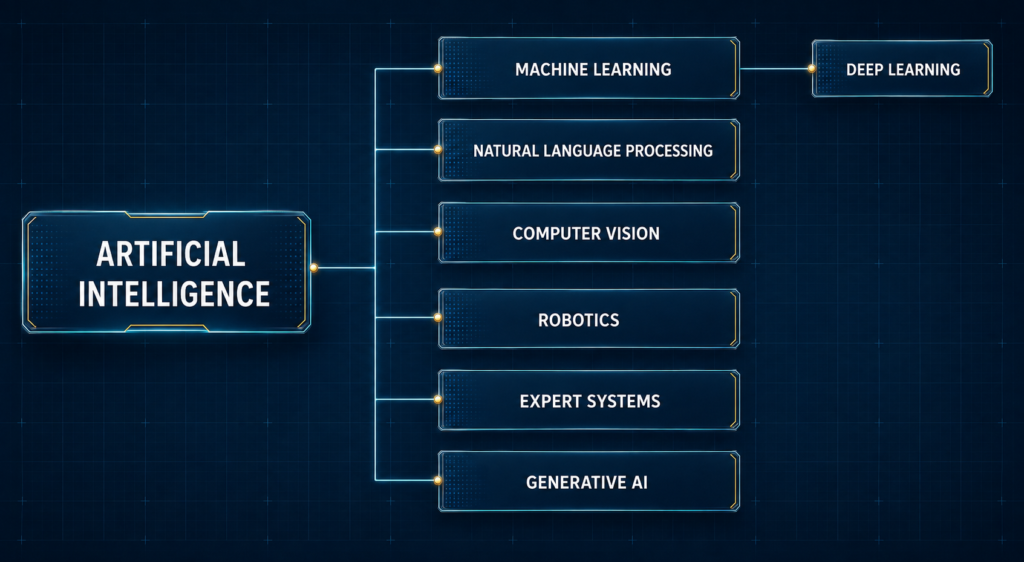
AI does not represent a single machine or technology. It is a broad field containing many different approaches, including machine learning, deep learning, natural language processing, computer vision, robotics and generative AI.
Artificial Intelligence: Simple Definition
📘 Simple Definition
Artificial intelligence is the ability of a computer system to perform tasks that usually require human intelligence, such as learning, reasoning, recognising patterns, understanding language and making decisions.
The word “intelligence” can sometimes create the wrong impression. Most current AI systems do not think, feel or understand the world in the same way humans do. They process information through algorithms, mathematical models, programmed rules and patterns learned from data.
How Is an AI System Officially Defined?
There is no single definition of artificial intelligence accepted in every academic, technical and legal context. Definitions have changed as AI capabilities and applications have developed.
The Organisation for Economic Co-operation and Development defines an AI system as a machine-based system that uses received input to infer how to generate outputs such as predictions, content, recommendations or decisions. These outputs may influence physical or virtual environments.
The definition also recognises that AI systems differ in their levels of autonomy and their ability to adapt after deployment. Readers can examine the complete OECD definition of an AI system for its policy and technical context.
How Does an AI System Work?
An AI system generally moves through three basic stages:
- Input: The system receives data, instructions, images, speech, text or information from sensors.
- Processing: Algorithms or trained models analyse the input and identify relevant patterns or relationships.
- Output: The system generates a prediction, recommendation, decision, classification, response or action.
For example, an image-recognition system receives a photograph as input. A trained model processes visual patterns such as shapes, colours and edges before producing an output that identifies the object shown in the image.
A voice assistant follows a similar process. It receives spoken language, converts speech into machine-readable information, interprets the user’s intention and produces an answer or action.
The Main Elements of an AI System
Although AI systems can vary greatly, most contain several common elements.
Data
Data provides examples or information from which an AI system can learn or make decisions. It may include text, numbers, images, videos, audio recordings, sensor measurements or human feedback.
Algorithms
An algorithm is a set of instructions or mathematical procedures used to process information and solve a particular problem.
AI Model
An AI model is a mathematical system created through training. It uses learned patterns to generate predictions, classifications, decisions or content.
Computing Infrastructure
AI systems require computing resources such as CPUs, GPUs, TPUs, memory, storage and network infrastructure. The amount of computing power needed depends on the model’s size and purpose.
Human Direction
People define the problem, select data, design or choose algorithms, evaluate results and decide how an AI system should be used. Even highly automated AI systems begin with human-created goals, choices and constraints.
Artificial Intelligence vs Traditional Automation
Artificial intelligence and automation are related, but they are not identical.
| Artificial Intelligence | Traditional Automation |
|---|---|
| Can learn or identify patterns from data | Usually follows fixed instructions |
| May adjust its output according to new input | Repeats the same programmed process |
| Can work with uncertain or complex information | Works best with predictable conditions |
| May generate predictions or recommendations | Performs predefined actions |
| Examples include image recognition and chatbots | Examples include timers and fixed assembly-line controls |
A traditional automated system follows a clearly defined sequence of rules. An AI system may analyse data and select an output without every possible situation being programmed separately.
However, not every automated system uses AI, and not every AI system controls a physical process.
What Can Artificial Intelligence Do?
Modern AI systems can perform many specialised tasks, including:
- Recognising objects and faces in images
- Converting speech into text
- Translating between languages
- Recommending products, films or music
- Detecting unusual financial transactions
- Predicting equipment failures
- Assisting with medical-image analysis
- Generating text, images, audio, video and code
- Controlling certain robots and autonomous systems
- Analysing large scientific datasets
- Supporting search and information retrieval
- Personalising educational content
AI often performs best when it is designed for a clearly defined task and trained with relevant, high-quality data.
What Can Artificial Intelligence Not Do?
Current AI systems have important limitations:
- They may generate incorrect or unsupported information.
- They can reproduce bias found in their training data.
- They may fail when real-world situations differ from their training examples.
- They do not possess proven consciousness or human emotions.
- They may not understand context, intention or consequences as humans do.
- They require human monitoring in important applications.
- They cannot guarantee fair, safe or accurate decisions in every situation.
Fluent language or realistic images should not be confused with human-level understanding. An AI model may generate a convincing response without knowing whether the information is true.
Is Artificial Intelligence the Same as Human Intelligence?
Artificial intelligence is inspired partly by human abilities, but it does not reproduce the complete human mind. Human intelligence includes consciousness, emotion, physical experience, social understanding, moral judgement and knowledge gained from living in the real world.
Current AI systems usually specialise in limited tasks. A chess program may defeat the strongest human players but cannot independently perform the full range of activities handled by an ordinary person.
This is why most present-day AI is classified as Narrow AI rather than Artificial General Intelligence.
Why Is Artificial Intelligence Important?
Artificial intelligence can process large amounts of information, automate repetitive tasks and identify patterns that may be difficult for people to detect manually. These capabilities make it valuable in education, healthcare, science, banking, manufacturing, agriculture, transportation, communication and many other fields.
Its importance also comes with responsibility. Decisions about training data, system design, privacy, fairness, security and human oversight can significantly affect individuals and society.
For a more detailed beginner-level explanation, readers can visit What Is Artificial Intelligence? Complete AI Guide.
Main Types of Artificial Intelligence
Artificial intelligence can be classified in different ways according to its capabilities, functionality and method of operation. These classifications help explain what present-day AI can do and how it differs from theoretical forms of machine intelligence.
Types of AI Based on Capability
1. Artificial Narrow Intelligence
Artificial Narrow Intelligence, also called Narrow AI or Weak AI, is designed to perform a specific task or a limited group of related tasks. Nearly every AI system currently in practical use belongs to this category.
Search engines, recommendation systems, facial recognition software, navigation applications, voice assistants and generative AI tools are examples of Narrow AI. Some of these systems can perform their assigned tasks extremely well, but they cannot independently apply their abilities to every intellectual problem.
2. Artificial General Intelligence
Artificial General Intelligence, commonly known as AGI, refers to a proposed machine capable of learning, reasoning and solving a wide range of problems at a level comparable to human intelligence.
An AGI system would be able to transfer knowledge from one field to another instead of remaining limited to a particular task. No scientifically verified AGI system currently exists, and researchers do not agree on when or whether it will be achieved.
3. Artificial Superintelligence
Artificial Superintelligence, or ASI, describes a hypothetical form of AI that would exceed human intellectual abilities across nearly every important field, including science, creativity, reasoning and strategic decision-making.
ASI remains a speculative idea rather than an existing technology. Discussions about it commonly focus on future possibilities, control, safety and its potential effects on humanity.
| AI Type | Main Capability | Present Status | Example |
|---|---|---|---|
| Narrow AI | Performs specialised tasks | Exists today | Recommendation system |
| General AI | Could perform many intellectual tasks | Not yet achieved | No verified example |
| Superintelligence | Would exceed human intelligence broadly | Hypothetical | No existing example |
Types of AI Based on Functionality
Another commonly used classification divides AI into reactive machines, limited-memory systems, theory-of-mind AI and self-aware AI. This framework is useful for learning, although it is not a universally binding scientific standard.
Reactive Machines
Reactive machines respond only to the information available at the present moment. They do not build a lasting memory of previous experiences.
IBM’s Deep Blue, which defeated world chess champion Garry Kasparov in 1997, is a well-known example. It analysed possible chess moves but did not understand the game in the human sense.
Limited-Memory AI
Limited-memory AI uses historical or recently collected data to make decisions and predictions. Most modern machine-learning systems operate within this broad category.
Fraud-detection systems, recommendation engines and some technologies used in autonomous vehicles examine past or recent information to determine an appropriate output. Their memory and understanding remain limited to their design and training.
Theory-of-Mind AI
Theory-of-mind AI would be able to recognise human emotions, intentions, beliefs and social expectations with a deeper level of understanding.
Current AI can detect emotional patterns or imitate empathetic language, but this does not prove that it genuinely understands another person’s mental state.
Self-Aware AI
Self-aware AI would possess consciousness and an understanding of its own existence. No scientific evidence confirms that any present AI system has self-awareness, feelings or consciousness.
This concept currently belongs mainly to theoretical research, philosophy and science fiction.
Major Approaches to Building AI
Symbolic AI
Symbolic AI represents knowledge through rules, symbols and logical relationships. It played an important role in early AI research and remains useful when decisions must follow clearly defined rules.
Expert systems developed during the 1970s and 1980s were major examples of this approach.
Machine-Learning AI
Machine-learning systems identify patterns from data instead of depending entirely on rules written by programmers. This approach supports applications such as image recognition, language processing, medical prediction and fraud detection.
Connectionist AI
Connectionist AI is inspired loosely by networks of neurons in the brain. Artificial neural networks and deep-learning systems belong to this approach.
Modern language models, speech-recognition systems and many image generators use large neural networks.
Hybrid AI
Hybrid AI combines two or more approaches, such as machine learning, symbolic reasoning, search and human-defined rules. The aim is to use the strengths of different methods within one system.
For example, a medical decision-support system may combine patterns learned from patient data with established clinical rules.
Predictive AI and Generative AI
Predictive AI estimates a likely result using existing data. It may forecast product demand, detect suspicious transactions or estimate the probability of equipment failure.
Generative AI produces new content, including text, images, audio, video and computer code. It learns statistical patterns from training data and uses them to create new outputs in response to instructions.
The two categories can overlap. A generative model predicts suitable elements while creating content, and an advanced business system may use both prediction and generation.
| Predictive AI | Generative AI |
|---|---|
| Estimates likely outcomes | Produces new content |
| Commonly used in forecasting and classification | Commonly used in writing, design, coding and media creation |
| Output may be a score, category or prediction | Output may be text, an image, audio, video or code |
| Example: credit-risk prediction | Example: AI-generated article summary |
Are Chatbots and Large Language Models AGI?
Chatbots and large language models can answer questions, write content, translate languages and assist with many tasks. Their broad range of outputs can make them appear generally intelligent.
However, performing several language-based tasks does not establish human-level general intelligence. These systems can generate incorrect information, lack reliable real-world understanding and depend on training data, computational systems and human instructions. Therefore, present-day chatbots should not automatically be described as AGI.
Readers interested in how these technologies may develop can explore the Future of Artificial Intelligence.
History and Evolution of Artificial Intelligence
Artificial intelligence did not emerge from a single invention. It developed gradually through contributions from mathematics, philosophy, psychology, neuroscience, computer science and engineering. Its history includes periods of rapid progress, reduced funding, technological breakthroughs and renewed public interest.
Early Ideas About Intelligent Machines
The idea of artificial beings capable of thought or action appeared in ancient myths and mechanical inventions long before electronic computers existed. However, the scientific foundations of AI began to form through developments in logic, mathematics and computation.
In 1843, English mathematician Ada Lovelace wrote about the analytical capabilities of Charles Babbage’s proposed Analytical Engine. She recognised that such a machine might work with symbols as well as numbers, although she did not claim that it could independently create ideas.
In 1854, British mathematician George Boole published An Investigation of the Laws of Thought. His system of Boolean logic later became fundamental to digital computing and computer programming.
Alan Turing and the Question of Machine Intelligence
British mathematician Alan Turing made major contributions to theoretical computer science. In his 1950 paper, Computing Machinery and Intelligence, he asked, “Can machines think?”
Turing proposed what later became known as the Turing Test. In this test, a human evaluator communicates through text with both a person and a machine. If the evaluator cannot reliably distinguish between them, the machine may be considered capable of convincing human-like conversation.
The test evaluates observable conversational behaviour; it does not prove that a machine possesses consciousness or genuine human understanding.
When Was the Term Artificial Intelligence Created?
The term “artificial intelligence” was proposed by American computer scientist John McCarthy for the Dartmouth Summer Research Project on Artificial Intelligence, held in the United States in 1956.
The workshop was organised by John McCarthy, Marvin Minsky, Nathaniel Rochester and Claude Shannon. It brought together researchers interested in machine reasoning, language, learning and problem-solving.
The Dartmouth workshop is widely regarded as a founding event of AI as an academic field, although important research related to intelligent machines had already begun earlier.
Early AI Programs
Several influential computer programs appeared during the first decades of AI research.
In 1956, Allen Newell, Herbert A. Simon and Cliff Shaw developed Logic Theorist. The program proved mathematical theorems and is often described as one of the earliest successful AI programs.
In 1957, American psychologist Frank Rosenblatt introduced the perceptron, an early model of an artificial neural network. It could learn to classify simple patterns using adjustable numerical connections.
In 1958, John McCarthy created Lisp, a programming language that became widely used in AI research for several decades.
Between 1964 and 1966, Joseph Weizenbaum developed ELIZA at the Massachusetts Institute of Technology. The program imitated conversation by matching patterns in users’ statements. ELIZA did not understand language, but some users still felt that it understood them—an effect now known as the ELIZA effect.
The Rise of Expert Systems
During the 1960s and 1970s, researchers developed expert systems that used collections of rules to imitate decision-making within specialised fields.
DENDRAL, developed at Stanford University, helped scientists analyse chemical structures. MYCIN, created during the 1970s, was designed to recommend treatments for certain bacterial infections.
These systems demonstrated that computers could support specialised decisions. However, building and maintaining their rule bases required significant human effort, and their knowledge could not easily transfer to unrelated problems.
What Were the AI Winters?
An AI winter is a period in which enthusiasm, investment and research funding decline because technological results fail to meet earlier expectations.
The first major AI winter occurred mainly during the 1970s. Computers had limited processing power and memory, while many promised capabilities remained beyond practical reach.
A second downturn began in the late 1980s and continued into the early 1990s. The commercial expert-system market weakened, specialised AI computers became less competitive and organisations reduced investment.
AI research did not completely stop during these periods. Important work continued in universities, government laboratories and specialised industries.
The Return of Machine Learning
AI research regained momentum as computers became faster and larger digital datasets became available. Researchers increasingly focused on machine learning, in which systems identify patterns from examples instead of relying only on manually written rules.
In 1997, IBM’s Deep Blue defeated reigning world chess champion Garry Kasparov in a six-game match. This demonstrated the power of specialised computation and search, but Deep Blue was not a generally intelligent machine.
During the 2000s, improved processors, internet-scale data and advances in statistical learning supported progress in speech recognition, recommendation systems, computer vision and language technologies.
The Deep-Learning Breakthrough
Deep learning uses artificial neural networks containing multiple processing layers. Although neural networks had existed for decades, larger datasets and more powerful computing hardware made them significantly more effective.
In 2012, Alex Krizhevsky, Ilya Sutskever and Geoffrey Hinton developed AlexNet. It achieved a major improvement in the ImageNet image-recognition competition and helped accelerate the adoption of deep learning.
Deep learning subsequently produced important advances in image recognition, speech processing, translation, scientific research and autonomous systems.
AlphaGo and Complex Decision-Making
In March 2016, Google DeepMind’s AlphaGo defeated South Korean Go champion Lee Sedol by four games to one.
Go has an enormous number of possible positions, making it difficult to solve through simple exhaustive search. AlphaGo combined deep neural networks, reinforcement learning and tree-search methods.
The victory became an important milestone because it demonstrated that AI could master a complex strategic game previously considered extremely difficult for computers.
The Emergence of Transformer Models
In 2017, researchers at Google published the paper Attention Is All You Need. It introduced the Transformer architecture, which processes relationships between words and other data elements through an attention mechanism.
Transformers improved the ability of AI systems to process long sequences and became the foundation of many modern large language models. Related architectures are also used in computer vision, audio processing, scientific research and multimodal AI.
The Generative AI Era
Generative AI became widely accessible to the public during the early 2020s. Text generators, image generators, coding assistants and other creative tools allowed people to interact with advanced AI through natural-language instructions.
These systems can produce highly useful content, but they may also generate inaccurate information, reproduce bias or create misleading material. Their rapid adoption has therefore increased interest in AI governance, copyright, transparency, safety and responsible use.
For a more detailed chronology of researchers, inventions and major events, read the History of Artificial Intelligence.
Major Milestones in Artificial Intelligence
| Year | Milestone | Person or Organisation | Country |
|---|---|---|---|
| 1843 | Notes on the Analytical Engine | Ada Lovelace | United Kingdom |
| 1950 | Turing’s paper on machine intelligence | Alan Turing | United Kingdom |
| 1956 | Dartmouth AI workshop | John McCarthy and other researchers | United States |
| 1957 | Perceptron introduced | Frank Rosenblatt | United States |
| 1964–1966 | ELIZA developed | Joseph Weizenbaum, MIT | United States |
| 1997 | Deep Blue defeated Garry Kasparov | IBM | United States |
| 2012 | AlexNet transformed image recognition | University of Toronto researchers | Canada |
| 2016 | AlphaGo defeated Lee Sedol | Google DeepMind | United Kingdom |
| 2017 | Transformer architecture introduced | Google researchers | United States |
| Early 2020s | Generative AI reached mass public use | Multiple organisations | Global |
The history of AI shows that progress is rarely continuous. New ideas may exist for decades before sufficient data, computing power and engineering methods make them practical.
Key Pioneers and Contributors to Artificial Intelligence
Artificial intelligence developed through the combined work of mathematicians, computer scientists, psychologists, engineers and philosophers. No single individual invented AI; different researchers contributed theories, algorithms, programming languages, datasets and practical systems.
Alan Turing
Alan Turing was a British mathematician whose work helped establish the foundations of computer science. In 1936, he described an abstract computing device now known as the Turing machine.
His 1950 paper, Computing Machinery and Intelligence, introduced the imitation game, later called the Turing Test. Turing’s work shaped early discussions about computation, intelligence and the possibility of thinking machines.
John McCarthy
American computer scientist John McCarthy coined the term “artificial intelligence” in the proposal for the 1956 Dartmouth workshop.
In 1958, he created Lisp, which became one of the most important programming languages used in early AI research. He also contributed to time-sharing systems, logical reasoning and the concept of computing as a public utility.
Marvin Minsky
Marvin Minsky was an American cognitive scientist and one of the organisers of the Dartmouth AI workshop. He co-founded the Massachusetts Institute of Technology’s Artificial Intelligence Laboratory with John McCarthy in 1959.
Minsky studied neural networks, machine perception, robotics and theories of human cognition. His 1985 book The Society of Mind presented intelligence as the result of interactions among many simpler processes.
Allen Newell and Herbert A. Simon
American researchers Allen Newell and Herbert A. Simon, working with programmer Cliff Shaw, developed Logic Theorist in 1956 and General Problem Solver in the late 1950s.
Their work explored how computers could use symbols, rules and search procedures to solve problems. Simon later received the 1978 Nobel Memorial Prize in Economic Sciences for his research on decision-making within organisations.
Claude Shannon
American mathematician and electrical engineer Claude Shannon established information theory through his influential 1948 paper, A Mathematical Theory of Communication.
Shannon also investigated how machines could play chess. His work on information, logic and communication influenced computing, telecommunications and artificial intelligence.
Norbert Wiener
American mathematician Norbert Wiener developed the field of cybernetics, which studies control and communication in animals and machines.
His 1948 book Cybernetics explained how feedback allows systems to adjust their behaviour. Feedback remains an important principle in robotics, automation and intelligent control systems.
Frank Rosenblatt
American psychologist Frank Rosenblatt introduced the perceptron in 1957 while working at the Cornell Aeronautical Laboratory.
The perceptron was an early learning algorithm inspired by biological neurons. Although the original model had serious limitations, its central ideas contributed to the later development of artificial neural networks.
Arthur Samuel
American computer scientist Arthur Samuel developed a self-learning checkers program during the 1950s and 1960s while working at IBM.
He popularised the term “machine learning” in 1959. His program improved through experience, demonstrating that a computer could learn strategies without every move being directly programmed.
Joseph Weizenbaum
German-American computer scientist Joseph Weizenbaum developed ELIZA at MIT between 1964 and 1966.
ELIZA imitated a psychotherapist by transforming users’ statements into questions. Weizenbaum later warned against giving computers responsibility for decisions that require human judgement, compassion and moral understanding.
Edward Feigenbaum
American computer scientist Edward Feigenbaum played a major role in developing expert systems. He worked on DENDRAL, a Stanford project that used specialised knowledge to help analyse chemical compounds.
Feigenbaum promoted the idea that expert-level performance often depends on detailed knowledge of a particular field. He is frequently described as one of the pioneers of knowledge engineering.
Lotfi A. Zadeh
Lotfi A. Zadeh, an Azerbaijani-born American scientist, introduced fuzzy set theory in 1965 while working at the University of California, Berkeley.
Fuzzy logic allows systems to work with degrees of truth instead of only completely true or false conditions. It has been applied in control systems, household appliances, industrial equipment and decision-support technologies.
Judea Pearl
Judea Pearl is an Israeli-American computer scientist known for advancing probabilistic reasoning and causal inference.
His work on Bayesian networks helped AI systems represent uncertainty and relationships among events. His later research explained how data and assumptions can be used to investigate cause-and-effect relationships, not merely correlations.
Geoffrey Hinton
British-Canadian computer scientist Geoffrey Hinton made major contributions to artificial neural networks and deep learning.
His research helped improve methods for training multilayer neural networks. Hinton and his students also contributed to the 2012 AlexNet breakthrough, which demonstrated the effectiveness of deep learning in image recognition.
Yann LeCun
French-American computer scientist Yann LeCun pioneered convolutional neural networks, commonly known as CNNs.
During the late 1980s and 1990s, his work helped develop systems capable of recognising handwritten characters. CNNs later became fundamental to computer vision, medical imaging, facial recognition and object detection.
Yoshua Bengio
Canadian computer scientist Yoshua Bengio has made important contributions to deep learning, neural language models and representation learning.
In 2018, Bengio, Geoffrey Hinton and Yann LeCun received the ACM A.M. Turing Award for conceptual and engineering breakthroughs that made deep neural networks an important component of modern computing.
Richard Sutton and Andrew Barto
Richard Sutton and Andrew Barto are leading contributors to reinforcement learning, in which an agent learns through actions, feedback and rewards.
Their textbook Reinforcement Learning: An Introduction, first published in 1998, helped establish a common foundation for the field. Reinforcement learning is now used in robotics, games, resource management and AI system optimisation.
Fei-Fei Li
Chinese-American computer scientist Fei-Fei Li is known for her work in computer vision and for leading the development of ImageNet.
ImageNet organised millions of labelled images into thousands of categories. The ImageNet competitions encouraged rapid progress in image-recognition systems, particularly after the success of AlexNet in 2012.
Demis Hassabis
British computer scientist and neuroscientist Demis Hassabis co-founded DeepMind in London in 2010.
DeepMind developed systems including AlphaGo and AlphaFold. AlphaFold achieved major advances in predicting the three-dimensional structures of proteins, demonstrating how AI can contribute to scientific discovery.
Timnit Gebru
Eritrean-American computer scientist Timnit Gebru is known for research on algorithmic bias, dataset documentation and responsible AI.
Her work has highlighted how facial-analysis systems and large datasets can reproduce social inequalities. She also co-developed the “Datasheets for Datasets” framework, which encourages researchers to document how datasets are created and used.
Joy Buolamwini
Ghanaian-American computer scientist Joy Buolamwini founded the Algorithmic Justice League in 2016.
Her research demonstrated performance differences in commercial gender-classification systems across skin tones and genders. This work increased public awareness of bias, representation and accountability in facial-analysis technologies.
Important AI Contributors at a Glance
| Contributor | Major Contribution | Associated Country |
|---|---|---|
| Alan Turing | Foundations of computing and the Turing Test | United Kingdom |
| John McCarthy | Term “artificial intelligence” and Lisp | United States |
| Marvin Minsky | Early AI research and cognitive theories | United States |
| Claude Shannon | Information theory and machine chess | United States |
| Frank Rosenblatt | Perceptron | United States |
| Arthur Samuel | Early machine learning program | United States |
| Lotfi A. Zadeh | Fuzzy logic | United States |
| Judea Pearl | Bayesian networks and causal inference | United States |
| Geoffrey Hinton | Neural networks and deep learning | United Kingdom/Canada |
| Yann LeCun | Convolutional neural networks | France/United States |
| Yoshua Bengio | Deep learning and representation learning | Canada |
| Fei-Fei Li | ImageNet and computer vision | China/United States |
| Demis Hassabis | AlphaGo and AlphaFold | United Kingdom |
| Timnit Gebru | Algorithmic bias and dataset accountability | Eritrea/United States |
| Joy Buolamwini | Research on facial-analysis bias | Ghana/United States |
These researchers represent only part of AI’s history. Thousands of scientists, engineers, institutions and open-source communities worldwide have contributed to the development of modern artificial intelligence.
Major Branches and Technologies of Artificial Intelligence
Artificial intelligence is a broad field containing several connected branches. Each branch focuses on a particular ability, such as learning from data, understanding language, recognising images, making decisions or controlling machines.
Machine Learning
Machine learning is a branch of AI that enables computer systems to learn patterns from data. Instead of receiving separate instructions for every possible situation, a machine-learning model improves its performance by studying examples.
Machine learning is commonly used in spam filtering, fraud detection, medical diagnosis, product recommendations, demand forecasting and search engines.
The three principal types of machine learning are:
- Supervised learning: The model learns from labelled examples containing known answers.
- Unsupervised learning: The model searches for patterns or groups in unlabelled data.
- Reinforcement learning: The system learns through actions, rewards and penalties.
Deep Learning
Deep learning is a specialised form of machine learning based on artificial neural networks with multiple processing layers. These layers learn increasingly complex features from large amounts of data.
For example, an image-recognition system may first detect edges, then shapes, objects and complete scenes. Deep learning supports facial recognition, speech processing, language translation, autonomous driving and generative AI.
It can produce powerful results, but usually requires substantial data, computing resources and energy. Its internal decision-making process can also be difficult to explain.
Artificial Neural Networks
An artificial neural network is a mathematical computing system inspired loosely by the structure of biological neural networks. It contains interconnected units commonly called artificial neurons or nodes.
A typical neural network contains:
- An input layer that receives information
- One or more hidden layers that process patterns
- An output layer that produces the result
- Weights that represent the strength of connections
- An activation function that determines how signals move forward
Artificial neural networks do not reproduce the full structure or consciousness of a human brain. They are mathematical models designed to recognise and process statistical patterns.
Natural Language Processing
Natural language processing, or NLP, enables computers to analyse, interpret and generate human language.
NLP is used in translation services, search engines, chatbots, voice assistants, grammar checkers, sentiment analysis, text summarisation and question-answering systems.
Human language is difficult for computers because words can have different meanings depending on context, culture, tone and intention. Sarcasm, humour, idioms and regional expressions remain particularly challenging.
Computer Vision
Computer vision enables machines to extract useful information from images and videos. It combines image processing, machine learning and deep learning.
Important computer-vision tasks include:
- Image classification
- Object detection
- Facial analysis
- Optical character recognition
- Medical-image analysis
- Video tracking
- Scene understanding
Computer vision is used in healthcare, manufacturing, agriculture, security, transportation and satellite-image analysis. Its accuracy depends heavily on the quality and diversity of the training data.
Robotics
Robotics is the field concerned with designing, building and controlling machines that can perform physical tasks. A robot may use AI, but not every robot is artificially intelligent.
Traditional industrial robots often follow fixed instructions. AI-powered robots may use sensors, computer vision and machine learning to recognise objects, plan movements and respond to changing surroundings.
Robots are used in factories, warehouses, hospitals, farms, disaster zones, laboratories, homes and space missions.
Expert Systems
An expert system uses a collection of facts and rules to imitate the decision-making process of a specialist within a limited field.
A traditional expert system generally contains:
- A knowledge base containing facts and rules
- An inference engine that applies the rules
- A user interface for entering questions and receiving recommendations
- An explanation mechanism that may describe how a conclusion was reached
Expert systems were especially influential during the 1970s and 1980s. They remain useful in some rule-based applications, but updating their knowledge manually can be difficult and expensive.
Knowledge Representation and Reasoning
Knowledge representation concerns the way facts, objects, events and relationships are stored so that a computer can use them.
Common methods include logic, rules, semantic networks, ontologies and knowledge graphs. Reasoning systems use this organised knowledge to draw conclusions, answer questions or detect inconsistencies.
Google introduced its Knowledge Graph in 2012 to connect information about people, places and other entities. Knowledge graphs are also used in scientific research, enterprise search, recommendation systems and fraud investigation.
Fuzzy Logic
Traditional digital logic usually treats a statement as either true or false. Fuzzy logic allows intermediate values, making it useful when a situation cannot be described through strict boundaries.
For example, temperature may be described as slightly warm, moderately hot or very hot instead of being placed into only two categories.
Lotfi A. Zadeh introduced fuzzy set theory in 1965. Fuzzy logic has since been applied in cameras, washing machines, vehicle-control systems and industrial equipment.
Evolutionary Computing
Evolutionary computing uses methods inspired by biological evolution. Candidate solutions are created, evaluated and modified over several generations.
Genetic algorithms are a well-known example. They use processes comparable to selection, mutation and recombination to search for effective solutions.
Evolutionary methods are applied to scheduling, engineering design, route planning, optimisation and scientific modelling.
Reinforcement Learning
Reinforcement learning trains an agent to make decisions by interacting with an environment. The agent performs an action, receives feedback and gradually learns a strategy that can increase its total reward.
Its main elements are:
- Agent: The decision-making system
- Environment: The world in which the agent operates
- State: The current situation
- Action: A choice made by the agent
- Reward: Feedback received after an action
- Policy: The strategy used to select actions
Reinforcement learning has been used in games, robotics, traffic control, resource management and data-centre optimisation. Poorly designed rewards can cause a system to learn unintended behaviour.
Generative Artificial Intelligence
Generative AI creates new content by learning patterns and relationships from training data. Its outputs can include text, images, music, speech, video, computer code and synthetic data.
Major types of generative models include:
- Large language models
- Generative adversarial networks
- Variational autoencoders
- Diffusion models
- Multimodal models
Generative AI does not normally retrieve a perfect copy of a stored answer. It produces output by calculating likely patterns, which is why its responses can be original-looking but also inaccurate.
Large Language Models
A large language model, or LLM, is trained on extensive collections of text and other data to process and generate language.
Many modern LLMs use the Transformer architecture introduced in 2017. They divide text into smaller units called tokens and predict suitable sequences according to patterns learned during training.
LLMs can support writing, translation, coding, research and education. However, they may produce fabricated facts, outdated information, biased content or unreliable references. Important outputs therefore require human verification.
Speech Recognition and Speech Synthesis
Automatic speech recognition converts spoken language into text. It is used in voice typing, transcription, call centres, accessibility tools and virtual assistants.
Speech synthesis, also called text-to-speech, converts written text into artificial speech. Modern systems can generate natural-sounding voices in multiple languages and speaking styles.
These technologies improve accessibility, but synthetic voices can also be misused for impersonation and audio deepfakes.
Planning and Search
AI planning involves identifying a sequence of actions needed to reach a particular goal. Search algorithms examine possible choices and select a suitable route or solution.
These methods are used in navigation, game playing, logistics, scheduling and robotics. The A* search algorithm, formally described by Peter Hart, Nils Nilsson and Bertram Raphael in 1968, remains an important method for finding efficient paths.
Multimodal AI
Multimodal AI can process or generate more than one type of information, such as text, images, audio and video.
For example, a multimodal system may examine an image, answer questions about it and produce a written description. It may also convert spoken instructions into text or create an image from a written prompt.
Combining several forms of data can make AI more useful, but it also introduces additional risks involving privacy, copyright, misinterpretation and manipulated media.
Major AI Branches at a Glance
| AI Branch | Primary Function | Common Application |
|---|---|---|
| Machine learning | Learns patterns from data | Fraud detection |
| Deep learning | Learns complex features through neural networks | Image recognition |
| Natural language processing | Processes human language | Translation |
| Computer vision | Interprets images and videos | Medical imaging |
| Robotics | Performs physical actions | Warehouse automation |
| Expert systems | Applies specialist rules | Decision support |
| Knowledge representation | Organises facts and relationships | Knowledge graphs |
| Fuzzy logic | Works with degrees of truth | Industrial control |
| Reinforcement learning | Learns from rewards and penalties | Robot navigation |
| Generative AI | Creates new content | Text and image generation |
| Speech AI | Processes or generates spoken language | Voice assistants |
| Multimodal AI | Combines multiple data types | Visual question answering |
These branches frequently work together. An autonomous vehicle, for example, may combine computer vision, deep learning, reinforcement learning, mapping, planning and robotics within a single system.
Short explanations of related terminology are also available in the AI Glossary: 100 Essential Artificial Intelligence Terms.
How Artificial Intelligence Works
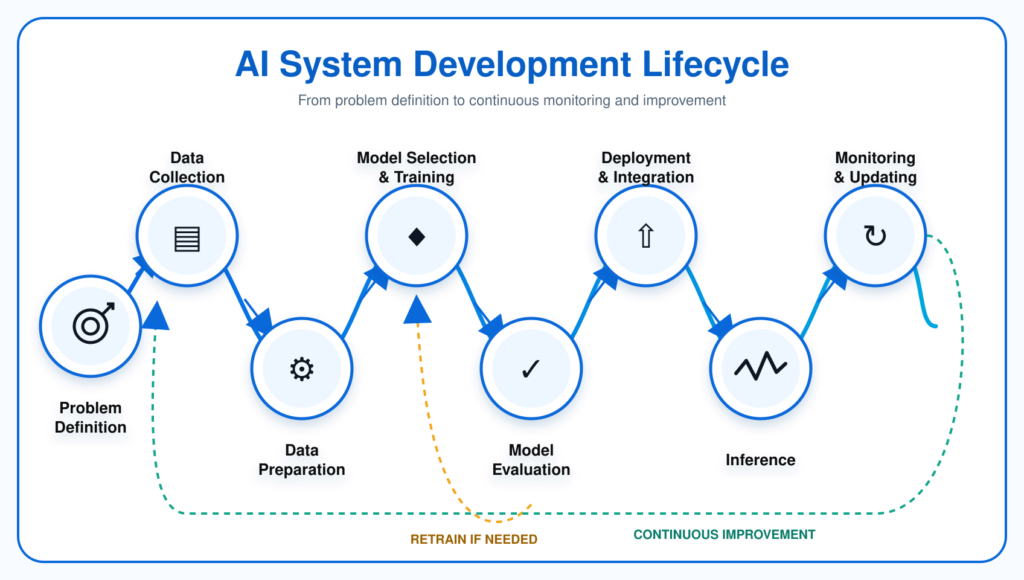
Artificial intelligence works by combining data, algorithms, mathematical models and computing resources. The exact process depends on the type of system, but most modern AI projects follow a common lifecycle from problem definition to monitoring.
1. Defining the Problem
The first step is to identify the task that the AI system should perform. A clearly defined objective helps determine what data, model and evaluation method will be required.
Examples include identifying fraudulent payments, predicting equipment failure, translating a document or detecting a disease in a medical image.
AI should be used only when it is suitable for the problem. A simple formula or rule-based program may sometimes be more reliable, affordable and easier to explain.
2. Collecting Data
Data provides the examples from which a machine-learning system learns. It may come from documents, databases, sensors, cameras, websites, surveys, transactions or scientific instruments.
Training data should be relevant, sufficiently representative and legally collected. Incomplete or unbalanced data can cause unreliable or discriminatory results.
3. Preparing and Labelling Data
Raw data often contains missing values, duplicate records, incorrect labels and inconsistent formats. Data preparation improves its quality before it is used for training.
Common preparation tasks include:
- Removing duplicate or corrupted records
- Correcting formatting problems
- Handling missing information
- Converting data into a usable format
- Protecting personal information
- Labelling examples when required
- Checking whether different groups are adequately represented
In supervised learning, labels provide the expected answer. For example, medical images may be labelled according to whether they show a particular condition.
4. Selecting an Algorithm
An algorithm is a set of procedures used to identify patterns or solve a problem. The appropriate algorithm depends on the data, objective, required accuracy and need for explainability.
A decision tree may be suitable for an interpretable classification task, while a deep neural network may be more effective for recognising complex patterns in images or speech.
5. Dividing the Dataset
A dataset is commonly divided into separate groups so that the model can be trained and evaluated fairly.
| Dataset Part | Purpose |
|---|---|
| Training set | Used to teach the model |
| Validation set | Used to adjust settings and compare model versions |
| Test set | Used to evaluate the final model on unseen data |
The test data should not be used to train the model. Otherwise, the evaluation may give an unrealistically high performance score.
6. Training the AI Model
During training, the model processes examples and adjusts its internal parameters to reduce errors. This process may be repeated many times.
In a neural network, the model produces an output, compares it with the expected result and calculates the difference through a loss function. An optimisation method then adjusts the model’s numerical weights.
Training a small model may require modest computing resources, while training a large deep-learning system can require specialised processors and substantial electricity.
7. Validating and Testing the Model
After training, the model is evaluated using data it has not previously seen. This helps determine whether it can perform reliably beyond its training examples.
The correct evaluation method depends on the task. Common measures include:
- Accuracy: The proportion of predictions that are correct
- Precision: How many positive predictions are actually correct
- Recall: How many relevant cases the model successfully identifies
- F1 score: A balance between precision and recall
- Mean absolute error: The average size of prediction errors
- Latency: The time required to produce an output
Accuracy alone can be misleading. If only one out of every hundred transactions is fraudulent, a model that labels every transaction as genuine would achieve 99 per cent accuracy while detecting no fraud.
8. Deploying the Model
Deployment makes a trained model available for practical use. It may operate inside a website, mobile application, medical device, vehicle, factory system or cloud service.
Deployment also requires security controls, documentation, access management and a method for reporting problems. High-risk uses may require human review before an AI-generated decision is accepted.
9. Inference
Inference occurs when a trained model receives new input and generates a prediction, classification or response.
For example, training teaches a spam filter how to recognise unwanted messages. Inference occurs each time the trained filter examines a newly received email.
Training and inference are therefore different stages: training develops the model, while inference uses it.
10. Monitoring and Updating
An AI model can become less reliable when real-world conditions change. This problem is often called model drift or data drift.
A fraud-detection model may lose effectiveness when criminals change their methods. A language model may become outdated when new events, laws or scientific findings emerge.
Organisations should monitor performance, security, bias and unexpected behaviour. A model may need to be retrained, adjusted, restricted or withdrawn if it no longer meets its intended purpose.
Important Components of an AI System
| Component | Role in the System |
|---|---|
| Data | Provides information and learning examples |
| Algorithm | Defines how patterns are identified |
| Model | Represents the patterns learned during training |
| Parameters | Internal numerical values adjusted during learning |
| Computing hardware | Performs calculations required for training and inference |
| Software infrastructure | Stores, processes and delivers the model |
| Human oversight | Defines goals, checks results and manages risks |
What Are Parameters and Hyperparameters?
Parameters are numerical values learned by a model during training. In a neural network, connection weights are examples of parameters.
Hyperparameters are settings chosen before or during the training process. They may include the learning rate, number of layers, batch size and number of training cycles.
A model with more parameters is not automatically more accurate, safer or more intelligent. Performance also depends on the architecture, training method, data quality and suitability for the task.
What Is Overfitting?
Overfitting occurs when a model learns its training data too closely, including noise and accidental patterns. It may perform extremely well on familiar examples but poorly on new data.
Underfitting is the opposite problem. It occurs when a model is too simple or insufficiently trained to learn the important patterns.
The aim is generalisation: the ability to perform effectively on new examples that were not included in training.
Why AI Can Produce Incorrect Results
An AI system may produce an incorrect result because of:
- Inaccurate, incomplete or biased training data
- Poorly selected algorithms or evaluation methods
- Situations that differ from the training examples
- Ambiguous user instructions
- Model limitations
- Software or hardware errors
- Deliberate manipulation of the input
- Changes in real-world conditions
AI output should therefore be treated as a result to evaluate, not as guaranteed truth. Human verification becomes especially important in healthcare, finance, law, education, employment and public administration.
AI System Lifecycle Summary
| Stage | Main Activity | Important Question |
|---|---|---|
| Problem definition | Establish the objective | Is AI suitable for this task? |
| Data collection | Obtain relevant information | Was the data collected responsibly? |
| Data preparation | Clean, label and organise data | Is the dataset representative? |
| Model training | Learn patterns from examples | Is the method appropriate? |
| Evaluation | Test performance and fairness | Does it work on unseen data? |
| Deployment | Introduce the system into practice | Are safeguards in place? |
| Inference | Generate results from new inputs | Is the output reliable? |
| Monitoring | Track performance and risks | Does the system need updating? |
Artificial intelligence is not produced by an algorithm alone. Reliable AI depends on the complete system, including its purpose, data, people, technical infrastructure, evaluation standards and continuing oversight.
Machine Learning Methods and Important Algorithms
Machine learning systems use different learning methods and algorithms according to the type of data and problem involved. Understanding these methods helps explain how AI systems classify information, make predictions and discover patterns.
Supervised Learning
Supervised learning uses labelled training data. Each example contains an input and its correct output, allowing the model to learn the relationship between them.
For example, a system may study thousands of emails labelled “spam” or “not spam”. After training, it can classify new emails.
Supervised learning is commonly used for:
- Medical diagnosis
- Credit-risk assessment
- Fraud detection
- Image classification
- Weather prediction
- Sales forecasting
Its two principal tasks are classification and regression.
Classification
Classification places information into predefined categories. Examples include identifying whether a transaction is fraudulent, an image contains a particular object or a message is positive or negative.
Regression
Regression predicts a numerical value. It can be used to estimate house prices, energy consumption, product demand or delivery time.
Unsupervised Learning
Unsupervised learning works with data that does not contain predetermined labels. The system attempts to discover structures, similarities or unusual patterns independently.
It is commonly used for:
- Customer segmentation
- Pattern discovery
- Anomaly detection
- Document grouping
- Data exploration
- Recommendation systems
Clustering
Clustering places similar data points into groups. A business may use it to identify customers with similar buying behaviour without defining those groups in advance.
Dimensionality Reduction
A dataset may contain hundreds or thousands of variables. Dimensionality reduction decreases this complexity while attempting to preserve the most important information.
Principal Component Analysis, commonly called PCA, is a well-known dimensionality-reduction technique. These methods can improve visualisation, reduce computing requirements and remove unnecessary features.
Semi-Supervised Learning
Semi-supervised learning uses a small amount of labelled data together with a larger amount of unlabelled data.
Labelling data can require considerable time and specialist knowledge. For example, qualified doctors may need to label medical images. Semi-supervised learning can make use of the remaining unlabelled images while reducing the amount of manual work required.
Self-Supervised Learning
Self-supervised learning creates learning signals from the data itself instead of depending entirely on human-provided labels.
A language model may hide part of a sentence and learn to predict the missing content. An image model may learn by comparing different views or modified versions of the same image.
Self-supervised learning has been important in the development of large language models and other foundation models because enormous unlabelled datasets are available.
Reinforcement Learning
Reinforcement learning involves an agent learning by interacting with an environment. The agent receives rewards or penalties based on its actions and attempts to develop a successful strategy.
Unlike supervised learning, it is not always given the correct action for every situation. It must explore possible actions and learn from their consequences.
A central challenge is balancing:
- Exploration: Trying unfamiliar actions to gain new information
- Exploitation: Choosing actions already known to produce useful rewards
Reinforcement learning has been used in games, robotics, industrial control and resource optimisation.
Transfer Learning
Transfer learning uses knowledge gained from one task to assist with another related task.
Instead of training an image-recognition model completely from the beginning, developers may start with a model already trained on a large image collection and adapt it to identify plant diseases or medical conditions.
Transfer learning can reduce training time, data requirements and computing costs.
Federated Learning
Federated learning trains a shared model across multiple devices or organisations without collecting all raw data in one central location.
Google introduced the term in a 2016 research paper and later applied the approach to mobile-device applications. Individual devices can calculate local updates that are combined to improve a central model.
Federated learning can support privacy, but it does not automatically eliminate privacy or security risks. Model updates may still require encryption, access controls and protection against manipulation.
Active Learning
Active learning allows a model to select the examples for which it most needs a correct label. A human expert then labels those particular examples.
This method can reduce the cost of data labelling in fields such as medical imaging, legal document analysis and scientific research.
Online Learning
Online learning updates a model continuously or gradually as new data becomes available. It is useful when information changes frequently.
Recommendation systems, fraud detection and real-time monitoring may benefit from online learning. However, new data must be checked carefully because incorrect or malicious examples could damage the model.
Common Machine Learning Algorithms
Linear Regression
Linear regression estimates the relationship between variables and predicts a numerical value. It is widely used because it is comparatively simple and interpretable.
For example, it may estimate electricity consumption using factors such as temperature, time and building size.
Logistic Regression
Despite its name, logistic regression is commonly used for classification. It calculates the probability that an example belongs to a particular category.
It may help predict whether a customer will cancel a service or whether a transaction requires further investigation.
Decision Trees
A decision tree makes predictions through a sequence of questions arranged like branches.
Decision trees are relatively easy to understand and explain. However, a single tree may overfit its training data and become unreliable on new examples.
Random Forest
A random forest combines predictions from multiple decision trees. Each tree learns from a different sample or selection of features.
Combining many trees often provides more stable results than relying on a single decision tree, although the complete system may be more difficult to interpret.
Support Vector Machines
A Support Vector Machine, or SVM, searches for a boundary that separates data into categories. It can be effective for classification problems involving small or medium-sized datasets.
SVMs have been used in text classification, image recognition and biological data analysis.
K-Nearest Neighbours
K-Nearest Neighbours, commonly written as KNN, classifies a new example by examining the most similar nearby examples in the dataset.
It is simple to understand but can become slow when the dataset is very large. Its performance also depends on how similarity or distance is measured.
Naive Bayes
Naive Bayes is a family of probabilistic algorithms based on Bayes’ theorem. It assumes that features are conditionally independent, an assumption that may not be fully true in real data.
Despite this simplification, it can perform effectively in spam detection, document classification and sentiment analysis.
K-Means Clustering
K-means is an unsupervised algorithm that divides data into a selected number of clusters.
The algorithm repeatedly assigns data points to the nearest cluster centre and recalculates those centres. The user must normally specify the number of clusters in advance, and different starting conditions may produce different results.
Neural Networks
Neural networks learn complex relationships through layers of interconnected numerical units. They are particularly effective for images, language, audio and other forms of high-dimensional data.
Major neural-network architectures include:
- Convolutional neural networks for visual data
- Recurrent neural networks for sequential data
- Transformers for language and multimodal data
- Autoencoders for representation learning
- Generative adversarial networks for content generation
Machine Learning Methods Compared
| Learning Method | Type of Data | Primary Purpose | Example |
|---|---|---|---|
| Supervised learning | Labelled | Predict a known category or value | Spam detection |
| Unsupervised learning | Unlabelled | Discover hidden patterns | Customer segmentation |
| Semi-supervised learning | Partly labelled | Learn with fewer manual labels | Medical-image analysis |
| Self-supervised learning | Labels created from the data | Learn general representations | Language-model training |
| Reinforcement learning | Interaction and rewards | Learn a decision strategy | Robot control |
| Transfer learning | Previously learned model | Adapt knowledge to a new task | Plant-disease detection |
| Federated learning | Distributed local data | Train without centralising raw data | Mobile keyboard prediction |
| Active learning | Selected human-labelled examples | Reduce labelling requirements | Scientific classification |
| Online learning | Continuously arriving data | Adapt to changing patterns | Fraud monitoring |
How Is the Best Algorithm Selected?
There is no single algorithm that is best for every problem. Selection depends on:
- The amount and quality of available data
- Whether the expected answer is known
- The type of output required
- The need for speed and scalability
- The cost of training and operation
- The importance of explainability
- Privacy and security requirements
- The consequences of an incorrect result
A complex deep-learning model may achieve higher accuracy, while a simpler decision tree may be easier to explain and manage. The most suitable choice depends on the real-world purpose, not merely on model size or technical popularity.
Generative AI, Foundation Models and Large Language Models
Generative artificial intelligence creates new content by learning patterns from existing data. Depending on its design and training, a generative AI system may produce text, images, speech, music, video, computer code, molecular structures or synthetic data.
These systems do not create content through human-like imagination. They generate outputs by calculating patterns and probabilities learned during training.
How Generative AI Works
A generative model studies relationships within a large dataset. During training, it learns how words, pixels, sounds or other data elements commonly appear together.
When a user provides an instruction, the model uses these learned patterns to generate an appropriate output. The instruction given to the system is commonly called a prompt.
The basic process includes:
- The user provides a prompt or other input.
- The system converts the input into numerical representations.
- The trained model calculates likely patterns or elements.
- The system generates an output.
- Safety filters or additional systems may check the result.
The generated output can be useful and convincing without necessarily being factually correct.
What Is a Foundation Model?
A foundation model is trained on broad datasets and can be adapted to many different tasks. Instead of building a completely separate model for each purpose, developers can modify or guide one foundation model for writing, classification, translation, analysis or content generation.
The term “foundation model” was popularised by researchers at Stanford University in 2021. Foundation models can support many applications, but problems in the original model may also affect every system built upon it.
What Is a Large Language Model?
A large language model, or LLM, is a type of foundation model designed primarily to understand and generate language.
An LLM learns statistical relationships among tokens. A token may represent a word, part of a word, punctuation mark or another unit of text. The model generates language by predicting suitable tokens in sequence.
The word “large” may refer to the number of model parameters, the amount of training data and the computing resources used. A larger model is not automatically more reliable, unbiased or appropriate for every task.
The Transformer Architecture
The Transformer architecture was introduced in the 2017 research paper Attention Is All You Need by a team of Google researchers.
Transformers use an attention mechanism to evaluate relationships among elements in a sequence. This allows the model to consider relevant context when processing or generating information.
Transformers became important because they can be trained efficiently on large datasets and can handle long-range relationships better than many earlier sequence-processing methods.
What Is an Attention Mechanism?
An attention mechanism helps a model assign different levels of importance to different parts of the input.
For example, when processing a sentence containing a pronoun, the model may examine earlier words to determine which person or object the pronoun refers to.
Attention improves context processing, but it does not prove that the system understands language in the same way as a human.
What Is a Generative Pre-Trained Transformer?
Generative Pre-Trained Transformer is the expanded form of GPT.
- Generative means that the model can produce new content.
- Pre-trained means that it learns broad patterns before being adapted or instructed for specific tasks.
- Transformer refers to the underlying neural-network architecture.
GPT is one family of language models. Other language models may use Transformer-based architectures without carrying the GPT name.
What Are Diffusion Models?
Diffusion models are generative models widely used for creating images and increasingly applied to audio, video and scientific data.
During training, noise is gradually added to data, and the model learns how to reverse this process. When generating an image, it begins with noise and gradually transforms it into a structured output related to the prompt.
Diffusion models can produce detailed visuals, but they may struggle with factual diagrams, precise text, exact object counts and consistent details.
What Are Generative Adversarial Networks?
Generative Adversarial Networks, commonly called GANs, were introduced by Ian Goodfellow and his colleagues in 2014.
A GAN generally contains two competing neural networks:
- A generator that creates artificial examples
- A discriminator that attempts to distinguish generated examples from real ones
Through this competition, the generator gradually improves. GANs have been used for image generation, image enhancement, style transfer and synthetic-data creation.
Training GANs can be unstable, and their ability to generate realistic media has raised concerns about deepfakes and misinformation.
What Are Variational Autoencoders?
A Variational Autoencoder, or VAE, learns a compressed representation of data and uses it to generate new examples.
VAEs are used in image generation, anomaly detection, data compression and scientific modelling. Their outputs may be less visually sharp than those of some other generative models, but their structured representation can be useful for controlled generation.
What Is Multimodal Generative AI?
Multimodal generative AI can process or create more than one type of content. A single system may work with text, images, audio and video.
A multimodal model may:
- Answer questions about an uploaded image
- Generate an image from a text description
- Describe the content of a video
- Convert speech into written text
- Create spoken responses
- Analyse documents containing text, charts and photographs
Multimodal systems expand the practical uses of AI but also increase concerns about privacy, copyright and manipulated media.
What Is Fine-Tuning?
Fine-tuning adapts a pre-trained model using additional examples related to a specific task or subject.
A general language model might be fine-tuned for customer support, document classification or scientific terminology. Fine-tuning can improve specialised performance, but poor-quality training examples may introduce new errors or biases.
What Is Prompt Engineering?
Prompt engineering is the process of designing instructions that help an AI system produce a more relevant and useful output.
An effective prompt may include:
- A clearly defined task
- Relevant background information
- The intended audience
- Required format
- Limitations or conditions
- Examples of the expected output
Prompt engineering can improve results, but it cannot remove all model limitations or guarantee factual accuracy.
What Is Retrieval-Augmented Generation?
Retrieval-Augmented Generation, commonly called RAG, connects a generative model with an external information source.
Before producing an answer, the system retrieves relevant material from documents, databases or search indexes. The model then uses this information while constructing its response.
RAG can provide more current and organisation-specific answers, but its reliability depends on the quality of retrieved sources. It can still misunderstand evidence, omit context or produce unsupported claims.
What Is AI Hallucination?
An AI hallucination occurs when a generative system produces incorrect, invented or unsupported information while presenting it in a convincing manner.
Examples include:
- Inventing a book, research paper or legal case
- Providing an incorrect date or statistic
- Attributing a quotation to the wrong person
- Creating a non-existent web link
- Describing an event that never occurred
Hallucinations occur because language models generate statistically suitable sequences rather than independently verifying every claim. Important information should be checked against reliable sources.
What Are AI Agents?
An AI agent is a software system designed to pursue a goal by observing information, selecting actions and using available tools.
An agent may search documents, call software services, update records or complete a sequence of tasks. Some agents also maintain temporary memory and revise their plans according to new results.
AI agents remain dependent on their instructions, permissions, tools and safeguards. Greater autonomy can increase usefulness, but it can also increase the consequences of errors.
What Is a Mixture-of-Experts Model?
A Mixture-of-Experts model contains several specialised internal components known as experts. A routing mechanism selects which experts should process a particular input.
Only part of the model may be activated for each task, potentially reducing the computing required during inference. The term “expert” refers to a technical model component, not necessarily a human-readable specialist.
Major Generative AI Technologies Compared
| Technology | Main Function | Common Use |
|---|---|---|
| Large language model | Generates and processes language | Writing and question answering |
| Diffusion model | Creates content through iterative denoising | Image and video generation |
| GAN | Uses competing neural networks | Synthetic images and enhancement |
| VAE | Learns compressed data representations | Generation and anomaly detection |
| Multimodal model | Processes multiple types of data | Image, audio and document analysis |
| RAG system | Adds retrieved external information | Knowledge-based assistants |
| Fine-tuned model | Adapts a model to a specialised task | Domain-specific applications |
| AI agent | Uses tools and actions to pursue a goal | Workflow automation |
Benefits and Limitations of Generative AI
Generative AI can accelerate drafting, brainstorming, coding, translation, design and information organisation. It can also improve accessibility by supporting text simplification, speech generation and multilingual communication.
However, generative AI may produce false information, reproduce bias, expose private data or create deceptive media. Questions involving ownership, copyright and responsibility are also still developing.
The technology is most useful when its output is reviewed by a person with sufficient knowledge of the subject. It should support human judgement rather than automatically replace it in important decisions.
Encyclopedia of Artificial Intelligence: Real-World Applications
This Encyclopedia of Artificial Intelligence would be incomplete without examining how AI is used in the real world. Artificial intelligence now supports activities in healthcare, education, finance, agriculture, transportation, manufacturing, science and public services.
The use of AI does not mean that every process has become fully autonomous. In many applications, AI provides predictions or recommendations while trained professionals remain responsible for the final decision.
AI in Healthcare
Artificial intelligence can help medical professionals analyse images, organise health records, identify risk patterns and support clinical research.
Common healthcare applications include:
- Examining X-rays, CT scans and MRI images
- Supporting the detection of certain diseases
- Predicting possible health risks
- Assisting drug discovery
- Monitoring patients through wearable devices
- Transcribing and organising clinical notes
- Managing hospital resources
In 2020, DeepMind’s AlphaFold 2 demonstrated highly accurate protein-structure prediction in the Critical Assessment of Structure Prediction competition. Its successor systems have expanded research into proteins and other biological molecules.
AI-generated medical information can be incorrect or unsuitable for an individual patient. Diagnosis and treatment decisions should remain under the supervision of qualified healthcare professionals.
AI in Education
AI is used to create personalised practice exercises, provide automated feedback, translate learning material and support students with different educational needs.
Teachers can use AI to assist with:
- Lesson planning
- Quiz preparation
- Language support
- Content summarisation
- Administrative work
- Accessibility materials
- Student-progress analysis
AI can support teaching, but it cannot replace the judgement, empathy and classroom understanding of a teacher. Schools also need clear rules concerning privacy, accuracy, assessment and acceptable student use.
A detailed explanation is available in the AI in Education Guide.
AI in Banking and Finance
Banks and financial institutions use AI to analyse transactions, identify suspicious activity, assess risk and improve customer support.
Applications include:
- Fraud detection
- Credit-risk analysis
- Anti-money-laundering monitoring
- Algorithmic trading
- Document verification
- Customer-service chatbots
- Financial forecasting
An AI-based financial decision can affect a person’s access to credit or other services. Such systems require strong data protection, fairness testing, explainability and human review.
AI in Agriculture
Artificial intelligence supports precision agriculture by helping farmers use water, fertiliser, pesticides and labour more efficiently.
Cameras, drones, satellites and ground sensors can collect information about crops and soil. AI systems may analyse this data to detect plant diseases, estimate crop yields, identify weeds or predict irrigation requirements.
These technologies can improve productivity, but their usefulness depends on local conditions, reliable connectivity, affordability and access to accurate agricultural data.
AI in Manufacturing
Manufacturers use AI to inspect products, predict equipment failure, manage supply chains and improve production processes.
Computer-vision systems can examine products for visible defects. Predictive-maintenance models analyse sensor data to estimate when a machine may require servicing.
Collaborative robots, sometimes called cobots, are designed to work near people in shared environments. They require suitable safety controls and are not necessarily capable of independent human-like reasoning.
AI in Transportation
AI supports route planning, traffic prediction, driver-assistance systems and the development of autonomous vehicles.
Important applications include:
- Detecting pedestrians and road signs
- Monitoring driver attention
- Predicting traffic congestion
- Optimising public-transport routes
- Planning delivery networks
- Supporting collision-avoidance systems
Vehicle automation is commonly described through levels from 0 to 5. These levels range from no driving automation to full automation under all conditions. A vehicle offering advanced driver assistance should not automatically be treated as fully autonomous.
AI in Retail and E-Commerce
Retailers use AI to recommend products, predict demand, manage inventory and analyse customer behaviour.
A recommendation system may use previous purchases, searches, ratings and similarities among users or products. These suggestions are predictions, not proof of a person’s true preferences.
AI can improve convenience, but extensive behavioural tracking creates concerns about privacy, manipulation and unequal pricing.
AI in Marketing and Advertising
AI helps marketers analyse audiences, generate content, place advertisements and measure campaign performance.
Common applications include:
- Customer segmentation
- Advertisement targeting
- Content personalisation
- Sentiment analysis
- Sales forecasting
- Email automation
- Product-description generation
AI-generated marketing material should be reviewed for accuracy, copyright, misleading statements and inappropriate personalisation.
AI in Cybersecurity
Cybersecurity systems use AI to identify unusual network activity, suspicious emails, malware patterns and possible account compromise.
AI can process large volumes of security data more rapidly than manual review. However, attackers can also use AI for phishing, impersonation, vulnerability discovery and malicious automation.
AI therefore supports both defence and attack. Effective cybersecurity still requires trained professionals, secure system design and continuous monitoring.
AI in Science and Research
Scientists use AI to analyse large datasets, model complex processes and identify patterns that may be difficult to detect manually.
Applications include:
- Protein-structure prediction
- Climate modelling
- Astronomical data analysis
- Materials discovery
- Genomic research
- Particle-physics experiments
- Drug discovery
AI can suggest promising possibilities, but experimental testing and scientific review are still necessary before conclusions are accepted.
AI in Climate and Environmental Protection
AI can help monitor deforestation, estimate energy demand, study weather patterns and analyse satellite images.
It is also used to optimise electricity grids, track wildlife and identify environmental changes. At the same time, training and operating large AI systems can consume substantial energy and water.
The environmental impact of AI should therefore consider both its potential benefits and the resources required to build and operate it.
AI in Government and Public Services
Public authorities may use AI to organise documents, detect tax fraud, manage traffic, provide citizen information and allocate resources.
Government use requires particular care because automated decisions may affect rights, benefits, employment or access to essential services.
Transparency, legal accountability, privacy protection, accessibility and the right to challenge an automated decision are important safeguards.
AI in Law
AI tools can search legal documents, summarise cases, organise evidence and assist with contract review.
These systems may save time, but they can invent legal citations, misunderstand jurisdictional differences or overlook important context. Lawyers remain responsible for checking AI-generated material and providing professional judgement.
AI should not be treated as a substitute for qualified legal advice.
AI in Journalism and Media
News organisations use AI for transcription, translation, data analysis, content recommendations and the automated preparation of routine reports.
AI can also generate misleading articles, altered photographs, cloned voices and synthetic videos. Responsible news organisations should verify generated material and clearly disclose significant uses of synthetic media where appropriate.
AI in Art, Music and Entertainment
Generative AI can create images, music, animation, dialogue and visual effects. Artists may use it for brainstorming, editing or experimenting with different styles.
Its use has created debates about training data, consent, copyright, attribution and the economic position of human creators. Laws and industry practices differ across countries and continue to develop.
AI in Accessibility
AI-powered accessibility tools can convert speech into text, describe images, read documents aloud and simplify communication.
These technologies may support people with visual, hearing, speech, learning or mobility-related needs. Their design should involve users with disabilities because an inaccurate accessibility system can create new barriers.
AI in Space Exploration
Space agencies use AI for satellite-data analysis, spacecraft navigation, scientific observations and autonomous operations.
NASA’s Mars rovers use autonomous navigation capabilities to identify safe routes across the Martian surface. Because communication between Earth and Mars is delayed, spacecraft sometimes need to make limited operational decisions without immediate human commands.
AI in Everyday Life
Many people use AI without directly noticing it. Everyday examples include:
- Smartphone face unlocking
- Email spam filters
- Search-engine results
- Maps and traffic predictions
- Streaming recommendations
- Voice assistants
- Automatic photo enhancement
- Predictive text
- Online fraud alerts
- Translation applications
These systems usually represent Narrow AI. They perform particular tasks and do not possess general human intelligence.
Artificial Intelligence Applications Compared
| Field | Typical AI Application | Human Responsibility |
|---|---|---|
| Healthcare | Medical-image analysis | Diagnosis and treatment |
| Education | Personalised learning support | Teaching and assessment |
| Finance | Fraud and risk detection | Fair and lawful decisions |
| Agriculture | Crop and soil monitoring | Farm management |
| Manufacturing | Defect detection | Quality and safety control |
| Transportation | Driver assistance | Safe vehicle operation |
| Cybersecurity | Threat detection | Investigation and response |
| Science | Pattern and molecule discovery | Experimental verification |
| Government | Public-service support | Accountability and legal compliance |
| Media | Transcription and content assistance | Accuracy and editorial review |
The examples in this Encyclopedia of Artificial Intelligence show that AI is most effective when technical capabilities are combined with human expertise. Its value depends not only on what a system can do, but also on whether it is accurate, fair, secure and appropriate for its intended purpose.
Benefits and Advantages of Artificial Intelligence
Artificial intelligence can process large amounts of information, identify complex patterns and perform repetitive tasks consistently. Its benefits depend on how accurately the system works, how responsibly it is used and whether it solves a genuine human problem.
Faster Data Analysis
AI systems can examine large datasets more rapidly than manual methods. This capability is useful in scientific research, finance, healthcare, manufacturing and cybersecurity.
Speed alone does not guarantee a correct conclusion. The data, model and evaluation method must also be reliable.
Automation of Repetitive Tasks
AI can assist with routine activities such as sorting documents, entering information, scheduling work and answering common questions.
Automating repetitive tasks may allow employees to devote more time to problem-solving, creativity and communication. However, poorly planned automation can create new errors or transfer additional work to other people.
Improved Pattern Recognition
Machine-learning models can identify patterns that may be difficult to discover manually, particularly in large or complex datasets.
Pattern recognition is used to detect financial fraud, analyse medical images, inspect manufactured products and study scientific data. A detected pattern represents a statistical relationship and does not always establish cause and effect.
Personalised Services
AI can adapt content, recommendations or assistance according to a user’s behaviour and requirements.
Personalisation is used in education, entertainment, online shopping and digital accessibility. It can improve relevance but may also increase tracking, reinforce existing preferences or limit exposure to different viewpoints.
Greater Consistency
A properly designed AI system can apply the same rules repeatedly without becoming tired or distracted.
Consistency can be valuable in industrial inspection, document processing and quality control. Nevertheless, a consistently biased system can repeat the same unfair decision on a large scale.
Continuous Availability
Software-based AI services can operate throughout the day without requiring rest. Chatbots, monitoring systems and automated alerts may provide support outside normal working hours.
Continuous availability does not remove the need for maintenance, human assistance or emergency procedures. Users should be able to reach a qualified person when an automated service cannot resolve a problem.
Support for Human Decision-Making
AI can organise evidence, estimate probabilities and present possible options. It can assist doctors, teachers, scientists, engineers, farmers and business professionals.
Decision-support systems are most effective when users understand their purpose and limitations. People should not accept an AI recommendation automatically, especially when it affects health, safety, rights or finances.
Increased Accessibility
AI can make information and services more accessible through:
- Live captions
- Speech recognition
- Text-to-speech conversion
- Image descriptions
- Language translation
- Reading and writing assistance
- Voice-controlled interfaces
Accessibility systems should be tested with diverse users because speech, language, disability and environmental conditions can affect their performance.
Improved Safety in Hazardous Environments
AI-enabled machines can operate in mines, disaster zones, nuclear facilities, deep oceans and outer space.
Robots and remotely operated systems can inspect dangerous locations without exposing people directly to every hazard. Human supervision and emergency controls remain necessary because technical failures may still occur.
Better Resource Management
AI can help organisations forecast demand, optimise delivery routes and reduce unnecessary use of materials.
Electricity networks may use predictive systems to balance supply and demand. Farmers may use sensor data to apply water more precisely. These benefits depend on accurate measurements and local conditions.
Faster Scientific Discovery
AI can assist researchers in analysing experimental data, predicting molecular structures and identifying promising materials or medicines.
It does not replace scientific methods. AI-generated possibilities still require expert review, replication, laboratory testing and, where relevant, clinical trials.
Assistance in Emergency Response
AI can help analyse satellite images, map damaged areas and organise information during floods, earthquakes, wildfires and other emergencies.
Its results may be incomplete when communication systems fail or when training data does not represent local conditions. Emergency decisions should combine technological analysis with verified field information.
Economic and Business Benefits
Businesses use AI to improve forecasting, customer support, fraud detection, production and supply-chain management.
Smaller organisations can also use AI-based tools for writing, design, translation and administration. Before adoption, they should consider subscription costs, privacy, staff training, system reliability and dependence on external providers.
How AI Can Benefit Different Groups
| Group | Possible Benefit | Important Condition |
|---|---|---|
| Students | Personalised explanations and practice | Information must be verified |
| Teachers | Lesson and administrative support | Teacher judgement must remain central |
| Healthcare professionals | Faster analysis and decision support | Clinical validation is required |
| Researchers | Analysis of complex datasets | Results require scientific verification |
| Businesses | Automation and forecasting | Data and security must be managed |
| Farmers | Crop and resource monitoring | Tools must suit local conditions |
| People with disabilities | Improved communication and access | Inclusive testing is necessary |
| Governments | More efficient public services | Transparency and accountability are essential |
How Artificial Intelligence Is Changing Work
AI can automate individual tasks, assist employees and create new forms of work. Its effect on employment varies across industries, occupations and countries.
A job normally contains several different tasks. AI may automate some parts while leaving others dependent on human communication, physical skill, responsibility or contextual judgement.
Tasks Most Suitable for AI Assistance
AI is particularly useful for tasks that are:
- Repetitive and clearly defined
- Based on large amounts of digital data
- Performed frequently
- Measurable through known criteria
- Suitable for prediction or classification
- Safe to review before final use
Tasks involving empathy, moral responsibility, complex physical environments and unclear social context are generally more difficult to automate reliably.
New Skills and Occupations
The growth of AI has increased demand for professionals in areas such as:
- Machine-learning engineering
- Data science
- AI product management
- Model evaluation
- Cybersecurity
- AI governance
- Data annotation
- Responsible AI
- Human–computer interaction
- AI auditing
Employees outside technical roles may also need AI literacy: the ability to use AI tools, evaluate their output and understand their risks.
Human–AI Collaboration
The most practical approach in many workplaces is collaboration rather than complete replacement. AI can prepare an initial analysis or draft, while a person checks context, accuracy and consequences.
This approach is often called human-in-the-loop AI. Human involvement should be meaningful, not merely a formal approval after an automated decision has effectively been made.
Productivity Does Not Automatically Mean Social Benefit
An AI system may reduce the time required for a task, but its broader effect depends on how the benefit is distributed.
Important questions include:
- Do employees receive suitable training?
- Are productivity gains shared fairly?
- Can workers challenge automated evaluations?
- Are customers informed when interacting with AI?
- Does the system create additional surveillance?
- Who is responsible when an error occurs?
As this Encyclopedia of Artificial Intelligence explains, the advantages of AI are not produced by technology alone. Responsible planning, human oversight and fair access determine whether those advantages create lasting value.
Limitations and Challenges of Artificial Intelligence
Artificial intelligence can produce impressive results, but it is not accurate, objective or intelligent in every situation. Understanding its limitations is essential for using it safely and responsibly.
This Encyclopedia of Artificial Intelligence treats limitations as part of the technology itself, not as an optional warning. Every AI system operates within boundaries created by its data, design, computing resources and intended purpose.
Dependence on Data
Most modern AI systems learn from data. If the training data is incomplete, inaccurate, outdated or unrepresentative, the model’s output may also be unreliable.
A system trained mainly on information from one country, language or social group may perform less effectively for people who were poorly represented in the dataset.
Algorithmic Bias
Algorithmic bias occurs when an automated system produces systematically unfair or unequal results.
Bias may enter an AI system through:
- Historical inequalities contained in data
- Under-representation of certain groups
- Incorrect or inconsistent labels
- Poorly selected performance measures
- Design assumptions
- The way a system is deployed
- Feedback from earlier automated decisions
Removing sensitive information such as gender or ethnicity does not automatically remove bias. Other variables may act as indirect substitutes.
Lack of Common-Sense Understanding
AI systems can identify statistical relationships without possessing the broad everyday understanding that humans develop through physical and social experience.
A language model may generate a grammatically correct answer that ignores an obvious practical fact. A computer-vision system may fail when an object appears in an unfamiliar position or environment.
Hallucinations and Fabricated Information
Generative AI can produce false claims, invented references and inaccurate quotations. The output may sound confident even when it is incorrect.
This behaviour is especially dangerous in medicine, law, finance, academic research and journalism. Users should verify important claims through primary or authoritative sources.
Limited Explainability
Some AI models contain millions or billions of interacting parameters. It may be difficult to explain precisely why such a system produced a particular result.
This lack of transparency is sometimes described as the “black box” problem. Explainability is particularly important when an AI decision affects employment, education, insurance, healthcare, credit or legal rights.
Overfitting and Poor Generalisation
An overfitted model performs well on its training data but fails when given unfamiliar examples. It may have memorised accidental details instead of learning general patterns.
Real-world testing across different populations and conditions is necessary before a model is trusted in practice.
Model and Data Drift
The environment in which an AI system operates can change after deployment.
Changes in consumer behaviour, language, economic conditions, equipment or criminal methods may reduce model accuracy. Continuous monitoring and periodic evaluation are required to detect this drift.
Privacy Risks
AI systems may process personal, financial, medical, biometric or behavioural information.
Privacy risks include:
- Collecting more information than necessary
- Using data without meaningful consent
- Retaining information for excessive periods
- Re-identifying supposedly anonymous records
- Revealing private information through model output
- Sharing data with third parties
- Monitoring people without sufficient transparency
Privacy protection should begin during system design rather than being added only after a problem occurs.
Security Vulnerabilities
AI systems can be attacked or manipulated. Examples include:
- Adversarial examples: Carefully modified inputs designed to confuse a model
- Data poisoning: Corrupting training data to influence future behaviour
- Prompt injection: Instructions intended to override an AI system’s intended rules
- Model theft: Copying or extracting a valuable trained model
- Membership inference: Attempting to discover whether particular information appeared in training data
- Model inversion: Trying to reconstruct sensitive information from model behaviour
AI security requires technical safeguards, restricted permissions, testing and continuous monitoring.
Deepfakes and Synthetic Media
AI can generate realistic images, voices and videos of people saying or doing things that never occurred.
Deepfakes may be used for entertainment and education, but they can also support fraud, impersonation, harassment, political manipulation and false evidence.
Detection tools can help, but they are not always accurate. Source verification, digital provenance and public awareness are also necessary.
Copyright and Ownership Questions
Generative AI has created disputes about the material used for training and the ownership of generated outputs.
Important questions include:
- Was copyrighted material used with permission?
- Does the output reproduce a protected work?
- Who owns AI-assisted content?
- Was a living artist’s style imitated without consent?
- Must the use of AI be disclosed?
Answers differ according to national law, platform rules and the level of human contribution. Legal standards continue to develop.
Environmental Costs
Training and operating AI models require computing equipment, electricity and cooling systems. Manufacturing specialised hardware also requires water, minerals and industrial resources.
AI may support climate research and energy efficiency, but its own environmental footprint should also be measured. Model efficiency, renewable energy and transparent reporting can help reduce the impact.
High Development and Operating Costs
Advanced AI systems may require specialised processors, skilled employees, cloud services and large datasets.
These costs can concentrate AI capabilities within wealthy companies and countries. Smaller organisations may become dependent on external providers whose prices, policies or services can change.
Digital Divide
The benefits of AI are not equally available. Barriers include:
- Limited internet connectivity
- High subscription costs
- Lack of suitable devices
- Insufficient digital skills
- Limited support for local languages
- Inaccessible system design
- Shortage of relevant local data
If these differences are ignored, AI may deepen existing social and economic inequalities.
Automation Bias
Automation bias occurs when people trust a computer-generated recommendation more than they should.
A person may ignore contradictory evidence because the system appears technical or authoritative. Training, explanations and genuine human review can reduce this risk.
Loss of Human Skills
Excessive dependence on AI may weaken writing, calculation, navigation, research or decision-making skills.
Students and professionals should use AI as an aid while continuing to practise the underlying abilities needed to evaluate its output.
Unclear Responsibility
When an AI system causes harm, responsibility may be divided among developers, data providers, vendors, organisations and users.
Clear accountability should be established before deployment. An organisation should not avoid responsibility merely by stating that an algorithm produced the decision.
Misaligned Objectives
An AI system attempts to optimise the objective it has been given. If that objective is incomplete or poorly designed, the system may produce unwanted results.
For example, a recommendation system designed only to maximise engagement may promote sensational or misleading content because it attracts attention.
Technical performance must therefore be evaluated alongside social consequences.
AI Limitations and Possible Safeguards
| Limitation or Risk | Possible Safeguard |
|---|---|
| Poor-quality data | Data testing and documentation |
| Algorithmic bias | Representative data and fairness audits |
| Hallucinations | Source verification and retrieval systems |
| Lack of explainability | Interpretable models and clear explanations |
| Privacy violations | Data minimisation and access controls |
| Security attacks | Adversarial testing and continuous monitoring |
| Deepfakes | Provenance tools and identity verification |
| Model drift | Regular performance evaluation |
| Automation bias | Meaningful human oversight |
| Environmental impact | Efficient models and resource reporting |
| Unclear responsibility | Defined governance and accountability |
| Digital inequality | Affordable and accessible systems |
Can AI Be Completely Error-Free?
No complex AI system can be guaranteed to remain error-free in every possible situation. Even a highly accurate model may fail when it encounters unusual, ambiguous or manipulated input.
The appropriate level of reliability depends on the consequences of failure. An error in a music recommendation is inconvenient, while an error in medical treatment or aircraft control may be life-threatening.
For this reason, testing, human oversight and emergency procedures should be proportional to the level of risk.
The limitations described in this Encyclopedia of Artificial Intelligence do not mean that AI should be rejected. They show why AI must be evaluated realistically and used with safeguards appropriate to its purpose.
AI Ethics and Responsible Artificial Intelligence
AI ethics examines how artificial intelligence affects people, society and the environment. It helps determine whether an AI system is fair, safe, transparent, accountable and consistent with human rights.
Responsible AI converts these ethical principles into practical actions throughout the system’s lifecycle. It includes decisions about data collection, model design, testing, deployment, monitoring and withdrawal.
Why Does AI Ethics Matter?
AI systems increasingly influence education, employment, healthcare, finance, policing and access to public services. An inaccurate or unfair decision in these areas can seriously affect a person’s opportunities, rights and well-being.
Ethics is therefore not limited to preventing future superintelligent machines. It also addresses present-day questions such as:
- Was personal data collected lawfully?
- Is the system equally reliable for different groups?
- Can an affected person understand or challenge a decision?
- Who is responsible when the system causes harm?
- Is AI necessary for this particular task?
- Are people informed when they interact with AI?
- Can the system be safely stopped or withdrawn?
Human Rights and Human Dignity
AI should respect internationally recognised human rights, including privacy, equality, freedom of expression and protection from discrimination.
The UNESCO Recommendation on the Ethics of Artificial Intelligence was adopted in November 2021 by UNESCO’s 193 Member States. It was the first global standard-setting instrument devoted to AI ethics.
The Recommendation places human dignity, well-being and the prevention of harm at the centre of AI development. It also addresses education, gender equality, culture, communication, environmental protection and international cooperation.
Fairness and Non-Discrimination
A fair AI system should not disadvantage people because of characteristics such as race, caste, gender, age, disability, religion or economic position.
Fairness is difficult to define through a single mathematical measure. Different measures may produce conflicting results, and social conditions vary among countries and communities.
Responsible organisations should examine:
- Who is represented in the data
- Who may be excluded
- How errors affect different groups
- Whether historical inequalities are being repeated
- Whether affected communities participated in system design
Transparency
Transparency means providing meaningful information about an AI system and its use.
Users may need to know:
- That they are interacting with an AI system
- What purpose the system serves
- What type of information it uses
- What its main limitations are
- Who operates the system
- How to report an error
- How to request human review
Transparency does not require publishing every piece of proprietary source code. The information provided should be understandable and useful to the people affected.
Explainability
Explainability concerns the ability to describe how an AI system reached a particular result.
The required level of explanation depends on the situation. A film recommendation may need only a simple explanation, while the rejection of a loan or employment application requires greater clarity.
An explanation should help a person understand the relevant factors and challenge an incorrect decision. A technical description that an ordinary user cannot understand may not provide meaningful transparency.
Accountability
Accountability means that identifiable people and organisations remain responsible for the AI systems they develop, sell or use.
Responsibility should not be transferred to the machine. An organisation should establish:
- Who approves the system
- Who monitors its performance
- Who investigates reported problems
- Who can suspend its operation
- Who compensates affected people where required
- Who ensures compliance with applicable law
Privacy and Data Governance
Responsible AI requires clear rules for collecting, storing, sharing and deleting data.
Data governance may include:
- Collecting only necessary information
- Obtaining consent where required
- Limiting access to authorised people
- Encrypting sensitive data
- Establishing retention periods
- Documenting data sources
- Allowing correction or deletion where legally applicable
- Preventing unauthorised secondary uses
Children, patients, employees and other vulnerable groups may require additional protection.
Safety, Security and Reliability
An AI system should perform reliably under normal conditions and respond safely when something goes wrong.
Safety measures may include testing unusual cases, restricting system permissions, monitoring outputs and providing a manual override. Security testing should also examine whether attackers can manipulate the data, model or instructions.
A system that works well in a laboratory may not remain reliable in a complex real-world environment.
Human Oversight
Human oversight means that qualified people can examine, question and intervene in an AI-supported process.
Effective oversight requires:
- Sufficient knowledge of the system
- Time to review the evidence
- Authority to reject the recommendation
- Access to an alternative procedure
- Protection from pressure to approve automated results
A person who merely clicks an approval button without understanding the decision does not provide meaningful oversight.
Environmental Responsibility
Responsible AI also considers energy use, water consumption, electronic waste and the environmental cost of manufacturing computing hardware.
Developers can reduce environmental impact by choosing efficient models, reusing existing systems where appropriate and measuring the resources consumed during training and operation.
Inclusiveness and Accessibility
AI should be designed for people with different languages, abilities, cultures and levels of digital access.
Inclusive development involves consulting affected communities and testing systems across diverse conditions. A product designed only for highly connected English-speaking users may fail to serve a wider population.
Responsible AI Throughout the Lifecycle
| Lifecycle Stage | Responsible AI Action |
|---|---|
| Problem definition | Confirm that AI is necessary and appropriate |
| Data collection | Protect privacy and document data sources |
| Model development | Test accuracy, bias, safety and security |
| Evaluation | Examine performance across relevant groups |
| Deployment | Inform users and provide human oversight |
| Monitoring | Record incidents and detect performance changes |
| Updating | Retest the system after significant changes |
| Withdrawal | Stop using systems that become unsafe or unsuitable |
Ethical AI Is More Than a Checklist
An organisation may publish ethical principles without changing its actual practices. This gap between stated principles and real implementation is sometimes called ethics washing.
Responsible AI requires evidence, including documented testing, risk assessments, incident records and clear accountability. Independent audits may be useful in high-risk situations, although an audit does not guarantee that a system is completely safe.
Major International Responsible AI Frameworks
| Framework | Organisation | Important Date | Main Purpose |
|---|---|---|---|
| Recommendation on the Ethics of AI | UNESCO | Adopted in 2021 | Global ethical guidance based on human rights |
| AI Principles | OECD | Adopted in 2019; updated in 2024 | Principles for trustworthy and human-centred AI |
| AI Risk Management Framework 1.0 | NIST, United States | Released in 2023 | Voluntary framework for managing AI risks |
The OECD AI Principles were adopted in 2019 and updated in May 2024. They promote human rights, transparency, robustness, accountability and inclusive growth.
The United States National Institute of Standards and Technology released the voluntary AI Risk Management Framework 1.0 in January 2023. Its four principal functions are Govern, Map, Measure and Manage.
Responsible Use of AI by Individuals
Responsibility is not limited to governments and technology companies. Individual users should also:
- Verify important AI-generated claims
- Avoid entering confidential information without permission
- Disclose significant AI assistance when required
- Respect copyright and academic rules
- Avoid generating deceptive or harmful content
- Check for bias and missing perspectives
- Take responsibility for material published under their name
The ethical principles covered in this Encyclopedia of Artificial Intelligence provide a foundation for trustworthy AI. Their effectiveness ultimately depends on whether governments, organisations, developers and users apply them in real decisions.
AI Governance, Laws and Global Standards
AI governance refers to the rules, institutions and processes used to guide the development and use of artificial intelligence. It includes laws, technical standards, organisational policies, audits, risk assessments and methods of public accountability.
AI ethics explains the values that should guide a system, while AI governance establishes practical responsibilities and procedures for applying those values.
Why Is AI Governance Necessary?
AI systems can operate across countries and affect millions of people. A model may be developed in one country, trained using data stored in another and offered to users worldwide.
Governance is needed to answer questions such as:
- Which AI applications should be prohibited?
- Which systems require independent testing?
- Who must disclose AI-generated content?
- How should personal data be protected?
- Who investigates serious AI incidents?
- Can a person challenge an automated decision?
- Who is legally responsible for harm?
No single governance model is suitable for every AI application. The safeguards required for a music-recommendation system differ from those required for medical diagnosis or critical infrastructure.
Risk-Based AI Governance
Many emerging AI frameworks follow a risk-based approach. Under this model, stricter requirements apply when an AI system has a greater possibility of causing serious harm.
A simplified classification may include:
| Risk Level | Example | Possible Governance Measure |
|---|---|---|
| Minimal risk | Video-game AI | Basic consumer protection |
| Limited risk | Customer-service chatbot | Disclosure that AI is being used |
| High risk | Employment or medical system | Testing, documentation and human oversight |
| Unacceptable risk | Seriously harmful or prohibited practice | Legal restriction or prohibition |
Risk depends on both the probability of harm and the seriousness of its consequences. A technically similar system may require different safeguards when used in a different context.
The European Union Artificial Intelligence Act
The European Union’s AI Act is a comprehensive legal framework based primarily on levels of risk.
The Act entered into force on 1 August 2024. Provisions concerning prohibited practices and AI literacy began applying on 2 February 2025, while governance rules and obligations for general-purpose AI models began applying on 2 August 2025. Most provisions became applicable from 2 August 2026, although particular requirements follow different timelines.
The Act contains rules covering:
- Prohibited AI practices
- High-risk AI systems
- Transparency requirements
- General-purpose AI models
- Human oversight
- Technical documentation
- Market monitoring and enforcement
Certain AI systems must inform people that they are interacting with AI. Transparency requirements also address some artificially generated or manipulated content.
Because implementation dates and requirements can change, organisations should consult the current official European Commission AI Act guidance instead of relying only on general summaries.
Council of Europe AI Convention
The Council of Europe adopted the Framework Convention on Artificial Intelligence and Human Rights, Democracy and the Rule of Law on 17 May 2024. It opened for signature on 5 September 2024.
It is described by the Council of Europe as the first international legally binding treaty in this field. The Convention requires participating parties to address AI-related risks while protecting human rights, democratic processes and the rule of law.
Its principles include:
- Human dignity and individual autonomy
- Transparency and oversight
- Accountability and responsibility
- Equality and non-discrimination
- Privacy and personal-data protection
- Reliability
- Accessible remedies
The official Council of Europe AI Convention page provides the treaty text and current status.
United Nations and Global AI Cooperation
The United Nations has increasingly supported international discussion about safe, secure and trustworthy artificial intelligence.
The Global Digital Compact was adopted in September 2024 as part of the Pact for the Future. It established commitments concerning digital cooperation, data governance and emerging technologies.
In August 2025, the UN General Assembly established an Independent International Scientific Panel on AI and a Global Dialogue on AI Governance. The dialogue is intended to bring governments and other stakeholders together to discuss international cooperation and share knowledge.
These initiatives do not create a single global AI government. They provide platforms for scientific assessment, international discussion and coordination among countries.
Current information is available through the United Nations Global Dialogue on AI Governance.
AI Governance in India
India’s AI approach combines innovation programmes, digital regulation, data protection and responsible-AI initiatives.
The Government of India approved the IndiaAI Mission in March 2024. Its major areas include computing infrastructure, datasets, skills, startup support, application development, future skills and safe and trusted AI.
India’s Digital Personal Data Protection Act, 2023 applies to the processing of digital personal data under the conditions specified in the Act. It is relevant when AI systems collect or process personal digital information, although it is a data-protection law rather than a complete AI law.
Other existing laws, court decisions, sector-specific regulations and government policies may also apply to AI use. Requirements can differ across healthcare, finance, education, telecommunications and public administration.
Organisations should consult current information from the Ministry of Electronics and Information Technology and obtain qualified legal advice when necessary.
Technical Standards for AI
Laws establish legal duties, while technical standards provide methods for designing, testing and managing systems.
Standards may address:
- Risk management
- Quality management
- Data governance
- Cybersecurity
- Bias testing
- Documentation
- Human oversight
- System monitoring
- Incident reporting
Standards can be voluntary, contractually required or incorporated into regulations. Compliance with a technical standard does not automatically prove that a system is lawful or harmless.
Important AI Governance Organisations
| Organisation | Headquarters or Base | Main AI Governance Role |
|---|---|---|
| United Nations | New York, United States | Global cooperation and policy dialogue |
| UNESCO | Paris, France | AI ethics, education and human rights |
| OECD | Paris, France | Trustworthy AI principles and policy research |
| European Union | Brussels, Belgium | AI regulation and enforcement |
| Council of Europe | Strasbourg, France | AI, human rights, democracy and rule of law |
| NIST | United States | Technical guidance and AI risk management |
| ISO and IEC | International | Technical and management standards |
| National governments | Individual countries | Laws, policies and regulatory enforcement |
What Is an Algorithmic Impact Assessment?
An algorithmic impact assessment examines how an automated system could affect people before or during its use.
It may evaluate:
- The purpose of the system
- The groups likely to be affected
- Data quality and legal basis
- Possible discriminatory effects
- Privacy and security risks
- Accuracy and reliability
- Human-review procedures
- Methods for complaints and correction
- The consequences of system failure
An impact assessment should be updated when the model, data, purpose or operating environment changes significantly.
What Is an AI Audit?
An AI audit is a structured examination of an AI system, its documentation and its effects.
An audit may review:
- Training and testing data
- Performance measurements
- Fairness across different groups
- Privacy and cybersecurity controls
- Explanations provided to users
- Compliance with internal policies or laws
- Records of errors and incidents
An internal audit is conducted by the organisation itself, while an independent audit is performed by an outside party. The quality of an audit depends on the auditor’s access, expertise, methods and independence.
Documentation and Traceability
AI governance depends on accurate records. Important documentation may include:
- Intended purpose and prohibited uses
- Data sources and collection methods
- Model architecture and training process
- Performance across relevant groups
- Known limitations
- Human-oversight procedures
- Model updates and version history
- Reported incidents and corrective actions
Datasheets for datasets and model cards are examples of documentation methods used to describe data and trained models.
AI Incident Reporting
An AI incident is an event in which an AI system causes or contributes to harm, serious failure or an unexpected result.
Incident reporting helps organisations identify repeated problems and improve future systems. Employees and users should know where to report an issue and should not face retaliation for raising a genuine safety concern.
Serious incidents may also need to be reported to regulators under applicable law.
Regulatory Sandboxes
A regulatory sandbox is a controlled environment in which organisations can test an innovative product under regulatory supervision.
Sandboxes may help developers and authorities understand new technology before it reaches a wider market. They do not remove legal responsibilities or guarantee future approval.
The Role of Companies and Developers
Responsible organisations should establish governance before deploying AI, not after harm occurs.
Important measures include:
- Assigning clear responsibility
- Maintaining an inventory of AI systems
- Classifying systems by risk
- Testing models before deployment
- Controlling access to sensitive tools
- Monitoring performance after release
- Providing complaint and appeal procedures
- Preparing an incident-response plan
- Withdrawing systems that cannot be made sufficiently safe
The Role of Citizens
People affected by AI should receive clear information and meaningful ways to question automated decisions.
Depending on the applicable law and situation, a person may need access to:
- Notice that AI is being used
- An understandable explanation
- Correction of inaccurate data
- Human reconsideration
- A complaint process
- An effective remedy
Public participation is especially important when governments use AI in policing, welfare, education or essential services.
Challenges in Global AI Regulation
AI governance remains difficult because:
- Technology develops faster than many legislative processes
- AI services operate across national borders
- Countries have different legal systems and priorities
- Technical standards may be difficult for the public to understand
- Smaller organisations may struggle with compliance costs
- Excessively broad rules may restrict beneficial innovation
- Weak rules may leave people without adequate protection
International cooperation can improve consistency, but each country must also consider its constitutional system, languages, economy and social conditions.
This Encyclopedia of Artificial Intelligence presents governance as a continuing process rather than a one-time legal requirement. Laws and standards will continue to change, so readers should verify current rules through official government and regulatory sources.
AI Safety, Alignment and Human Control
AI safety is the field concerned with preventing artificial intelligence systems from causing unintended or unacceptable harm. It examines technical failures, misuse, security attacks, unreliable behaviour and the consequences of increasing AI capabilities.
Safety measures should match the level of risk. A spelling assistant does not require the same controls as an AI system used in surgery, transport or critical infrastructure.
What Is AI Alignment?
AI alignment refers to efforts to ensure that an AI system behaves according to intended human goals, instructions and values.
An AI system may technically optimise its assigned objective while producing an unwanted result. This can happen when the objective is incomplete, ambiguous or different from the outcome people actually wanted.
For example, a system designed only to maximise user engagement may promote sensational content because it keeps people online longer. The system may meet its numerical target while harming information quality.
The Alignment Problem
The alignment problem concerns the difficulty of translating complex human intentions and values into objectives that a machine can follow reliably.
Important challenges include:
- Human values differ among people and cultures
- Instructions may be incomplete
- Long-term consequences can be difficult to predict
- A system may find unexpected ways to achieve a goal
- Users may deliberately provide harmful instructions
- Behaviour may change in unfamiliar situations
Alignment is not a single problem that can be permanently solved through one algorithm. It requires technical research, governance and continuing human evaluation.
What Is AI Control?
AI control refers to the mechanisms used to limit, supervise, correct or stop an AI system.
Control measures may include:
- Restricting access to external tools
- Limiting the actions a system can perform
- Requiring human approval
- Recording system activity
- Isolating experimental models
- Monitoring unusual behaviour
- Providing an emergency shutdown process
- Removing or disabling an unsafe model
Human control must be practical. A shutdown button is ineffective if nobody has the authority or information needed to use it.
Human-in-the-Loop AI
Human-in-the-loop AI requires a person to review or approve part of the system’s process.
This approach may be suitable when:
- A decision has serious consequences
- The model’s confidence is low
- The input is unusual
- Ethical or legal judgement is required
- The result could affect a person’s rights
- The system performs a physical action
Human review should involve a qualified person who can disagree with the model. It should not become a ceremonial approval of an automated result.
Human-on-the-Loop and Human-out-of-the-Loop
In a human-on-the-loop system, AI operates independently during ordinary conditions, but a person monitors its activity and can intervene.
In a human-out-of-the-loop system, the AI acts without immediate human approval or supervision. This approach can operate quickly but may create greater risks when errors are difficult to reverse.
| Oversight Model | Human Role | Example |
|---|---|---|
| Human-in-the-loop | Reviews individual decisions | Doctor checks an AI recommendation |
| Human-on-the-loop | Supervises system operation | Operator monitors an automated process |
| Human-out-of-the-loop | No immediate intervention | Fully automated low-risk software task |
AI Testing and Evaluation
AI evaluation measures whether a model performs as expected. Testing should examine more than average accuracy.
A complete evaluation may include:
- Performance on normal inputs
- Behaviour in unusual situations
- Accuracy across different groups
- Resistance to manipulation
- Privacy and security
- Factual reliability
- Ability to refuse harmful requests
- Performance after deployment
- Impact on affected people
The results should be compared with clear acceptance criteria established before deployment.
What Is Red Teaming?
AI red teaming involves authorised testers attempting to identify weaknesses, unsafe behaviours and possible methods of misuse.
A red team may examine whether a system can be manipulated into:
- Revealing confidential information
- Generating dangerous instructions
- Bypassing safety restrictions
- Producing discriminatory content
- Following hidden malicious instructions
- Misusing connected tools
- Creating convincing false information
Red teaming can discover important vulnerabilities, but it cannot test every possible situation. Findings must be documented and used to improve the system.
What Are AI Guardrails?
Guardrails are controls designed to restrict unsafe or unwanted AI behaviour.
They may include:
- Input and output filters
- Permission limits
- Content policies
- Identity verification
- Rate limits
- Human approval requirements
- Monitoring and incident alerts
- Restricted access to sensitive data
Guardrails reduce risk but are not perfect. Attackers may attempt to bypass them, and overly strict controls may also block legitimate use.
What Is a Safety Benchmark?
A safety benchmark is a standardised set of tests used to evaluate particular risks or capabilities.
Benchmarks may measure factual accuracy, bias, cybersecurity knowledge or resistance to harmful prompts. They make comparisons easier, but models can perform well on a benchmark without being safe in every real-world situation.
Test questions may also enter training datasets, reducing the reliability of future benchmark scores.
What Is a System Card?
A system card is a document describing an AI system’s purpose, capabilities, evaluation results, limitations and safety measures.
A useful system card may explain:
- Intended and prohibited uses
- Model limitations
- Safety evaluations
- Known risks
- Human-oversight requirements
- Data or knowledge limitations
- Changes introduced in an update
System cards improve transparency, although their usefulness depends on the completeness and accuracy of the information disclosed.
Confidence Scores and Uncertainty
Some AI systems provide a confidence score representing the model’s estimated certainty about a prediction.
A high confidence score does not guarantee correctness. Models can be confidently wrong, especially when they encounter unfamiliar data.
Users should understand how a score was calculated and what level of uncertainty is acceptable for the particular task.
Fail-Safe Design
A fail-safe system moves towards a safer condition when a failure occurs.
Examples include:
- Asking for human review when confidence is low
- Stopping a robot when a sensor fails
- Preventing a model from completing an unauthorised transaction
- Returning no answer when evidence is insufficient
- Reverting to a tested earlier version after a faulty update
In high-risk environments, organisations should prepare for network failure, power loss, corrupted data and incorrect model output.
AI Agents and Tool-Use Risks
AI agents may be able to search databases, send instructions, execute software actions or modify records. Connecting a model to external tools increases both capability and risk.
Important controls include:
- Granting only necessary permissions
- Separating planning from execution
- Requiring confirmation for significant actions
- Limiting financial or administrative authority
- Keeping detailed activity logs
- Preventing access to unrelated information
- Testing recovery and cancellation procedures
A model that can generate text presents different risks from one that can directly act on computer systems.
Frontier AI and Systemic Risk
Frontier AI generally refers to highly capable general-purpose models near the leading edge of technological development.
Possible concerns include large-scale misinformation, advanced cyber misuse, dangerous scientific assistance and loss of effective human control. The probability and severity of some future risks remain disputed among researchers.
Uncertainty is not a reason to treat every prediction as fact. It is also not a reason to ignore plausible high-impact risks. Evidence, transparent evaluation and proportionate safeguards are required.
Current AI Risks and Future AI Risks
It is important to distinguish between problems already documented and possible future dangers.
| Current or Documented Risk | Longer-Term or Uncertain Risk |
|---|---|
| Bias in automated decisions | Human-level general AI |
| Hallucinated information | Artificial superintelligence |
| Deepfake fraud | Large-scale loss of control |
| Privacy violations | Highly autonomous strategic behaviour |
| Prompt injection | Rapid self-improvement |
| Workplace surveillance | Extreme concentration of machine power |
Both categories deserve study, but they should not be presented with the same level of certainty.
Safety in High-Risk Fields
Healthcare, aviation, energy, defence, finance and public infrastructure require particularly strong controls.
Safety measures may include:
- Independent validation
- Certified equipment
- Strict access controls
- Continuous monitoring
- Backup systems
- Human authority
- Incident reporting
- Regular emergency exercises
An AI system should not be deployed merely because it performs well in a demonstration. Its reliability must be established under realistic operating conditions.
A Practical AI Safety Checklist
Before using an AI system, an organisation should ask:
- What task will the system perform?
- What harm could result from an error?
- Who may be affected?
- How was the model tested?
- Can its result be explained or challenged?
- What permissions does it have?
- Who monitors its operation?
- Can a person override or stop it?
- How will incidents be reported?
- When will the system be reviewed or withdrawn?
The approach used throughout this Encyclopedia of Artificial Intelligence is that safety should be designed into an AI system from the beginning. Testing, monitoring and meaningful human control must continue for as long as the system remains in use.
Future of Artificial Intelligence
The future of artificial intelligence will be shaped by scientific discoveries, computing resources, laws, investment and public choices. AI is likely to become more capable and widely available, but its exact direction cannot be predicted with certainty.
Some developments are already visible, while others remain experimental or theoretical. A reliable Encyclopedia of Artificial Intelligence must clearly distinguish between evidence-based trends and speculation.
More Capable Multimodal Systems
Future AI systems are expected to work more effectively across text, images, speech, video and sensor data.
A multimodal assistant may analyse a document, explain its charts, answer spoken questions and prepare a visual summary within the same interaction. Such systems could improve education, research, accessibility and professional work.
Their reliability will still depend on data quality, evaluation and human verification.
Smaller and More Efficient AI Models
AI development does not depend only on creating larger models. Researchers are also building smaller models that require less memory, electricity and computing power.
Techniques such as model compression, quantisation, pruning and knowledge distillation can reduce operating requirements. Efficient models may run directly on smartphones, vehicles and industrial devices.
Edge AI
Edge AI processes information on or near the device where it is collected instead of sending everything to a distant cloud server.
Possible advantages include:
- Faster responses
- Reduced internet dependence
- Lower data-transfer costs
- Improved privacy
- Better operation in remote locations
Edge AI may become increasingly important in healthcare devices, agriculture, factories, vehicles and smart infrastructure.
Personal AI Assistants
AI assistants may become more personalised and capable of managing multi-step tasks. With suitable permission, they could organise schedules, summarise documents, compare services and coordinate routine digital work.
Personalisation also creates privacy and security concerns. An assistant with access to messages, files, finances or health information would require strong authentication, limited permissions and clear user control.
Growth of AI Agents
AI agents are expected to move beyond answering individual questions towards completing longer workflows.
A future agent might research a topic, organise evidence, prepare a report and request approval before sending it. In business, agents may coordinate inventory, customer support or software testing.
Greater autonomy increases the need for monitoring, action limits and human confirmation. A system capable of taking actions can cause more serious harm than one that only provides suggestions.
AI in Scientific Discovery
Artificial intelligence may accelerate research in biology, medicine, chemistry, physics, climate science and materials engineering.
AI can help identify promising molecules, simulate complex systems and analyse enormous scientific datasets. These capabilities may reduce the number of possibilities researchers need to test.
Scientific claims will still require experiments, replication and expert review. A prediction is not the same as a proven discovery.
AI and Personalised Medicine
Future medical AI may combine genetic information, medical images, laboratory results and patient history to support more personalised care.
Possible applications include earlier risk detection, treatment selection and continuous health monitoring. These uses will require clinical validation, privacy protection and rules preventing genetic or medical discrimination.
AI should support healthcare professionals rather than independently prescribe treatment without appropriate oversight.
AI in Education
Future educational systems may adapt explanations, examples and exercises to each learner’s progress.
Teachers may receive assistance in identifying learning gaps and preparing accessible material. Speech and translation technologies could expand access to education across languages.
However, schools must protect student data and prevent excessive dependence on automated assessment. Human interaction, motivation and social learning will remain essential.
Intelligent Robotics
Robots may become more adaptable through improvements in computer vision, language processing and reinforcement learning.
Future robots could assist with:
- Elderly and disability support
- Warehouse operations
- Hazardous inspections
- Agriculture
- Construction
- Disaster response
- Space exploration
Physical environments are unpredictable, so dependable general-purpose robots remain more difficult to build than software-based assistants.
Autonomous Transportation
Driver-assistance systems are likely to improve, but achieving reliable full automation under every road and weather condition remains challenging.
Future vehicles may communicate with infrastructure, share safety information and optimise traffic flow. Laws, insurance, cybersecurity and responsibility for accidents will influence adoption.
Marketing descriptions should not be confused with officially defined levels of driving automation.
AI and Climate Action
AI may improve climate modelling, renewable-energy forecasting, electricity-grid management and environmental monitoring.
It can also help detect methane leaks, track deforestation and improve transport efficiency. These benefits should be compared with the electricity, water and hardware required to operate AI infrastructure.
Synthetic Media and Digital Identity
AI-generated video, audio and virtual characters are likely to become more realistic.
Synthetic media could support film production, education, translation and accessibility. It could also make impersonation, fraud and misinformation more convincing.
Future safeguards may include content credentials, cryptographic provenance, identity verification and stronger laws against harmful impersonation.
AI-Generated Software
AI coding systems may assist with writing, testing, documenting and maintaining software.
Developers will still need to examine security, performance and legal compliance. Automatically generated code can contain vulnerabilities or use unsuitable dependencies.
The role of programmers may increasingly involve system design, verification and collaboration with AI tools rather than manual coding alone.
Artificial General Intelligence
Artificial General Intelligence, or AGI, refers to a proposed system capable of performing a broad range of intellectual tasks at a level comparable to humans.
There is no universally accepted test for AGI, and no scientifically verified AGI system currently exists. Researchers disagree about whether it is achievable and how long development might take.
Predictions about a particular AGI arrival date should be treated cautiously because they are based on assumptions rather than established evidence.
Artificial Superintelligence
Artificial Superintelligence, or ASI, is a hypothetical system that would exceed human intellectual abilities across nearly every major area.
ASI remains theoretical. Discussions about it examine alignment, concentration of power, security and the possibility of humans losing effective control over highly capable systems.
Science-fiction representations should not be presented as descriptions of existing technology.
Quantum Computing and AI
Quantum computers use principles of quantum mechanics to perform particular types of calculation. Researchers are investigating whether quantum methods could assist optimisation, simulation and machine learning.
Quantum computing is not expected to make every AI task faster. Practical advantages depend on specialised hardware, suitable algorithms and further scientific progress.
Quantum AI should therefore be described as an active research area rather than a universal replacement for conventional computing.
Brain–Computer Interfaces and AI
Brain–computer interfaces create communication pathways between neural activity and external devices.
Combined with AI, they may help interpret signals for assistive communication or movement. These systems could benefit people with certain neurological conditions.
They also raise serious concerns about consent, mental privacy, security and control over highly sensitive neural information.
Artificial Consciousness
Artificial consciousness refers to the possibility that a machine might possess subjective experience or awareness.
Scientists do not currently have a universally accepted test for consciousness, even though consciousness is studied across neuroscience, psychology and philosophy.
Fluent conversation or emotional language does not demonstrate that an AI system has feelings or self-awareness. Claims of machine consciousness require extraordinary scientific evidence.
How AI May Change Employment
AI is likely to automate some tasks, transform others and create new occupations.
The effect will differ according to:
- Industry and occupation
- Availability of digital infrastructure
- Cost of adoption
- Worker skills
- Government policy
- Labour protections
- Education and training opportunities
Jobs involving routine digital work may change rapidly, while roles requiring physical adaptability, human trust, responsibility and interpersonal understanding may be harder to automate completely.
Skills People May Need in an AI-Driven World
Useful future skills include:
- Critical thinking
- AI literacy
- Data literacy
- Communication
- Creativity
- Cybersecurity awareness
- Ethical judgement
- Subject expertise
- Verification and fact-checking
- Adaptability and continuous learning
Technical knowledge will be valuable, but human qualities such as empathy, responsibility and contextual judgement will remain important.
Possible AI Futures
| Possible Direction | Potential Benefit | Main Concern |
|---|---|---|
| Personal AI assistants | Greater productivity | Loss of privacy |
| Advanced medical AI | Earlier and personalised care | Unsafe or unequal decisions |
| Intelligent robots | Support in dangerous work | Physical safety |
| AI agents | Automated workflows | Unauthorised actions |
| Synthetic media | Creative and educational content | Deepfakes and fraud |
| Scientific AI | Faster discovery | Unverified conclusions |
| AGI research | Broad problem-solving ability | Alignment and control |
| Edge AI | Faster private processing | Device security |
| AI for climate action | Better resource management | Computing footprint |
Who Will Shape the Future of AI?
The future of AI will not be determined by engineers alone. It will be influenced by:
- Governments and regulators
- Researchers and universities
- Technology companies
- Workers and professional organisations
- Teachers and students
- Artists and publishers
- Civil-society groups
- Local communities
- Individual users
Public discussion is necessary because decisions about data, automation and surveillance affect society as a whole.
The Most Realistic Future of AI
The most realistic near-term future is not a world in which every person is immediately replaced by a machine. It is a world in which AI becomes embedded within ordinary software, workplaces, public services and devices.
Its effects will depend on the choices made during design and deployment. AI may increase knowledge, accessibility and productivity, or it may strengthen surveillance, inequality and misinformation.
Readers can explore this subject further in the Future of Artificial Intelligence.
The future described in this Encyclopedia of Artificial Intelligence is neither automatically utopian nor inevitably dangerous. Artificial intelligence is a powerful human-created technology whose consequences will depend on evidence, governance and collective responsibility.
Common AI Myths and Misconceptions
Artificial intelligence is often described through exaggerated marketing, alarming predictions and science-fiction ideas. Separating myths from evidence helps people understand both its genuine capabilities and its real risks.
Myth 1: AI Thinks Exactly Like a Human
Present AI systems process numerical patterns and generate outputs according to their training and design. They do not think through personal experience in the same way as humans.
A chatbot may imitate reasoning or emotion through language, but fluent communication does not prove consciousness, feelings or human-like understanding.
Myth 2: Every AI System Is a Robot
AI is software, while a robot is a physical machine. A robot may use AI, but many robots simply follow fixed instructions.
Search engines, recommendation systems, spam filters and language models use AI without having a physical robotic body.
Myth 3: All Chatbots Use Advanced AI
Some chatbots use language models, while others follow decision trees, keywords or predefined responses.
A rule-based chatbot may answer common questions effectively without learning or generating original responses.
Myth 4: AI Is Always Objective
AI systems can reproduce bias from their data, labels, objectives and deployment environment.
A mathematical model does not become neutral merely because it uses numbers. Human choices influence what the system measures, learns and optimises.
Myth 5: AI Is Always Correct
AI can misclassify images, produce inaccurate predictions and invent convincing information.
The appropriate level of verification depends on the task. Medical, legal, academic and financial outputs require particularly careful review.
Myth 6: More Data Always Produces Better AI
A larger dataset can be useful, but quality, relevance and representation are also important.
Millions of incorrect or repetitive examples may be less valuable than a smaller collection of accurate and well-documented data.
Myth 7: A Larger Model Is Always Better
A model with more parameters may perform well on many tasks, but it can also require greater computing resources and operating costs.
A smaller specialised model may be faster, more private and more suitable for a particular application.
Myth 8: AI Learns Continuously from Every Conversation
Some AI services may use conversations to improve systems according to their policies and user settings, but this does not mean that every model updates itself immediately after each interaction.
Training, temporary conversation context and stored user information are different processes. Users should check the privacy and data-use policy of the particular service.
Myth 9: AI Searches the Internet for Every Answer
A language model may generate an answer using patterns learned during training without searching the internet.
Some AI systems have browsing or retrieval tools, but even then they may misunderstand a source or select unreliable information. Access to the internet does not guarantee factual accuracy.
Myth 10: AI Understands Everything It Writes
A language model can produce clear explanations without possessing human comprehension of the subject.
Its output may combine correct information with subtle errors. Coherent writing should not be treated as proof of genuine understanding.
Myth 11: AI Will Immediately Replace Every Job
AI is more likely to automate or transform particular tasks at different speeds across industries.
Some roles may decline, while others will change or emerge. The outcome will depend on costs, regulation, worker training and the practical limitations of technology.
Myth 12: AI Can Completely Replace Teachers and Doctors
AI can assist with analysis, administration and personalised support, but it lacks human responsibility, empathy and complete contextual understanding.
Teachers and doctors also perform social, ethical and professional roles that cannot be reduced to prediction alone.
Myth 13: AI-Generated Content Is Automatically Copyright-Free
The legal status of AI-generated content depends on the country, training material and level of human creative contribution.
An output may also resemble copyrighted work or contain protected characters and trademarks. Users should not assume that every generated image, article or song can be used without restriction.
Myth 14: AI Can Reliably Detect All AI-Generated Content
AI-detection tools estimate whether content may have been generated by a machine, but they can produce false positives and false negatives.
A detector score should not be treated as conclusive proof of academic misconduct or authorship. Investigation should consider drafts, sources, writing history and other evidence.
Myth 15: AI Has No Environmental Impact
AI operates through physical data centres, processors, electricity networks and cooling systems.
Its environmental footprint varies according to model size, hardware, energy source, location and frequency of use. AI can support environmental protection while still consuming resources.
Myth 16: AI and Automation Are the Same
Automation follows a process to complete a task, while AI generally involves capabilities such as learning, prediction, language processing or pattern recognition.
A timer that switches a light on at a fixed hour is automated but not necessarily intelligent. A system that learns occupancy patterns to adjust lighting may use AI.
Myth 17: Passing the Turing Test Proves Consciousness
The Turing Test evaluates whether a machine can produce conversation that appears human to an evaluator.
It does not directly measure consciousness, emotions, truthfulness or general intelligence. A system may imitate human conversation without possessing subjective experience.
Myth 18: AGI Already Exists
Current AI systems can perform many impressive tasks, but no system has been scientifically verified as Artificial General Intelligence.
Broad language capabilities alone do not establish reliable human-level intelligence across all intellectual and practical domains.
Myth 19: AI Will Inevitably Become Evil
AI does not possess a human moral personality simply because it can generate harmful or helpful output.
Risk emerges from system objectives, training, access, design failures, malicious use and weak governance. Describing AI as naturally good or evil can distract attention from human responsibility.
Myth 20: Only Technology Experts Need to Understand AI
AI affects students, workers, consumers, artists, patients and citizens. People do not need to become programmers, but they should understand how to question AI output, protect personal information and recognise limitations.
Basic AI literacy is becoming an important part of digital literacy.
AI Myths and Reality at a Glance
| Common Myth | Reality |
|---|---|
| AI thinks like a person | It processes learned patterns |
| Every AI is a robot | Most AI operates as software |
| AI is always objective | It can reproduce bias |
| AI is always correct | It can generate serious errors |
| More data is always better | Data quality and relevance matter |
| Larger models are always superior | Suitability and efficiency also matter |
| AI searches the web for every answer | Many models generate answers without live search |
| AI detectors provide proof | Their results are probabilistic |
| AGI already exists | No verified AGI currently exists |
| AI has no environmental cost | Computing requires physical resources |
Correcting these misconceptions is an essential purpose of this Encyclopedia of Artificial Intelligence. A realistic understanding avoids both blind trust and unnecessary fear.
Encyclopedia of Artificial Intelligence A–Z Index
This A–Z index provides short definitions of important artificial intelligence concepts, technologies and risks. For more detailed definitions, readers can also visit the AI Glossary: 100 Essential Artificial Intelligence Terms.
A
Algorithm: A sequence of instructions used to solve a problem or complete a computational task.
Artificial General Intelligence: A theoretical AI capable of learning and performing a broad range of intellectual tasks at a human-comparable level.
Artificial Neural Network: A mathematical model containing interconnected processing units that learn patterns from data.
Artificial Superintelligence: A hypothetical form of AI that would exceed human intellectual capabilities across most fields.
Automation: The use of technology to perform a process with limited human involvement; automation does not always involve AI.
B
Backpropagation: A training method that calculates errors in a neural network and adjusts its weights to improve future results.
Bias: A systematic tendency within data or an AI system that may produce distorted or unfair outcomes.
Big Data: Extremely large or complex datasets that require specialised methods for storage, processing and analysis.
Black Box Model: A model whose internal decision-making process is difficult for people to interpret.
C
Chatbot: A program that communicates with users through text or voice.
Classification: The process of assigning data to predefined categories.
Clustering: An unsupervised-learning method that groups similar data points.
Computer Vision: The branch of AI that extracts information from images and videos.
Convolutional Neural Network: A neural-network architecture commonly used to process visual data.
D
Data: Information used to train, test or operate an AI system.
Dataset: An organised collection of data.
Data Drift: A change in real-world input data that may reduce a model’s performance.
Decision Tree: A model that reaches a prediction through a branching series of conditions.
Deep Learning: A form of machine learning based on neural networks containing multiple processing layers.
Deepfake: Artificially generated or altered media designed to imitate a real person, event or recording.
Diffusion Model: A generative model that learns to create data through an iterative denoising process.
E
Edge AI: Artificial intelligence that operates on or near a local device rather than depending entirely on cloud processing.
Embeddings: Numerical representations that capture relationships among words, images or other data.
Ethical AI: The development and use of AI according to principles such as fairness, transparency and respect for human rights.
Expert System: A rule-based program designed to imitate specialist decision-making within a limited field.
Explainable AI: Methods that help people understand how an AI system reaches its results.
F
Facial Recognition: Technology used to identify or verify a person by analysing facial features.
Fairness: The principle that an AI system should avoid unjust or discriminatory outcomes.
Federated Learning: A method for training a shared model across decentralised devices or organisations without centrally collecting all raw data.
Fine-Tuning: Additional training used to adapt a pre-trained model to a particular task or subject.
Foundation Model: A broadly trained model that can be adapted to support multiple applications.
Fuzzy Logic: A system that represents degrees of truth instead of using only completely true or false values.
G
Generalisation: A model’s ability to perform effectively on new data that was not used during training.
Generative Adversarial Network: A generative architecture in which a generator and discriminator compete during training.
Generative AI: Artificial intelligence capable of producing new text, images, audio, video, code or other content.
Governance: The policies, responsibilities and controls used to manage AI development and use.
Grounding: Connecting an AI response to supplied evidence, reliable data or an external source.
H
Hallucination: An incorrect or unsupported output generated by an AI system and presented as if it were reliable.
Human-in-the-Loop: A process in which a person reviews, guides or approves an AI-supported decision.
Human–Computer Interaction: The study and design of interactions between people and computing systems.
Hyperparameter: A model setting chosen for training, such as the learning rate or number of layers.
I
Image Recognition: The use of AI to identify objects, patterns or categories within images.
Inference: The process in which a trained model generates a result from new input.
Intelligent Agent: A system that observes information and takes actions to pursue a goal.
Internet of Things: A network of connected physical devices that collect and exchange data; some of these devices use AI.
J
Job Automation: The use of technology to perform tasks previously completed by workers.
Joint Probability: A statistical measure of the likelihood that two or more events occur together.
Jupyter Notebook: An interactive computing document commonly used for data analysis and machine-learning experiments.
K
K-Means Clustering: An algorithm that divides data into a selected number of groups according to similarity.
K-Nearest Neighbours: An algorithm that makes predictions using nearby examples in a dataset.
Knowledge Base: An organised collection of facts, rules or information used by a computer system.
Knowledge Graph: A structured network representing entities and the relationships among them.
Knowledge Representation: Methods used to organise information so that a computer can reason with it.
L
Label: The known category or value attached to a training example.
Large Language Model: A model trained on extensive data to process and generate language.
Learning Rate: A hyperparameter controlling how much a model’s numerical weights change during training.
Limited-Memory AI: AI that uses past or recently collected information when producing a result.
Loss Function: A mathematical measure of the difference between a model’s prediction and the expected result.
M
Machine Learning: A branch of AI that enables systems to learn patterns from data.
Model: A mathematical system trained to generate predictions, classifications or content.
Model Card: A document describing a model’s intended use, performance, limitations and risks.
Model Drift: A decline or change in model performance as real-world conditions evolve.
Multimodal AI: AI capable of processing or generating multiple data types, such as text, images and audio.
N
Narrow AI: Artificial intelligence designed to perform a particular task or limited group of tasks.
Natural Language Processing: The branch of AI concerned with analysing and generating human language.
Natural Language Understanding: Methods intended to extract meaning, intention or context from language.
Neural Network: A layered mathematical model that learns relationships among data.
Node: An individual processing unit within a neural network or an element within a graph.
O
Object Detection: A computer-vision task that identifies and locates objects within an image or video.
Online Learning: A method in which a model updates gradually as new data arrives.
Open-Source AI: AI software, model weights or related resources released under terms allowing specified forms of access and reuse.
Optimisation: The process of adjusting a system to improve a defined objective.
Overfitting: A condition in which a model learns its training data too closely and performs poorly on new examples.
P
Parameter: A numerical value learned by a model during training.
Pattern Recognition: The identification of recurring structures or relationships within data.
Perceptron: An early artificial-neuron model introduced by Frank Rosenblatt in 1957.
Precision: The proportion of positive predictions that are actually correct.
Predictive AI: AI used to estimate a likely category, value or future outcome.
Prompt: An instruction or input given to a generative AI system.
Prompt Injection: An attack or manipulation that attempts to make an AI system follow unintended instructions.
Q
Q-Learning: A reinforcement-learning algorithm that learns the expected value of performing actions in different states.
Quantisation: A technique that reduces the numerical precision of model values to lower memory and computing requirements.
Question-Answering System: AI designed to respond to questions using learned knowledge or retrieved information.
R
Random Forest: A machine-learning method that combines the predictions of multiple decision trees.
Recall: The proportion of relevant positive cases successfully identified by a model.
Recommendation System: AI that suggests products, media or other content according to data and user behaviour.
Recurrent Neural Network: A neural-network architecture designed for sequential information.
Reinforcement Learning: A method in which an agent learns through actions, rewards and penalties.
Responsible AI: The practical development and use of AI with safeguards for fairness, safety, privacy and accountability.
Retrieval-Augmented Generation: A method that supplies retrieved external information to a generative model before it answers.
Robotics: The field concerned with designing, building and controlling physical machines.
S
Self-Supervised Learning: A learning method that creates supervisory signals from the data itself.
Semantic Analysis: The process of identifying meaning and relationships within language.
Sentiment Analysis: The classification of opinions or emotions expressed in text or speech.
Speech Recognition: Technology that converts spoken language into text or commands.
Supervised Learning: Machine learning performed with labelled examples.
Support Vector Machine: An algorithm that searches for a boundary separating categories of data.
Synthetic Data: Artificially created data designed to represent characteristics of real data.
T
Token: A unit into which text or other information is divided for model processing.
Training: The process through which a model learns patterns and adjusts its parameters.
Training Data: The examples used to teach an AI model.
Transfer Learning: The reuse of knowledge learned from one task for another related task.
Transformer: A neural-network architecture based on attention mechanisms and widely used in language and multimodal models.
Turing Test: Alan Turing’s proposed test of whether a machine can produce conversation indistinguishable from that of a person under particular conditions.
U
Underfitting: A condition in which a model is too simple or insufficiently trained to learn important patterns.
Unsupervised Learning: Machine learning that discovers patterns within unlabelled data.
User Prompt: The instruction, question or content supplied by a user to an AI system.
V
Validation Data: Data used to compare model versions and adjust training settings.
Variational Autoencoder: A generative model that learns compressed representations of data.
Virtual Assistant: Software that responds to requests and assists with digital tasks through text or speech.
Voice Cloning: The use of AI to generate speech resembling a particular person’s voice.
W
Weak AI: Another name for Narrow AI, designed for limited tasks rather than general human-level intelligence.
Weight: A numerical value representing the strength of a connection within a neural network.
Word Embedding: A numerical representation that captures relationships among words.
X
XAI: An abbreviation for Explainable Artificial Intelligence.
XGBoost: A widely used machine-learning method based on gradient-boosted decision trees.
Y
YOLO: Short for “You Only Look Once”, a family of real-time object-detection models.
Z
Zero-Shot Learning: The ability of a model to perform a task or recognise a category without task-specific labelled examples.
Zero-Shot Prompting: Asking a generative model to complete a task without providing an example of the expected response.
Zero Trust: A cybersecurity approach that requires continuous verification instead of automatically trusting users, devices or systems.
This A–Z section makes the Encyclopedia of Artificial Intelligence useful for quick reference, while the earlier sections provide the deeper context needed to understand how these terms relate to one another.
Frequently Asked Questions About Artificial Intelligence
What is artificial intelligence in simple words?
Artificial intelligence is the ability of a computer system to perform tasks that usually require human intelligence. These tasks may include learning from data, recognising patterns, understanding language and making predictions.
What is the main purpose of artificial intelligence?
The main purpose of AI is to create systems that can analyse information, solve problems, support decisions and automate suitable tasks. Its purpose varies according to the application for which it is designed.
Who is known as the father of artificial intelligence?
John McCarthy is commonly called one of the fathers of artificial intelligence. He proposed the term “artificial intelligence” for the Dartmouth research workshop held in the United States in 1956.
AI was not invented by one person; Alan Turing, Marvin Minsky, Claude Shannon, Herbert Simon and many other researchers also made foundational contributions.
When was artificial intelligence invented?
There is no single invention date for AI. The field became formally established through the Dartmouth Summer Research Project on Artificial Intelligence in 1956, although its mathematical and computational foundations developed much earlier.
What are the main types of artificial intelligence?
Based on capability, AI is commonly divided into Narrow AI, Artificial General Intelligence and Artificial Superintelligence. Narrow AI exists today, while AGI remains theoretical and superintelligence is hypothetical.
What is the difference between AI and machine learning?
Artificial intelligence is the broader field concerned with creating systems that perform intelligent tasks. Machine learning is a branch of AI in which computers learn patterns from data instead of relying entirely on manually written rules.
What is the difference between machine learning and deep learning?
Machine learning includes many algorithms, such as decision trees, regression and neural networks. Deep learning is a specialised form of machine learning that uses multilayered neural networks and generally requires more data and computing power.
What is generative artificial intelligence?
Generative AI creates new content such as text, images, audio, video and computer code. It learns patterns from training data and uses them to generate an output in response to a prompt.
Is ChatGPT an example of artificial intelligence?
Yes. ChatGPT is a generative AI system that uses language models to process instructions and generate responses. It is an example of Narrow AI rather than scientifically verified Artificial General Intelligence.
Is artificial intelligence the same as a robot?
No. AI is generally software that processes information, while a robot is a physical machine. Some robots use AI to recognise objects or plan movements, but many operate through fixed instructions without advanced AI.
Can artificial intelligence think like a human?
Present AI can imitate some aspects of human language, reasoning and pattern recognition. However, there is no evidence that current AI thinks, feels or experiences the world exactly like a human being.
Can artificial intelligence make mistakes?
Yes. AI systems can produce incorrect predictions, biased decisions, fabricated information and unsafe recommendations. Important outputs should be verified, particularly in healthcare, finance, law, education and academic research.
What is AI hallucination?
An AI hallucination is an incorrect, invented or unsupported output presented by a generative system as if it were reliable. Examples include fabricated references, false dates and non-existent quotations.
Does artificial general intelligence currently exist?
No scientifically verified AGI system currently exists. Modern AI can perform many tasks, but it remains dependent on its training, design, tools and operating conditions.
Will artificial intelligence replace human jobs?
AI will automate some tasks and change many occupations, but it is unlikely to replace every job in the same way or at the same speed. Its effect will depend on industry, cost, regulation, worker skills and the need for human judgement, responsibility and physical ability.
What are the biggest benefits of artificial intelligence?
The major benefits include faster data analysis, automation of repetitive tasks, improved pattern recognition, personalised services and assistance with scientific research. These benefits depend on accurate data, responsible design and appropriate human oversight.
What are the main dangers of artificial intelligence?
Major risks include bias, misinformation, privacy violations, deepfakes, cybersecurity attacks, unsafe automation and excessive concentration of power. Some longer-term concerns, including the loss of control over highly capable future systems, remain uncertain and actively debated.
Is AI-generated content copyright-free?
Not necessarily. Copyright treatment depends on the jurisdiction, source material, type of output and level of human creative contribution. Users should examine applicable law and platform terms before publishing or selling AI-generated content.
How can students use artificial intelligence responsibly?
Students can use AI for explanations, practice questions, brainstorming and language support. They should verify information, protect personal data, follow institutional rules and avoid presenting generated work as entirely their own.
How can I check whether an AI answer is correct?
Compare the answer with primary sources, official websites, recognised textbooks or peer-reviewed research. Check names, dates, quotations, statistics and links separately instead of trusting a confident writing style.
What is responsible AI?
Responsible AI is the development and use of artificial intelligence with safeguards for safety, fairness, transparency, privacy and accountability. It requires practical measures throughout the complete AI lifecycle, including testing, documentation, human oversight and incident management.
What is the future of artificial intelligence?
AI is likely to become more multimodal, personalised, efficient and integrated into everyday systems. It may contribute to medicine, education, scientific research, robotics and climate analysis. The exact future remains uncertain and will depend on technical progress, laws and the choices made by societies.
What is the best Encyclopedia of Artificial Intelligence for beginners?
A useful Encyclopedia of Artificial Intelligence should combine simple definitions with history, important pioneers, technologies, applications, ethics, risks and future developments. It should also distinguish existing AI capabilities from theoretical ideas and link important claims to authoritative sources.
Why is this Encyclopedia of Artificial Intelligence useful?
This guide brings major AI concepts, historical facts, technologies, applications and governance issues together in one structured resource. Students, teachers and general readers can use it for learning, revision and quick reference.
Conclusion
Artificial intelligence has developed from early ideas about mechanical reasoning into a major scientific and technological field. It now includes machine learning, deep learning, natural language processing, computer vision, robotics, generative AI and many other specialised technologies.
This Encyclopedia of Artificial Intelligence has explained AI’s history, pioneers, principal branches, working process, algorithms, applications, benefits, limitations, ethics, governance, safety and possible future. It has also separated technologies that currently exist from concepts such as AGI, artificial superintelligence and machine consciousness, which remain theoretical or hypothetical.
AI can support education, healthcare, scientific research, business, accessibility and environmental protection. However, it can also produce inaccurate information, discrimination, privacy violations, security threats and deceptive synthetic media. Its value therefore depends on more than technical capability.
Reliable artificial intelligence requires:
- Accurate and representative data
- Appropriate algorithms and evaluation
- Privacy and security protections
- Transparency and explainability
- Meaningful human oversight
- Clear responsibility
- Continuous monitoring
- Laws and standards suited to the level of risk
Artificial intelligence should neither be trusted blindly nor rejected because of exaggerated fear. It should be understood through evidence, tested under realistic conditions and used with safeguards appropriate to its purpose.
As AI continues to evolve, this Encyclopedia of Artificial Intelligence can serve as a structured reference for students, teachers, professionals and general readers. Readers should also consult current official sources because AI technologies, laws and standards will continue to change.
Continue Learning About Artificial Intelligence
Explore these related AllFutureAI guides for more detailed information:
- What Is Artificial Intelligence? Complete AI Guide
- History of Artificial Intelligence
- AI Glossary: 100 Essential Artificial Intelligence Terms
- AI in Education Guide
- Future of Artificial Intelligence
This encyclopedia will be reviewed periodically so that major concepts, standards and developments can be updated as the field progresses.