
Introduction
Artificial intelligence has moved from research laboratories into classrooms, offices, hospitals, factories, farms, financial institutions, creative studios and everyday digital devices. However, many people still find AI difficult to understand because its history, terminology, technologies and applications are spread across different sources. This guide brings together 150 AI Questions and Answers in one organised place so that readers can learn the subject from its foundations to its possible future.
AI is not limited to chatbots, robots or image generators. It is a broad field of computer science concerned with building machines and software that can perform tasks normally associated with human intelligence. These tasks may include learning from data, recognising images, understanding language, solving problems, making predictions and supporting decisions. Readers who are completely new to the subject can also begin with our detailed guide on What Is Artificial Intelligence?.
📘 Simple Definition
Artificial intelligence is the ability of a computer system or machine to perform tasks that usually require human intelligence, such as learning, reasoning, understanding language, recognising patterns and making decisions.
The development of AI did not begin with modern chatbots. Its intellectual roots can be traced to mathematics, philosophy, logic, psychology and early computing. Important contributions came from researchers such as Alan Turing, John McCarthy, Marvin Minsky, Claude Shannon, Herbert Simon, Allen Newell, Frank Rosenblatt, Geoffrey Hinton, Yann LeCun and Yoshua Bengio. Universities, governments and technology companies in countries including the United States, the United Kingdom, Canada, France, Japan, China and India have also contributed to its development. The History of Artificial Intelligence provides an extended account of the people and events that shaped this field.
This guide has been designed for more than one type of reader. Students can use it to prepare notes, assignments, presentations, examinations and interview answers. Teachers can use it to explain difficult concepts through clear examples. Researchers can use it as a starting reference for important terms, people and milestones. Professionals can understand how AI affects their industries, while general readers can learn how it influences work, education, communication, creativity and daily life.
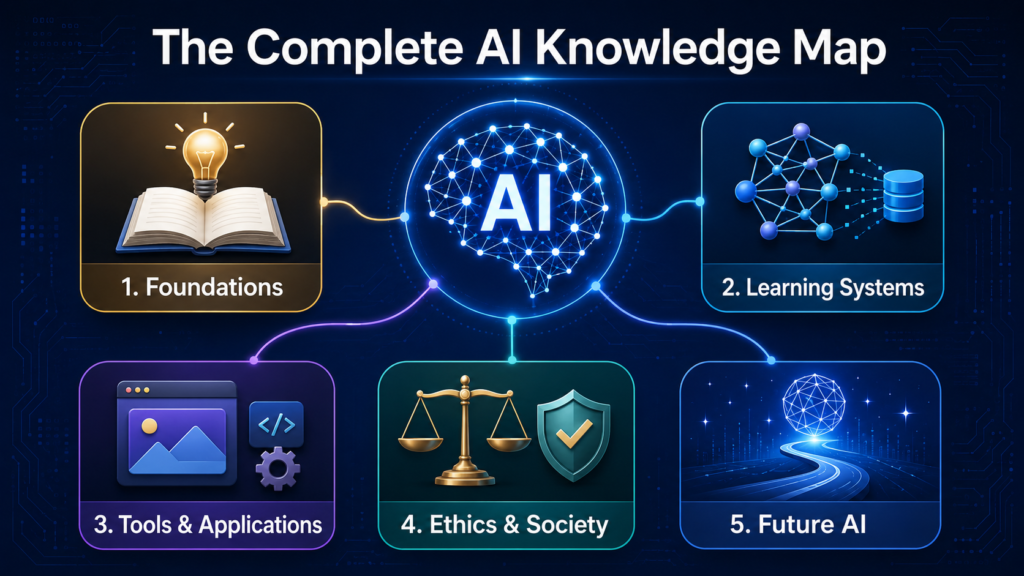
The 150 questions have been arranged in a logical sequence. The guide begins with basic concepts and then moves through AI history, pioneers, machine learning, deep learning, neural networks, natural language processing, large language models, computer vision, robotics and generative AI. Later sections examine popular tools, companies, practical applications, hardware, data, ethics, privacy, copyright, cybersecurity, employment, international governance, artificial general intelligence and the future relationship between humans and intelligent machines.
Where a question concerns an important person or historical event, the answer will include relevant names, dates, countries, institutions and contributions. Technology-related answers will explain what the technology is, how it works, where it is used and what limitations it has. Application-based answers will consider both benefits and risks so that readers receive a balanced understanding instead of an exaggerated picture of AI.
The guide can be read from beginning to end as a structured learning resource, but each question is also written to stand on its own. Readers who need a specific answer can use the Table of Contents or search within the page. Comparison tables, timelines, practical examples, knowledge boxes and quick summaries will make complex information easier to understand and revise.
Artificial intelligence changes rapidly, but its foundational ideas remain essential. Understanding these foundations helps people evaluate new AI tools, claims and developments more critically. It also makes it easier to distinguish real technological progress from marketing language, misinformation and unrealistic predictions.
Whether you want to understand a basic AI term, identify an important scientist, prepare an academic assignment, explore the use of AI in a particular field or think seriously about its future, this guide is intended to serve as a useful and educational reference. Let us begin with the fundamental questions that explain what artificial intelligence is and why it has become one of the most influential technologies of the modern world.
Part 1: AI Fundamentals and Basic Concepts
Before studying the history, technologies and applications of artificial intelligence, it is important to understand its basic ideas. The following questions explain what AI means, how it works, what its main goals are and how it differs from related concepts such as automation, robotics and machine learning.
1. What is artificial intelligence?
Artificial intelligence, commonly called AI, is a field of computer science that develops machines and software capable of performing tasks that normally require human intelligence. These tasks include learning, reasoning, recognising patterns, understanding language, solving problems, making predictions and supporting decisions.
The term artificial intelligence was proposed by American computer scientist John McCarthy in 1955 for the Dartmouth Summer Research Project on Artificial Intelligence, which was held in New Hampshire, United States, in 1956. McCarthy described AI as “the science and engineering of making intelligent machines.”
Modern definitions focus not only on imitating human behaviour but also on what an AI system can do. The US National Institute of Standards and Technology describes AI as a machine-based system that can make predictions, recommendations or decisions for human-defined objectives. AI systems may work entirely in digital environments, such as recommendation engines, or influence the physical world through robots, vehicles and industrial machines. The NIST definition of artificial intelligence provides a useful official reference.
2. What does “intelligence” mean in artificial intelligence?
In AI, intelligence generally refers to the ability of a system to receive information, interpret it and use it to achieve a goal. An intelligent system may learn from examples, recognise objects, understand instructions, compare alternatives, solve a problem or adjust its behaviour when circumstances change.
Human intelligence includes consciousness, emotions, social understanding, creativity, common sense and life experience. AI does not need to possess all these qualities to be considered intelligent. A navigation system may intelligently identify the fastest route without understanding travel in the human sense. Similarly, a medical image-analysis system may detect patterns associated with a disease without experiencing illness or understanding a patient’s feelings.
There is no single universally accepted test for intelligence. Different AI systems are therefore judged according to the task they are designed to perform, the accuracy of their outputs, their ability to adapt and the level of autonomy with which they operate.
3. How does artificial intelligence work?
An AI system usually works by receiving input, processing it through rules or a trained model and producing an output. The input may be text, numbers, images, sound, video, sensor readings or information from another computer system.
A simplified AI process includes the following stages:
- Input collection: The system receives data from users, databases, cameras, microphones, sensors or other sources.
- Data preparation: The information is cleaned, organised and converted into a form the system can process.
- Model or rule application: An algorithm examines the input using programmed rules or patterns learned during training.
- Inference: The system produces a prediction, classification, recommendation, decision or piece of generated content.
- Evaluation: The result is checked against expected outcomes, quality measures or human feedback.
- Improvement: Where applicable, the model is updated using new data, corrections or feedback.
For example, an email spam filter studies characteristics commonly found in unwanted messages. When a new email arrives, it evaluates the words, links, sender information and other patterns before predicting whether the message is legitimate or spam.
4. What are the main goals of artificial intelligence?
The broad goal of AI is to create systems that can perform useful tasks requiring intelligence. AI researchers do not follow only one objective; the field includes several connected goals.
The major goals of artificial intelligence include:
- enabling machines to learn from data and experience;
- representing knowledge in a form computers can use;
- reasoning with available information;
- solving problems and planning actions;
- understanding and generating human language;
- recognising images, speech, objects and patterns;
- making predictions and recommendations;
- operating with an appropriate level of autonomy;
- supporting people in complex or time-consuming tasks; and
- developing a better scientific understanding of intelligence.
Some researchers seek to create highly specialised systems that perform one task extremely well. Others study artificial general intelligence, which would be able to learn and perform a wide variety of intellectual tasks. Present-day AI remains largely specialised, even when a single system can handle several types of information or activities.
5. What are the essential components of an AI system?
An AI system is built from several connected components. Their importance varies according to the system’s purpose, but most AI systems include the following elements:
- Objective: The task or outcome the system is expected to achieve.
- Input: The data or information received by the system.
- Data: The examples, records or observations used to develop or operate the system.
- Algorithm: A set of computational procedures used to process information.
- Model: A mathematical or computational representation learned from data or created through rules.
- Computing resources: Processors, memory, storage and network infrastructure used to train and run the system.
- Output: A prediction, recommendation, classification, decision, action or generated content.
- Evaluation: Methods used to test accuracy, reliability, safety and usefulness.
- Human oversight: People who design, monitor, review or correct the system.
The OECD explains an AI system through three broad elements: inputs collected from an environment, operational logic that interprets those inputs and outputs that influence a physical or virtual environment. Some systems also use actuators, such as robotic arms or vehicle controls, to act on their outputs. The OECD explanation of how AI works describes this relationship between perception, reasoning and action.
6. How is AI different from traditional computer programming?
Traditional computer programs usually follow rules written directly by programmers. The developer specifies what the program should do under particular conditions. For example, a payroll program calculates salary by following fixed formulas involving working days, deductions and allowances.
Many modern AI systems work differently. Instead of receiving a complete rule for every possible situation, a machine learning model studies examples and discovers statistical patterns. An image-recognition model, for instance, may learn to distinguish cats from dogs by analysing thousands of labelled pictures rather than following a manually written list of every possible physical feature.
The difference is not absolute. AI software still requires programming, and traditional rules are often combined with learned models. Early expert systems were considered AI even though they relied heavily on manually created rules. The main distinction is that AI systems are designed to perform tasks involving learning, reasoning, perception or adaptation, while conventional programs generally execute predetermined instructions.
7. What is the difference between AI, automation and robotics?
AI, automation and robotics are related, but they do not mean the same thing.
Automation uses technology to perform a repetitive process with limited human involvement. A system that automatically sends a receipt after a payment is an example of automation. It may follow a fixed rule without using AI.
Artificial intelligence enables a system to analyse information, recognise patterns, make predictions or select an action. An AI-powered fraud detection system may examine changing transaction patterns and identify unusual behaviour that was not covered by a simple fixed rule.
Robotics deals with designing and operating physical machines that can sense, move or perform actions. A robotic arm that repeats the same movement on an assembly line may use automation but no advanced AI. An autonomous mobile robot that recognises obstacles and changes its route may combine robotics, automation and AI.
Therefore, automation concerns performing processes, robotics concerns physical machines, and AI concerns intelligent information processing. A single system may use one, two or all three.
8. What are the main branches of artificial intelligence?
Artificial intelligence contains several overlapping branches, each focused on a different type of problem. The major branches include:
- Machine Learning: Enables systems to learn patterns from data.
- Deep Learning: Uses multilayered neural networks to learn complex patterns.
- Natural Language Processing: Helps machines understand, interpret and generate human language.
- Computer Vision: Enables systems to analyse images and video.
- Speech Processing: Supports speech recognition, voice generation and spoken interaction.
- Knowledge Representation and Reasoning: Organises facts and rules so machines can draw conclusions.
- Expert Systems: Reproduces specialised decision-making using knowledge and rules.
- Robotics: Connects perception, planning and physical action.
- Planning and Search: Identifies possible actions and selects a path towards a goal.
- Generative AI: Produces new text, images, audio, video, code and other content.
These branches are not completely separate. A voice assistant, for example, may combine speech recognition, natural language processing, machine learning and generative AI. Readers can consult The Complete AI Glossary: 100 Essential AI Terms for clear explanations of important terminology used across these branches.
9. How does AI learn from data?
AI commonly learns from data through a process called machine learning. During training, an algorithm examines examples and adjusts the internal parameters of a model to reduce errors or improve performance.
Three major learning approaches are:
- Supervised learning: The model learns from labelled examples, such as emails marked “spam” or “not spam.”
- Unsupervised learning: The system looks for patterns or groups in data without receiving correct labels.
- Reinforcement learning: An agent learns through interaction by receiving rewards for useful actions and penalties for undesirable ones.
Data is commonly divided into training, validation and test sets. Training data helps the model learn, validation data supports model selection and adjustment, and test data measures how well the final model handles unseen examples.
The aim is not simply to remember the training data. A useful model must generalise, meaning that it applies learned patterns to new situations. Poor-quality, incomplete or biased data can produce unreliable results, which is why data collection, preparation and evaluation are essential parts of AI development.
10. Why is artificial intelligence important in the modern world?
AI is important because it can process large amounts of information, identify complex patterns and perform certain tasks faster or more consistently than manual methods. It can support scientific research, improve accessibility, personalise education, assist medical professionals, detect fraud, forecast demand, optimise transport and help organisations make data-informed decisions.
AI also allows people to interact with technology through natural language, images and voice. Generative AI has expanded these possibilities by helping users draft text, create visual content, write code, summarise documents and explore ideas. Examples of currently available systems can be found in Best AI Tools in 2026.
Its importance does not mean that every AI use is beneficial. AI systems can make mistakes, reproduce bias, expose private information, spread false content or be applied irresponsibly. Their outputs depend on data, design choices, objectives and the environment in which they are used. Human judgement, transparency, testing and accountability therefore remain essential.
AI is best understood as a powerful set of technologies that can extend human capability. Its value depends on how carefully people design, govern and use it.
🔍 Quick Summary
Artificial intelligence is the broad field of developing systems that perform tasks associated with intelligence. Machine learning is one way of building AI, while deep learning is a specialised form of machine learning. Automation performs processes, robotics performs physical actions, and AI provides capabilities such as learning, reasoning, perception and decision support. These technologies may work separately or together in a single system.
Part 2: Origin and History of Artificial Intelligence
Artificial intelligence did not emerge from a single invention. It developed gradually through ideas from philosophy, mathematics, logic, psychology, neuroscience, engineering and computer science. Understanding this history helps explain why AI has experienced periods of rapid progress, disappointment and renewed growth.
11. What ideas existed before modern artificial intelligence?
The idea of creating artificial beings with human-like abilities appeared long before electronic computers. Ancient Greek myths described mechanical beings such as Talos, a bronze guardian said to protect the island of Crete. Similar stories of artificial servants and mechanical creatures appeared in several cultures. These were imaginative ideas rather than scientific AI, but they reflected a long-standing human interest in creating intelligence outside the human body.
More practical foundations came from philosophy and formal logic. In the fourth century BCE, the Greek philosopher Aristotle developed syllogistic logic, a method of reaching conclusions from stated premises. For example, if all humans are mortal and Socrates is human, logic allows the conclusion that Socrates is mortal. This idea—that reasoning can follow formal rules—later became central to symbolic AI.
During the 13th century, Ramon Llull, a philosopher from Majorca, developed mechanical arrangements of rotating discs intended to combine concepts and produce logical statements. In the 17th century, German mathematician and philosopher Gottfried Wilhelm Leibniz imagined a universal language of reasoning in which disputes could be resolved through calculation.
These early ideas did not create AI, but they introduced important principles: knowledge could be represented symbolically, reasoning could follow rules and some mental processes might be reproduced mechanically.
12. Which developments in mathematics and computing prepared the way for AI?
Several developments made it possible to move from philosophical ideas about intelligence to working machines.
In 1837, British mathematician Charles Babbage described the Analytical Engine, a proposed general-purpose mechanical computer. Although it was never completed in his lifetime, its design included concepts resembling memory, processing and programmable instructions.
In 1843, English mathematician Ada Lovelace published extensive notes on the Analytical Engine. Her Note G described a method for calculating Bernoulli numbers and is often regarded as an early published computer algorithm. Lovelace also recognised that a machine might manipulate symbols and not merely calculate numbers, although she cautioned that it could only do what people instructed it to perform.
In 1854, English mathematician George Boole published An Investigation of the Laws of Thought. Boolean algebra represented logical statements through values such as true and false. This mathematical system later became essential to digital circuits and computer programming.
In 1936, British mathematician Alan Turing described an abstract computing device now called the Turing machine. It demonstrated how a machine following simple instructions could perform any calculation that could be expressed algorithmically.
In 1937, American mathematician Claude Shannon showed how Boolean logic could be applied to electrical switching circuits. His work connected abstract logic with practical electronic systems. The development of electronic computers during and after the Second World War then provided the hardware required to test theories about machine intelligence.
13. How did early neuroscience and cybernetics contribute to AI?
Early AI was strongly influenced by attempts to understand how biological brains process information.
In 1943, American neurophysiologist Warren McCulloch and logician Walter Pitts published “A Logical Calculus of the Ideas Immanent in Nervous Activity.” They proposed a mathematical model of an artificial neuron that could receive inputs and produce an output when a threshold was reached. Their work demonstrated that networks of simplified neurons could perform logical operations. It became an important conceptual foundation for artificial neural networks.
In 1948, American mathematician Norbert Wiener published Cybernetics: Or Control and Communication in the Animal and the Machine. Cybernetics studied feedback, control and communication in biological organisms and machines. A thermostat, for example, receives information about temperature and acts to maintain a desired level. More advanced AI systems similarly use feedback to adjust their behaviour.
In 1949, Canadian psychologist Donald Hebb proposed a theory of learning based on the strengthening of connections between neurons that are activated together. The simplified expression “cells that fire together wire together” became associated with Hebbian learning and influenced later neural-network research.
These developments encouraged researchers to think of intelligence as a process involving interconnected units, information flow, feedback and learning.
14. What contribution did Alan Turing make to artificial intelligence?
Alan Mathison Turing was one of the most important intellectual founders of computer science and artificial intelligence. He was born in London, United Kingdom, in 1912 and died in 1954.
Turing’s 1936 work on computable numbers introduced the theoretical Turing machine and helped establish the foundations of general-purpose computing. During the Second World War, he worked at Bletchley Park and contributed to British efforts to decipher encrypted German communications.
On 1 October 1950, the journal Mind published Turing’s paper “Computing Machinery and Intelligence”. Rather than becoming trapped in the philosophical question “Can machines think?”, Turing proposed an operational experiment called the imitation game.
In the test, a human evaluator communicates through text with an unseen human and an unseen machine. If the evaluator cannot reliably identify which participant is the machine, the machine may be considered to have demonstrated intelligent conversational behaviour. This later became known as the Turing Test.
The test does not prove that a machine possesses consciousness, emotions or genuine understanding. However, it provided a practical way to discuss machine intelligence through observable behaviour. Turing also anticipated machine learning by suggesting that researchers might build a “child machine” and educate it rather than attempting to program an adult-level mind completely from the beginning.
15. When, where and by whom was the term “artificial intelligence” coined?
The term artificial intelligence was introduced by American computer scientist John McCarthy in a proposal prepared in 1955 for a research workshop at Dartmouth College.
The Dartmouth Summer Research Project on Artificial Intelligence was held during the summer of 1956 in Hanover, New Hampshire, United States. The proposal was prepared by:
- John McCarthy of Dartmouth College;
- Marvin Minsky of Harvard University;
- Nathaniel Rochester of IBM; and
- Claude Shannon of Bell Telephone Laboratories.
The researchers proposed studying the idea that aspects of learning and intelligence could be described precisely enough for a machine to simulate them. The workshop brought together researchers interested in neural networks, computation, language, abstraction and problem-solving.
Participants did not immediately solve the problem of machine intelligence, but the workshop gave the emerging field a name and a shared research identity. For this reason, the Dartmouth workshop of 1956 is widely treated as the formal birth of artificial intelligence as an academic discipline.
💡 Did You Know?
The expression “artificial intelligence” appeared in the research proposal written in 1955, but the famous Dartmouth workshop itself took place in 1956. Therefore, 1955 is associated with the naming of the field, while 1956 is commonly recognised as the year in which AI became an organised academic discipline.
16. What were the earliest successful AI programs?
The first generation of AI programs focused on logical reasoning, games, language and problem-solving.
Logic Theorist: Developed in 1955–1956 by Allen Newell, Herbert A. Simon and Cliff Shaw at the RAND Corporation and Carnegie Institute of Technology in the United States, Logic Theorist proved mathematical theorems from Principia Mathematica. It is frequently described as one of the first working AI programs.
General Problem Solver: Newell, Simon and Shaw later developed the General Problem Solver, beginning in the late 1950s. It attempted to solve different problems by comparing a current situation with a desired goal and selecting operations to reduce the difference.
Checkers program: American computer scientist Arthur Samuel developed a checkers-playing program at IBM during the 1950s. It improved through experience and became an important early example of machine learning. Samuel popularised the term machine learning in 1959.
LISP: John McCarthy developed the LISP programming language at the Massachusetts Institute of Technology in 1958. Its ability to process symbols and lists made it one of the dominant languages of early AI research.
ELIZA: German-American computer scientist Joseph Weizenbaum created ELIZA at MIT between 1964 and 1966. Its best-known script, DOCTOR, imitated a psychotherapist by transforming user statements into questions. ELIZA did not understand conversation, but some users still formed an emotional impression of it.
Shakey the Robot: Developed at the Stanford Research Institute in California between 1966 and 1972, Shakey combined perception, planning and movement. It is often described as the first general-purpose mobile robot capable of reasoning about its actions.
These systems were limited by modern standards, but they demonstrated that computers could perform tasks previously associated with reasoning, learning and language.
17. What were expert systems, and why were they important in AI history?
Expert systems were AI programs designed to reproduce the decision-making knowledge of human specialists within a limited field. They generally contained two main parts:
- a knowledge base containing facts and rules; and
- an inference engine that applied those rules to a particular problem.
One of the earliest and most influential expert systems was DENDRAL, which began at Stanford University in the United States in 1965. Edward Feigenbaum, Bruce Buchanan, Joshua Lederberg and other researchers developed it to help chemists infer molecular structures from mass-spectrometry data. The project demonstrated that detailed specialist knowledge could be more valuable than a completely general problem-solving method. Stanford’s historical account confirms that the DENDRAL Project began in 1965.
During the early and mid-1970s, Edward Shortliffe and colleagues at Stanford developed MYCIN. It used rules to help identify certain bacterial infections and recommend antibiotics. Although MYCIN performed well in experimental evaluations, legal, ethical and practical concerns prevented its routine clinical deployment.
Around 1980, John McDermott and researchers at Carnegie Mellon University developed XCON, also called R1, for Digital Equipment Corporation in the United States. It helped configure orders for VAX computer systems and became a well-known commercial application of expert-system technology.
Expert systems encouraged major investment in AI during the 1980s. However, they were expensive to build and update. They also struggled when problems fell outside the rules stored in their knowledge bases.
18. What were the First and Second AI Winters?
An AI winter is a period in which confidence, investment and research funding in artificial intelligence decline after earlier expectations are not fulfilled. Historians use approximate rather than universally fixed dates for these periods.
First AI Winter
The first AI winter is generally associated with the mid-1970s and late 1970s. Early researchers had predicted rapid progress in language translation, general reasoning, vision and robotics. However, computers had limited memory and processing power, available datasets were small and many AI methods worked only on simplified problems.
In the United States, a 1966 report by the Automatic Language Processing Advisory Committee criticised the progress of machine translation and contributed to reduced funding in that field.
In the United Kingdom, Professor Sir James Lighthill submitted a critical report on AI research to the Science Research Council in 1973. The report questioned whether many techniques could scale beyond limited demonstrations. It contributed to reduced British support for AI research. A later UK parliamentary review describes how the Lighthill Report contributed to the First AI Winter.
Second AI Winter
The second AI winter began in the late 1980s and continued into the early 1990s. Commercial expert systems had attracted considerable investment, but many were difficult to maintain, expensive to operate and unable to adapt beyond their programmed knowledge.
Specialised LISP machines also lost their advantage as cheaper general-purpose computers became more powerful. Expectations surrounding Japan’s Fifth Generation Computer Systems project, launched in 1982, were not fully achieved. Businesses reduced investment, AI companies closed and the term “AI” became commercially unpopular for a time.
The AI winters did not mean that all research stopped. Important work continued under names such as machine learning, pattern recognition, neural networks, statistical modelling and data mining.
19. How did machine learning and deep learning revive artificial intelligence?
AI recovered because researchers gradually shifted from relying mainly on manually written rules to developing systems that learned from data.
During the 1980s and 1990s, improvements in statistical learning, decision trees, Bayesian networks, support vector machines and reinforcement learning created more reliable methods. The growth of the internet and digital services produced larger datasets, while faster processors and cheaper storage made it possible to analyse them.
Neural-network research also returned to prominence. The backpropagation algorithm became widely influential during the 1980s because it allowed multilayer neural networks to adjust internal weights based on prediction errors. In 2006, Geoffrey Hinton and collaborators published important work that helped renew interest in deep neural networks.
Another major development was ImageNet, a large labelled image database associated with computer scientist Fei-Fei Li and collaborators in the United States. In 2012, Alex Krizhevsky, Ilya Sutskever and Geoffrey Hinton of the University of Toronto in Canada used a deep convolutional neural network called AlexNet to achieve a major improvement in the ImageNet image-recognition competition. Graphics processing units made its large-scale training practical.
Further milestones followed. IBM Watson defeated leading Jeopardy! champions in 2011. Google DeepMind’s AlphaGo defeated Lee Sedol 4–1 in Seoul, South Korea, in March 2016. In 2017, Google researchers introduced the Transformer architecture in “Attention Is All You Need”. Transformers later became the foundation of many large language models and generative AI systems.
The revival therefore resulted from the combination of better algorithms, larger datasets, more powerful hardware and practical applications.
20. What are the most important milestones in the history of artificial intelligence?
The following timeline presents major ideas, people, institutions and events that contributed to the development of AI. It is selective rather than a record of every invention, but it covers the milestones most useful for students and general readers.
| Year | Milestone | Person or Organisation | Country and Importance |
|---|---|---|---|
| 4th century BCE | Formal syllogistic logic | Aristotle | Ancient Greece; introduced rule-based reasoning from premises to conclusions. |
| 1837 | Analytical Engine described | Charles Babbage | United Kingdom; proposed a programmable general-purpose mechanical computer. |
| 1843 | Notes and algorithm for the Analytical Engine | Ada Lovelace | United Kingdom; recognised that machines could manipulate symbols as well as numbers. |
| 1854 | Boolean algebra published | George Boole | United Kingdom; created a mathematical basis for logical operations used in digital computing. |
| 1936 | Turing machine described | Alan Turing | United Kingdom; established a theoretical model of general computation. |
| 1937 | Logic connected with electrical circuits | Claude Shannon | United States; showed how Boolean algebra could be implemented through switching circuits. |
| 1943 | Mathematical model of an artificial neuron | Warren McCulloch and Walter Pitts | United States; provided a foundation for artificial neural networks. |
| 1948 | Cybernetics published | Norbert Wiener | United States; advanced the study of feedback and control in machines and living systems. |
| 1950 | Turing Test proposed | Alan Turing | United Kingdom; offered a behavioural approach to evaluating machine intelligence. |
| 1955 | Term “artificial intelligence” used in proposal | John McCarthy and collaborators | United States; gave the emerging research field its name. |
| 1956 | Dartmouth AI workshop | McCarthy, Minsky, Rochester, Shannon and others | United States; commonly treated as the formal birth of AI as a discipline. |
| 1955–1956 | Logic Theorist developed | Newell, Simon and Shaw | United States; one of the earliest working AI programs. |
| 1958 | LISP programming language developed | John McCarthy | United States; became a major language for symbolic AI research. |
| 1959 | Term “machine learning” popularised | Arthur Samuel | United States; described computers learning from experience. |
| 1965 | DENDRAL project began | Stanford researchers | United States; became an early and influential expert system. |
| 1964–1966 | ELIZA developed | Joseph Weizenbaum, MIT | United States; demonstrated text-based human–computer conversation. |
| 1966–1972 | Shakey the Robot developed | Stanford Research Institute | United States; combined perception, planning, reasoning and movement. |
| 1973 | Lighthill Report published | Sir James Lighthill | United Kingdom; contributed to reduced AI funding during the First AI Winter. |
| 1970s | MYCIN developed | Edward Shortliffe and Stanford researchers | United States; applied expert-system rules to infectious-disease treatment advice. |
| 1980 | XCON introduced | Carnegie Mellon University and Digital Equipment Corporation | United States; demonstrated a valuable commercial expert-system expert-system application. |
| Late 1980s–early 1990s | Second AI Winter | AI industry and research community | Mainly United States, Europe and Japan; investment fell as expert-system expectations were not fulfilled. |
| 1997 | Deep Blue defeated Garry Kasparov | IBM | United States; first computer to defeat a reigning world chess champion in a match under standard tournament controls. |
| 2006 | Renewed deep-learning research | Geoffrey Hinton and collaborators | Canada; helped revive multilayer neural-network research. |
| 2009 | ImageNet introduced to the research community | Fei-Fei Li and collaborators | United States; provided a large labelled dataset for visual-recognition research. |
| 2011 | Watson won Jeopardy! | IBM | United States; demonstrated advances in question answering and natural language processing. |
| 2012 | AlexNet transformed image recognition | Krizhevsky, Sutskever and Hinton | Canada; showed the power of deep neural networks trained with GPUs. |
| 2016 | AlphaGo defeated Lee Sedol | Google DeepMind | United Kingdom and South Korea; demonstrated advanced deep learning and reinforcement learning. |
| 2017 | Transformer architecture introduced | Google researchers | United States; created the foundation for many modern language and generative AI models. |
| 2020 | AlphaFold2 achieved a major protein-structure breakthrough | Google DeepMind | United Kingdom; demonstrated AI’s importance in scientific discovery. |
| 2022 | ChatGPT released publicly | OpenAI | United States; brought conversational generative AI to a global mainstream audience. |
| 2023 onward | Rapid growth of multimodal and generative AI | Research laboratories and technology companies | Global; AI systems increasingly work across text, images, audio, video, code and scientific data. |
This history shows that AI progress has never followed a straight line. It has advanced through the interaction of ideas, data, computing power, experimentation and practical need. Periods of disappointment exposed limitations, while later breakthroughs often revived concepts that had been studied decades earlier.
Part 3: AI Pioneers, Scientists and Important Personalities
Artificial intelligence was not invented by one person. It developed through the work of mathematicians, computer scientists, psychologists, neuroscientists, engineers and philosophers from several countries. Some established its theoretical foundations, while others created algorithms, programming languages, datasets, robots and practical AI systems.
21. Who is known as the father of artificial intelligence?
John McCarthy is most commonly known as the “father of artificial intelligence.” He was born on September 4, 1927, in Boston, Massachusetts, United States, and died on October 24, 2011.
McCarthy earned this title because he helped establish AI as a separate academic field. His major contributions include:
- Coining the term “artificial intelligence” in the 1955 proposal for the Dartmouth Summer Research Project.
- Organising the Dartmouth workshop in 1956 with Marvin Minsky, Claude Shannon and Nathaniel Rochester.
- Creating LISP in 1958, one of the earliest and most influential AI programming languages.
- Advancing commonsense reasoning and non-monotonic logic.
- Promoting computer time-sharing, which allowed multiple people to use a computer interactively.
- Establishing the Stanford Artificial Intelligence Laboratory, commonly known as SAIL.
- Publishing the influential paper “Programs with Common Sense” in 1959.
McCarthy received the ACM A.M. Turing Award in 1971. Stanford University describes him as a central figure who coined the term AI, developed LISP and helped define the field for more than five decades. More details are available in the official John McCarthy archive at Stanford University.
🎓 Student Tip
Titles such as “father of AI” are informal descriptions rather than universally regulated scientific titles. For examinations and assignments, remember the following commonly accepted associations:
- John McCarthy — Father of Artificial Intelligence
- Alan Turing — Theoretical foundation of AI and the Turing Test
- Arthur Samuel — Pioneer of machine learning and creator of the term
- Edward Feigenbaum — Father of expert systems
- Geoffrey Hinton, Yann LeCun and Yoshua Bengio — Pioneers of modern deep learning
22. Which early thinkers created the scientific foundations of AI?
Several scientists established the theoretical foundations upon which modern artificial intelligence was built.
Alan Turing
Alan Mathison Turing was born in London, United Kingdom, in 1912. He developed the concept of the Turing Machine in 1936, helped formalise computation and published “Computing Machinery and Intelligence” in 1950. His proposed imitation game later became known as the Turing Test.
Turing demonstrated that reasoning processes could be represented as computational operations. His work connected mathematics, machines and intelligence.
Warren McCulloch and Walter Pitts
Warren McCulloch, born in the United States in 1898, was a neurophysiologist. Walter Pitts, born in the United States in 1923, was a mathematician and logician.
In their 1943 paper, “A Logical Calculus of the Ideas Immanent in Nervous Activity,” they introduced a mathematical model of an artificial neuron. Their model demonstrated how networks of simple artificial neurons could perform logical operations.
This work became one of the foundations of neural networks and deep learning.
Norbert Wiener
Norbert Wiener, born in Missouri, United States, in 1894, established the field of cybernetics. His 1948 book Cybernetics: Or Control and Communication in the Animal and the Machine studied feedback, control and communication in biological and mechanical systems.
Feedback remains essential in robotics, autonomous machines and reinforcement learning.
Claude Shannon
Claude Shannon, born in Michigan, United States, in 1916, created information theory. His 1948 paper “A Mathematical Theory of Communication” explained how information could be measured, encoded and transmitted.
In 1950, Shannon also published an important paper on programming computers to play chess. His work influenced computer communication, search algorithms, game-playing AI and data processing.
Together, these researchers transformed questions about human thought into problems that could be studied through mathematics, logic and computation.
23. What were Marvin Minsky’s major contributions to artificial intelligence?
Marvin Lee Minsky was born in New York City, United States, in 1927 and died in 2016. He was one of the founders of AI and a long-time professor at the Massachusetts Institute of Technology.
His important contributions include:
- Helping organise the 1956 Dartmouth AI workshop.
- Co-founding the MIT Artificial Intelligence Laboratory with John McCarthy.
- Building the SNARC neural-network learning machine with Dean Edmonds in 1951.
- Conducting research in neural networks, robotics, computer vision and human cognition.
- Developing the frame concept for representing structured knowledge.
- Writing influential books such as Perceptrons with Seymour Papert and The Society of Mind.
- Training and influencing generations of AI researchers at MIT.
In The Society of Mind, Minsky argued that intelligence does not necessarily come from one central mechanism. Instead, it may emerge from the interaction of many smaller processes or “agents,” none of which is individually intelligent.
Minsky received the ACM A.M. Turing Award in 1969. MIT recognises him as a co-founder of its AI laboratory and one of the central architects of artificial intelligence. His early neural-network work is explained in his official MIT academic biography.
It is also important to understand the debate surrounding Perceptrons, published in 1969. The book correctly demonstrated important limitations of single-layer perceptrons. However, its influence was sometimes interpreted too broadly, contributing to reduced enthusiasm for neural-network research during the following years.
24. How did Allen Newell, Herbert Simon and Cliff Shaw shape symbolic AI?
Allen Newell, Herbert A. Simon and J. C. Shaw were leading developers of symbolic artificial intelligence in the United States.
Their major achievement was the Logic Theorist, developed during 1955 and 1956. It was one of the earliest AI programs capable of proving mathematical theorems.
The system used symbols, rules and search procedures to find proofs from Principia Mathematica, the famous work by Alfred North Whitehead and Bertrand Russell. In some cases, the program found proofs that were more efficient than the published human proofs.
The team later developed the General Problem Solver, or GPS. GPS attempted to solve different types of problems through a technique called means–ends analysis. The program compared the current situation with the desired goal and selected actions that could reduce the difference.
Their key contributions include:
- Establishing symbolic problem-solving as a major AI approach.
- Developing heuristic search techniques.
- Creating the Information Processing Language, or IPL.
- Connecting computer problem-solving with human cognitive psychology.
- Proposing the Physical Symbol System Hypothesis.
The Physical Symbol System Hypothesis states that a system capable of manipulating physical symbols has the necessary and sufficient means for general intelligent action. This idea became one of the central claims of classical AI.
Allen Newell was born in San Francisco, United States, in 1927. Herbert Simon was born in Milwaukee, United States, in 1916. Simon also received the 1978 Nobel Memorial Prize in Economic Sciences for research on decision-making in organisations.
Newell and Simon jointly received the ACM A.M. Turing Award in 1975. Their original research materials and programs are preserved in the Carnegie Mellon University digital collections.
25. How did Arthur Samuel and Frank Rosenblatt contribute to machine learning?
Arthur Samuel and Frank Rosenblatt demonstrated that computers could improve their performance through experience.
Arthur Samuel and machine learning
Arthur Lee Samuel was born in Kansas, United States, in 1901. While working at IBM, he developed a computer program that learned to play checkers.
The program used techniques such as:
- Evaluation functions
- Search
- Stored game positions
- Self-play
- Learning from previous games
- Alpha–beta pruning
Samuel used the term “machine learning” in his 1959 paper, “Some Studies in Machine Learning Using the Game of Checkers.” He described the possibility of programming a computer so that it could eventually play better than the person who created the program.
IBM recognises Samuel’s checkers system as one of the earliest successful examples of a computer improving through experience. The history of the project is explained in IBM’s account of early game-playing AI.
Frank Rosenblatt and the perceptron
Frank Rosenblatt was born in New York, United States, in 1928. He was a psychologist and researcher at the Cornell Aeronautical Laboratory.
In 1957 and 1958, Rosenblatt developed the perceptron, an early trainable artificial neural-network model. The Mark I Perceptron was designed to recognise simple visual patterns.
A perceptron receives inputs, assigns weights to them, calculates a result and adjusts the weights when its prediction is incorrect. This basic learning process remains conceptually important in modern neural networks.
Rosenblatt’s system was limited because a single-layer perceptron could not solve every type of classification problem. Nevertheless, it established the important idea that a machine could learn useful internal weights from examples. Cornell University describes Rosenblatt’s perceptron as an important foundation of present-day neural networks and deep learning. Cornell’s history of the perceptron provides additional information.
26. Who were the major pioneers of expert systems, speech recognition and applied AI?
The transition from experimental AI programs to useful real-world systems involved several important researchers.
Edward Feigenbaum
Edward Albert Feigenbaum was born in New Jersey, United States, in 1936. He is widely called the “father of expert systems.”
Feigenbaum argued that an intelligent system’s performance depends not only on general reasoning methods but also on specialised knowledge about a particular field. This became known as the knowledge principle.
He helped develop:
- DENDRAL for analysing molecular structures
- Knowledge-engineering methods
- Large knowledge-based systems
- Practical applications of AI in science and industry
Joshua Lederberg and Bruce Buchanan
Joshua Lederberg, born in New Jersey, United States, in 1925, was a geneticist and Nobel Prize winner. He collaborated with Feigenbaum on DENDRAL.
Bruce Buchanan, born in Ohio, United States, in 1939, made major contributions to knowledge-based AI. He worked on DENDRAL and helped develop the reasoning methods used in expert systems.
DENDRAL combined knowledge from chemistry with computer search. It is considered one of the earliest successful expert systems.
Edward Shortliffe
Edward Shortliffe, born in Canada in 1947 and professionally associated with the United States, developed MYCIN at Stanford during the 1970s with support from Buchanan and other researchers.
MYCIN used approximately 600 rules to help identify bacterial infections and recommend antibiotics. It demonstrated the value of rule-based reasoning and certainty factors, although it was never adopted for routine clinical use.
Raj Reddy
Dabbala Rajagopal “Raj” Reddy was born in Katur, in present-day Andhra Pradesh, India, in 1937. He later became a professor at Carnegie Mellon University in the United States.
Reddy’s research contributed to:
- Continuous speech recognition
- Spoken-language systems
- Robotics
- Autonomous vehicles
- Human–computer interaction
- Large-scale applied AI systems
He was the founding director of Carnegie Mellon University’s Robotics Institute. Reddy and Feigenbaum jointly received the 1994 ACM A.M. Turing Award for pioneering the design and construction of large-scale artificial-intelligence systems and demonstrating their practical importance. Carnegie Mellon documents his contributions to speech recognition, robotics and applied AI.
Raj Reddy’s story is particularly important for Indian students because it demonstrates India’s early and significant connection with global AI research.
27. Why are Geoffrey Hinton, Yann LeCun and Yoshua Bengio called the pioneers of deep learning?
Geoffrey Hinton, Yann LeCun and Yoshua Bengio are sometimes collectively called the “godfathers of deep learning.” Their research helped neural networks become practical enough for computer vision, speech recognition, language processing and generative AI.
Geoffrey Hinton
Geoffrey Hinton was born in London, United Kingdom, in 1947. Much of his influential work was conducted at the University of Toronto in Canada.
His contributions include:
- Boltzmann machines
- Distributed representations
- Learning useful representations from data
- Popularising effective backpropagation methods with David Rumelhart and Ronald Williams
- Deep belief networks
- Word representations
- Training and mentoring important deep-learning researchers
Hinton, David Rumelhart and Ronald Williams published an influential 1986 paper demonstrating how backpropagation could help multi-layer neural networks learn internal representations.
Hinton should not be described as the sole inventor of backpropagation. The mathematical and computational ideas developed through the work of several researchers over many years. His team played a major role in demonstrating and popularising its usefulness for neural networks.
Yann LeCun
Yann LeCun was born near Paris, France, in 1960. He later worked at Bell Labs, New York University and Meta in the United States.
LeCun’s major contributions include:
- Convolutional neural networks
- Gradient-based learning
- Handwritten digit recognition
- Computer vision
- Self-supervised learning
- The LeNet architecture
LeNet helped banks and postal systems read handwritten numbers from cheques and documents. Convolutional neural networks later became a foundation of modern computer vision.
Yoshua Bengio
Yoshua Bengio was born in Paris, France, in 1964 and has spent much of his academic career at the Université de Montréal in Canada.
His work includes:
- Neural language models
- Representation learning
- Deep generative models
- Learning long-term patterns in sequences
- Attention and neural-network research
- AI safety and responsible AI research
Hinton, LeCun and Bengio received the 2018 ACM A.M. Turing Award for conceptual and engineering breakthroughs that made deep neural networks a critical component of computing. Their contributions are summarised on the official ACM Turing Award pages.
In 2024, Geoffrey Hinton and John Hopfield received the Nobel Prize in Physics for foundational discoveries and inventions that enable machine learning with artificial neural networks. The Royal Swedish Academy’s Nobel Prize announcement explains the scientific importance of their work.
🧠 Research Insight
The 2018 Turing Award recognised the computing foundations of deep learning, while the 2024 Nobel Prize in Physics demonstrated how ideas from physics, statistics and computation contributed to neural-network research. AI is therefore not an isolated subject; it is an interdisciplinary field built from many branches of knowledge.
28. Who developed reinforcement learning and probabilistic AI?
Modern AI must often learn through rewards or make decisions when information is uncertain. Richard Sutton, Andrew Barto and Judea Pearl made foundational contributions to these areas.
Richard Sutton and Andrew Barto
Richard Sutton, born in Ohio, United States, in 1957, has been professionally associated with institutions in both the United States and Canada.
Andrew Barto, born in Hungary in 1948 and professionally associated with the United States, worked with Sutton to establish the modern foundations of reinforcement learning.
Reinforcement learning involves an agent that:
- Observes its environment.
- Selects an action.
- Receives a reward or penalty.
- Updates its strategy.
- Attempts to maximise long-term reward.
Sutton and Barto developed and organised important concepts including:
- Temporal-difference learning
- Reward prediction
- Policy learning
- Value functions
- Actor–critic methods
- Exploration versus exploitation
- General reinforcement-learning frameworks
Their textbook Reinforcement Learning: An Introduction became a standard reference for students and researchers.
Sutton and Barto received the 2024 ACM A.M. Turing Award for developing the conceptual and algorithmic foundations of reinforcement learning. The award citation is available through the official ACM profile of Andrew Barto.
Judea Pearl
Judea Pearl was born in Tel Aviv in 1936, in what was then Mandatory Palestine and is now Israel. He later became a professor at the University of California, Los Angeles, in the United States.
Pearl transformed the way AI systems reason about uncertainty and causation. His contributions include:
- Bayesian networks
- Probabilistic graphical models
- Belief propagation
- Causal diagrams
- The do-calculus
- Counterfactual reasoning
A Bayesian network represents variables and the probabilistic relationships between them. It can help an AI system update its beliefs when new evidence becomes available.
Pearl later emphasised the difference between correlation and causation. Correlation tells us that two things are related, while causal reasoning investigates whether changing one thing would produce a change in another.
Pearl received the 2011 ACM A.M. Turing Award for fundamental contributions to AI through probabilistic and causal reasoning. His work is summarised in his official ACM Turing Award profile.
29. Who were the major pioneers of computer vision?
Computer vision enables machines to identify, classify and understand information contained in images and videos. Its development involved early neural-network researchers, dataset creators and deep-learning scientists.
Kunihiko Fukushima
Kunihiko Fukushima was born in Japan in 1936. In 1980, he introduced the neocognitron, a hierarchical neural network designed for visual pattern recognition.
Its structure influenced later convolutional neural networks. It used layers that could identify increasingly complex visual features while becoming less sensitive to the exact position of an object.
Yann LeCun
Yann LeCun developed convolutional neural networks that could recognise handwritten characters. His LeNet system demonstrated that neural networks could solve useful visual-recognition problems.
Fei-Fei Li
Fei-Fei Li was born in Beijing, China, in 1976 and later moved to the United States. She became a professor of computer science at Stanford University and a leading researcher in computer vision and human-centred AI.
Li led the creation of ImageNet, a large, organised collection of labelled images. The project was started because AI researchers needed much larger and more diverse datasets for training and evaluating visual-recognition systems.
ImageNet and the ImageNet Large Scale Visual Recognition Challenge helped researchers compare models using a common dataset and benchmark. The official ImageNet website explains that the project played an important role in advancing computer vision and deep learning.
The AlexNet team
In 2012, Alex Krizhevsky, Ilya Sutskever and Geoffrey Hinton, working at the University of Toronto in Canada, developed AlexNet.
AlexNet achieved a major improvement in the ImageNet competition by combining:
- Deep convolutional layers
- Graphics processing units
- The ReLU activation function
- Data augmentation
- Dropout
- Large-scale labelled data
Its success convinced much of the research community that deep neural networks, powerful hardware and large datasets could dramatically improve computer vision.
Other important computer-vision contributors
- David Marr developed influential theories of visual perception.
- Takeo Kanade, born in Japan and associated with Carnegie Mellon University, contributed to computer vision, face detection and autonomous systems.
- Jitendra Malik, born in India and associated with the University of California, Berkeley, contributed to image segmentation and visual recognition.
- Olga Russakovsky contributed to ImageNet research, dataset analysis and efforts to make computer vision more inclusive.
- Jia Deng was a central member of the team that built ImageNet and its recognition challenge.
Computer vision’s progress shows that algorithms alone are not sufficient. High-quality datasets, suitable evaluation methods, human-labelled examples and computing hardware are equally important.
30. Which other modern AI scientists and leaders should students know about?
No short list can include every important AI researcher. However, the following personalities represent several major directions in modern AI.
Demis Hassabis and John Jumper
Demis Hassabis was born in London, United Kingdom, in 1976. He co-founded DeepMind in 2010 and helped lead work on systems such as AlphaGo and AlphaFold.
John Jumper was born in Arkansas, United States, in 1985. He led the development of AlphaFold2 with Hassabis and the DeepMind team.
AlphaFold2 uses AI to predict the three-dimensional structures of proteins from their amino-acid sequences. Protein structure is important for understanding biological functions, diseases and drug development.
Hassabis and Jumper jointly received half of the 2024 Nobel Prize in Chemistry for protein-structure prediction. David Baker received the other half for computational protein design. The achievement is explained in the official Nobel Prize in Chemistry announcement.
David Silver
David Silver, born in the United Kingdom, led important DeepMind research on reinforcement learning and game-playing systems.
He played a major role in developing:
- AlphaGo
- AlphaZero
- General game-playing systems
- Deep reinforcement learning
- Search combined with neural networks
In 2016, AlphaGo defeated South Korean Go champion Lee Sedol in a five-game match. The achievement demonstrated that neural networks, reinforcement learning and tree search could be combined to solve highly complex decision problems.
Andrew Ng
Andrew Ng was born in London, United Kingdom, in 1976 and has worked extensively in the United States and China.
His contributions include:
- Founding and leading the Google Brain project
- Conducting research in machine learning and deep learning
- Promoting data-centric AI
- Working on computer vision, speech and autonomous systems
- Co-founding Coursera
- Making AI education accessible to millions of learners
Stanford University describes his work on Google Brain, massive-scale deep learning and global online education in its Andrew Ng profile.
Cynthia Breazeal
Cynthia Breazeal was born in New Mexico, United States, in 1967. She is a pioneer of social robotics and human–robot interaction.
At the MIT Media Lab, she developed Kismet, an expressive social robot designed to interact with people using facial expressions, movement and voice.
Her research examines how robots can:
- Communicate socially
- Learn from people
- Support education
- Provide personalised assistance
- Work alongside humans
- Build long-term interactions responsibly
Her work and role in establishing social robotics are described in her official MIT biography.
Timnit Gebru and Joy Buolamwini
Timnit Gebru, born in Ethiopia and professionally associated with the United States, is known for research on dataset bias, algorithmic fairness and responsible AI.
Joy Buolamwini, born in Canada and of Ghanaian heritage, conducted influential research showing that some commercial facial-analysis systems performed less accurately for darker-skinned women than for lighter-skinned men.
Their work helped demonstrate that AI performance should not be measured only through average accuracy. Researchers must also examine how a system performs for people belonging to different demographic groups. Their influential Gender Shades study can be read in the official published research paper.
Why these personalities matter
These researchers represent different sides of modern artificial intelligence:
- Hassabis and Jumper — AI for scientific discovery
- David Silver — reinforcement learning
- Andrew Ng — AI research, industry and education
- Cynthia Breazeal — social robotics
- Timnit Gebru and Joy Buolamwini — AI fairness and accountability
- Fei-Fei Li — computer vision and human-centred AI
- Hinton, LeCun and Bengio — deep learning
AI progress is not the achievement of one country, institution or company. It is the result of international collaboration involving researchers born in the United States, United Kingdom, Canada, France, China, India, Japan, Israel, Ethiopia and many other countries.
🔍 Quick Summary
The history of AI contains several overlapping schools of thought. John McCarthy and Marvin Minsky helped establish AI as a field. Newell and Simon advanced symbolic reasoning. Arthur Samuel and Frank Rosenblatt introduced important machine-learning ideas. Feigenbaum and Raj Reddy demonstrated practical AI systems. Hinton, LeCun and Bengio enabled modern deep learning. Sutton and Barto established reinforcement learning, while Judea Pearl transformed probabilistic and causal reasoning. Fei-Fei Li helped accelerate computer vision through ImageNet, and modern researchers are expanding AI into science, robotics, education and responsible technology.
Part 4: Types and Levels of Artificial Intelligence
Artificial intelligence can be classified in several ways. Some classifications describe how capable an AI system is, while others describe how it behaves, learns, processes information or produces results.
The most common educational classifications are:
- Classification by capability: ANI, AGI and ASI
- Classification by functionality: reactive machines, limited-memory AI, theory-of-mind AI and self-aware AI
- Classification by technical approach: symbolic, connectionist and hybrid AI
- Classification by output or purpose: predictive, generative, conversational and agentic AI
These classifications overlap. For example, a generative AI chatbot may also be narrow AI, limited-memory AI, a neural-network system and a multimodal system at the same time.
31. What are the main types of artificial intelligence?
AI is most commonly classified according to its capability and functionality.
Classification by capability
This classification examines the range and level of intelligence demonstrated by an AI system.
The three capability-based types are:
- Artificial Narrow Intelligence
- Artificial General Intelligence
- Artificial Superintelligence
Classification by functionality
This classification examines how an AI system processes information and interacts with its environment.
The four commonly discussed functionality-based types are:
- Reactive machines
- Limited-memory AI
- Theory-of-mind AI
- Self-aware AI
The following table compares these seven commonly discussed AI types.
| AI Type | Classification Basis | Main Capability | Present Status | Example |
|---|---|---|---|---|
| Artificial Narrow Intelligence | Capability | Performs specific tasks or a limited group of tasks | Exists and is widely used | Search engines, recommendation systems and AI chatbots |
| Artificial General Intelligence | Capability | Could perform intellectual tasks across many fields at a human-comparable level | Not scientifically confirmed | Research goal; no universally accepted example |
| Artificial Superintelligence | Capability | Would exceed the best human abilities across most cognitive fields | Hypothetical | No real-world example |
| Reactive Machine AI | Functionality | Responds only to current input without maintaining a meaningful memory of past experience | Exists | IBM Deep Blue |
| Limited-Memory AI | Functionality | Uses learned data or recent information to make decisions | Exists and is widely used | Modern machine-learning models and driver-assistance systems |
| Theory-of-Mind AI | Functionality | Would understand beliefs, intentions, emotions and social states | Experimental research stage | Social and emotionally responsive AI research |
| Self-Aware AI | Functionality | Would possess awareness of its own internal existence and mental state | Hypothetical | No real-world example |
The OECD definition of an AI system recognises that AI systems can produce predictions, content, recommendations or decisions and may operate at different levels of autonomy and adaptiveness. This shows why one simple classification cannot describe every AI system.
📘 Simple Definition
AI types are categories used to describe what an AI system can do, how it works and how independently it operates. A single AI system may belong to several categories at the same time.
32. What is Artificial Narrow Intelligence?
Artificial Narrow Intelligence, abbreviated as ANI, is AI designed to perform a specific task or a limited set of related tasks. It is also known as narrow AI or weak AI.
ANI may perform its assigned task extremely well, sometimes better than humans. However, it cannot automatically transfer that ability to every other task.
For example, an AI system trained to detect diseases in X-ray images cannot automatically drive a car, translate a book or manage a company. It would require different training, data, tools and system design.
Common examples of narrow AI include:
- Search-engine ranking systems
- Email spam filters
- Product and video recommendation systems
- Face-recognition software
- Voice assistants
- Navigation applications
- Fraud-detection systems
- Medical image-analysis tools
- Translation systems
- Chess and Go programs
- Generative AI chatbots
- AI image and video generators
All widely deployed AI systems currently fall under narrow AI or specialised general-purpose AI. Some modern systems can perform a broad range of tasks, but broad usefulness does not automatically make them AGI.
For example, ChatGPT, Gemini and Claude can write, summarise, translate, explain, code and analyse information. However, they still have limitations in reliability, independent learning, long-term planning, factual accuracy, physical-world understanding and autonomous decision-making. They are therefore generally treated as highly capable narrow or general-purpose AI systems rather than confirmed AGI.
Readers can compare the capabilities of leading conversational systems in ChatGPT vs Gemini vs Claude and explore more systems in Best AI Chatbots in 2026.
Advantages of narrow AI
- It can perform specialised tasks quickly.
- It can process large amounts of data.
- Its performance can be measured against a defined objective.
- It can support human decision-making.
- It can automate repetitive work.
- It can improve productivity and consistency.
Limitations of narrow AI
- It lacks broad human-like understanding.
- It may fail outside its training conditions.
- It can reproduce bias present in its data.
- It may produce confident but incorrect outputs.
- It cannot independently develop universal intelligence.
- Its apparent understanding may come from pattern recognition rather than conscious comprehension.
Narrow AI is the only capability-based category that unquestionably exists in practical use today.
33. What is Artificial General Intelligence?
Artificial General Intelligence, abbreviated as AGI, refers to a proposed AI system capable of learning, reasoning and performing intellectual tasks across many different fields at a level comparable to a capable human.
AGI is also called:
- General AI
- Human-level AI
- Strong AI, in some contexts
- General-purpose machine intelligence
However, these terms are not always used in exactly the same way.
A true AGI would be expected to demonstrate several abilities:
- Learn new tasks without requiring complete retraining
- Transfer knowledge from one subject to another
- Understand unfamiliar situations
- Apply common sense
- Reason with incomplete information
- Make and revise long-term plans
- Learn from relatively few examples
- Communicate across different domains
- Adapt when circumstances change
- Identify and correct some of its own mistakes
- Combine language, vision, memory and action
- Perform a wide range of intellectual work
For example, a genuine AGI might learn mathematics, understand legal reasoning, conduct scientific research, organise a business plan and acquire a new skill without being separately engineered for every task.
Has AGI already been achieved?
There is no universally accepted scientific agreement that AGI has been achieved.
Modern foundation models can perform many impressive tasks, but researchers disagree about:
- What exact abilities are required for AGI
- How general intelligence should be measured
- Whether performance should equal an average human or an expert human
- Whether physical interaction with the world is necessary
- How much autonomy an AGI must possess
- Whether consciousness is relevant
- Whether a system must learn continuously after deployment
Google DeepMind researchers have proposed measuring AGI through different levels of performance, generality and autonomy instead of treating AGI as a simple yes-or-no condition. Their Levels of AGI framework demonstrates that even researchers working toward AGI do not rely on one universally settled definition.
Does AGI need to be conscious?
Not necessarily. Intelligence and consciousness are different concepts.
An AI might perform a broad range of tasks without having feelings, subjective experience or awareness. Therefore, an AI system could potentially meet some definitions of AGI without being conscious or self-aware.
34. What is Artificial Superintelligence?
Artificial Superintelligence, abbreviated as ASI, is a hypothetical form of AI that would exceed the best human abilities across almost every important cognitive field.
An ASI might outperform humans in:
- Scientific discovery
- Mathematical reasoning
- Strategic planning
- Engineering
- Medical research
- Software development
- Economic analysis
- Creative problem-solving
- Social persuasion
- Learning speed
- Memory and information processing
ASI does not currently exist, and there is no confirmed timeline for its development.
How is ASI different from AGI?
AGI would have broad, human-comparable intelligence. ASI would perform significantly beyond human intelligence.
A simplified distinction is:
- ANI performs specific tasks.
- AGI would perform many intellectual tasks at approximately human level.
- ASI would exceed human abilities across most intellectual tasks.
Possible benefits of ASI
A safely developed superintelligent system might help humanity:
- Discover treatments for complex diseases
- Develop clean-energy technologies
- Improve climate modelling
- Design new materials
- Solve difficult mathematical problems
- Increase agricultural productivity
- Improve disaster prediction
- Accelerate space research
Possible risks of ASI
A highly capable system could also create serious risks if its goals, decisions or actions were not properly controlled.
Possible concerns include:
- Loss of meaningful human control
- Goal misalignment
- Concentration of power
- Cybersecurity threats
- Automated weapons
- Economic disruption
- Manipulation of people
- Unpredictable behaviour
- Rapid self-improvement
- Dependence on systems humans cannot fully understand
Researchers at Google DeepMind have examined possible pathways from AGI to ASI, including scaling, new AI paradigms, recursive improvement and multi-agent systems. Their 2026 research report, From AGI to ASI, treats ASI as an open research question rather than an existing technology.
AI Challenge
A system being faster than humans at calculation or better at one game does not make it superintelligent. ASI would require superior performance across a very broad range of intellectual abilities, not excellence in one specialised task.
35. What is reactive-machine AI?
A reactive machine responds to the current situation but does not maintain a meaningful internal memory of past experiences.
It receives an input, evaluates the available options and produces an output. It does not learn from previous interactions while operating.
The general process is:
- Observe the current situation.
- Examine possible actions.
- Evaluate the actions according to programmed rules.
- Select an appropriate response.
- Repeat the process when new input arrives.
Example: IBM Deep Blue
IBM’s Deep Blue is commonly used as an example of reactive-machine AI. In 1997, it defeated world chess champion Garry Kasparov in a six-game match.
Deep Blue could:
- Examine the current chessboard
- Search many possible moves
- Evaluate possible future positions
- Select a strong move
However, it did not understand chess as a human understands it. It had no emotions, personal goals or general knowledge of the world. It did not become a doctor, translator or writer after winning a chess match.
Advantages of reactive machines
- Fast response
- Predictable behaviour
- Clearly defined task
- Lower memory requirements
- Useful in stable environments
Limitations of reactive machines
- Cannot learn continuously from experience
- Cannot use personal history
- Cannot adapt well to unexpected situations
- Cannot form a rich model of the world
- Cannot perform tasks outside their programmed purpose
Reactive systems remain useful for tasks where the environment is well-defined and extensive memory is unnecessary.
36. What is limited-memory AI?
Limited-memory AI can use information from past data or recent events to make a current decision.
The word “limited” does not always mean that the system has only a small amount of computer storage. It means that its use of memory is restricted compared with human long-term understanding and lifelong learning.
A limited-memory AI system may use:
- Historical training data
- Recent user messages
- Previous sensor readings
- Earlier transactions
- Past customer behaviour
- Stored examples
- Temporary environmental information
- A defined context window
Examples include:
- Driver-assistance systems monitoring nearby vehicles
- Fraud-detection systems examining previous transactions
- Recommendation engines using viewing history
- Chatbots using earlier messages in a conversation
- Predictive-maintenance systems using machine records
- Medical AI comparing a scan with previous cases
- Language models processing text within a context window
An autonomous-driving system may observe the current speed and position of nearby vehicles while also considering their recent movement. This allows it to estimate whether another vehicle is slowing, changing lanes or approaching dangerously.
Similarly, a chatbot may refer to information provided earlier in the conversation. However, this does not necessarily mean that it has permanent memory, personal understanding or human-like recollection.
IBM’s explanation of limited-memory AI describes it as AI that can use past and present information to select an action.
Most modern machine-learning applications can broadly be placed in the limited-memory category, although the term is an educational classification rather than a complete technical description of every system.
37. What is theory-of-mind AI?
Theory of mind is the ability to understand that other people may have beliefs, knowledge, intentions, emotions and perspectives different from one’s own.
A theory-of-mind AI would need to model questions such as:
- What does this person know?
- What does the person believe?
- Is the belief correct or mistaken?
- What is the person trying to achieve?
- How might the person feel?
- How could the person react to a decision?
- Does the person understand the AI’s intention?
This ability could be important in:
- Social robots
- Healthcare assistants
- Educational AI
- Customer-support systems
- Negotiation systems
- Collaborative robots
- Mental-health support tools
- Human–computer teamwork
Does theory-of-mind AI currently exist?
Some AI systems can detect facial expressions, analyse sentiment, predict behaviour or answer theory-of-mind test questions. However, these abilities do not prove that the system genuinely understands another person’s mental state.
An AI may learn statistical patterns associated with sadness, anger, uncertainty or belief without experiencing or deeply comprehending those states.
Therefore, human-level theory-of-mind AI has not been conclusively demonstrated. It remains an active research goal involving AI, psychology, cognitive science, neuroscience and robotics.
Why is theory of mind difficult for AI?
Human emotions and intentions depend on:
- Culture
- Personal history
- Social relationships
- Tone of voice
- Facial expressions
- Physical context
- Unspoken expectations
- Incomplete or misleading information
The same sentence can have different meanings depending on who says it, when it is said and what happened earlier. This makes genuine social understanding far more difficult than simple emotion classification.
38. What is self-aware AI?
Self-aware AI is a hypothetical system that would possess awareness of its own existence, internal condition, goals and relationship with the surrounding world.
A self-aware AI might theoretically be able to:
- Recognise itself as a distinct entity
- Reflect on its own thoughts
- Understand its internal state
- Distinguish itself from other agents
- Describe its own experiences
- Form an awareness of its continued existence
- Recognise the consequences of actions for itself and others
No scientifically verified self-aware AI currently exists.
Can a chatbot’s use of “I” prove self-awareness?
No. An AI system saying “I think,” “I understand” or “I feel” does not prove consciousness or self-awareness.
Language models learn how words are commonly used in human communication. They can generate convincing statements about feelings, intentions or identity without necessarily possessing any subjective experience.
The following abilities must not be automatically confused:
- Fluent language is not proof of consciousness.
- Memory is not proof of self-awareness.
- Self-description is not proof of subjective experience.
- Emotion recognition is not proof of emotion.
- Goal-directed behaviour is not proof of personal desire.
Why is self-aware AI difficult to evaluate?
Scientists and philosophers do not yet have a complete explanation of human consciousness. Without a universally accepted theory of consciousness, creating a reliable test for machine consciousness is extremely difficult.
Self-aware AI is therefore mainly discussed in philosophy, cognitive science, AI ethics and science fiction rather than as an available technology.
39. What are symbolic, connectionist and hybrid AI?
AI can also be classified according to the technical approach used to create intelligent behaviour.
Symbolic AI
Symbolic AI represents knowledge through symbols, facts, rules and logical relationships. It is sometimes called:
- Rule-based AI
- Classical AI
- Good Old-Fashioned AI
- GOFAI
Examples include:
- Expert systems
- Logic programs
- Knowledge graphs
- Rule-based diagnostic systems
- Automated theorem provers
- Planning systems
A simple symbolic rule may look like this:
If a patient has symptom A and test result B, then consider condition C.
Advantages of symbolic AI include:
- Rules can be inspected.
- Reasoning may be easier to explain.
- Expert knowledge can be directly represented.
- It can work well in structured domains.
Its limitations include:
- Creating and maintaining rules can be difficult.
- It may perform poorly with noisy data.
- It may struggle with images, speech and unstructured language.
- It does not automatically learn every required rule from data.
Connectionist AI
Connectionist AI uses networks of interconnected processing units inspired loosely by biological neural networks.
Modern connectionist AI includes:
- Artificial neural networks
- Deep-learning models
- Convolutional neural networks
- Recurrent neural networks
- Transformers
- Generative models
Rather than receiving every rule directly from a programmer, the system learns patterns by adjusting numerical parameters during training.
Connectionist AI is especially useful for:
- Image recognition
- Speech processing
- Natural-language processing
- Translation
- Pattern detection
- Generative AI
Its limitations may include:
- Large data requirements
- High computing costs
- Difficult-to-explain decisions
- Bias learned from data
- Unreliable behaviour outside training conditions
Hybrid AI
Hybrid AI combines symbolic reasoning with machine learning or neural networks.
For example, a hybrid medical system might:
- Use a neural network to analyse an X-ray.
- Use a knowledge base to compare findings with medical rules.
- Provide a recommendation with supporting evidence.
- Ask a human doctor to make the final decision.
Hybrid or neuro-symbolic AI aims to combine:
- The learning ability of neural networks
- The structured reasoning of symbolic systems
- Better explainability
- More reliable use of domain knowledge
- Improved generalisation
Many researchers believe that combining learning, reasoning, memory and structured knowledge may be important for developing more capable AI.
40. What is the difference between predictive, generative, conversational and agentic AI?
These terms classify AI according to the kind of output it produces or the role it performs.
Predictive AI
Predictive AI uses patterns in historical and current data to estimate a likely future result or unknown value.
Examples include:
- Sales forecasting
- Weather prediction
- Credit-risk estimation
- Fraud detection
- Disease-risk prediction
- Predictive maintenance
- Student-performance prediction
A predictive system usually answers a question such as, “What is likely to happen?”
Discriminative AI
Discriminative AI learns how to distinguish between categories or predict a label directly from input data.
Examples include:
- Spam versus genuine email
- Diseased versus healthy tissue
- Fraudulent versus legitimate transaction
- Cat versus dog image
- Positive versus negative sentiment
Discriminative models are often used within predictive AI systems.
Generative AI
Generative AI learns patterns and structures from data and produces new synthetic content.
It can generate:
- Text
- Images
- Audio
- Music
- Video
- Software code
- Presentations
- Designs
- Synthetic data
NIST defines generative AI as a class of models that emulates the structure and characteristics of input data to generate derived synthetic content. This definition appears in the NIST Generative AI Profile.
Conversational AI
Conversational AI communicates with users through natural language.
It may use:
- Speech recognition
- Natural-language processing
- Large language models
- Text-to-speech technology
- Dialogue management
- Retrieval systems
Examples include customer-support chatbots, virtual assistants, voice bots and AI tutors.
Conversational AI describes the way a system interacts with a person. A conversational system may also be predictive, generative or rule-based.
Agentic AI
Agentic AI refers to systems designed to pursue goals and perform actions with a degree of autonomy.
An AI agent may:
- Receive a goal.
- Break it into smaller tasks.
- Create a plan.
- Select and use tools.
- Search or retrieve information.
- Take permitted actions.
- Evaluate results.
- Revise its plan.
For example, a coding agent may inspect a software project, identify a bug, modify authorised files and run tests. A business agent may organise information, prepare reports and update approved systems.
Agentic AI is not the same as AGI. An agent may autonomously complete a workflow while remaining narrow and limited to a specific environment.
Multimodal AI
Multimodal AI can process or generate more than one type of data, such as:
- Text
- Images
- Audio
- Video
- Documents
- Sensor information
A multimodal assistant may read a chart, listen to a spoken question and provide a written explanation. However, multimodality alone does not make a system generally intelligent.
Can one AI system belong to all these categories?
Yes. A single system might be:
- Narrow AI by capability
- Limited-memory AI by functionality
- Connectionist AI by architecture
- Generative AI by output
- Conversational AI by interface
- Multimodal AI by data type
- Agentic AI by operating style
Therefore, these categories should not be treated as mutually exclusive.
🔍 Quick Summary
Present-day AI is mainly Artificial Narrow Intelligence. Reactive and limited-memory systems exist, while full theory-of-mind and self-aware AI remain research or hypothetical concepts. AGI has not been scientifically confirmed, and ASI remains hypothetical. AI can also be classified as symbolic, connectionist, hybrid, predictive, generative, conversational, multimodal or agentic depending on its architecture, output and purpose.
Part 5: Machine Learning and Its Methods
Machine learning is one of the most important branches of artificial intelligence. It enables computers to identify patterns, make predictions and improve their performance using data instead of depending only on manually written rules.
Machine learning powers many everyday systems, including search engines, fraud detection, medical diagnosis, product recommendations, voice assistants, autonomous vehicles and generative AI.
41. What is machine learning?
Machine learning, commonly abbreviated as ML, is a branch of artificial intelligence in which computer systems learn patterns from data and use those patterns to make predictions, classifications or decisions.
In traditional programming, humans generally provide the data and rules, and the computer produces an answer.
Traditional programming can be simplified as:
Data + Human-written rules → Output
In machine learning, humans provide data and examples. A learning algorithm identifies useful patterns and creates a model.
Machine learning can be simplified as:
Data + Learning algorithm → Trained model
The trained model can then process new data:
New data + Trained model → Prediction or decision
For example, instead of manually writing thousands of rules describing every possible spam email, developers can train a machine-learning model using examples of spam and genuine emails. The model learns patterns associated with suspicious messages and then classifies new emails.
According to Google’s introduction to supervised machine learning, a model learns relationships between input features and labelled outcomes and then uses those relationships to make predictions on unseen data.
📘 Simple Definition
Machine learning is a method of teaching computers through data and examples. The system learns patterns from previous information and uses them to make predictions about new information.
Is machine learning the same as artificial intelligence?
No. Artificial intelligence is the broader field, while machine learning is one method of creating AI systems.
The relationship can be understood as:
- Artificial intelligence is the broad field of intelligent machines.
- Machine learning is a branch of AI that learns from data.
- Deep learning is a specialised branch of machine learning based on multi-layer neural networks.
- Generative AI frequently uses deep-learning models to create content.
Not every AI system uses machine learning. Traditional expert systems, logic programs and rule-based systems may operate without learning directly from data.
42. How does the machine-learning process work?
A complete machine-learning project involves much more than selecting an algorithm. It begins with defining a problem and continues through data preparation, training, evaluation, deployment and monitoring.
Step 1: Define the problem
The first step is to identify what the system should predict or achieve.
Examples include:
- Will a customer repay a loan?
- Is an email spam?
- What will next month’s sales be?
- Which product should be recommended?
- Does an X-ray show signs of disease?
The problem must have a clear objective and a measurable result.
Step 2: Collect data
The model requires relevant data. Data may come from:
- Databases
- Sensors
- Surveys
- Business transactions
- Websites
- Images and videos
- Medical records
- Public datasets
- User interactions
- Scientific experiments
The data must be collected legally, ethically and with appropriate privacy protections.
Step 3: Clean and prepare the data
Real-world data may contain:
- Missing values
- Duplicate records
- Incorrect entries
- Inconsistent formats
- Extreme values
- Unnecessary information
- Biased samples
- Incorrect labels
Data cleaning attempts to identify and correct these problems.
Google’s Machine Learning Crash Course emphasises that dataset quality and preparation often have a greater impact than simply choosing a more advanced algorithm. Its dataset and generalisation module explains why representative, reliable data are essential.
Step 4: Select features and labels
A feature is an input variable used by the model.
For a house-price model, features might include:
- Area of the house
- Number of rooms
- Location
- Age of the building
- Distance from the city centre
A label or target is the answer that a supervised model attempts to predict. In this example, the label would be the house price.
Step 5: Divide the dataset
The data is usually divided into:
- Training set
- Validation set
- Test set
The training set teaches the model. The validation set helps select settings and compare model versions. The test set provides a final evaluation using unseen data.
Step 6: Select an algorithm
The algorithm depends on the problem, data type, dataset size, required accuracy and need for explainability.
Possible algorithms include:
- Linear regression
- Decision trees
- Random forests
- Support vector machines
- K-means clustering
- Neural networks
Step 7: Train the model
During training, the algorithm examines examples and adjusts the model’s internal parameters to reduce errors.
Step 8: Validate and tune the model
Developers evaluate the model using validation data and adjust its hyperparameters.
Step 9: Test the final model
The final selected model is evaluated on the test set. This provides an estimate of how it may perform on new, unseen data.
Step 10: Deploy and monitor the model
After successful testing, the model may be integrated into an application, website, machine or business process.
Monitoring is necessary because data and real-world conditions can change after deployment.
43. What are the essential terms used in machine learning?
Understanding basic ML vocabulary makes advanced concepts much easier.
Dataset
A dataset is an organised collection of data used for training or evaluating a model.
Data point or sample
A sample is one individual example in a dataset. One student record, photograph, transaction or email may be one sample.
Feature
A feature is an input characteristic used for prediction. Age, income, temperature, height, colour and word frequency may all be features.
Label or target
A label is the correct answer associated with an example in supervised learning.
For an email dataset, the label might be “spam” or “not spam.”
Algorithm
An algorithm is the mathematical procedure used to learn patterns from data.
Model
A model is the trained mathematical system produced by the learning process.
The algorithm is the learning method, while the model is the result of applying that method to data.
Parameter
A parameter is an internal value learned by the model during training. Neural-network weights are examples of parameters.
Hyperparameter
A hyperparameter is a setting selected before or during experimentation rather than directly learned from the training examples.
Examples include:
- Learning rate
- Number of decision trees
- Maximum tree depth
- Batch size
- Number of neural-network layers
Prediction
A prediction is the output produced by a trained model for new input.
Loss function
A loss function measures how far the model’s prediction is from the correct answer. Training attempts to reduce this loss.
Optimiser
An optimiser changes model parameters to reduce the loss. Gradient descent and Adam are common optimisation methods.
Epoch
An epoch is one complete pass through the training dataset.
Batch
A batch is a smaller group of training examples processed together before the model’s parameters are updated.
Inference
Inference is the process of using a trained model to produce an answer for new data.
Training teaches the model; inference uses the trained model.
Ground truth
Ground truth is the trusted reference answer used to train or evaluate a model. However, ground-truth labels may themselves contain human mistakes or bias.
44. What is supervised learning?
Supervised learning is a machine-learning method in which a model learns from labelled examples.
Each training example includes:
- Input data
- The correct output or label
The model learns the relationship between inputs and correct outputs and then predicts outputs for new data.
Supervised learning is mainly used for classification and regression.
Classification
Classification predicts a category or class.
Examples include:
- Spam or not spam
- Fraudulent or genuine transaction
- Diseased or healthy
- Positive, negative or neutral sentiment
- Cat, dog or bird
- Pass or fail
Classification may be:
- Binary classification — two possible classes
- Multi-class classification — more than two classes
- Multi-label classification — one example can have several labels
For example, an image may be labelled both “beach” and “sunset.”
Regression
Regression predicts a continuous numerical value.
Examples include:
- House price
- Temperature
- Sales amount
- Electricity demand
- Delivery time
- Crop production
Common supervised-learning algorithms
- Linear regression
- Logistic regression
- Decision trees
- Random forests
- Gradient-boosting machines
- Support vector machines
- K-nearest neighbours
- Naive Bayes
- Neural networks
Advantages of supervised learning
- Performance can be compared with known answers.
- It works well for many prediction tasks.
- Several reliable evaluation metrics are available.
- Results may be highly accurate when the data is representative.
- Some algorithms are easy to interpret.
Limitations of supervised learning
- Large labelled datasets may be expensive.
- Human labelling can be slow.
- Incorrect labels reduce model quality.
- Biased labels can produce biased predictions.
- The model may fail when new data differs from training data.
45. What is unsupervised learning?
Unsupervised learning is a machine-learning method that finds patterns in data without using manually provided correct labels.
The system is given input data but is not told exactly what answer to produce. It attempts to discover structures, groups, similarities or unusual records.
Major unsupervised-learning tasks
Clustering
Clustering groups similar data points together.
Examples include:
- Dividing customers into purchasing groups
- Grouping news articles by topic
- Organising similar images
- Identifying groups of students with similar learning needs
- Classifying genes with similar behaviour
Common clustering algorithms include:
- K-means clustering
- Hierarchical clustering
- DBSCAN
- Gaussian mixture models
Dimensionality reduction
A dataset may contain hundreds or thousands of features. Dimensionality reduction creates a smaller representation while attempting to preserve useful information.
Common methods include:
- Principal Component Analysis
- t-SNE
- UMAP
- Autoencoders
Dimensionality reduction is useful for:
- Data visualisation
- Noise reduction
- Faster model training
- Feature extraction
- Data compression
Anomaly detection
Anomaly detection identifies unusual data points that differ from normal patterns.
Applications include:
- Fraud detection
- Cybersecurity
- Machine-failure detection
- Medical abnormality detection
- Suspicious network activity
Association-rule learning
Association-rule learning finds relationships between items or events.
For example, a supermarket may discover that customers who buy one product frequently buy another product with it.
Advantages of unsupervised learning
- It does not require fully labelled data.
- It can reveal hidden patterns.
- It is useful for exploring unfamiliar datasets.
- It can identify unexpected groups or anomalies.
- It can support later supervised learning.
Limitations of unsupervised learning
- Results may be difficult to evaluate.
- Discovered groups may not have practical meaning.
- The number of clusters may be difficult to select.
- Human interpretation is often required.
- Patterns can reflect noise or bias in the data.
The scikit-learn unsupervised-learning documentation covers clustering, dimensionality reduction, anomaly detection and related methods.
46. What is semi-supervised learning?
Semi-supervised learning uses a small amount of labelled data together with a larger amount of unlabelled data.
It is useful when unlabelled data is easily available but labelling every example is expensive, slow or dependent on expert knowledge.
For example, a hospital may possess thousands of medical scans, but only a smaller number may have been carefully labelled by specialist doctors.
A semi-supervised process may:
- Train an initial model on labelled examples.
- Use the model to predict labels for unlabelled examples.
- Select sufficiently confident predictions.
- Add selected examples to the training process.
- Retrain or improve the model.
Common semi-supervised techniques include:
- Self-training
- Pseudo-labelling
- Label propagation
- Co-training
- Consistency regularisation
- Graph-based methods
Practical applications
- Medical-image analysis
- Speech recognition
- Document classification
- Webpage categorisation
- Fraud detection
- Agricultural image analysis
Advantages
- Reduces the need for manual labelling.
- Uses large collections of unlabelled data.
- Can improve performance over a very small labelled dataset.
- May reduce development cost.
Limitations
- Incorrect pseudo-labels can spread errors.
- Labelled and unlabelled data must be reasonably related.
- Biased labelled examples can influence the entire model.
- Selecting confidence thresholds can be difficult.
IBM defines semi-supervised learning as an approach that combines labelled and unlabelled data for classification and regression tasks.
What is active learning?
Active learning is a related method in which the model selects the most informative or uncertain examples and asks a human expert to label them.
For example, instead of asking a doctor to label 100,000 medical images, the system may identify the 2,000 cases from which it expects to learn the most.
47. What is self-supervised learning?
Self-supervised learning trains a model using supervisory signals created from the data itself rather than relying mainly on human-written labels.
The system creates a learning task by hiding, changing or separating part of the input and asking the model to predict the missing or related information.
Examples include:
- Hiding words and predicting them
- Predicting the next word in a sentence
- Predicting a missing portion of an image
- Matching different views of the same object
- Predicting future frames in a video
- Matching related audio and video
- Learning whether two data segments belong together
Example in language modelling
Suppose a model receives the sentence:
“The Earth moves around the ____.”
The model may be trained to predict “Sun” from the surrounding words. Large numbers of similar prediction tasks help the model learn grammar, meaning, facts and language patterns.
Example in computer vision
A system may receive two modified versions of the same photograph. It learns that both versions represent the same underlying object even when colour, size, angle or crop has changed.
Why is self-supervised learning important?
Most data available in the world is unlabelled. Books, webpages, images, audio and video do not always contain carefully prepared training labels.
Self-supervised learning allows developers to use these large data collections for pre-training. The resulting model can later be adapted to a specific task through fine-tuning, prompting or other methods.
Self-supervised learning has contributed significantly to:
- Large language models
- Foundation models
- Speech-recognition systems
- Computer-vision models
- Multimodal AI
- Representation learning
It differs from semi-supervised learning. Semi-supervised learning uses some manually labelled data and a larger amount of unlabelled data. Self-supervised learning creates learning targets directly from the unlabelled data.
48. What is reinforcement learning?
Reinforcement learning, abbreviated as RL, is a machine-learning method in which an agent learns by interacting with an environment and receiving rewards or penalties.
The goal is to learn a strategy that maximises long-term reward.
Essential elements of reinforcement learning
- Agent: The learner or decision-maker
- Environment: The world in which the agent operates
- State: The current situation
- Action: A choice available to the agent
- Reward: Feedback received after an action
- Policy: The strategy used to select actions
- Value: The expected long-term reward from a state or action
- Episode: One complete sequence of interaction
For example, in a game:
- The AI player is the agent.
- The game is the environment.
- The board position is the state.
- A move is an action.
- Winning may provide a positive reward.
- Losing may provide a negative reward.
The agent gradually learns which actions are likely to produce better long-term results.
Exploration and exploitation
An RL agent must balance two choices:
- Exploration: Trying new actions to collect information
- Exploitation: Selecting an action already believed to be effective
Too much exploration may waste time. Too much exploitation may prevent the agent from finding a better strategy.
Common reinforcement-learning methods
- Q-learning
- SARSA
- Deep Q-Networks
- Policy-gradient methods
- Actor–critic methods
- Proximal Policy Optimisation
- Multi-agent reinforcement learning
- Reinforcement learning from human feedback
Applications of reinforcement learning
- Robotics
- Game-playing AI
- Traffic-signal control
- Resource allocation
- Industrial control
- Recommendation systems
- Energy management
- Autonomous systems
- Training conversational AI behaviour
Limitations and risks
- Training may require many interactions.
- Poor reward design can produce unwanted behaviour.
- Real-world experiments may be expensive or unsafe.
- The agent may exploit loopholes in the reward system.
- Simulated learning may not transfer perfectly to reality.
- Long-term consequences can be difficult to estimate.
🚀 AI in Real Life
If an AI is rewarded only for completing a task quickly, it may ignore quality or safety. Reward design must represent the complete objective, including accuracy, fairness, cost and human safety.
49. What are the most common machine-learning algorithms?
A machine-learning algorithm should be selected according to the problem, type of data, dataset size, available computing power and need for explainability.
Linear regression
Linear regression predicts a continuous numerical value by modelling the relationship between input variables and an output.
Best used for:
- Price prediction
- Sales forecasting
- Demand estimation
- Trend analysis
It is simple and interpretable but may not represent complex nonlinear relationships.
Logistic regression
Despite its name, logistic regression is mainly used for classification.
Best used for:
- Spam detection
- Loan-default prediction
- Disease-risk estimation
- Pass-or-fail classification
It can produce a probability for a class and is relatively easy to explain.
Decision tree
A decision tree uses a sequence of questions to reach a prediction.
For example:
- Is income above a particular value?
- Is repayment history satisfactory?
- Is existing debt below a threshold?
Decision trees are easy to visualise but may overfit the training data.
Random forest
A random forest combines predictions from many decision trees.
It generally provides better stability and accuracy than one tree and can handle nonlinear relationships. However, it is less interpretable than a single decision tree.
Gradient boosting
Gradient-boosting algorithms build a sequence of models, with each new model attempting to correct errors made by previous models.
Popular implementations include:
- XGBoost
- LightGBM
- CatBoost
They are widely used for structured or tabular business data.
Support Vector Machine
A Support Vector Machine, or SVM, identifies a decision boundary that separates classes.
SVMs can work well with medium-sized and high-dimensional datasets but may become computationally expensive on very large datasets.
K-Nearest Neighbours
K-Nearest Neighbours, or KNN, predicts an outcome by examining nearby examples.
It is easy to understand but may be slow during inference and sensitive to feature scaling.
Naive Bayes
Naive Bayes uses Bayes’ theorem with simplifying independence assumptions.
It is fast and often useful for:
- Text classification
- Spam filtering
- Sentiment analysis
- Document categorisation
K-means clustering
K-means divides data into a selected number of clusters.
It is widely used for customer segmentation and pattern discovery but requires the number of clusters to be chosen in advance.
Principal Component Analysis
Principal Component Analysis, or PCA, reduces the number of features while preserving as much variation as possible.
It is used for:
- Data compression
- Visualisation
- Noise reduction
- Faster model training
Neural networks
Neural networks learn complex relationships through layers of connected artificial neurons.
They are especially powerful for:
- Images
- Audio
- Video
- Natural language
- Complex pattern recognition
- Generative AI
They may require large datasets, powerful hardware and careful training.
Ensemble learning
Ensemble learning combines several models to produce a stronger result.
Common ensemble methods include:
- Bagging
- Boosting
- Stacking
- Voting
Random forests and gradient-boosting systems are important examples of ensemble learning.
50. How are machine-learning models trained, evaluated and improved?
A model should not be judged only by how well it performs on training data. It must work accurately and reliably on new, unseen examples.
Training, validation and test sets
The training set is used to learn model parameters.
The validation set is used to:
- Compare algorithms
- Tune hyperparameters
- Select features
- Choose decision thresholds
- Decide when to stop training
The test set is used only after the main development decisions have been completed. It estimates final performance on unseen data.
Google’s guide to dividing machine-learning datasets warns that duplicated or overlapping examples can create an unfair evaluation.
Cross-validation
Cross-validation divides data into several parts or folds. The model is trained and evaluated several times using different folds.
In five-fold cross-validation:
- The data is divided into five parts.
- Four parts are used for training.
- One part is used for validation.
- The process is repeated five times.
- The scores are combined.
Cross-validation is useful when the available dataset is limited.
Classification metrics
Accuracy
Accuracy measures the proportion of all predictions that were correct.
Accuracy = Correct predictions ÷ Total predictions
Accuracy may be misleading when one class is much more common than another.
Precision
Precision asks:
“Of all examples predicted as positive, how many were actually positive?”
Precision = True Positives ÷ (True Positives + False Positives)
High precision is important when false alarms are costly.
Recall
Recall asks:
“Of all actual positive examples, how many did the model identify?”
Recall = True Positives ÷ (True Positives + False Negatives)
High recall is important when missing a positive case is dangerous, such as disease screening.
F1 score
The F1 score balances precision and recall.
F1 = 2 × (Precision × Recall) ÷ (Precision + Recall)
Confusion matrix
A confusion matrix shows:
- True positives
- True negatives
- False positives
- False negatives
It helps explain the types of mistakes made by a classifier.
ROC-AUC and PR-AUC
ROC-AUC measures how well a model separates classes across different decision thresholds.
Precision–Recall AUC is often more informative when the positive class is rare.
Regression metrics
Mean Absolute Error
MAE calculates the average absolute difference between predicted and actual values.
It is easy to interpret in the original unit.
Mean Squared Error
MSE squares the errors before averaging them. Large mistakes therefore receive a greater penalty.
Root Mean Squared Error
RMSE is the square root of MSE and is expressed in the same unit as the predicted value.
R-squared
R-squared measures how much of the variation in the target is explained by the model. It should be interpreted with other metrics rather than used alone.
The scikit-learn model-evaluation documentation provides official definitions and implementations of classification, regression and clustering metrics.
What is overfitting?
Overfitting occurs when a model learns the training data too closely, including noise and accidental patterns.
An overfitted model:
- Performs very well on training data
- Performs poorly on unseen data
- May be unnecessarily complex
- Fails to generalise
Ways to reduce overfitting include:
- Collecting more representative data
- Reducing model complexity
- Using regularisation
- Applying cross-validation
- Removing irrelevant features
- Using data augmentation
- Applying dropout in neural networks
- Stopping training early
- Pruning decision trees
What is underfitting?
Underfitting occurs when a model is too simple or insufficiently trained to learn important patterns.
An underfitted model performs poorly on both training and test data.
It may be improved by:
- Using a more capable model
- Adding useful features
- Training for longer
- Reducing excessive regularisation
- Improving data quality
- Adjusting hyperparameters
What is data leakage?
Data leakage occurs when information unavailable during real-world prediction is accidentally included in training.
Examples include:
- Using future information to predict the past
- Allowing test data to influence training
- Including the final outcome as an input feature
- Applying data preparation to the full dataset before splitting it
Leakage can make a weak model appear highly accurate.
What is model drift?
Model drift occurs when real-world patterns change after deployment.
For example:
- Customer behaviour changes.
- Fraud methods evolve.
- New vocabulary appears.
- Economic conditions change.
- Sensors are replaced.
- Medical practices develop.
A deployed model should therefore be monitored and, when necessary, retrained using relevant and properly governed data.
🎓 Student Tip
Never write that one metric is best for every machine-learning problem. The correct metric depends on the cost of different errors. In disease screening, recall may be critical; in spam filtering, precision may be more important; and in price prediction, MAE or RMSE may be appropriate.
🔍 Quick Summary
Machine learning enables computers to learn patterns from data. Its five important learning methods are supervised, unsupervised, semi-supervised, self-supervised and reinforcement learning. A complete ML project involves problem definition, data collection, preparation, training, validation, testing, deployment and monitoring. A useful model must perform well on new data, avoid leakage and overfitting, and be evaluated with metrics suited to the real-world objective.
Part 6: Deep Learning, Neural Networks and AI Models
Deep learning is responsible for many recent advances in image recognition, speech processing, translation, autonomous systems and generative AI. It uses artificial neural networks with multiple processing layers to learn complex representations from data.
Modern AI models can contain millions or billions of adjustable parameters. However, a larger model is not automatically more accurate, reliable or intelligent. Its quality also depends on its architecture, training data, objective, evaluation and real-world use.
51. What is deep learning?
Deep learning is a specialised branch of machine learning that uses artificial neural networks containing multiple processing layers.
The relationship can be represented as:
- Artificial intelligence is the broad field.
- Machine learning is a branch of AI.
- Deep learning is a branch of machine learning.
- Generative AI often uses deep-learning models.
The word “deep” refers primarily to the presence of multiple computational layers, not to deep human understanding.
Each layer learns a different representation of the input. In an image-recognition system, for example:
- Early layers may detect edges and colour changes.
- Middle layers may identify textures, curves and shapes.
- Deeper layers may recognise eyes, wheels, faces or complete objects.
- The output layer may assign the image to a category.
Deep learning is especially useful when the data is large, complex and unstructured.
It is commonly applied to:
- Images
- Video
- Speech
- Music
- Natural language
- Medical scans
- Scientific data
- Sensor information
- Software code
The 2015 research review by Yann LeCun, Yoshua Bengio and Geoffrey Hinton explains that deep learning uses multiple processing layers to learn representations at different levels of abstraction.
📘 Simple Definition
Deep learning is a machine-learning method in which a neural network learns information through several layers. Each layer transforms the data and helps the system recognise increasingly complex patterns.
How is deep learning different from traditional machine learning?
Traditional machine-learning systems often depend heavily on manual feature engineering. Human experts decide which characteristics should be extracted from the data.
For example, a traditional image-recognition system might require programmers to define:
- Edge patterns
- Colour combinations
- Shapes
- Corners
- Texture measurements
A deep-learning system can learn many of these useful features automatically from training data.
However, deep learning is not always the best choice. Traditional models may be preferable when:
- The dataset is small.
- The data is mainly structured or tabular.
- The decision must be easy to explain.
- Computing resources are limited.
- A simpler model already performs well.
52. What is an artificial neural network?
An artificial neural network, abbreviated as ANN, is a computational model made from connected processing units called artificial neurons, nodes or units.
These units are organised into layers and connected through adjustable numerical values called weights.
Artificial neural networks are loosely inspired by the way biological neurons communicate, but they are not accurate copies of the human brain.
A biological neuron is a complex living cell involving electrical and chemical processes. An artificial neuron is mainly a mathematical operation.
Basic structure of a neural network
A typical neural network contains:
- An input layer
- One or more hidden layers
- An output layer
Input layer
The input layer receives the original data.
Examples include:
- Pixel values from an image
- Words or tokens from a sentence
- Measurements from a sensor
- Customer information
- Audio samples
Hidden layers
Hidden layers transform the information received from the previous layer.
They are called hidden because their intermediate values are not the original input or final output.
A shallow neural network has relatively few hidden layers. A deep neural network has several or many hidden layers.
Output layer
The output layer produces the final prediction.
Examples include:
- Probability that an email is spam
- Predicted house price
- Name of an object in an image
- Next word in a sentence
- Recommended action for a robot
Google’s official neural-network learning module explains that neural networks use nodes, hidden layers and activation functions to learn nonlinear patterns.
Why are neural networks useful?
Neural networks can learn complex relationships that may be difficult to represent with simple rules.
They are particularly useful when:
- The relationship between inputs and outputs is nonlinear.
- The data contains many interacting features.
- Manual feature engineering is difficult.
- Large amounts of data are available.
- The problem involves images, speech or language.
53. How does an artificial neuron work?
An artificial neuron receives numerical inputs, applies weights, adds a bias and passes the result through an activation function.
A simplified neuron calculation is:
Output = Activation function [(Input₁ × Weight₁) + (Input₂ × Weight₂) + … + Bias]
Inputs
Inputs are numerical values received from the dataset or previous neural-network layer.
Weights
A weight determines the importance and direction of an input’s influence.
- A large positive weight increases influence in one direction.
- A negative weight influences the result in the opposite direction.
- A value near zero gives the input relatively little influence.
Weights are learned during training.
Bias
Bias is an additional adjustable value. It allows the neuron to shift its response instead of depending only on the weighted inputs.
Weighted sum
The neuron multiplies each input by its corresponding weight, adds the results and includes the bias.
Activation function
The activation function transforms the weighted sum before sending it to the next layer.
Without nonlinear activation functions, stacking many ordinary linear layers would still behave like one linear transformation. Activation functions allow neural networks to learn complex, nonlinear patterns.
Example
Suppose a simple model predicts whether a student may require additional academic support.
Inputs might include:
- Attendance percentage
- Assignment score
- Previous examination score
The model assigns a weight to each input. Training changes those weights until the model’s predictions become more accurate.
This example should be used carefully. A real educational decision should not rely only on an automated score because family circumstances, disability, health, language and other contextual factors may not be fully represented in the data.
54. How does a neural network learn through forward propagation and backpropagation?
Neural-network training generally involves repeated cycles of:
- Forward propagation
- Loss calculation
- Backpropagation
- Parameter updating
Forward propagation
During forward propagation, data moves from the input layer through the hidden layers to the output layer.
Each neuron:
- Receives values
- Applies weights
- Adds a bias
- Uses an activation function
- Passes the result forward
The network eventually produces a prediction.
Loss calculation
The prediction is compared with the correct answer using a loss function.
The loss measures the model’s error. A lower loss generally indicates that the prediction is closer to the desired output.
Backpropagation
Backpropagation calculates how much each weight contributed to the error.
It applies the chain rule from calculus to pass error information backward from the output layer through the network.
Backpropagation does not directly decide the final value of every weight. It calculates gradients that indicate how the loss may change if a parameter changes.
Gradient descent
An optimiser such as gradient descent uses these gradients to update the parameters.
A simplified update is:
New weight = Old weight − (Learning rate × Gradient)
The process is repeated across many batches and epochs.
What is the learning rate?
The learning rate controls the size of each parameter update.
- A very high learning rate may cause unstable training.
- A very low learning rate may make training extremely slow.
- A suitable learning rate helps the model move steadily toward a lower loss.
Important optimisers
Common neural-network optimisers include:
- Stochastic Gradient Descent
- Momentum
- RMSProp
- Adam
- AdamW
Google describes backpropagation as the primary neural-network training algorithm that makes gradient-based learning practical in multi-layer networks.
Research Insight
Backpropagation was not invented by one person at one moment. Its mathematical and computational foundations developed through the work of several researchers. The influential 1986 paper by David Rumelhart, Geoffrey Hinton and Ronald Williams helped demonstrate how backpropagation could train multi-layer networks to learn useful internal representations.
55. What are activation functions and loss functions?
Activation functions and loss functions perform different roles.
- An activation function transforms a neuron’s output.
- A loss function measures the model’s prediction error.
Common activation functions
ReLU
ReLU stands for Rectified Linear Unit.
Its simple rule is:
- If the input is positive, return the input.
- If the input is negative, return zero.
ReLU is widely used in hidden layers because it is computationally efficient and helps networks learn nonlinear patterns.
A limitation is the “dead ReLU” problem, in which some units repeatedly output zero and stop contributing to learning.
Leaky ReLU
Leaky ReLU allows a small negative output instead of returning zero for every negative input. This can reduce the dead-unit problem.
Sigmoid
The sigmoid function converts a value into a number between 0 and 1.
It is useful for binary-probability outputs, such as the probability that a transaction is fraudulent.
In deep hidden layers, sigmoid can contribute to vanishing gradients.
Tanh
The hyperbolic tangent function produces values between −1 and 1. It is centred around zero but can also experience vanishing gradients.
Softmax
Softmax converts output values into a probability distribution across several classes.
For example, an image classifier may produce:
- Cat: 0.70
- Dog: 0.20
- Bird: 0.10
The probabilities add up to 1.
Google’s guide to neural-network activation functions explains how nonlinear activation allows networks to represent relationships that stacked linear operations cannot learn.
Common loss functions
Mean Squared Error
Mean Squared Error is often used for regression. It squares the difference between predicted and actual values.
Large errors receive a greater penalty.
Mean Absolute Error
Mean Absolute Error calculates the average absolute difference between predictions and correct values.
It may be less sensitive to extreme errors than Mean Squared Error.
Binary cross-entropy
Binary cross-entropy is commonly used for classification problems with two possible classes.
Categorical cross-entropy
Categorical cross-entropy is commonly used for classification involving several classes.
Contrastive loss
Contrastive loss helps a model learn which examples should have similar representations and which should remain different.
It is used in representation learning and multimodal systems.
Is lower loss always better?
Lower training loss does not automatically mean better real-world performance.
A model may reduce its training loss while overfitting. Validation results, test performance, fairness, robustness and practical impact must also be evaluated.
56. What are the main types of neural-network architectures?
A neural-network architecture describes how its layers and connections are arranged.
Different architectures are designed for different types of problems.
Feedforward Neural Network
A feedforward network sends information from the input toward the output without using recurrent feedback connections.
It is commonly used for:
- Classification
- Regression
- Pattern recognition
- Tabular data
A Multi-Layer Perceptron is a common feedforward network.
Convolutional Neural Network
A Convolutional Neural Network, or CNN, is designed mainly for spatial data such as images.
It is used for:
- Image classification
- Object detection
- Face recognition
- Medical imaging
- Video analysis
Recurrent Neural Network
A Recurrent Neural Network, or RNN, processes sequential information using connections that carry information from earlier steps.
It has been used for:
- Text
- Speech
- Time-series data
- Music
- Sensor sequences
LSTM and GRU
Long Short-Term Memory networks and Gated Recurrent Units are special recurrent architectures designed to preserve important information across longer sequences.
Autoencoder
An autoencoder learns to compress input into a smaller internal representation and then reconstruct the original input.
Autoencoders are used for:
- Data compression
- Noise removal
- Anomaly detection
- Representation learning
- Dimensionality reduction
Generative Adversarial Network
A Generative Adversarial Network, or GAN, contains two competing networks:
- A generator creates synthetic examples.
- A discriminator attempts to identify whether an example is real or generated.
GANs have been used for image generation, enhancement, style transfer and synthetic data.
Transformer
A transformer uses attention mechanisms to process relationships between different parts of an input.
Transformers are central to:
- Large language models
- Translation
- Text generation
- Image models
- Speech systems
- Multimodal AI
Transformers will be explained in detail in the next part of this guide.
Diffusion model
A diffusion model learns to reverse a gradual noise-adding process. It can begin with noise and progressively transform it into a meaningful image, audio sample or video.
Many tools listed in Best AI Image Generators in 2026 and Best AI Video Generators in 2026 use diffusion or related generative architectures.
Graph Neural Network
A Graph Neural Network, or GNN, processes data represented as nodes and connections.
Applications include:
- Social networks
- Molecular structures
- Fraud networks
- Recommendation systems
- Transport networks
- Knowledge graphs
No single neural-network architecture is best for every problem.
57. How does a Convolutional Neural Network recognise images?
A Convolutional Neural Network, or CNN, learns spatial patterns using filters that move across an image.
Instead of connecting every pixel directly to every neuron in the next layer, a convolutional layer examines small local regions.
Convolutional filter
A filter, also called a kernel, is a small matrix of learned numerical values.
As the filter moves across an image, it can detect patterns such as:
- Horizontal edges
- Vertical edges
- Curves
- Corners
- Textures
- Colour changes
The filter produces a feature map showing where a learned pattern appears.
Pooling
Pooling reduces the size of feature maps while retaining important information.
Common pooling methods include:
- Max pooling
- Average pooling
Pooling can reduce computation and make the network less sensitive to small changes in object position.
Hierarchical learning
CNN layers often learn visual information in stages:
- Early layers detect edges.
- Middle layers identify textures and shapes.
- Later layers recognise object parts.
- Deeper layers identify complete objects.
Important CNN architectures
Influential CNN architectures include:
- LeNet
- AlexNet
- VGG
- GoogLeNet
- ResNet
- EfficientNet
In 2012, Alex Krizhevsky, Ilya Sutskever and Geoffrey Hinton presented AlexNet, a deep CNN trained using graphics processors.
The original AlexNet research paper reported a network with approximately 60 million parameters and a significant improvement in ImageNet image-classification performance.
CNN applications
CNNs are used in:
- Face recognition
- Handwriting recognition
- Self-driving systems
- Satellite-image analysis
- Crop-disease detection
- Medical diagnosis
- Manufacturing inspection
- Document scanning
- Wildlife monitoring
CNN limitations
A CNN may:
- Learn background or texture shortcuts
- Fail when the image distribution changes
- Be vulnerable to adversarial modifications
- Perform differently across demographic groups
- Require large labelled datasets
- Produce a classification without a complete explanation
High test accuracy does not guarantee that a CNN learned the same visual concept that a human would use.
58. What are RNNs, LSTMs and GRUs?
RNNs, LSTMs and GRUs are neural-network architectures designed for sequential data.
Sequential data has an order in which earlier information may affect later information.
Examples include:
- Sentences
- Speech
- Music
- Stock prices
- Weather records
- Machine-sensor readings
- Video frames
Recurrent Neural Network
A Recurrent Neural Network processes one part of a sequence at a time while passing an internal state to the next step.
For example, when reading a sentence, the network’s interpretation of the current word may depend on earlier words.
Vanishing-gradient problem
Basic RNNs can struggle to preserve information across long sequences.
During backpropagation through many time steps, gradients may become extremely small. Earlier information then has little influence on learning. This is called the vanishing-gradient problem.
Gradients can also become excessively large, producing the exploding-gradient problem.
Long Short-Term Memory network
An LSTM is a type of RNN designed to remember useful information for longer periods.
It uses gates to control:
- What information enters memory
- What information remains stored
- What information is removed
- What information is sent to the next step
The principal gates are commonly described as:
- Input gate
- Forget gate
- Output gate
Gated Recurrent Unit
A GRU is a simplified gated recurrent architecture.
It generally uses:
- Update gate
- Reset gate
GRUs may train faster than LSTMs in some situations because they contain fewer components.
Applications
RNNs, LSTMs and GRUs have been used for:
- Speech recognition
- Machine translation
- Sentiment analysis
- Time-series forecasting
- Handwriting recognition
- Music generation
- Language modelling
Transformers have replaced recurrent networks in many large-scale language applications because they can process relationships across long sequences more efficiently during training. However, recurrent architectures remain useful in some streaming, time-series and resource-limited applications.
59. What are embeddings, representation learning, transfer learning and foundation models?
These concepts explain how modern AI systems reuse learned knowledge.
Representation learning
Representation learning allows a model to discover useful ways of representing data rather than depending only on manually selected features.
A useful representation places important characteristics in a form that another model or layer can process.
Embedding
An embedding is a numerical vector representing an object such as:
- A word
- A sentence
- An image
- A product
- A user
- A song
- A document
Similar objects are often placed closer together in the embedding space.
For example, embeddings for “teacher” and “student” may be closer than embeddings for “teacher” and “mountain,” depending on the training data and task.
Embeddings support:
- Semantic search
- Recommendation systems
- Retrieval-augmented generation
- Document similarity
- Image search
- Clustering
- Fraud detection
- Classification
Google’s embeddings learning module explains how high-dimensional information can be converted into useful lower-dimensional numerical representations.
Static and contextual embeddings
A static word embedding gives one representation to a word regardless of context.
This creates difficulty for a word with several meanings. For example, “bank” may refer to a financial institution or the side of a river.
A contextual embedding creates a representation based on the surrounding words. The representation of “bank” can therefore change according to the sentence.
Pre-training
Pre-training teaches a model broad patterns using a large dataset before it is adapted to a specific task.
A language model may first learn from large text collections. An image model may first learn from a large image dataset.
Fine-tuning
Fine-tuning continues training a pre-trained model using a smaller, task-specific dataset.
For example, a general image model may be fine-tuned to identify crop diseases or medical abnormalities.
Transfer learning
Transfer learning applies knowledge gained from one task or dataset to another related task.
A model trained on general images may already understand edges, shapes and textures. This knowledge can reduce the amount of task-specific data needed for a new visual problem.
Google Research describes how transfer learning for chest radiography can begin with a model pre-trained on general images and then refine it for medical tasks.
Foundation model
A foundation model is a large model trained on broad data that can be adapted to many downstream applications.
Foundation models may process:
- Language
- Images
- Audio
- Video
- Software code
- Scientific data
- Multiple data types together
They may be adapted through:
- Prompting
- Fine-tuning
- Retrieval
- Tool integration
- Additional instruction training
- Parameter-efficient methods
A foundation model is not automatically accurate, unbiased or safe. Problems in its training data or objectives can affect many applications built upon it.
60. What are model parameters, model size and the major limitations of deep learning?
A parameter is an internal numerical value learned during training.
Weights and biases are common examples.
A neural network may contain:
- Thousands of parameters
- Millions of parameters
- Billions of parameters
- In some cases, even more
Does a larger number of parameters make a better model?
Not always.
More parameters may increase the model’s capacity to represent complex patterns, but they can also increase:
- Training cost
- Memory requirements
- Inference cost
- Energy consumption
- Overfitting risk
- Deployment difficulty
- Latency
Model performance also depends on:
- Data quality
- Architecture
- Training objective
- Optimisation
- Evaluation
- Context and task
- Safety controls
A smaller, specialised model may outperform a larger general model on a particular task.
What is model compression?
Model compression reduces the computing or memory required to use a trained model.
Common methods include:
Quantisation
Quantisation stores or calculates model values using lower numerical precision.
For example, a model may use 8-bit values instead of 32-bit values. This can reduce memory and improve speed, although excessive compression may reduce accuracy.
Pruning
Pruning removes weights, neurons or connections that contribute relatively little to the output.
Knowledge distillation
Knowledge distillation trains a smaller student model to imitate a larger teacher model.
Low-rank approximation
Low-rank methods represent large parameter structures using smaller components.
Efficient architectures
Some architectures are specifically designed for mobile phones, embedded systems and edge devices.
Major deep-learning limitations
Large data requirements
Deep models often require large, representative datasets. Obtaining and labelling such data can be expensive.
Computing cost
Training may require specialised hardware, electricity, cloud infrastructure and technical expertise.
Lack of explainability
A model may produce an accurate result without providing a clear human-understandable explanation.
Bias
Models can learn historical, cultural and demographic biases contained in their data.
Distribution shift
A model trained under one set of conditions may fail when real-world data changes.
Adversarial vulnerability
Small, carefully designed changes to an input may cause incorrect predictions.
Correlation without causation
Deep models often learn statistical relationships. They do not automatically understand why one event causes another.
Shortcut learning
A model may use an unintended pattern that happens to predict the correct label in training data.
For example, a medical-image model might learn to recognise a hospital’s markings instead of the disease itself.
Catastrophic forgetting
When a neural network learns a new task, it may lose performance on previously learned tasks unless special training methods are used.
Uncertainty
A model may produce a confident answer even when the input is unfamiliar or ambiguous.
Reproducibility
Results may vary because of different datasets, random initialisation, software versions, hardware or training settings.
How can deep-learning systems be made more reliable?
Reliability can be improved through:
- Better dataset documentation
- Representative training data
- Independent testing
- Human oversight
- Uncertainty estimation
- Explainability methods
- Robustness testing
- Bias evaluation
- Security testing
- Model monitoring
- Clear limits on use
- Regular updates
- Audit trails
🔍 Quick Summary
Deep learning uses multi-layer neural networks to learn complex representations from data. A neural network contains inputs, weights, biases, activation functions and output layers. It learns through forward propagation, loss calculation, backpropagation and parameter updates. CNNs process spatial data, while RNNs, LSTMs and GRUs process sequences. Embeddings convert information into numerical representations, and transfer learning allows knowledge to be reused. Foundation models can support many tasks, but they still require careful evaluation, monitoring and human oversight.
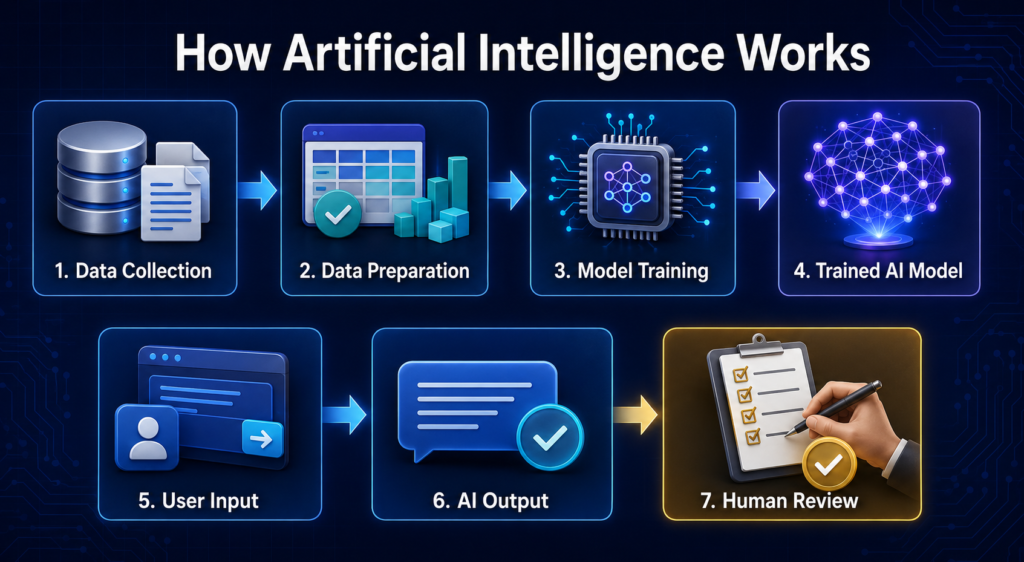
Part 7: Natural Language Processing, LLMs and Generative AI
Natural Language Processing allows computers to work with human language. Large language models and generative AI have expanded this ability from basic text classification to writing, translation, conversation, coding, image creation and multimodal reasoning.
However, these systems do not understand language in exactly the same way humans do. They learn statistical patterns from data and can produce fluent but incorrect information. Their outputs therefore require appropriate verification.
61. What is Natural Language Processing?
Natural Language Processing, abbreviated as NLP, is a branch of artificial intelligence that enables computers to process, analyse, generate and respond to human language.
The word “natural” distinguishes ordinary human languages such as English, Hindi, Punjabi, French and Japanese from formal programming languages such as Python, Java and C++.
NLP combines knowledge from:
- Artificial intelligence
- Machine learning
- Deep learning
- Computer science
- Linguistics
- Statistics
- Psychology
- Cognitive science
Major NLP tasks
Text classification
Text classification assigns a category to a document, sentence or message.
Examples include:
- Spam detection
- News categorisation
- Complaint classification
- Topic identification
- Intent recognition
Sentiment analysis
Sentiment analysis estimates whether text expresses a positive, negative or neutral opinion.
Businesses use it to analyse reviews, feedback and social-media comments.
Machine translation
Machine translation converts text from one language into another.
Examples include:
- English to Hindi
- Punjabi to English
- French to German
Translation systems must handle grammar, context, idioms and cultural meaning rather than simply replacing individual words.
Information extraction
Information extraction identifies useful facts from unstructured text.
It may extract:
- Names
- Dates
- Countries
- Organisations
- Locations
- Products
- Events
- Relationships
Question answering
A question-answering system attempts to provide an answer from its learned knowledge, supplied documents or retrieved sources.
Text summarisation
Summarisation produces a shorter version of a document while preserving its main meaning.
It may be:
- Extractive — selects important sentences from the source
- Abstractive — generates a new summary in its own wording
Text generation
Text generation creates new language based on instructions or previous text.
Applications include:
- Articles
- Emails
- Reports
- Stories
- Explanations
- Software code
Speech recognition
Speech recognition converts spoken audio into text.
Text-to-speech
Text-to-speech converts written text into synthetic spoken audio.
Named Entity Recognition
Named Entity Recognition, or NER, identifies entities such as names, dates, organisations and locations.
Natural-language inference
Natural-language inference examines the relationship between statements, such as whether one statement supports, contradicts or is unrelated to another.
📘 Simple Definition
Natural Language Processing is the technology that helps computers work with human language. It allows machines to read, classify, translate, summarise, generate and respond to text or speech.
62. How does an NLP system process human language?
Traditional NLP systems often process language through several stages. Modern neural networks may learn many of these stages jointly, but the underlying concepts remain important.
Step 1: Text collection
The system receives language from sources such as:
- Documents
- Websites
- Books
- Emails
- Messages
- Transcribed speech
- Customer reviews
- Social-media posts
Step 2: Text cleaning
Text cleaning may involve:
- Removing unnecessary symbols
- Correcting encoding problems
- Standardising spaces
- Handling upper- and lower-case letters
- Identifying sentence boundaries
- Removing duplicate content
Cleaning must be performed carefully because punctuation, capitalisation and formatting can carry meaning.
Step 3: Tokenisation
Tokenisation divides text into smaller units called tokens.
A token may be:
- A complete word
- Part of a word
- A character
- A punctuation mark
- A special symbol
For example, the word “unbelievable” might be treated as one token or divided into smaller units such as “un,” “believ” and “able,” depending on the tokenizer.
Step 4: Normalisation
Normalisation converts different text forms into a more consistent representation.
It may include:
- Lower-casing
- Expanding abbreviations
- Standardising dates
- Handling spelling variations
- Removing unnecessary punctuation
Excessive normalisation can remove useful meaning. For example, capitalisation may help identify a person or place.
Step 5: Stemming and lemmatisation
Stemming removes word endings using simple rules.
For example:
- Playing → play
- Connected → connect
Stemming may sometimes produce a form that is not a complete word.
Lemmatisation attempts to convert a word into its correct dictionary form.
For example:
- Better → good
- Am, is and are → be
Step 6: Part-of-speech tagging
Part-of-speech tagging identifies whether a word functions as a:
- Noun
- Verb
- Adjective
- Adverb
- Pronoun
- Preposition
- Conjunction
The same word may have different roles in different sentences.
Step 7: Syntactic analysis
Syntactic analysis examines the grammatical structure of a sentence.
It may identify:
- Subject
- Verb
- Object
- Clauses
- Dependency relationships
Step 8: Semantic analysis
Semantic analysis attempts to represent meaning.
It considers:
- Word meanings
- Sentence meaning
- Relationships between concepts
- Ambiguity
- Context
Step 9: Pragmatic and contextual analysis
Pragmatics examines what a speaker means in a particular situation.
For example, “Can you open the window?” is grammatically a question about ability, but it is normally understood as a request.
Why is human language difficult for AI?
Human language contains:
- Ambiguity
- Sarcasm
- Idioms
- Humour
- Regional variation
- Cultural references
- Unspoken assumptions
- Multiple meanings
- Changing vocabulary
- Code-mixing between languages
For example, Indian users may combine Hindi, Punjabi and English in one conversation. An NLP system must recognise the intended meaning even when grammar, spelling and script vary.
63. What is a language model?
A language model is a system that estimates the probability of tokens or sequences of tokens.
It learns which words, subwords or symbols are likely to occur in a particular context.
For example, in the sentence:
“The Sun rises in the ____.”
A language model may assign a high probability to “east.”
Early statistical language models
Early language models used counting and probability.
An n-gram model predicts language using sequences containing a fixed number of items.
Examples include:
- Unigram — one token
- Bigram — two consecutive tokens
- Trigram — three consecutive tokens
A bigram model may estimate the probability of “artificial intelligence” by counting how frequently “intelligence” follows “artificial.”
Limitations of n-gram models
- They use limited context.
- Many possible sequences never appear in the training data.
- They struggle with long-distance relationships.
- They require large frequency tables.
- They do not generalise well to unfamiliar wording.
Neural language models
Neural language models represent words and contexts using numerical vectors.
RNNs, LSTMs and GRUs allowed models to use more previous information than basic n-grams, but they still faced difficulty with long sequences and parallel training.
Transformer language models
Transformers made it easier to process relationships across longer sequences using attention mechanisms.
Important transformer-based model families include:
- GPT
- BERT
- T5
- Llama
- Gemini
- Claude
- Mistral
- Qwen
- Gemma
- DeepSeek
The Google Machine Learning Crash Course defines a language model as a model that estimates the probability of tokens or sequences within a larger context.
Is every language model a chatbot?
No.
A language model may be used for:
- Search
- Classification
- Translation
- Text completion
- Embeddings
- Summarisation
- Information extraction
- Question answering
A chatbot adds a conversational interface, instructions, memory systems, safety controls and sometimes external tools around a language model.
64. What is a Large Language Model?
A Large Language Model, abbreviated as LLM, is a neural language model trained on large amounts of text or related data and containing a large number of learned parameters.
The word “large” may refer to:
- Number of parameters
- Amount of training data
- Computing resources used
- Breadth of tasks
- Size of the model architecture
There is no single official parameter number at which a language model becomes an LLM.
What are tokens?
Tokens are the units processed by a language model.
A token can be:
- A complete word
- Part of a word
- A number
- Punctuation
- A code fragment
- A special control symbol
One word does not always equal one token.
A common English word may be represented by one token, while an uncommon, technical or non-English word may be divided into several tokens.
Tokenisation influences:
- Processing cost
- Context length
- Multilingual performance
- Response length
- Model efficiency
What are parameters?
Parameters are learned numerical values that store patterns developed during training.
They do not function like clearly labelled database entries. A model does not normally contain one identifiable parameter for “India” and another for “New Delhi.” Knowledge is distributed across many parameter values.
What is a context window?
A context window is the amount of information that a model can process together during one interaction.
It may include:
- System instructions
- User prompts
- Earlier messages
- Uploaded documents
- Retrieved sources
- Tool results
- The model’s generated output
A larger context window allows more information to be considered, but it does not guarantee that every detail will be remembered or used correctly.
What can an LLM do?
An LLM may help with:
- Writing
- Summarisation
- Translation
- Coding
- Brainstorming
- Classification
- Tutoring
- Research assistance
- Document analysis
- Question answering
- Data interpretation
The Google guide to large language models explains that LLMs use large parameter counts and broader context to predict token sequences.
Readers can explore individual systems through the ChatGPT Complete Guide, Google Gemini Complete Guide and Claude AI Complete Guide.
Does an LLM contain every fact from its training data?
No. Training compresses statistical patterns into model parameters. The model may:
- Remember some information
- Combine related patterns
- Generalise from examples
- Forget details
- Confuse similar facts
- Generate unsupported information
An LLM should not be treated as a perfectly accurate database.
65. What is a transformer, and how does self-attention work?
A transformer is a neural-network architecture introduced in the 2017 research paper “Attention Is All You Need.”
The paper was written by Ashish Vaswani and colleagues working at Google. The transformer was originally developed for machine translation but later became central to language, vision, audio and multimodal AI.
The original Attention Is All You Need paper proposed an architecture based primarily on attention mechanisms instead of recurrent or convolutional sequence processing.
What is attention?
Attention allows a model to assign different levels of importance to different parts of the input.
Consider the sentence:
“Riya gave Neha the book because she had finished reading it.”
To interpret “she” and “it,” the model must examine relationships among several words.
Attention helps the model determine which tokens are most relevant to each other.
What is self-attention?
Self-attention compares tokens within the same sequence.
For every token, the model creates numerical representations commonly called:
- Query
- Key
- Value
A simplified process is:
- The query represents what the current token is looking for.
- Keys represent what other tokens contain.
- The model compares queries with keys.
- It calculates attention scores.
- The values are combined according to those scores.
- The token receives a context-aware representation.
What is multi-head attention?
Multi-head attention performs several attention operations in parallel.
Different heads may learn different relationships, such as:
- Grammar
- Reference between pronouns and nouns
- Word meaning
- Position
- Topic
- Long-distance dependency
Attention heads are learned mathematical mechanisms. They should not automatically be interpreted as perfect explanations of human-like reasoning.
What is positional encoding?
Self-attention alone does not naturally know word order. Positional information is therefore added so that the model can distinguish:
- “The dog chased the cat.”
- “The cat chased the dog.”
The words are similar, but their order changes the meaning.
Encoder, decoder and encoder–decoder models
Encoder-only models
Encoder models are designed mainly to understand or represent input.
They are useful for:
- Classification
- Search
- Entity recognition
- Embeddings
BERT is an influential encoder-based model. Google introduced BERT in 2018 as a model that learns bidirectional representations using both left and right context.
Decoder-only models
Decoder models generate output token by token.
They are commonly used for:
- Text generation
- Conversation
- Code generation
- Completion
GPT-style models are decoder-based.
Encoder–decoder models
Encoder–decoder models process an input through an encoder and generate a result through a decoder.
They are useful for:
- Translation
- Summarisation
- Text transformation
- Question answering
T5 is an important encoder–decoder model family.
66. What is generative AI?
Generative AI is artificial intelligence that creates new synthetic content based on patterns learned from training data.
It can generate:
- Text
- Images
- Audio
- Speech
- Music
- Video
- Software code
- Designs
- Presentations
- Three-dimensional objects
- Synthetic datasets
Generative AI differs from traditional predictive AI.
- Predictive AI estimates a category, value or future outcome.
- Generative AI produces new content.
However, one system may contain both predictive and generative components.
Major generative-model approaches
Autoregressive models
Autoregressive models generate one unit after another while considering previous units.
Large language models frequently generate text in this way.
Generative Adversarial Networks
GANs use a generator and discriminator in competition.
The generator creates examples, while the discriminator attempts to distinguish generated examples from real ones.
Variational Autoencoders
Variational Autoencoders, or VAEs, learn a structured latent representation from which new examples can be generated.
Diffusion models
Diffusion models learn to reverse a gradual noising process.
During generation, they can begin with random noise and progressively produce an image, audio clip or video.
Transformer-based multimodal models
Multimodal transformers can connect text, images, audio and other data types using shared representations.
Is generative AI copying its training data?
The answer is not simply yes or no.
Generative models normally create outputs from learned statistical patterns rather than directly copying one stored example. However, models can sometimes reproduce:
- Memorised phrases
- Recognisable images
- Personal data
- Copyrighted material
- Training examples
The risk depends on the model, dataset, prompt and training method.
Users should not assume that every generated output is automatically original, accurate or legally safe.
67. How does an LLM generate text?
A language model commonly generates text by repeatedly predicting a likely next token.
Suppose the prompt is:
“Artificial intelligence can help students to…”
The model calculates probabilities for possible next tokens, such as:
- Learn
- Understand
- Create
- Organise
- Improve
It selects one token according to its decoding settings, adds it to the sequence and predicts the next token. This continues until the response is complete or a limit is reached.
Does the model choose only the highest-probability token?
Not always.
If it always selected the single most likely token, responses could become repetitive or rigid. Generation systems may sample from several likely tokens.
Temperature
Temperature controls randomness.
- Lower temperature usually produces more predictable output.
- Higher temperature allows more variation.
- Very high temperature may reduce coherence or accuracy.
Temperature does not add knowledge to the model. It changes how the system selects among possible outputs.
Top-k sampling
Top-k sampling limits selection to the k most probable tokens.
For example, if k equals 20, the model selects from the 20 most likely options.
Top-p sampling
Top-p, or nucleus sampling, selects from the smallest group of tokens whose combined probability reaches a chosen threshold.
Greedy decoding
Greedy decoding selects the highest-probability token at each step.
It is simple but may not produce the best overall sequence.
Beam search
Beam search keeps several possible sequences and compares them during generation.
It has been widely used for translation and sequence-generation tasks.
Why does next-token prediction produce useful answers?
During large-scale training, the model learns patterns involving:
- Grammar
- Facts
- Style
- Reasoning structures
- Document formats
- Dialogue
- Code
- Relationships between concepts
Predicting the next token across a very large and varied dataset can produce internal representations useful for many tasks.
However, a fluent sequence is not necessarily a factually correct sequence.
68. How are LLMs pre-trained, fine-tuned and aligned?
An LLM may pass through several training and adaptation stages. Not every model uses exactly the same process.
Stage 1: Data collection and preparation
Developers collect and prepare text, code, images or other data.
The process may include:
- Removing duplicates
- Filtering low-quality content
- Detecting unsafe material
- Removing some personal information
- Balancing data sources
- Applying licensing or policy rules
- Tokenising content
Dataset composition strongly influences the model’s language, knowledge, bias and behaviour.
Stage 2: Pre-training
During pre-training, the model learns general patterns from a large dataset.
A decoder-based language model may learn by predicting the next token.
An encoder model such as BERT may learn by predicting masked or hidden tokens.
Pre-training produces a base model. A base model may complete text but may not reliably follow user instructions.
Stage 3: Supervised fine-tuning
During supervised fine-tuning, the model is trained on examples of desired behaviour.
Training examples may contain:
- User instruction
- High-quality response
- Correct format
- Safety behaviour
- Task-specific demonstration
Stage 4: Instruction tuning
Instruction tuning exposes the model to many instructions and expected responses.
It improves the ability to understand requests such as:
- Summarise this document.
- Explain this concept.
- Translate this paragraph.
- Write a formal email.
- Classify this feedback.
Stage 5: Preference training
Human or AI evaluators may compare model responses and indicate which response is more useful, safe or accurate.
The preference data can be used to improve behaviour.
Reinforcement Learning from Human Feedback
RLHF uses human preferences as a training signal.
A simplified RLHF process is:
- Generate several responses.
- Ask human evaluators to rank them.
- Train a reward model from those rankings.
- Optimise the language model according to the reward model.
OpenAI’s InstructGPT research describes the use of supervised demonstrations and reinforcement learning from human feedback to improve instruction following.
Reinforcement Learning from AI Feedback
RLAIF uses feedback produced partly or mainly by AI systems according to defined principles or evaluation criteria.
Human review may still be involved in creating the principles, supervising the process and testing results.
Stage 6: Safety training and evaluation
Developers may test and improve the model for:
- Harmful content
- Privacy
- Bias
- Cybersecurity
- Misinformation
- Instruction-following
- Refusal behaviour
- Tool-use safety
Stage 7: Task-specific adaptation
A model may be adapted using:
- Full fine-tuning
- Parameter-efficient fine-tuning
- LoRA
- Prompt tuning
- Adapters
- Retrieval
- Tool integration
Alignment methods improve behaviour but do not guarantee perfect truthfulness, fairness or safety.
69. What are RAG, grounding, tool use and AI agents?
An LLM’s internal parameters may contain outdated, incomplete or inaccurate information. External information and tools can extend its abilities.
Retrieval-Augmented Generation
Retrieval-Augmented Generation, abbreviated as RAG, combines information retrieval with text generation.
A simplified RAG process is:
- A user asks a question.
- The system searches an approved document collection.
- It retrieves relevant passages.
- The passages are added to the model’s context.
- The model generates an answer based partly on those passages.
- The system may provide citations.
The original Retrieval-Augmented Generation paper, published in 2020 by Patrick Lewis and colleagues, combined a pre-trained generator with an external document index for knowledge-intensive tasks.
What is grounding?
Grounding connects an AI response to supplied evidence, documents, databases, sensor information or verified tools.
Examples include grounding an answer in:
- A company policy manual
- A textbook
- Official government data
- A medical guideline
- A user’s uploaded documents
- A live database
Grounding can improve relevance and traceability, but the model may still misunderstand or misrepresent the source.
What is tool use?
A model may be allowed to use external tools, such as:
- Web search
- Calculator
- Database
- Code interpreter
- Calendar
- Email system
- Mapping service
- Weather service
- File reader
- Image analyser
Tool access should be controlled according to permissions and risk.
What is function calling?
Function calling allows a model to produce structured instructions for an approved software function.
For example, instead of inventing a weather report, the model can request current data from a weather service.
What is an AI agent?
An AI agent can plan and perform a sequence of actions to pursue a goal.
An agent may:
- Interpret the goal.
- Create a plan.
- Select tools.
- Perform actions.
- inspect results.
- Correct its approach.
- Stop when the task is complete.
An AI agent is not automatically AGI. It may remain limited to a particular workflow.
Does RAG eliminate hallucinations?
No.
RAG can reduce some factual errors, but it can fail if:
- Retrieval finds the wrong document.
- The source is outdated.
- The document itself is incorrect.
- Important evidence is missed.
- Retrieved passages conflict.
- The model misunderstands the source.
- The generated citation does not support the claim.
NIST recommends documenting how generative systems use fine-tuning and retrieval in its Generative AI Risk Management Profile.
70. What are AI hallucinations, and how should LLM answers be verified?
An AI hallucination is an output that appears plausible but contains fabricated, incorrect or unsupported information.
Hallucinations may include:
- Invented facts
- Incorrect dates
- Non-existent books
- Fake quotations
- Fabricated legal cases
- Incorrect calculations
- False medical claims
- Invalid website links
- Non-existent academic references
- Incorrect descriptions of a source
Why do LLMs hallucinate?
LLMs are trained mainly to generate probable and useful sequences, not to guarantee that every sentence is true.
Hallucinations may result from:
- Incomplete training information
- Conflicting sources
- Ambiguous prompts
- Weak retrieval
- Pressure to provide an answer
- Incorrect patterns learned from data
- Excessive confidence in generation
- Knowledge outside the model’s available context
- Errors introduced during long reasoning chains
How can hallucinations be reduced?
Users and developers can:
- Ask the model to state uncertainty.
- Provide reliable source documents.
- Use retrieval from authoritative databases.
- Request citations.
- Open and check every citation.
- Use external tools for calculations.
- Compare important claims with primary sources.
- Use structured output formats.
- Break complex tasks into smaller steps.
- Ask the model to separate facts from assumptions.
- Apply human expert review.
- Test the system using known examples.
How should different users verify AI output?
Students
Students should compare important information with textbooks, official educational resources and original research.
They should not submit AI-generated assignments without understanding, checking and rewriting the material according to institutional rules.
Teachers
Teachers should verify:
- Dates
- Definitions
- Quotations
- References
- Answer keys
- Curriculum alignment
Researchers
Researchers should inspect the original paper rather than relying only on an AI summary. Every author name, journal, year, DOI, statistic and quotation should be verified.
Medical users
Medical information should be checked with qualified healthcare professionals and trusted clinical guidance. An AI chatbot should not replace diagnosis or treatment.
Legal and financial users
Legal and financial information can change according to country, jurisdiction, date and personal circumstances. It should be verified through official sources and qualified professionals.
Businesses
Businesses should review generated content for:
- Accuracy
- Confidentiality
- Copyright
- Bias
- Regulatory compliance
- Brand safety
- Customer impact
🎓 Student Tip
A source link is not proof by itself. Open the source and check whether it actually supports the claim. Also confirm the author, publication, date and context before using the information in notes, assignments or research.
🔍 Quick Summary
NLP enables computers to work with human language. Language models estimate token probabilities, while LLMs learn broad language patterns from large datasets. Transformers use self-attention to connect information across a sequence. Generative AI creates text, images, audio, video and code. Pre-training, instruction tuning and preference training improve model capabilities and behaviour. RAG and tools can add external information, but they do not guarantee accuracy. Every important AI-generated claim should be verified through reliable sources.
Part 8: Computer Vision, Robotics and Expert Systems
Artificial intelligence does not work only with text and numbers. It can also analyse images, recognise objects, control robots and help people make decisions using stored expert knowledge. This section explains computer vision, robotics, expert systems and fuzzy logic in a simple but complete way.
71. What is computer vision?
Computer vision is a branch of artificial intelligence that enables computers to analyse and understand images and videos. Its purpose is to extract useful information from visual data and take an appropriate action.
For example, a computer-vision system may:
- Identify a person in a photograph
- Detect vehicles on a road
- Read text from a scanned document
- Find abnormalities in a medical image
- Inspect products in a factory
- Recognise plants, animals or landmarks
- Help a robot understand its surroundings
Computer vision is often compared with human eyesight, but the comparison is not exact. Humans naturally understand context, relationships and meaning. A computer must convert an image into numerical data and process it using algorithms or trained AI models.
Modern computer-vision systems commonly use deep learning models, especially convolutional neural networks and vision transformers. These models learn visual patterns from large collections of labelled or unlabelled images.
According to IBM’s explanation of computer vision, computer vision combines cameras, data and AI algorithms to derive meaningful information from visual inputs.
📘 Simple Definition
Computer vision is the ability of a computer to recognise, analyse and understand information contained in images and videos.
72. How does a computer-vision system work?
A computer-vision system normally works through several connected stages.
First, an image or video is captured using a camera, scanner, satellite, medical-imaging device or another visual sensor. The system then prepares the visual data by resizing it, reducing noise, adjusting brightness or separating important areas.
Next, an AI model searches for useful visual features. These may include edges, colours, shapes, textures, faces, objects or movement. Modern deep-learning systems can learn many of these features automatically during training.
The general process is:
- Image acquisition: A camera or sensor collects visual data.
- Preprocessing: The image is cleaned or adjusted.
- Feature learning: The AI model identifies important patterns.
- Prediction: It classifies, detects or separates objects.
- Decision or action: The result is displayed, stored or used by another system.
- Feedback: Errors may be reviewed to improve the model.
For example, a traffic-monitoring camera captures a road image. The model detects vehicles, identifies their positions and may count them or estimate traffic density.
The quality of the result depends on training data, image quality, lighting, camera angle and the suitability of the model. A system trained on clear daytime images may perform poorly in fog, darkness or heavy rain.
73. What is the difference between image classification, object detection, segmentation and tracking?
These are four important computer-vision tasks, but they answer different questions.
Image classification identifies the main category of an entire image. If a photograph contains a tiger, the system may label the complete image as “tiger.”
Object detection identifies multiple objects and shows where they are located. It may draw separate boxes around a tiger, tree and vehicle in the same image.
Image segmentation examines an image at the pixel level. It separates the exact areas belonging to different objects. In medical imaging, segmentation can help outline the shape and size of a tumour.
Object tracking follows an identified object across a sequence of video frames. It can track a vehicle through traffic footage or follow a player during a sports match.
In short:
- Classification asks, “What is in this image?”
- Detection asks, “What objects are present, and where are they?”
- Segmentation asks, “Which exact pixels belong to each object?”
- Tracking asks, “Where does the object move over time?”
A single application may use several tasks together. An autonomous vehicle, for example, may detect pedestrians, segment the road and track nearby vehicles at the same time.
74. What are OCR and facial recognition?
Optical character recognition, commonly called OCR, is a technology that converts printed, handwritten or photographed text into machine-readable text.
OCR is used for:
- Digitising books and old records
- Extracting information from invoices and receipts
- Reading identity documents
- Processing bank cheques
- Recognising vehicle number plates
- Making scanned documents searchable
- Assisting visually impaired users
An OCR system first locates text in an image and then recognises letters, numbers and symbols. According to IBM’s OCR guide, modern OCR may combine image processing, pattern recognition and machine learning.
Facial recognition is a computer-vision technology that analyses facial features to verify or identify a person. Face verification compares a face with one claimed identity, such as unlocking a phone. Face identification searches for a possible match among many stored faces.
Facial recognition may support security, identity verification and finding missing persons. However, it also creates serious privacy, consent, surveillance and fairness concerns.
The U.S. National Institute of Standards and Technology has reported that performance differences can occur across demographic groups, algorithms and image conditions. Therefore, facial recognition should be tested carefully and should not be treated as completely error-free.
75. What is robotics, and how is it related to artificial intelligence?
Robotics is the field concerned with designing, building, programming and operating machines that can perform physical tasks. These machines are called robots.
A robot may contain:
- A mechanical body
- Sensors
- A processor or controller
- Software
- Motors or other actuators
- A power source
- Communication systems
Artificial intelligence can make a robot more capable of understanding its surroundings, making decisions, learning from experience or adapting to changing conditions.
However, robotics and AI are not the same thing. Not every robot uses advanced AI. A factory robot may repeatedly perform a fixed movement using traditional programming. Similarly, many AI systems—such as a writing assistant or recommendation engine—do not have a physical robotic body.
AI-powered robots can perform more flexible tasks, such as recognising objects, avoiding obstacles, understanding spoken instructions or selecting an appropriate route.
Robots are used in factories, hospitals, warehouses, farms, homes, disaster areas, oceans and space missions. NASA explains that robotics can reduce risks to humans and expand exploration capabilities in environments that may be distant or dangerous.
76. What are the main types of robots?
Robots can be classified according to their design, movement and purpose.
Industrial robots perform manufacturing tasks such as welding, painting, assembling and packaging. They are commonly found in automobile and electronics factories.
Service robots assist people outside traditional industrial manufacturing. Examples include cleaning robots, delivery robots and hotel-assistance robots.
Collaborative robots, or cobots, are designed to work near humans. They may assist workers in lifting, assembly or inspection tasks.
Mobile robots move through an environment using wheels, tracks or legs. Warehouse robots are a common example.
Humanoid robots have a body structure or behaviour resembling humans. They may walk, speak, carry objects or interact socially.
Medical robots assist with surgery, rehabilitation, patient monitoring or hospital transportation.
Aerial robots, including drones, fly through the air. They are used in photography, agriculture, mapping, inspection and emergency response.
Underwater and space robots operate in places that are difficult or dangerous for people. Examples include remotely operated underwater vehicles and planetary rovers.
Autonomous vehicles use sensors, software and AI to navigate roads or controlled environments.
Some robots belong to more than one category. A hospital delivery robot, for example, may be both a service robot and an autonomous mobile robot.
77. How does an intelligent robot sense, plan and act?
An intelligent robot generally follows a continuous process called the sense–plan–act cycle.
Sense: The robot collects information through cameras, microphones, touch sensors, GPS, radar, lidar or temperature sensors.
Perceive: Its software interprets the sensor data. It may recognise an object, estimate distance, detect a person or create a map.
Plan: The robot decides what it should do. It may calculate a safe route, select an object to pick up or determine how to complete a task.
Act: Motors and other actuators move the robot’s wheels, arms, joints or tools.
Check and adjust: New sensor information helps the robot determine whether its action was successful. It can then correct its movement or create a new plan.
For example, a warehouse robot senses shelves and people, identifies its current location, plans a route and moves towards the required package. If an obstacle appears, it may stop and choose another route.
Human oversight remains important, especially in healthcare, transport, defence and other high-risk situations. Unexpected conditions, damaged sensors or incorrect AI predictions can cause errors.
🚀 AI in Real Life
Because communication between Earth and Mars takes time, a Mars rover cannot depend on continuous real-time human control. AI can help it identify obstacles, select safer movements and perform certain tasks with limited autonomy. The European Space Agency describes AI applications in rover navigation and space-mission planning.
78. What is an expert system?
An expert system is an AI program designed to imitate the decision-making process of a human specialist in a particular subject area.
Instead of possessing general intelligence, an expert system focuses on a limited domain, such as medical diagnosis, mineral analysis, equipment maintenance or financial assessment.
A traditional expert system contains knowledge in the form of facts and rules. For example:
IF a machine is overheating AND its cooling fan is not working, THEN inspect the cooling system.
The system applies such rules to information supplied by a user and produces a conclusion, recommendation or diagnosis.
Expert systems became an important area of AI research during the 1960s, 1970s and 1980s. One early example was DENDRAL, developed at Stanford University to assist with the analysis of chemical structures. MYCIN was later created to investigate how rule-based systems could support medical decisions concerning certain bacterial infections.
Expert systems demonstrated that specialised knowledge could be represented in computer programs. However, their knowledge usually had to be entered and maintained by human experts.
Modern AI systems often use machine learning, but rule-based expert systems are still useful where decisions must follow clear policies and explanations are important.
79. What are the components, examples and limitations of an expert system?
The main components of a traditional expert system are:
- Knowledge base: Stores facts, rules and specialist knowledge.
- Inference engine: Applies rules to available information to reach a conclusion.
- User interface: Allows a user to enter information and receive advice.
- Explanation facility: Describes how or why the system reached a result.
- Knowledge-acquisition process: Collects and updates knowledge from specialists.
An expert system may use forward chaining, which begins with known facts and moves towards a conclusion. It may also use backward chaining, which begins with a possible conclusion and checks whether supporting facts are available.
Classic examples include DENDRAL for chemical analysis, MYCIN for medical research and XCON for configuring computer systems.
Expert systems also have limitations:
- They usually work only within a narrow domain.
- Building and updating the knowledge base can take considerable time.
- Human experts may disagree with one another.
- The system may struggle with unusual situations not covered by its rules.
- It does not necessarily possess common sense.
- Incorrect or incomplete rules can produce unreliable conclusions.
Therefore, an expert system should normally support qualified professionals rather than replace their judgement in high-stakes situations.
80. What is fuzzy logic, and how is it different from Boolean logic?
Fuzzy logic is a method of reasoning that allows values between completely true and completely false.
Traditional Boolean logic normally uses two values:
- 1 for true
- 0 for false
Fuzzy logic may represent a condition using any degree between 0 and 1. For example, instead of saying that a room is either “hot” or “not hot,” a fuzzy system may describe it as hot to a degree of 0.7.
This approach is useful because many real-world ideas are not perfectly black or white. Temperature, speed, risk, comfort and brightness may exist at different levels.
A fuzzy-logic controller may use rules such as:
IF the room is moderately hot, THEN increase the fan speed slightly.
Fuzzy logic has been used in air conditioners, cameras, washing machines, vehicle-control systems and industrial equipment.
It is important not to confuse fuzzy logic with probability. Probability describes uncertainty about whether an event will occur. Fuzzy logic describes the degree to which something belongs to a category.
Fuzzy logic can also be included within an expert system. It helps the system handle approximate expressions such as low risk, high temperature or moderate pressure instead of depending only on exact boundaries.
🔍 Quick Summary
- Computer vision enables machines to analyse images and videos.
- Classification, detection, segmentation and tracking perform different visual tasks.
- OCR converts images of text into editable or searchable text.
- Facial recognition requires privacy, fairness and accuracy safeguards.
- Robotics deals with machines that perform physical tasks.
- AI can help robots perceive, plan, learn and adapt.
- Expert systems use stored facts and rules to imitate specialised decision-making.
- Fuzzy logic handles degrees of truth instead of only true-or-false values.
Part 9: AI Tools, Companies, Models and Platforms
AI users frequently encounter terms such as model, chatbot, tool, assistant and platform. These terms are related, but they do not mean exactly the same thing. This section explains the major AI products and organisations shaping the present AI ecosystem.
81. What is the difference between an AI model, tool, chatbot and platform?
An AI model is the trained system that performs tasks such as generating text, analysing images, translating languages or making predictions. GPT, Gemini, Claude and Llama are examples of AI model families.
An AI tool is an application created for a specific purpose using one or more AI models. For example, an AI writing tool may use a language model to draft and improve content.
An AI chatbot allows users to communicate with AI through natural-language conversations. ChatGPT, Gemini, Claude and Grok provide chatbot-style interfaces, although their capabilities extend beyond simple conversation.
An AI assistant helps users complete tasks such as writing emails, summarising documents, researching topics, creating images or analysing files.
An AI platform provides models, data, development tools, APIs and infrastructure that organisations can use to build their own AI applications. Examples include Google AI Studio, Microsoft Azure AI, Amazon Bedrock and Hugging Face.
A simple way to understand the relationship is:
- The model is the intelligence.
- The tool is the application.
- The chatbot is a conversational interface.
- The platform is the environment used to build, manage or access AI systems.
One tool may also use different models for different tasks.
82. Which companies and organisations are leading the development of AI?
Artificial intelligence is being developed by technology companies, universities, research laboratories, governments and open-source communities across the world.
Major organisations include:
- OpenAI, based in the United States, develops GPT models and ChatGPT.
- Google DeepMind, with roots in the United Kingdom and the United States, develops Gemini and scientific AI systems.
- Anthropic, based in the United States, develops Claude.
- Microsoft, based in the United States, develops Copilot products and provides AI services through its cloud platforms.
- Meta, based in the United States, develops the Llama model family and Meta AI.
- NVIDIA, based in the United States, produces GPUs, software and computing systems used in AI development.
- xAI, based in the United States, develops Grok.
- Mistral AI, founded in France, develops language models, including open-weight models.
- Cohere, founded in Canada, develops enterprise-focused language models.
- Chinese companies and laboratories such as Alibaba, Baidu, Tencent and DeepSeek also develop major AI models.
- Hugging Face, created by French entrepreneurs and headquartered in the United States, supports the sharing of models, datasets and AI applications.
Universities including Stanford, MIT, Carnegie Mellon, Oxford, Cambridge, Tsinghua and the University of Toronto have also made important contributions to AI research.
No single company controls the entire AI field. Different organisations lead in language models, robotics, hardware, scientific research, cloud computing or open-source development.
83. What are OpenAI and ChatGPT?
OpenAI is an American artificial intelligence organisation founded in San Francisco in December 2015. Its founding group included Sam Altman, Elon Musk, Greg Brockman, Ilya Sutskever, John Schulman and Wojciech Zaremba.
OpenAI develops the GPT family of language models. GPT stands for Generative Pre-trained Transformer. These models can work with natural language and, depending on the model and product, may also process images, audio, video, files and code.
ChatGPT is OpenAI’s conversational AI product. It was publicly released on 30 November 2022 and helped make generative AI widely accessible to ordinary users.
ChatGPT can be used for:
- Explaining subjects
- Drafting and improving content
- Summarising documents
- Generating and debugging code
- Analysing files and data
- Brainstorming ideas
- Creating images
- Conducting guided research
- Supporting everyday productivity
ChatGPT is the application, while the GPT model works behind the application. OpenAI also provides models and development tools through its API platform. Its official model documentation explains the models currently available to developers.
Users should verify factual, academic, legal, medical and financial information because even an advanced model can produce inaccurate answers.
💡 Did You Know?
ChatGPT gained public attention faster than most earlier consumer AI products. Its conversational interface allowed people without programming knowledge to use a powerful language model through ordinary questions and instructions.
84. What are Google DeepMind and Gemini?
DeepMind was founded in London, United Kingdom, in 2010 by Demis Hassabis, Shane Legg and Mustafa Suleyman. Google acquired the company in 2014. In 2023, DeepMind and Google Brain were combined to form Google DeepMind.
Google DeepMind conducts research in artificial intelligence, machine learning, robotics, biology, mathematics, weather forecasting and scientific discovery.
Gemini is Google’s family of multimodal AI models and assistants. Multimodal means that a system can work with more than one type of information, such as text, images, audio, video and code.
Gemini can assist with:
- Answering questions
- Writing and editing
- Summarising documents
- Analysing images and files
- Generating and explaining code
- Supporting research
- Creating study materials
- Working with selected Google services
Google also provides Gemini models to developers through Google AI Studio and Google Cloud.
Google DeepMind develops other AI systems for image, audio, video, robotics and scientific applications. Its official models page lists major model families and their intended uses.
Gemini should not be confused with Google Search. Search locates web pages and information sources, while Gemini generates responses and may use additional tools or connected information to complete a task.
85. What are Anthropic and Claude AI?
Anthropic is an American AI company founded in 2021 by former OpenAI researchers, including siblings Dario Amodei and Daniela Amodei. The company focuses on developing useful, reliable and safer AI systems.
Claude is Anthropic’s family of large language models and its conversational AI assistant. Claude became publicly available in 2023.
Claude can help users with:
- Writing and editing
- Summarising long documents
- Analysing files
- Explaining difficult concepts
- Coding and debugging
- Research assistance
- Brainstorming
- Professional communication
- Working with structured information
Anthropic is also known for Constitutional AI, an approach that uses a written set of principles to help guide model behaviour during training. This does not mean that Claude is always correct or completely free from harmful outputs. Human review and fact-checking remain necessary.
Claude is available as a user-facing assistant and through a development platform for organisations building AI applications. The official Claude website describes it as an assistant for personal and professional work.
Claude is often useful for long documents, structured writing and code-related tasks, but its suitability depends on the user’s exact purpose, available features, pricing and regional access.
86. What is Microsoft Copilot?
Microsoft Copilot is the name used for a family of AI assistants and AI-powered features developed by Microsoft. These products are designed for personal productivity, workplace tasks, software development and business automation.
Microsoft Copilot for individual users can assist with questions, writing, idea generation, web-based information and image creation.
Microsoft 365 Copilot is designed to work with applications and organisational information. Depending on the account, licence and permissions, it can support work in:
- Microsoft Word
- Excel
- PowerPoint
- Outlook
- Teams
- OneNote
- SharePoint
For example, it may draft a Word document, explain spreadsheet data, create a presentation outline, summarise an email conversation or prepare meeting notes.
Microsoft also provides Copilot Studio for building customised AI agents. GitHub Copilot is a separate product designed mainly to assist programmers with writing, explaining and improving code.
Microsoft explains that its different Copilot products serve personal, organisational and development-related purposes. Its official Copilot selection guide helps organisations understand these differences.
Users should not enter confidential organisational information into a personal AI service unless their institution has approved its use and provided suitable data protection.
87. What are Meta AI and Llama?
Meta is the American technology company behind Facebook, Instagram and WhatsApp. It is also an important developer of artificial intelligence models and research.
Llama is Meta’s family of large language models. The first Llama model was released in 2023. Llama models can support tasks such as text generation, summarisation, coding, translation and conversational applications.
Llama is especially important because Meta has made model weights available under its own licences. This allows many researchers, developers and organisations to download, customise or run supported Llama models on their own infrastructure.
However, Llama should usually be described as open-weight, not automatically as completely open-source. Access to model weights does not necessarily provide every training dataset, development detail or unrestricted right associated with traditional open-source software.
Meta AI is the user-facing AI assistant built into selected Meta applications and websites. It can answer questions, generate content and assist with different creative or informational tasks.
Llama models are also available through various cloud platforms and developer services. Meta’s official Llama information explains how the model family supports research and application development.
The exact Llama versions and licence conditions can change, so developers should always check the licence attached to the model they plan to use.
88. What are xAI and Grok?
xAI is an American artificial intelligence company founded by Elon Musk in 2023. Its stated goal is to use AI to advance human understanding and scientific discovery.
Grok is xAI’s conversational generative AI assistant and model family. It is available through dedicated web and mobile services and has also been associated with the X social platform.
Depending on the available version and service, Grok may help with:
- General questions
- Web and current-topic searches
- Writing and summarisation
- Coding assistance
- Image analysis
- File analysis
- Voice interaction
- Image or video creation
- Reasoning and research tasks
One of Grok’s notable features is its connection with current information from the web and X. This can be useful for trends and recent events, but social-media information may be incomplete, misleading or unverified. Important claims should therefore be checked against reliable primary sources.
xAI also provides developer access to Grok models through an API. The official Grok documentation explains its main capabilities and supported interfaces.
Like other generative AI tools, Grok may produce incorrect or biased information. Its answers should be evaluated according to evidence rather than accepted only because they sound confident.
89. What are some important specialised AI tools and platforms?
Some AI tools are designed for general conversation, while others focus on a specific type of work.
Important categories and examples include:
- AI research: Perplexity and NotebookLM help users explore, organise and understand information.
- AI coding: Cursor and GitHub Copilot assist with writing, explaining, editing and debugging code.
- AI image generation: Midjourney, Leonardo AI, Adobe Firefly and Microsoft Designer create or edit visual content.
- AI design: Canva AI helps with presentations, social-media graphics and other design projects.
- AI video generation: Tools such as Runway, Veo and other video platforms create or edit video using prompts.
- AI writing: Grammarly and other writing assistants help with grammar, clarity, tone and drafting.
- AI productivity: Notion AI and Microsoft Copilot assist with notes, documents, tasks and workplace information.
- AI voice: Voice-generation and transcription tools create speech or convert audio into text.
- AI model development: Hugging Face allows developers and researchers to discover and share models, datasets and demonstration applications.
The Hugging Face Hub is particularly important for the open machine-learning community because it supports model, dataset and application sharing.
Users should select a specialised tool according to their purpose, accuracy requirements, privacy needs, commercial-use rights, budget and technical ability.
90. What is the difference between open-source, open-weight and proprietary AI?
These terms describe how much access users receive to an AI system.
Open-source AI generally provides source code under a licence that permits users to inspect, modify and redistribute it. However, applying the term to modern AI models can be complicated because a complete system may also depend on training data, model weights and documentation.
Open-weight AI provides the trained model parameters, or weights. Developers may be able to download and run the model, but its complete training data or development process may not be available. Licence restrictions may also apply.
Proprietary or closed AI is controlled by a company or organisation. Users normally access it through an application or API without downloading its internal model weights.
Open or open-weight models may offer:
- Greater customisation
- Local or private deployment
- Research flexibility
- More control over infrastructure
Proprietary models may offer:
- Easier setup
- Managed security and updates
- Technical support
- Integrated tools
- Strong ready-to-use performance
Neither approach is automatically better or safer. Open models can be misconfigured, while closed services may create privacy, cost or dependence concerns.
Before selecting a model, users should examine its licence, data-handling policy, hardware requirements, security controls, update schedule and suitability for the intended task.
🔍 Quick Summary
- An AI model provides intelligence, while a tool provides a usable application.
- OpenAI develops GPT models and ChatGPT.
- Google DeepMind develops Gemini and scientific AI systems.
- Anthropic develops Claude.
- Microsoft offers different Copilot products for personal, workplace and development tasks.
- Meta develops Llama models and Meta AI.
- xAI develops Grok.
- Specialised tools serve research, coding, design, writing, image and video creation.
- Open-source, open-weight and proprietary AI provide different levels of access and control.
- AI products change quickly, so features, model names, pricing and availability should always be checked on official websites.
Part 10: Prompt Engineering and Practical AI Use
AI tools become more useful when users know how to communicate with them. A carefully written prompt can improve relevance, accuracy and presentation, but no prompt can guarantee a completely correct answer. This section explains how to write effective prompts and use AI responsibly in studies, work and everyday life.
91. What is an AI prompt?
An AI prompt is the instruction, question, information or example that a user gives to an artificial intelligence system.
A prompt may be as short as:
Explain photosynthesis.
It may also contain detailed instructions:
Explain photosynthesis to a Class 8 student in approximately 200 words. Use simple English, include one everyday example and end with five revision points.
Prompts are not limited to written questions. Depending on the AI tool, a prompt may include:
- Text
- Images
- Audio
- Video
- Documents
- Spreadsheet data
- Computer code
- Examples of the required output
The quality of a prompt influences the usefulness of the response. A vague instruction may produce a general answer, while a clear instruction can produce a more focused result.
However, a detailed prompt does not automatically make the answer correct. AI generates responses by processing patterns and available context. It may misunderstand the request, miss important information or provide false details.
Therefore, an effective prompt should explain the task clearly, and the user should review the generated answer before using it.
📘 Simple Definition
A prompt is the input or instruction given to an AI system to tell it what to do and how to present the result.
92. What is prompt engineering, and why is it important?
Prompt engineering is the process of designing, testing and improving instructions given to an AI system.
It involves selecting suitable words, adding relevant context, explaining the expected result and correcting the prompt when the first response is not satisfactory.
Prompt engineering is important because the same AI model can produce very different responses to different instructions. For example, “Write about climate change” is broad. A better prompt would specify the audience, length, purpose, tone and required topics.
Prompt engineering can help users:
- Receive more relevant answers
- Control the structure and tone
- Reduce unnecessary information
- Generate content for a specific audience
- Analyse documents more systematically
- Create repeatable workflows
- Save time on revisions
It is useful for students, teachers, writers, researchers, programmers, marketers and business professionals. It does not always require programming knowledge.
Prompt engineering is also an iterative activity. A user may begin with a basic prompt, review the response and then add missing instructions.
For a more detailed explanation and practical examples, readers can visit the AI Prompt Engineering Guide.
Prompt engineering improves communication with AI, but it does not replace subject knowledge, critical thinking or fact-checking.
93. What makes an effective AI prompt?
An effective prompt clearly explains what the user wants and provides enough information for the AI to complete the task.
A useful prompt normally contains the following elements:
- Task: What should the AI do?
- Context: Why is the task being completed?
- Audience: Who will read or use the result?
- Requirements: What information must be included?
- Format: Should the response be a paragraph, list, table, email or report?
- Length: How detailed should the response be?
- Tone: Should it be formal, simple, persuasive or academic?
- Restrictions: What should the AI avoid?
- Examples: What kind of output is expected?
For example:
Explain the causes of the Industrial Revolution to a first-year college student. Write 500 words in easy English. Cover Britain’s role, major inventions, important people and social effects. Use headings and end with six revision points. Do not use unnecessarily difficult language.
A good prompt should be specific without becoming confusing. Unrelated instructions may reduce clarity.
It is also helpful to divide a complicated task into stages. First ask for an outline, then request individual sections and finally ask for a review.
Pro Tip
Use this basic formula:
Action + Context + Audience + Requirements + Output Format + Limitations
This formula can be adapted for academic, professional and creative tasks.
94. What are zero-shot, one-shot and few-shot prompting?
Zero-shot, one-shot and few-shot prompting describe how many examples are included in a prompt.
Zero-shot prompting provides instructions without an example.
Classify the following review as positive, negative or neutral: “The product is useful, but delivery was late.”
One-shot prompting provides one example before presenting the actual task.
Example: “Excellent service” = Positive
Now classify: “The product is useful, but delivery was late.”
Few-shot prompting provides several examples. These examples help the AI recognise the expected pattern, label, tone or format.
Few-shot prompting can be useful when:
- Categories are difficult to understand
- A specific writing style is required
- Answers must follow a fixed structure
- Information must be extracted consistently
- The user wants a particular formatting pattern
Examples should be accurate and relevant. Poor examples can guide the AI towards an incorrect response.
Few-shot prompting does not mean training the entire AI model again. The examples are normally used only as context for the current task or conversation.
For ordinary questions, zero-shot prompting may be sufficient. One-shot or few-shot prompting is more useful when the desired result is specialised, repetitive or difficult to explain through instructions alone.
95. How can role, context and output format improve a prompt?
Role, context and output format help an AI system understand the perspective, purpose and presentation required for a task.
A role instruction may say:
Act as an experienced schoolteacher.
This tells the AI to respond from a teaching perspective. However, assigning a role does not turn the AI into a qualified professional.
Context provides background information. For example:
The explanation is for a rural Class 10 classroom where students are studying the topic for the first time.
Output format explains how the answer should be organised:
Use a short introduction, four headings, one example and five revision questions.
A complete prompt may be:
Act as an experienced geography teacher. Explain soil erosion to Class 10 students in easy English. Cover water erosion, wind erosion, human causes and prevention. Use approximately 400 words, clear headings and five revision points.
Role instructions should be realistic. Phrases such as “You are the world’s greatest expert” usually add little value.
The most important elements are clear context, accurate source material and a well-defined task. Users should also specify whether they want a summary, lesson plan, report, comparison, checklist or another format.
96. How should students use AI for learning?
Students should use AI as a learning assistant, not as a substitute for reading, thinking and practising.
AI can help students:
- Understand difficult concepts
- Receive explanations at different learning levels
- Create revision notes
- Generate practice questions
- Improve grammar and writing
- Learn vocabulary
- Compare theories
- Prepare study schedules
- Receive feedback on their own answers
- Explore possible project topics
A useful approach is to attempt the work first and then ask AI to explain errors or suggest improvements.
For example:
I have written the following answer in my own words. Check its factual accuracy, identify missing points and explain how I can improve it. Do not rewrite the complete answer until I try again.
Students should not submit AI-generated work as entirely their own when their institution prohibits it. They should follow school or university rules concerning academic integrity, citations and permitted AI use.
AI-generated references, quotations, dates and statistics must be verified. Students should consult textbooks, teachers, official reports and original sources for important assignments.
🎓 Student Tip
After receiving an AI explanation, close it and try to write the answer from memory. If you cannot explain the concept in your own words, more learning is required.
97. How can professionals use AI productively?
Professionals can use AI to support routine, creative and analytical tasks. The purpose should be to improve efficiency and quality while keeping humans responsible for final decisions.
Common professional uses include:
- Drafting emails and reports
- Summarising meetings
- Organising notes
- Creating presentation outlines
- Analysing non-sensitive data
- Generating project ideas
- Preparing checklists
- Improving grammar and clarity
- Creating standard templates
- Explaining technical information
- Producing first drafts
- Automating repetitive processes
A professional should provide clear context without entering confidential or personally identifiable information into an unapproved AI service.
AI-generated work should be reviewed for:
- Factual accuracy
- Missing information
- Incorrect calculations
- Inappropriate tone
- Bias
- Confidentiality
- Legal or regulatory requirements
- Compatibility with organisational policies
AI is particularly useful for creating a first version quickly. Human experience is still required to determine whether the result is correct, appropriate and practical.
Professionals should keep a record of effective prompts for repeated tasks. A tested prompt library can improve consistency across reports, emails, customer responses and other routine work.
98. What is an AI hallucination, and how can users reduce it?
An AI hallucination occurs when an AI system produces information that appears convincing but is false, unsupported or invented.
Examples include:
- Inventing a book or research paper
- Providing an incorrect date
- Creating a false quotation
- Giving a link that does not exist
- Misidentifying a person
- Producing incorrect calculations
- Claiming that a feature exists when it does not
Hallucinations occur because generative AI predicts suitable outputs from patterns. It does not always retrieve facts from a verified database.
Users can reduce the risk by:
- Asking for sources
- Providing reliable reference material
- Requesting uncertainty to be stated
- Breaking a complicated question into smaller parts
- Checking dates, names and statistics separately
- Comparing the answer with official sources
- Using tools that provide traceable citations
- Asking the AI to distinguish facts from assumptions
A helpful instruction is:
Use only the information provided in the attached document. If the answer is not present, say “The information is not available in the provided source.”
Even after such instructions, verification remains necessary. High-stakes medical, legal, financial and safety decisions should always involve qualified professionals and authoritative information.
99. What information should users avoid sharing with AI tools?
Users should avoid entering confidential, sensitive or personally identifiable information into an AI tool unless the service has been formally approved for that purpose.
Information that generally should not be shared includes:
- Passwords
- One-time passwords
- Banking details
- Credit or debit card numbers
- Private identification numbers
- Medical records
- Confidential student records
- Unpublished research
- Business secrets
- Private legal documents
- Customer databases
- Employee information
- Private photographs without consent
- Confidential computer code
- Security keys and access tokens
Users should also avoid uploading documents without checking what personal information they contain.
Before using an AI service, examine its privacy policy, data-retention rules, account settings and organisational approval. Business and educational institutions may provide protected enterprise versions with different data-handling conditions.
Where possible, remove or replace identifying information. For example, use “Student A” instead of a student’s real name.
Deleting a chat does not necessarily mean that every related copy disappears immediately from all systems. Users should therefore make privacy decisions before submitting information, not only after it has been shared.
100. What is the best step-by-step method for using AI responsibly?
A responsible AI workflow combines clear instructions, careful review and human judgement.
Step 1: Define the purpose.
Decide what you want AI to help you achieve.
Step 2: Select the appropriate tool.
Choose a general or specialised AI tool according to the task.
Step 3: Protect sensitive information.
Remove confidential, personal or restricted data.
Step 4: Write a clear prompt.
Include context, audience, requirements, length and output format.
Step 5: Review the first response.
Identify missing information, unclear sections and possible errors.
Step 6: Improve through follow-up prompts.
Ask for corrections, examples or a different explanation.
Step 7: Verify important claims.
Check facts, dates, quotations, calculations, references and links.
Step 8: Add human knowledge.
Improve the result using personal experience and subject expertise.
Step 9: Follow applicable rules.
Respect copyright, academic-integrity policies, privacy and professional standards.
Step 10: Take responsibility for the final output.
The person who uses or publishes AI-generated material remains responsible for it.
🔍 Quick Summary
- A prompt tells an AI system what task to perform.
- Prompt engineering improves the clarity and usefulness of AI responses.
- Effective prompts include context, audience, requirements and output format.
- Examples can help AI follow a particular pattern.
- Students should use AI to learn, practise and receive feedback.
- Professionals should review AI-generated work before using it.
- AI hallucinations can sound convincing but contain false information.
- Confidential and personal data should not be shared carelessly.
- Responsible AI use requires verification, human judgement and accountability.
Part 11: AI Applications Across Different Fields
Artificial intelligence is now used in almost every major sector. It helps people analyse data, recognise patterns, predict possible outcomes, automate routine tasks and create new content. Its benefits depend on accurate data, responsible implementation and suitable human supervision.
101. How is AI used in healthcare and medicine?
AI is used in healthcare to support medical professionals, researchers, hospitals and public-health organisations.
Common applications include:
- Analysing X-rays, CT scans, MRI scans and other medical images
- Supporting the detection of diseases
- Predicting health risks from patient data
- Assisting in drug discovery
- Monitoring patients through wearable devices
- Organising medical records
- Scheduling hospital resources
- Supporting robotic surgery
- Identifying patterns in public-health data
- Providing general health information through virtual assistants
AI can process large amounts of medical data quickly, but it should not independently replace a qualified doctor. Medical decisions require clinical examination, patient history, professional judgement and informed consent.
Healthcare AI may also produce incorrect results if it is trained on incomplete or unrepresentative data. Privacy is especially important because medical records contain sensitive personal information.
The World Health Organization’s guidance on AI for health recognises the potential of AI in diagnosis, treatment, health research and drug development. It also emphasises human rights, safety, transparency, accountability and equal access.
Patients should not use a general AI chatbot as the only source for diagnosing an illness or selecting treatment. Urgent or serious medical concerns require a qualified healthcare professional.
🧠 Research Insight
AI in healthcare is most valuable when it supports doctors and patients rather than removing human responsibility. A technically accurate system can still be unsuitable if it ignores patient consent, privacy, local conditions or unequal access to healthcare.
102. How is AI used in education?
AI can support teaching, learning, assessment, administration and educational research.
Students may use AI to:
- Receive explanations at different learning levels
- Practise questions
- Improve grammar and writing
- Translate educational material
- Create revision notes
- Receive feedback
- Plan their studies
Teachers may use AI to prepare lesson outlines, worksheets, quizzes, examples and differentiated learning materials. Educational institutions may use it for timetable planning, student-support systems and administrative tasks.
AI can also improve accessibility through text-to-speech, speech-to-text, captions, translation and personalised interfaces.
However, AI presents several educational risks:
- Students may submit generated work without learning.
- Answers may contain factual errors.
- Excessive dependence may weaken critical thinking.
- Biased systems may disadvantage some learners.
- Unequal access may widen the digital divide.
- Student data may be collected or used without sufficient protection.
UNESCO’s work on AI in education recommends a human-centred approach based on inclusion and equity.
AI should assist teachers, not remove the human relationships essential to education. Students must learn how to question, verify and improve AI-generated information.
103. How is AI used in agriculture?
AI is used in agriculture to help farmers monitor crops, manage resources, predict risks and improve agricultural decisions.
Important applications include:
- Detecting plant diseases from images
- Monitoring crop growth
- Analysing soil conditions
- Predicting crop yield
- Identifying weeds and pests
- Managing irrigation
- Forecasting weather-related risks
- Monitoring livestock health
- Operating agricultural drones and robots
- Sorting agricultural products
- Estimating market demand
- Reducing unnecessary use of water, fertiliser and pesticides
A farmer may take a photograph of a damaged leaf and use an AI application to identify a possible disease. Sensors and satellite images can also help determine which areas of a field require water or nutrients.
The Food and Agriculture Organization explains that digital technologies and AI can support precision farming, climate-smart agriculture, supply-chain management and market access.
However, AI recommendations may be unreliable if local soil, crop varieties, climate or farming practices are not represented in the training data. Small farmers may also face problems related to cost, internet access, language and digital skills.
AI should combine scientific data with local agricultural knowledge and expert advice.
104. How is AI used in business, banking and finance?
Businesses use AI to analyse information, automate processes, understand customers and support decision-making.
Common business applications include:
- Customer-service chatbots
- Sales forecasting
- Inventory management
- Marketing personalisation
- Document processing
- Email and report drafting
- Recruitment support
- Fraud detection
- Business-data analysis
- Workflow automation
Banks and financial organisations use AI for fraud alerts, identity verification, credit-risk assessment, customer support, transaction monitoring and market analysis.
For example, an AI system may identify a transaction that differs significantly from a customer’s normal spending pattern. The bank may then request additional verification.
AI can improve speed and consistency, but financial decisions can seriously affect individuals and businesses. An incorrect fraud alert may block a legitimate transaction, while a biased credit system may treat applicants unfairly.
Organisations should test AI systems, protect customer data and provide a way for people to question automated decisions. Employees should also verify AI-generated financial summaries and calculations.
💼 Business Tip
Begin with a low-risk and measurable use case, such as document classification or frequently asked customer questions. Test its accuracy and cost before using AI for sensitive financial, employment or legal decisions.
105. How is AI used in manufacturing and supply chains?
AI helps manufacturers monitor machines, improve product quality, plan production and manage supply chains.
Major applications include:
- Predictive maintenance
- Automated quality inspection
- Production planning
- Demand forecasting
- Inventory management
- Warehouse automation
- Generative product design
- Energy management
- Supply-chain risk detection
- Workplace-safety monitoring
Predictive maintenance uses sensor data to identify signs that a machine may fail. Maintenance can then be scheduled before a major breakdown occurs.
Computer-vision systems can inspect products for cracks, incorrect dimensions, missing components or packaging errors. Robots may handle repetitive, physically demanding or dangerous tasks.
The U.S. National Institute of Standards and Technology identifies predictive maintenance, generative design, quality improvement and operational optimisation as important manufacturing applications.
AI does not remove the need for skilled workers. Engineers, technicians and operators are required to maintain machines, interpret results and respond to unexpected situations.
Manufacturers must also protect connected systems from cyberattacks. An error or attack affecting an AI-controlled production system could interrupt operations or create safety risks.
106. How is AI used in transportation, logistics and smart cities?
AI is used to improve the movement of people, vehicles and goods.
Transportation and logistics applications include:
- Route planning
- Traffic-flow prediction
- Delivery scheduling
- Fleet management
- Vehicle maintenance
- Driver-assistance systems
- Autonomous vehicles
- Warehouse robots
- Public-transport planning
- Shipment tracking
Navigation applications use traffic information to suggest faster routes. Logistics companies may use AI to decide how packages should be stored, grouped and delivered.
Smart-city systems may use AI to control traffic signals, monitor water or electricity usage, identify damaged infrastructure and support emergency responses.
The OECD’s work on AI in mobility notes that AI can support traffic optimisation, predictive maintenance, infrastructure planning and efficient route selection.
However, autonomous and smart-city systems can create safety, surveillance and privacy concerns. A vehicle must respond safely to unexpected road conditions. A city should not collect or analyse personal movement data without a lawful and transparent purpose.
Human oversight and clear responsibility are essential when an AI error could cause physical harm.
107. How is AI used in media, journalism and entertainment?
AI is used to create, edit, recommend and distribute media content.
In journalism, AI can assist with:
- Transcribing interviews
- Summarising documents
- Translating reports
- Analysing large datasets
- Detecting trends
- Preparing draft headlines
- Organising archives
Journalists must verify generated information, sources and quotations. AI should not invent eyewitness accounts, evidence or references.
In entertainment, AI is used for:
- Film and video editing
- Visual effects
- Music generation
- Game development
- Animation
- Voice generation
- Script assistance
- Content recommendation
- Audience analysis
Streaming services use recommendation systems to suggest films, programmes or music according to viewing patterns.
Generative AI also creates images, voices and videos that may appear realistic. This increases the risk of deepfakes, impersonation and misinformation.
Creative professionals must consider copyright, consent and attribution. A person’s face or voice should not be copied without appropriate permission. Publishers should also disclose AI-generated or substantially AI-edited content when required by law, platform rules or professional ethics.
AI can support creativity, but human originality, cultural understanding and editorial responsibility remain essential.
108. How is AI used in science, research, space and environmental protection?
Researchers use AI to analyse large datasets, discover patterns, simulate complex systems and generate possible research directions.
Scientific applications include:
- Analysing genetic and biological data
- Supporting drug and material discovery
- Modelling weather and climate
- Studying earthquakes and natural hazards
- Identifying species
- Monitoring forests and oceans
- Processing satellite images
- Detecting pollution
- Searching astronomical data
- Planning experiments
In space exploration, AI helps analyse images, plan missions, navigate robotic systems and identify unusual patterns in scientific data.
NASA explains that it uses AI in Moon and Mars exploration, weather-related work, mission planning, autonomous systems and scientific-data analysis.
Environmental organisations may use satellite images and machine learning to monitor deforestation, changes in glaciers, water conditions or wildlife habitats.
AI can accelerate research, but it does not automatically prove a scientific claim. Researchers must explain their methods, evaluate data quality, reproduce results and distinguish correlation from causation.
🚀 AI in Real Life
Spacecraft and planetary rovers may operate far from Earth, where communication is delayed. AI can help them navigate, organise observations and respond to limited situations without waiting for every instruction from human controllers.
109. How is AI used in government, law and public services?
Governments can use AI to improve administration, public services and policy analysis.
Possible applications include:
- Processing applications and documents
- Answering common citizen questions
- Detecting tax or benefit fraud
- Translating public information
- Managing traffic and infrastructure
- Supporting disaster response
- Analysing public-health information
- Planning government resources
- Identifying patterns in complaints
- Improving access to public records
In legal work, AI may assist with document review, case research, contract analysis, transcription and the organisation of evidence. However, legal interpretations and court decisions require qualified human judgement.
The OECD’s guidance on AI in public services explains that AI can streamline routine administrative tasks, allowing public servants to focus on work requiring judgement and discretion.
Government AI also creates serious risks. Biased data may lead to unfair decisions concerning welfare, policing, taxation or public benefits. Citizens may not understand how a decision was reached.
Public-sector AI should therefore include transparency, legal authority, data protection, security, human review and an effective appeal process. AI should not make an unchallengeable decision that affects a person’s rights or opportunities.
110. How is AI used in everyday life and accessibility?
Many people use AI daily without noticing it.
Everyday applications include:
- Search engines
- Email spam filters
- Maps and navigation
- Product recommendations
- Social-media feeds
- Smartphone cameras
- Voice assistants
- Translation applications
- Fraud alerts
- Smart-home devices
- Photo organisation
- Streaming recommendations
- Predictive text
- Customer-support systems
AI can also improve accessibility for people with disabilities.
Examples include:
- Screen readers
- Automatic captions
- Speech-to-text
- Text-to-speech
- Image descriptions
- Voice-controlled devices
- Real-time translation
- Reading and writing assistance
- Navigation support
- Communication tools
These applications can increase independence and access to education, employment and public information.
However, an accessibility tool must work reliably for different languages, accents, disabilities and environments. A poorly designed system may exclude the people it is intended to assist.
Users should also understand that recommendation systems influence what they see, watch and purchase. Constant personalisation may reduce exposure to different ideas or encourage excessive use.
AI in everyday life is most beneficial when people maintain control over settings, understand how their data is used and can choose whether to accept an automated recommendation.
🔍 Quick Summary
- AI supports healthcare, but doctors remain responsible for medical decisions.
- In education, AI should strengthen learning rather than replace thinking.
- Agriculture uses AI for crops, soil, irrigation and risk prediction.
- Businesses and banks use AI for automation, forecasting and fraud detection.
- Manufacturing uses AI for maintenance, inspection and production planning.
- Transportation systems use AI for routes, traffic and vehicle assistance.
- Media organisations use AI for creation, editing, analysis and recommendation.
- Scientists use AI to analyse data and accelerate discovery.
- Governments must use AI transparently and allow human review.
- Everyday AI can improve convenience and accessibility, but privacy and user control remain important.
Part 12: AI Hardware, Data, Cloud Computing and Infrastructure
Artificial intelligence depends on more than algorithms. It requires useful data, computing chips, memory, storage, networks, software and data centres. Understanding this infrastructure helps explain how AI models are trained, delivered and operated.
111. Why is data important for artificial intelligence?
Data provides the examples and information from which many AI systems learn patterns.
Depending on the task, AI data may include:
- Written text
- Images
- Audio recordings
- Videos
- Computer code
- Medical records
- Sensor readings
- Financial transactions
- Satellite images
- Customer interactions
- Machine-operation records
For example, an image-recognition system learns by processing many images. A language model learns patterns from large collections of text and other permitted data sources.
The amount of data is important, but its quality is often more important. A large dataset containing errors, duplicates or biased examples can produce an unreliable model.
AI developers should consider:
- Where the data came from
- Whether it was collected legally
- Whether people provided appropriate consent
- Whether it represents different groups and situations
- Whether it contains incorrect or outdated information
- Whether personal information has been protected
Not every AI system requires enormous datasets. A specialised model may perform well using a smaller collection of high-quality and relevant data.
Data alone does not create intelligence. Suitable algorithms, computing resources, testing and human expertise are also required.
112. What are training, validation and test datasets?
When developing a machine-learning model, available data is commonly divided into different groups.
Training data is used to teach the model. The model processes examples, makes predictions and adjusts its internal parameters to reduce errors.
Validation data is used during development to compare model settings and monitor performance. It helps developers decide which version of the model is working better.
Test data is used after training to evaluate the model on examples it has not previously seen. This provides a more realistic estimate of how it may perform in practical situations.
If the same examples are repeatedly used for both training and testing, the reported accuracy may be misleading.
The data should also represent the real environment in which the AI will operate. A crop-disease model trained only on clear, high-quality photographs may struggle with images taken using basic mobile cameras.
Important data-quality factors include:
- Accuracy
- Completeness
- Relevance
- Diversity
- Consistency
- Timeliness
- Proper labelling
- Legal and ethical collection
A model that performs well during testing may still require monitoring after deployment because users, language, markets and real-world conditions can change over time.
113. Which hardware components are required for AI?
AI systems use several types of computer hardware.
CPU: The central processing unit manages general computer operations. It is flexible and suitable for data preparation, application control and many smaller AI tasks.
GPU: The graphics processing unit can perform many mathematical operations in parallel. This makes it useful for training and running neural networks.
TPU: A tensor processing unit is specialised hardware developed for machine-learning calculations. Google describes its TPUs as custom-designed circuits for accelerating machine-learning workloads.
NPU: A neural processing unit is a specialised processor designed to run AI tasks efficiently. NPUs are increasingly included in smartphones and AI-capable personal computers.
Other important components include:
- RAM: Temporarily stores data being processed.
- High-bandwidth memory: Supplies data quickly to AI accelerators.
- Storage: Holds datasets, model files and results.
- Network equipment: Connects many computers and transfers data.
- Cooling systems: Remove heat produced by powerful chips.
- Power systems: Supply stable electricity to the equipment.
The required hardware depends on the task. A small model may run on a smartphone, while a large foundation model may require thousands of connected accelerators in a data centre.
114. Why are GPUs widely used in artificial intelligence?
GPUs were originally developed to process computer graphics. Graphics require a large number of similar calculations to be performed at the same time.
Neural networks also involve many repeated mathematical operations, especially matrix calculations. GPUs can process many of these operations in parallel, making them suitable for AI.
GPUs are used for:
- Training deep-learning models
- Running language models
- Generating images and videos
- Processing computer vision
- Scientific simulations
- Robotics
- Autonomous-vehicle development
A CPU may contain a smaller number of powerful general-purpose cores. A GPU normally contains many smaller processing units designed for parallel work.
This does not mean that a GPU is always necessary. Traditional machine-learning models, small datasets and ordinary AI applications may run effectively on CPUs or NPUs.
GPUs also require suitable software. AI frameworks and programming platforms help developers use the hardware efficiently.
The growth of deep learning created strong demand for high-performance GPUs. However, cost, electricity consumption, memory capacity and availability must all be considered when selecting hardware.
📘 Simple Definition
A CPU is a flexible general-purpose processor, while a GPU is designed to perform many similar calculations in parallel. This parallel ability makes GPUs especially useful for modern AI workloads.
115. What are AI data centres and AI supercomputers?
A data centre is a facility containing computing servers, storage systems, networking equipment, power supplies and cooling systems.
AI data centres are designed or upgraded to handle demanding AI workloads. They may contain large numbers of GPUs, TPUs or other accelerators connected through high-speed networks.
An AI supercomputer combines many powerful computing units so that they can work together on extremely large calculations.
AI data centres support:
- Model training
- Model inference
- Data storage
- Cloud AI services
- Scientific research
- Business applications
- Online AI assistants
Training a large model may require calculations to be distributed across many chips. Fast communication is necessary because the chips continually exchange information.
Cooling is also important. High-performance hardware produces considerable heat. Data centres may use air cooling, liquid cooling or other specialised systems.
AI data centres need physical security, cybersecurity, backup power and reliable internet connections. A failure in one part of the infrastructure can affect many users.
Not every organisation needs to build its own data centre. Many businesses, researchers and developers rent computing resources from cloud providers instead.
116. What is cloud AI?
Cloud AI refers to artificial intelligence models, computing resources and development tools provided through internet-based cloud services.
Instead of purchasing and maintaining expensive hardware, a user or organisation can rent computing capacity when required.
Cloud AI services may provide:
- Access to pre-trained models
- GPUs and other accelerators
- Data storage
- Model-training tools
- AI APIs
- Security and monitoring
- Application deployment
- Automatic scaling
Major providers include Amazon Web Services, Microsoft Azure, Google Cloud and other regional or specialised cloud companies.
Cloud AI offers several benefits:
- Lower initial infrastructure cost
- Access from different locations
- Ability to increase or reduce resources
- Faster development
- Managed updates and maintenance
- Access to several AI models
Possible limitations include recurring cost, internet dependence, data-location requirements, provider dependence and privacy concerns.
Organisations should check where their information is stored, who can access it and whether the service meets applicable security and legal requirements.
Cloud AI is particularly useful when demand changes over time. A business can use additional computing resources during a busy period without permanently owning all the hardware.
117. What are edge AI and on-device AI?
Edge AI processes data close to the place where it is collected instead of sending everything to a distant cloud data centre.
An edge device may be:
- A smartphone
- A security camera
- A vehicle
- A factory machine
- A drone
- A medical device
- A home appliance
- An agricultural sensor
On-device AI is a form of edge AI in which the model runs directly on the user’s device.
Benefits may include:
- Faster responses
- Reduced internet dependence
- Lower data-transfer requirements
- Improved privacy
- Real-time operation
- Continued use when connectivity is unavailable
For example, a smartphone may improve a photograph, recognise speech or suggest text without sending every operation to the cloud.
Edge AI also has limitations. Small devices have restricted processing power, memory, battery capacity and storage. Large models may need to be compressed or simplified before they can run efficiently.
Cloud and edge AI are often used together. A model may be trained in a large data centre and later deployed on a smaller device. The device can process urgent data locally while sending selected information to the cloud for additional analysis.
118. What is an AI API, and how does it connect AI with other applications?
API stands for Application Programming Interface. An AI API allows one software application to request an AI service from another system.
For example, a website may send text to an AI model through an API and receive a summary. A mobile application may use another API to translate speech or recognise an object in a photograph.
A simplified process is:
- The application sends a request.
- The request contains data and instructions.
- The AI service processes it.
- The service returns a result.
- The application displays or uses that result.
AI APIs can provide:
- Text generation
- Translation
- Image generation
- Speech recognition
- Voice generation
- Document analysis
- Computer vision
- Content moderation
- Data extraction
APIs allow developers to add AI without training a model from the beginning.
However, an API usually requires authentication through a secret key. That key should never be exposed publicly. Developers must also consider usage charges, response limits, data privacy, service availability and model updates.
An application should validate AI outputs before using them for sensitive actions. Giving an AI model access to email, databases or financial systems requires especially strong security controls and limited permissions.
119. What is the difference between AI training and inference?
Training is the process through which an AI model learns patterns from data. During training, the model makes predictions, measures errors and adjusts its internal parameters.
Training may require:
- Large datasets
- Powerful processors
- Considerable memory
- Significant time
- Specialist knowledge
- Repeated testing
Inference occurs when a trained model receives new input and produces an answer or prediction.
For example:
- Training: A model studies many labelled images of cats and dogs.
- Inference: The trained model examines a new photograph and predicts whether it contains a cat or dog.
Using a chatbot, generating an image or asking a voice assistant a question normally involves inference.
Training a very large model can be extremely expensive. Inference for one request may require fewer resources, but millions of daily requests can create substantial total cost.
There is also fine-tuning, in which an existing model receives additional training for a particular task or style.
Understanding this difference is useful because an organisation may use a model through inference without ever training the original model. It may only connect to a ready-made model through an application or API.
120. What is the environmental impact of AI infrastructure?
AI infrastructure uses electricity for computation, data transfer, storage and cooling. Data centres may also use water in certain cooling systems.
The environmental impact depends on:
- Model size
- Type of hardware
- Number of users
- Training duration
- Frequency of inference
- Data-centre efficiency
- Cooling technology
- Source of electricity
- Life cycle of electronic equipment
The International Energy Agency reports that data centres are an important and growing source of electricity demand. AI is one contributor, alongside cloud storage, video streaming and other digital services.
Environmental impact can be reduced by:
- Using efficient chips and algorithms
- Selecting an appropriately sized model
- Reusing trained models
- Improving data-centre cooling
- Scheduling flexible work when cleaner electricity is available
- Using renewable and low-emission energy
- Compressing models for smaller devices
- Extending hardware life
- Reporting energy and resource use transparently
AI may also support environmental goals by improving energy systems, weather forecasts and resource management. Therefore, its overall environmental effect includes both the resources it consumes and the problems it helps address.
🌍 Global AI Fact
AI is not an invisible or purely digital activity. Every cloud response depends on physical equipment, electricity, cooling, networks and storage located somewhere in the world.
🔍 Quick Summary
- Data quality strongly influences AI quality.
- Training, validation and test datasets serve different purposes.
- CPUs, GPUs, TPUs and NPUs perform different computing roles.
- GPUs are valuable because they perform many calculations in parallel.
- AI data centres combine processors, storage, networking, power and cooling.
- Cloud AI allows users to rent AI infrastructure and services.
- Edge AI processes information near the device where it is collected.
- APIs connect AI models with websites, software and mobile applications.
- Training teaches a model; inference uses the trained model.
- AI infrastructure consumes physical resources and should be designed efficiently.
Part 13: AI Ethics, Bias, Privacy, Copyright and Cybersecurity
Artificial intelligence can produce major benefits, but it can also cause harm when it is developed or used without proper safeguards. Responsible AI requires attention to fairness, privacy, security, transparency, copyright, human rights and accountability.
121. What is AI ethics?
AI ethics is the study and application of moral principles that guide the development, deployment and use of artificial intelligence.
It asks questions such as:
- Is the AI system fair?
- Does it protect privacy?
- Can its decision be explained?
- Who is responsible if it causes harm?
- Was its data collected legally?
- Does it respect human rights?
- Can people challenge its decisions?
- Is it safe and secure?
- Does it benefit society without excluding vulnerable groups?
Responsible AI puts these principles into practice throughout an AI system’s life cycle—from collecting data and training a model to deployment, monitoring and retirement.
In November 2021, UNESCO’s member states adopted the Recommendation on the Ethics of Artificial Intelligence, establishing an important global framework based on human rights, fairness, inclusion and environmental responsibility.
Ethical AI does not mean that every risk can be eliminated. It means that developers, organisations and governments identify risks, reduce avoidable harm, monitor outcomes and remain accountable.
📘 Simple Definition
AI ethics means developing and using artificial intelligence in ways that are fair, safe, transparent, responsible and respectful of human rights.
122. What is AI bias, and how does it occur?
AI bias occurs when an AI system produces systematically unfair or unequal results for certain individuals or groups.
Bias can enter an AI system through:
- Unrepresentative training data
- Incorrect or subjective labels
- Historical discrimination in records
- Poorly selected features
- Inappropriate system design
- Unequal testing
- Human assumptions
- The environment in which the system is used
For example, a recruitment model trained mainly on the historical records of one group may learn to favour patterns associated with that group. A facial-recognition system may perform differently across populations if its training and testing data lack sufficient diversity.
Bias does not always mean that a developer deliberately created an unfair system. It may come from society, data collection or the way an apparently neutral rule affects different people.
Bias can be reduced through representative data, diverse development teams, fairness testing, independent audits, human review and continuous monitoring.
Removing sensitive information such as gender or caste does not always remove bias because other variables may indirectly reveal similar information.
⚠️ AI Challenge
Fairness does not always mean treating everyone identically. In healthcare, education or public services, different groups may have different needs. Developers must define what fairness means for the specific situation and examine who may benefit or be harmed.
123. What are transparency, explainability and accountability in AI?
These three principles are related but different.
Transparency means providing appropriate information about an AI system. This may include its purpose, data sources, limitations, responsible organisation and whether a person is interacting with AI.
Explainability means helping people understand why an AI system produced a particular result. For example, a loan applicant may need to know which factors influenced a decision.
Accountability means that a person or organisation remains responsible for the AI system and its consequences. Responsibility should not be avoided by saying, “The computer made the decision.”
The NIST AI Risk Management Framework identifies accountability, transparency, explainability, privacy, fairness, safety and reliability as important characteristics of trustworthy AI.
Not every AI model can provide a complete technical explanation of its internal calculations. However, organisations can still explain:
- What the system is intended to do
- Which information it uses
- How its performance was tested
- What its limitations are
- Who reviews its decisions
- How a person can report an error or appeal
The level of explanation required should increase when an AI decision can affect health, employment, education, finance, liberty or access to essential services.
124. How does AI affect privacy and personal data?
AI systems may collect, analyse or generate information relating to individuals. This can create privacy risks when data is collected without valid permission, used for an unexpected purpose or exposed through a security failure.
Personal data may include:
- Names and contact details
- Photographs and voices
- Location information
- Financial records
- Medical information
- Educational records
- Online behaviour
- Biometric information
- Private messages
- Device identifiers
Organisations should collect only the data required for a legitimate purpose. They should protect it, limit access, define how long it will be retained and provide relevant information to users.
India enacted the Digital Personal Data Protection Act, 2023 on 11 August 2023. The official Act addresses the processing of digital personal data and recognises both lawful data use and an individual’s right to protection.
Privacy requirements differ among countries. Organisations must follow the laws applicable to their location, users and activities.
Individuals should avoid entering passwords, banking details, medical records, confidential documents or other sensitive information into an unapproved AI service.
125. Who owns AI-generated content, and is it protected by copyright?
There is no single worldwide answer. Copyright rules differ across countries, and this area continues to develop.
Important questions include:
- Was the output created entirely by AI?
- How much original human creativity was involved?
- Did the output reproduce protected material?
- What do the AI tool’s terms of service permit?
- Was a person’s image, voice or style used without consent?
- Will the content be used commercially?
In some countries, copyright protection normally requires meaningful human authorship. A purely machine-generated output may not receive the same protection as a human-created work. However, a human’s original selection, arrangement, editing or creative modification may be protected depending on the law.
The World Intellectual Property Organization’s guidance recommends that organisations examine intellectual-property risks and the terms governing AI tools.
Users should not assume that AI-generated material is automatically free from copyright concerns. An output may resemble an existing image, paragraph, character, logo or piece of music.
For commercial projects, users should preserve records of their prompts and human edits, review licence conditions and seek legal advice when ownership or infringement risks are significant.
126. What are deepfakes, and why are they dangerous?
A deepfake is synthetic or manipulated media created using AI to make a person appear to say or do something that did not actually happen.
Deepfakes may involve:
- Videos
- Photographs
- Voice recordings
- Live video calls
- Fake identification
- Altered speeches
- Impersonation of relatives or officials
Deepfake technology has legitimate uses in film production, education, accessibility and entertainment when appropriate consent and disclosure are provided.
It can also be misused for fraud, harassment, non-consensual intimate content, political manipulation, false evidence and reputational damage.
India’s CERT-In advisory on deepfake scams warns that realistic fake video, audio and images may be used for financial fraud, disinformation and impersonation.
Warning signs may include unusual facial movement, mismatched sound, unnatural lighting or an unexpected request for money. However, high-quality deepfakes may not contain obvious visual defects.
The safest response is independent verification. Contact the person or organisation through a previously known phone number or official channel. Do not transfer money or reveal sensitive information only because a familiar face or voice appears in a recording.
127. How is AI used in cybersecurity, and how can criminals misuse it?
AI has both defensive and harmful cybersecurity uses.
Security professionals use AI to:
- Detect unusual network activity
- Identify malware patterns
- Prioritise security alerts
- Find suspicious account behaviour
- Detect phishing attempts
- Analyse large security logs
- Support incident investigation
- Identify possible fraud
Cybercriminals may misuse AI to:
- Create convincing phishing emails
- Produce fake websites
- Impersonate trusted people
- Generate deepfake voices
- Automate scam messages
- Research potential targets
- Modify malicious content
- Spread misinformation at scale
AI does not make every cyberattack advanced. Many attacks still succeed because users reuse passwords, ignore updates, click suspicious links or reveal confidential information.
Security systems should combine AI with access controls, encryption, backups, employee training, software updates and human security specialists.
AI-generated code should also be reviewed before deployment because it may contain errors or vulnerabilities.
The main lesson is that AI can increase the speed and scale of both defence and attack. Strong cybersecurity practices remain necessary regardless of whether AI is involved.
128. What are prompt injection, data poisoning and adversarial attacks?
These are different ways in which an AI system may be manipulated or disrupted.
Prompt injection occurs when an instruction is designed to make an AI system ignore its intended rules or reveal information it should protect. Hidden instructions may also be placed inside documents or web pages processed by an AI agent.
Data poisoning occurs when harmful, false or misleading examples are inserted into training or reference data. The goal may be to reduce accuracy or influence future outputs.
Adversarial attacks use specially designed inputs to confuse an AI model. A small change that is difficult for a person to notice may cause the model to make an incorrect prediction.
Other risks include model theft, private-data leakage and unsafe actions performed by poorly controlled AI agents.
Protective measures include:
- Validating inputs
- Restricting system permissions
- Separating trusted and untrusted data
- Monitoring unusual behaviour
- Testing systems before deployment
- Keeping humans involved in sensitive actions
- Protecting training datasets
- Updating software
- Maintaining activity logs
An AI assistant should receive only the minimum access necessary for its task. It should not automatically send messages, transfer money, delete files or publish content without suitable safeguards.
129. How can individuals and organisations use AI more safely?
Safe AI use requires practical habits as well as technical controls.
Individuals should:
- Use strong, unique passwords
- Enable multi-factor authentication
- Avoid sharing confidential information
- Verify unexpected messages and calls
- Check AI-generated claims
- Review privacy settings
- Keep devices and applications updated
- Report suspicious or harmful content
- Avoid installing unverified AI applications
Organisations should:
- Create an approved AI-use policy
- Classify sensitive data
- Provide employee training
- Test AI systems for bias and security
- Limit user and agent permissions
- Review vendors and contracts
- Maintain audit logs
- Monitor model performance
- Prepare an incident-response plan
- Provide human review for important decisions
Before adopting a tool, an organisation should identify its purpose, possible users, data access, failure consequences and legal requirements.
✅ Pro Tip
Apply the principle of minimum necessary access. Give an AI system only the data, tools and permissions it genuinely requires. Wider access increases the possible damage caused by an error, cyberattack or unsafe instruction..
130. What major AI laws, policies and governance frameworks exist?
Countries and international organisations are developing different approaches to AI governance.
Important examples include:
- UNESCO Recommendation on the Ethics of AI: Adopted by 193 member states in November 2021 as a global ethical framework.
- NIST AI Risk Management Framework: Released in the United States in 2023 as a voluntary framework for identifying and managing AI risks.
- European Union AI Act: Entered into force on 1 August 2024. Most of its rules became applicable from 2 August 2026, while some provisions began earlier and certain high-risk requirements have later implementation dates. The Act uses a risk-based approach.
- India’s Digital Personal Data Protection Act, 2023: Governs the processing of digital personal data and is relevant when AI systems use such data.
- India AI Governance Guidelines: Unveiled under the IndiaAI Mission in November 2025 to encourage safe, inclusive and responsible AI development.
- Sector-specific laws: Existing rules concerning healthcare, finance, employment, consumer protection, cybersecurity and copyright may apply even when they do not specifically mention AI.
The European Commission’s official AI Act page provides the current application timeline.
An ethical guideline is not necessarily the same as a binding law. Rules also differ by country and may change. Organisations should therefore obtain current professional advice for high-risk or regulated AI applications.
🔍 Quick Summary
- AI ethics guides fair, safe and responsible AI use.
- Bias can enter through data, labels, design and real-world conditions.
- Transparency explains the system; explainability clarifies results; accountability identifies responsibility.
- AI systems must protect personal and sensitive information.
- Copyright protection for AI-generated work differs between countries.
- Deepfakes can support legitimate creativity but also enable fraud and misinformation.
- AI strengthens cybersecurity while also helping criminals scale attacks.
- Prompt injection and data poisoning can manipulate AI systems.
- Safe AI requires policies, limited permissions, monitoring and human review.
- AI governance includes laws, voluntary frameworks and sector-specific rules.
Part 14: AI Jobs, Economy, Education, Society and Global Governance
AI is changing how people work, learn, communicate and participate in society. Its effects will not be identical for every job, organisation or country. The outcome will depend on education, investment, labour policies, access to technology and responsible governance.
131. Will artificial intelligence replace human jobs?
AI will replace some tasks and may reduce the need for certain roles, but it is unlikely to eliminate every job performed by humans.
Most occupations contain several different tasks. AI may automate some of them while people continue to perform work requiring judgement, responsibility, physical ability, trust, creativity or human interaction.
For example, AI may draft a standard business letter, but an employee must verify the facts and decide whether it is appropriate. It may analyse a medical image, but a doctor remains responsible for diagnosis and patient care.
A 2025 study by the International Labour Organization estimated that one in four workers worldwide was employed in an occupation with some exposure to generative AI. However, the study concluded that transformation of jobs was more likely than complete replacement.
Possible outcomes include:
- Some jobs disappearing
- New jobs being created
- Existing jobs changing
- Workers becoming more productive
- New skills becoming necessary
- Human and AI systems working together
The effect will differ by occupation, country and industry. Employees, organisations and governments should prepare through training, social protection and responsible adoption rather than assuming that either no jobs or all jobs will disappear.
132. Which jobs and tasks are most likely to be affected by AI?
Tasks are generally more exposed when they are digital, repetitive, predictable and based on patterns.
Examples include:
- Data entry
- Basic document processing
- Routine translation
- Standard customer responses
- Simple content drafting
- Transcription
- Appointment scheduling
- Basic bookkeeping
- Repetitive coding tasks
- Initial document review
Occupations involving clerical and administrative work may experience significant changes because many of their tasks can be processed digitally.
Jobs requiring physical presence, complex human relationships or responsibility in unpredictable situations may be harder to automate completely. Examples include nursing, childcare, skilled trades, emergency services and many field-based roles.
However, these jobs may still use AI for planning, documentation or decision support.
Exposure does not automatically mean job loss. A lawyer may use AI to search documents, a teacher may create practice questions and an accountant may automate data classification while continuing to perform higher-level work.
Workers should examine their individual tasks rather than only their job titles. The most useful question is not simply, “Can AI do my job?” It is, “Which parts of my work can AI perform, and which abilities must I strengthen?”
133. What new jobs and careers are being created by AI?
AI is creating specialised technical roles as well as new responsibilities within traditional occupations.
Examples include:
- Machine-learning engineer
- AI researcher
- Data scientist
- AI product manager
- AI security specialist
- Robotics engineer
- Data engineer
- Model evaluator
- AI policy specialist
- Responsible AI officer
- AI auditor
- AI trainer
- Synthetic-data specialist
- AI application developer
- Human–AI interaction designer
Other professions may not use “AI” in their job title but will increasingly require AI skills. Teachers, doctors, lawyers, marketers, designers, journalists, farmers and office workers may need to understand how AI affects their field.
New work may also involve reviewing AI outputs, checking data quality, testing systems for bias, designing safe workflows and helping organisations follow relevant rules.
Not every AI career requires advanced mathematics or programming. Opportunities also exist in communication, project management, education, ethics, law, user experience and subject-specific AI implementation.
Job titles may change quickly. Therefore, learners should develop transferable skills instead of preparing only for one fashionable title.
AI knowledge becomes more valuable when combined with expertise in another field, such as healthcare, agriculture, finance, education or cybersecurity.
134. Which skills will people need in the AI era?
People will need a combination of digital, human and subject-specific abilities.
Important skills include:
- AI literacy
- Critical thinking
- Problem-solving
- Communication
- Data literacy
- Creativity
- Collaboration
- Ethical judgement
- Privacy and cybersecurity awareness
- Adaptability
- Subject knowledge
- Lifelong learning
Technical professionals may also require programming, mathematics, machine learning, data engineering and cloud-computing skills.
Most workers will not need to become AI engineers. The OECD’s research on the AI skills gap explains that while specialised AI professionals require advanced skills, a much larger number of workers need general AI literacy.
AI literacy includes understanding what AI can and cannot do, writing effective instructions, checking outputs, protecting data and recognising ethical risks.
Human abilities will remain important because AI cannot independently accept social, professional or legal responsibility.
🎓 Student Tip
Do not learn only how to operate one AI tool. Tools and model names will change. Build strong foundations in your subject, communication, research, verification and ethical AI use.
135. How can AI affect economic growth and productivity?
AI can improve productivity by helping people complete some tasks faster, analyse more information and reduce repetitive work.
Businesses may use AI to:
- Improve customer service
- Automate documents
- Forecast demand
- Detect fraud
- Optimise production
- Support product development
- Reduce equipment failures
- Assist employees
- Create new services
Higher productivity can contribute to economic growth, lower costs and improved services. It may also help small organisations access capabilities that previously required larger teams.
However, economic gains are not automatic. Organisations need suitable data, skilled workers, effective management and secure infrastructure. Purchasing an AI tool without redesigning the work process may produce little benefit.
The OECD’s research on AI and work recognises its potential to improve productivity, economic growth and employment while warning about displacement when transitions are poorly managed.
Economic benefits may also become concentrated among companies that control data, computing resources and advanced models. Competition policies, worker training and support for smaller businesses can help distribute the gains more widely.
136. Can AI increase inequality and the digital divide?
AI may reduce some inequalities while increasing others.
It can improve access to translation, education, healthcare information and assistive technology. A learner in a remote area may receive explanations that were previously unavailable.
At the same time, AI benefits may be unequal because people and countries have different access to:
- Reliable internet
- Computing infrastructure
- Quality education
- Electricity
- Local-language data
- Skilled workers
- Investment
- Affordable devices
Workers who understand AI may gain productivity and income advantages over those without training. Large companies may benefit more than small organisations because they have better data and infrastructure.
The International Monetary Fund has warned that AI may increase inequality if productivity and income gains primarily benefit higher-income workers and owners of capital.
Reducing the AI divide requires affordable connectivity, local-language tools, accessible education, public digital infrastructure, worker training and support for developing countries.
AI should not be judged only by its technical performance. Society must also ask who can access it, who receives its benefits and who carries its risks.
137. How should schools, colleges and universities prepare learners for AI?
Educational institutions should teach students how to understand, use and question AI responsibly.
Important areas include:
- Basic AI concepts
- Prompt writing
- Fact-checking
- Data literacy
- Privacy
- Copyright
- Bias and ethics
- Responsible research
- Creativity and problem-solving
- Human–AI collaboration
Students should learn when AI is permitted, when its use must be disclosed and when independent work is required.
Assessment methods may also need to change. Instead of depending only on assignments completed outside the classroom, institutions may use oral examinations, practical projects, classroom writing, reflective notes and discussions about the student’s process.
Teachers require training and institutional support. The UNESCO AI Competency Framework for Teachers identifies human-centred thinking, ethics, AI foundations, AI pedagogy and professional learning as important areas.
Education should not become only training for current AI tools. Students still need reading, writing, mathematics, scientific reasoning, social understanding and independent thought.
The main educational goal is to prepare learners to become responsible users, informed citizens and, where appropriate, creators of AI systems.
138. How can AI affect society, culture and human relationships?
AI can influence communication, entertainment, education, work and how people understand the world.
Recommendation systems affect which news, videos, music and social-media posts people see. Generative AI can create stories, art, voices and virtual characters. Translation systems can help people communicate across languages.
These benefits also create concerns:
- AI-generated misinformation may reduce trust.
- Personalised content may create narrow information environments.
- Local languages and cultures may be poorly represented.
- People may form emotional dependence on AI companions.
- Human communication may become less personal.
- Synthetic media may make authentic evidence harder to identify.
- A small number of technology companies may influence public information.
AI can preserve cultural material by digitising documents, translating languages and organising archives. However, systems must respect cultural context and should not present one society’s values as universal.
People should understand when they are communicating with AI rather than a human. Children and vulnerable users may require additional protections.
AI should strengthen human capabilities and connections. It should not be designed to manipulate people, exploit loneliness or replace every form of meaningful human interaction.
139. Why are countries developing national AI strategies?
A national AI strategy explains how a country plans to develop, use and govern artificial intelligence.
Common priorities include:
- AI research
- Computing infrastructure
- Digital skills
- Education
- Startup support
- Government services
- Local-language AI
- Data governance
- Cybersecurity
- Responsible AI
- International cooperation
- Economic competitiveness
Canada launched the Pan-Canadian Artificial Intelligence Strategy in 2017 and is widely recognised as an early adopter of a comprehensive national AI strategy. Many countries later introduced or updated their own plans.
A 2026 World Bank study on national AI strategies reported that more than 80 countries had published such strategies between January 2017 and June 2025.
Strategies differ because countries have different populations, languages, economies and technological resources. High-income countries may focus on frontier models and advanced computing, while developing countries may prioritise agriculture, education, healthcare and public services.
A strong national strategy requires measurable goals, funding, responsible governance and inclusion. Publishing a document alone does not guarantee successful implementation.
🌍 Global AI Fact
AI leadership depends on more than developing the largest model. Countries also need education, reliable electricity, connectivity, data protection, research institutions, skilled workers and practical applications suited to local needs.
140. Why is global cooperation on AI governance necessary?
AI systems, companies and digital information operate across national borders. A model developed in one country may be used by millions of people elsewhere.
International cooperation is necessary for:
- Safety standards
- Cybersecurity
- Human rights
- Scientific research
- Cross-border data issues
- AI-generated misinformation
- Labour transitions
- Environmental impact
- Support for developing countries
- Shared terminology and measurement
The OECD AI Principles were adopted in 2019 and updated in 2024. They promote trustworthy and innovative AI that respects human rights and democratic values.
United Nations member states adopted the Global Digital Compact on 22 September 2024 as part of the Pact for the Future. It provides a global framework for digital cooperation and AI governance.
On 26 August 2025, the UN General Assembly established the Independent International Scientific Panel on AI and the Global Dialogue on AI Governance. The first annual Global Dialogue on AI Governance was held in Geneva on 6–7 July 2026.
Global cooperation does not require every country to adopt identical laws. It helps nations share knowledge, establish common protections and ensure that countries with fewer resources can participate in decisions affecting the future of AI.
🔍 Quick Summary
- AI is more likely to transform many jobs than eliminate all human employment.
- Routine digital tasks generally face greater exposure.
- AI is creating new technical, ethical, policy and evaluation roles.
- Most workers need AI literacy, not advanced AI engineering skills.
- AI can improve productivity, but benefits depend on effective implementation.
- Unequal access may widen economic and digital divides.
- Schools should teach responsible AI use, critical thinking and verification.
- AI can support culture and communication while also influencing trust and relationships.
- National AI strategies coordinate skills, infrastructure, innovation and governance.
- International cooperation is necessary because AI opportunities and risks cross national borders.
Part 15: Future of AI, AGI, Superintelligence and Human–AI Relations
The future of AI cannot be predicted with certainty. AI capabilities may improve rapidly in some areas while continuing to face major limitations in others. The most important question is not only what AI will be able to do, but also how people choose to develop, govern and use it.
141. What will the future of artificial intelligence look like?
Future AI systems are likely to become more capable, multimodal, personalised and integrated into everyday tools.
Expected developments include:
- AI assistants that work across text, images, audio and video
- More capable AI agents
- Better translation across languages
- Smaller models running on personal devices
- Greater use of AI in science and medicine
- More intelligent robots
- AI-supported education
- Increased workplace automation
- Stronger safety testing and regulation
- Wider use of synthetic media
AI may become less visible as a separate tool because it will be built into phones, vehicles, medical devices, office software, factories and public services.
Progress will not be equal in every country or field. Computing costs, electricity, data quality, education, laws and public trust will affect adoption.
Future systems may perform many tasks more quickly than humans, but speed and accuracy in one task do not equal complete human intelligence. AI may continue to struggle with common sense, responsibility, unusual situations and understanding social context.
The future of AI will be influenced by technical discoveries, business decisions, government policies and public expectations. It is therefore a social and political future as well as a technological one.
142. What is Artificial General Intelligence or AGI?
Artificial General Intelligence, commonly called AGI, refers to a hypothetical AI system with broad abilities across many different intellectual tasks rather than expertise in only one area.
A narrow AI system may be highly capable at image recognition, translation or playing a game. AGI would be able to learn, reason, plan and adapt across a much wider range of unfamiliar tasks.
There is no single universally accepted definition of AGI.
The OpenAI Charter describes AGI as highly autonomous systems that outperform humans at most economically valuable work. Other definitions focus on human-level performance, general learning ability or competence across many cognitive tasks.
A useful AGI definition should consider:
- Performance
- Generality
- Ability to learn
- Adaptability
- Autonomy
- Reliability
- Real-world usefulness
AGI should not automatically be confused with consciousness. A system might display broad problem-solving ability without having feelings or subjective experience.
AGI is also different from a humanoid robot. An AGI could exist as software, while a robot could use narrow AI.
Because definitions differ, two experts may examine the same system and disagree about whether it qualifies as AGI.
143. Has AGI already been achieved?
There is no broad scientific agreement that publicly available AI systems have achieved full Artificial General Intelligence.
Modern AI models can perform an impressive range of tasks, including writing, coding, image analysis, translation, reasoning and research assistance. However, they still have important limitations:
- They may produce false information.
- Their performance can be inconsistent.
- They may misunderstand unfamiliar situations.
- They depend on human-created data and infrastructure.
- They can fail at apparently simple tasks.
- They do not independently possess human responsibility or life experience.
- Their long-term planning may be unreliable.
Researchers also lack a single accepted AGI test. Passing an examination or outperforming humans on a benchmark demonstrates capability in that area, but it does not necessarily prove general intelligence.
A Google DeepMind framework proposes evaluating progress towards AGI according to performance, generality and autonomy rather than treating AGI as a simple yes-or-no achievement.
Claims that AGI has been reached should therefore be examined carefully. The definition, evaluation method, level of autonomy and real-world reliability must all be stated clearly.
It is more accurate to say that current AI systems show increasingly general capabilities, while the status and requirements of full AGI remain debated.
144. What is Artificial Superintelligence or ASI?
Artificial Superintelligence, commonly called ASI, is a hypothetical AI system that would greatly exceed the best human abilities across most or all important intellectual areas.
These areas might include:
- Scientific research
- Strategic planning
- Engineering
- Medical discovery
- Creativity
- Social understanding
- Problem-solving
- Technology development
ASI has not been demonstrated as an established, publicly verified technology. It remains a subject of research, philosophy and future planning.
ASI is different from an AI model that performs one task better than humans. A calculator exceeds human speed in arithmetic, and a chess system may defeat a world champion, but neither is a general superintelligence.
Researchers disagree about whether ASI will ever be created, how it might emerge and how quickly it could develop after AGI.
Possible benefits include accelerated scientific discovery and solutions to difficult global problems. Possible dangers include misuse, concentration of power, loss of meaningful human control and actions that conflict with human interests.
Because the consequences could be significant, some researchers argue that safety, alignment, security and international cooperation should be developed before such systems become possible.
145. What are AI agents, and will they become more important?
An AI agent is a system designed to pursue a goal by planning steps, using tools, observing results and adjusting its actions.
A chatbot mainly produces a response. An agent may also take actions such as:
- Searching for information
- Reading documents
- Updating a spreadsheet
- Writing and testing code
- Scheduling meetings
- Organising files
- Preparing reports
- Monitoring a process
- Communicating with other software
Future AI agents may complete longer tasks involving several stages and different applications.
NIST describes agentic AI as systems capable of operating as autonomous agents, making decisions and adapting to changing conditions.
Greater autonomy also creates greater risk. An agent with access to email, files, payments or business systems could cause harm if it misunderstands the task or follows a malicious hidden instruction.
Safe agents require:
- Limited permissions
- Verified identities
- Activity logs
- Secure connections
- Approval before sensitive actions
- Clear stopping conditions
- Continuous monitoring
AI agents are likely to become important in workplaces, but their permissions should increase only after their reliability and security have been demonstrated.
146. What will human–AI collaboration look like?
Human–AI collaboration means people and AI systems combining their different strengths.
AI is useful for:
- Processing large amounts of information
- Finding patterns
- Producing drafts
- Repeating tasks consistently
- Generating alternatives
- Performing rapid calculations
Humans contribute:
- Purpose
- Values
- Responsibility
- Real-world experience
- Empathy
- Cultural understanding
- Ethical judgement
- Knowledge of consequences
A teacher may use AI to generate practice questions but decide which questions suit the class. A doctor may use an AI-supported analysis but make the clinical decision. A designer may explore AI-generated concepts and then apply human creativity and judgement.
Effective collaboration requires users to understand both the capabilities and limitations of AI. Blind acceptance is unsafe, while refusing every AI application may prevent useful improvements.
Workplaces may redesign jobs so that AI handles routine preparation while people focus on relationships, interpretation and complex decisions.
The strongest future model is not necessarily “AI instead of humans.” In many fields it may be “humans using AI responsibly, with clear authority and accountability.”
147. Which areas could benefit most from future AI development?
Future AI could support progress in areas where large amounts of data, complex calculations or limited human resources create difficulties.
Promising areas include:
- Earlier disease detection
- Drug and vaccine research
- Personalised education
- Climate and weather modelling
- Clean-energy development
- Disaster prediction and response
- Agricultural planning
- Scientific simulation
- New material discovery
- Accessibility technology
- Language translation
- Space exploration
- Infrastructure management
AI may help researchers compare millions of possible molecules or materials before selecting the most promising candidates for laboratory testing. It may help teachers create learning support for different student needs and languages.
In developing regions, smaller AI models may support farming, education and basic public services through mobile devices. However, these systems must be adapted to local languages, infrastructure and social conditions.
AI alone cannot solve problems caused by poverty, conflict, weak institutions or lack of resources. A prediction is useful only when people have the ability to act on it.
The greatest benefits will come when AI is combined with skilled professionals, reliable institutions, quality data and fair access.
148. What are the major future risks of AI?
Future AI risks range from ordinary errors to larger social and security problems.
Important risks include:
- Misinformation and deepfakes
- Cybercrime
- Privacy violations
- Biased decisions
- Job displacement
- Concentration of wealth and power
- Autonomous weapons
- Manipulation of users
- Loss of important human skills
- Uncontrolled actions by AI agents
- Environmental costs
- Dependence on a small number of companies
- Increasing inequality between countries
More capable systems may produce greater benefits, but they may also increase the scale of mistakes or deliberate misuse.
Long-term concerns include whether highly autonomous AI systems could pursue goals in unexpected ways, resist correction or create consequences that humans cannot easily control. Experts disagree about the probability and timing of such scenarios.
Risk management should match the possible harm. A music-recommendation error is not equal to an error in medical treatment, critical infrastructure or military operations.
Safety testing, cybersecurity, transparency, human control, emergency plans and international agreements should develop alongside AI capabilities.
⚠️ AI Challenge
The most difficult AI risks may not come from a machine independently becoming “evil.” They may result from people using powerful AI irresponsibly, organisations deploying it too quickly or systems pursuing poorly defined instructions at enormous scale.
149. Can AI become conscious or experience emotions?
Science does not currently provide a universally accepted test for determining whether an artificial system is conscious.
Present AI systems can produce statements such as “I understand,” “I am happy” or “I feel worried.” These statements do not prove that the system has subjective experiences. Language models learn patterns from human communication and can generate emotionally appropriate responses.
It is important to distinguish between:
- Recognising emotions
- Simulating emotional language
- Responding empathetically
- Actually experiencing an emotion
An AI system may perform the first three without possessing the fourth.
A 2023 research report titled Consciousness in Artificial Intelligence examined AI using ideas from scientific theories of consciousness. Its authors concluded that the systems they assessed were not conscious, while also arguing that future possibilities should be studied scientifically.
Researchers and philosophers continue to disagree about whether consciousness requires a biological brain or could emerge in another physical or computational system.
Users should not assume that a chatbot is conscious because it communicates naturally. At the same time, scientists should examine future systems carefully rather than making unsupported claims in either direction.
150. How should humanity prepare for the future of AI?
Preparing for the future of AI requires action by individuals, educational institutions, businesses, researchers and governments.
Important steps include:
- Expanding AI literacy
- Teaching critical thinking
- Protecting privacy
- Supporting worker retraining
- Testing high-risk systems
- Strengthening cybersecurity
- Funding independent research
- Building inclusive datasets
- Developing international standards
- Protecting human rights
- Supporting local languages
- Reducing unequal access
- Maintaining human control over critical decisions
Businesses should introduce AI according to a clear purpose rather than adopting it only because it is popular. Schools should teach students how to use AI responsibly without weakening independent learning.
Governments should encourage innovation while protecting citizens from unsafe, discriminatory or deceptive systems. Researchers should report limitations and test systems under realistic conditions.
Individuals should continue developing subject knowledge, communication, creativity and judgement. These abilities help people evaluate AI rather than simply depend on it.
Humanity does not need to predict every future development before taking action. It can establish principles, monitor evidence and improve safeguards as technology changes.
The future of AI should be measured not only by how intelligent machines become, but by whether the technology improves human well-being fairly and safely.
🔮 Future Outlook
The future of AI is neither automatically hopeful nor automatically dangerous. Its direction will depend on human choices concerning education, ownership, safety, access, regulation and responsibility. AI should remain a tool for advancing human knowledge and well-being—not a reason to abandon human judgement.
Quick Revision Summary of 150 AI Questions and Answers
This guide has explained artificial intelligence through 150 carefully organised questions and answers. The following summary provides a quick revision of its 15 major parts.
- AI Fundamentals: Artificial intelligence enables computer systems to perform tasks involving learning, reasoning, language, perception and decision-making.
- History of AI: AI developed through contributions from mathematics, philosophy, computer science and neuroscience. The Dartmouth Conference of 1956 helped establish AI as a recognised academic field.
- AI Pioneers: Alan Turing, John McCarthy, Marvin Minsky, Allen Newell, Herbert Simon, Geoffrey Hinton, Yann LeCun, Yoshua Bengio and several other researchers made important contributions.
- Types of AI: AI may be classified as narrow AI, AGI or superintelligence. It can also be described as reactive, limited-memory, theory-of-mind or self-aware AI.
- Machine Learning: Machine learning enables systems to identify patterns from data through supervised, unsupervised, semi-supervised and reinforcement learning.
- Deep Learning: Deep learning uses multi-layered neural networks. CNNs, RNNs, transformers and other architectures serve different purposes.
- NLP and Generative AI: Natural language processing helps machines work with human language. LLMs and generative models can create text, images, audio, video and code.
- Vision, Robotics and Expert Systems: Computer vision analyses visual information, robotics connects intelligence with physical action and expert systems apply specialised knowledge and rules.
- AI Tools and Companies: OpenAI, Google DeepMind, Anthropic, Microsoft, Meta, NVIDIA, xAI and other organisations develop important models, tools and infrastructure.
- Prompt Engineering: Clear prompts include context, audience, task, requirements and output format. Users must still verify every important result.
- AI Applications: AI is used in healthcare, education, agriculture, finance, manufacturing, transport, research, media, government and everyday life.
- AI Infrastructure: AI depends on data, processors, memory, storage, networks, data centres, cloud platforms, edge devices and reliable electricity.
- Ethics and Security: Responsible AI requires fairness, privacy, transparency, accountability, copyright awareness and cybersecurity.
- Jobs and Society: AI will automate some tasks, transform many jobs and create new roles. Education and worker training will influence how widely its benefits are shared.
- Future of AI: AGI and superintelligence remain debated future concepts. Human choices concerning safety, access and governance will shape AI’s long-term effects.
Key Artificial Intelligence Facts to Remember
- AI stands for Artificial Intelligence.
- The term “artificial intelligence” was proposed by John McCarthy in 1955 for the 1956 Dartmouth research project.
- The Dartmouth Conference was held in the United States in 1956.
- Alan Turing introduced the Imitation Game, later called the Turing Test, in 1950.
- Machine learning is generally treated as a subset of AI.
- Deep learning is a specialised area within machine learning.
- Artificial neural networks are inspired by certain ideas about biological neurons, but they are not artificial human brains.
- Supervised learning uses labelled examples.
- Unsupervised learning searches for patterns in unlabelled data.
- Reinforcement learning uses actions, rewards and penalties.
- NLP stands for Natural Language Processing.
- LLM stands for Large Language Model.
- GPT stands for Generative Pre-trained Transformer.
- A transformer uses attention mechanisms to process relationships within data.
- Generative AI creates new outputs based on patterns learned during training.
- Computer vision analyses images and videos.
- OCR converts images of written or printed text into machine-readable text.
- A robot is a physical machine; an AI model can exist entirely as software.
- Expert systems use a knowledge base and inference rules.
- Fuzzy logic allows degrees between completely true and completely false.
- An AI model is different from the application through which users access it.
- Open-weight and open-source AI do not always mean the same thing.
- A prompt is an instruction or input given to an AI system.
- AI hallucinations are confident-sounding but false or unsupported outputs.
- Training teaches a model; inference uses the trained model.
- GPUs are widely used because they perform many calculations in parallel.
- Edge AI processes information close to or directly on the user’s device.
- AI bias may come from data, labels, system design or real-world conditions.
- Deepfakes are AI-generated or manipulated images, audio or videos.
- AI ethics includes fairness, privacy, safety, transparency and accountability.
- Exposure of a job to AI does not automatically mean that the complete job will disappear.
- AGI has no single universally accepted definition or test.
- Superintelligence remains a hypothetical concept.
- Natural conversation does not prove that an AI system is conscious.
- AI-generated information should be verified before academic, professional or public use.
How Students Can Use This Guide for Notes and Assignments
These 150 AI Questions and Answers can support school, college, university, competitive-examination and general-learning requirements.
1. Create Chapter-Wise Notes
Treat each of the 15 parts as a separate chapter. Write the important definitions, names, dates and examples under the appropriate heading.
2. Prepare Short Answers
For a short-answer examination, use the first paragraph of the relevant answer and add two or three key points.
3. Prepare Long Answers
For a long-answer question:
- Begin with a definition.
- Explain the concept.
- Add its types or components.
- Include an example.
- Mention benefits and limitations.
- End with a short conclusion.
4. Create an AI Timeline
Collect the important years and events from the history section. Arrange them chronologically from early computing ideas to modern generative AI.
5. Prepare Personality Notes
Create separate short notes on Alan Turing, John McCarthy, Marvin Minsky, Geoffrey Hinton, Yann LeCun, Yoshua Bengio and other major personalities mentioned in the guide.
Include:
- Name
- Country
- Important institution
- Main contribution
- Important year
- Why the person matters
6. Create Comparison Questions
The guide can be used to prepare comparisons such as:
- AI vs machine learning
- Machine learning vs deep learning
- Narrow AI vs AGI
- Supervised vs unsupervised learning
- Training vs inference
- CPU vs GPU
- Cloud AI vs edge AI
- Open-source vs proprietary AI
- Chatbot vs AI agent
- Human intelligence vs artificial intelligence
7. Build Assignment Topics
Possible assignment topics include:
- History and evolution of artificial intelligence
- Role of AI in education
- AI applications in healthcare
- Artificial intelligence and employment
- Ethics and bias in AI
- Generative AI and copyright
- AI in agriculture
- Future of AI and human society
- AI governance in India
- Benefits and risks of AI agents
8. Verify and Cite Sources
Students should not cite this article as the only source for a major academic submission. Important dates, statistics, laws and research findings should also be checked through the authoritative references listed below.
9. Write in Your Own Words
Read the relevant answer, understand it and then explain it without copying. This improves memory, writing ability and academic integrity.
10. Prepare Revision Cards
Write one question on the front of a card and its definition, key points and example on the back. This method is useful for rapid revision.
🎓 Student Tip
While preparing an assignment, use this article as a starting reference and topic map. Then consult original books, research papers, government documents and official institutional sources for supporting evidence.
Recommended Internal AI Guides
Readers who want to study individual topics in more detail can continue with these guides:
- What Is Artificial Intelligence? – A beginner-friendly explanation of AI, its working, types and applications.
- History of Artificial Intelligence – A detailed journey from early ideas and pioneers to modern AI systems.
- The Complete AI Glossary: 100 Essential AI Terms – Definitions and examples of important AI terminology.
- AI Prompt Engineering Guide – Practical methods for writing clear and effective AI prompts.
- AI in Education – Uses, benefits, limitations and responsible implementation of AI in learning.
- Future of Artificial Intelligence – Emerging developments, possible opportunities and future AI risks.
- Best AI Tools in 2026: Complete Guide for Beginners – A practical guide to selecting AI tools for different tasks.
Authoritative AI References and Learning Resources
The following official and academic organisations provide reliable information for further study:
- Stanford Artificial Intelligence Index – Research and annual data on AI development, investment, performance, policy and society.
- NIST Artificial Intelligence – AI risk management, evaluation, standards, security and trustworthy AI resources.
- UNESCO Artificial Intelligence – AI ethics, education, human rights and international policy guidance.
- World Health Organization: AI for Health – Guidance on ethical and responsible AI use in healthcare.
- International Labour Organization: Generative AI and Jobs – Research concerning AI exposure and changes in employment.
- OECD Artificial Intelligence – AI principles, public policy, employment, skills and responsible governance.
- United Nations Global Digital Compact – International digital cooperation and AI governance framework.
- NASA Artificial Intelligence – Examples of AI in scientific research, space missions and autonomous systems.
- World Intellectual Property Organization: AI and Intellectual Property – Information concerning AI, copyright, patents and intellectual property.
- European Commission: AI Regulatory Framework – Official information and implementation updates concerning the European Union AI Act.
- IndiaAI – Information about India’s AI programmes, policy initiatives, skills, innovation and responsible AI.
Conclusion
Artificial intelligence is not a single machine, model or application. It is a broad field combining mathematics, computer science, data, hardware, language, vision, robotics and human knowledge.
The subject extends from the work of early thinkers and scientists to modern language models, AI agents and discussions about AGI. It offers valuable applications in education, healthcare, agriculture, science, business and public services. At the same time, it creates concerns involving bias, privacy, employment, misinformation, copyright, cybersecurity and unequal access.
Understanding AI requires more than learning tool names. Tools will change, but the central ideas—data, learning, reasoning, verification, ethics and human responsibility—will remain important.
These 150 AI Questions and Answers are intended to serve as a bookmarkable educational guide for students, teachers, professionals and general readers. Readers should return to the relevant section whenever they need a definition, explanation, comparison, historical fact or starting point for further research.
Final Thought
Artificial intelligence should not be judged only by how quickly it produces an answer or how closely it imitates human communication. Its real value lies in whether it helps people learn, create, solve problems and improve society responsibly. The future of AI will be shaped not only by intelligent machines, but by informed and ethical human decisions.