
Introduction
Writing has always been one of the most important skills in education, business, marketing, and communication. However, creating high-quality content consistently requires significant time, effort, and creativity. Writers often spend hours researching topics, organizing ideas, editing drafts, and improving readability before publishing their work.
Artificial intelligence is changing this process. Modern AI writing tools help writers create content faster, improve accuracy, generate ideas, and maintain productivity without sacrificing quality. These tools are now used by bloggers, students, marketers, business professionals, content creators, and researchers around the world.
The popularity of AI writing tools has grown rapidly because they can assist with many different writing tasks. Some tools specialize in content generation, while others focus on grammar correction, paraphrasing, research assistance, or marketing copy. When used correctly, AI can become a valuable writing assistant that supports creativity rather than replacing it.
In this guide, we will explore the best AI writing tools in 2026, compare their strengths, examine real-world use cases, and help you choose the right tool based on your writing goals.
This guide compares the best AI writing tools available in 2026 and explains how they can improve content creation and productivity.
What Are AI Writing Tools?
AI writing tools are software applications that use artificial intelligence and natural language processing to assist users with creating, editing, improving, and organizing written content. These tools can understand prompts, generate text, suggest improvements, rewrite content, and provide writing assistance across multiple formats.
Unlike traditional spell-checkers, modern AI writing platforms analyze context, tone, readability, structure, and intent. They can help users brainstorm ideas, create outlines, draft articles, improve grammar, and refine content for specific audiences.
How AI Writing Tools Work
Most AI writing tools are powered by large language models that have been trained on vast amounts of text data. These models identify patterns in language and generate responses based on user instructions.
When a writer provides a prompt, the AI analyzes the request and generates relevant content. Some platforms also include additional features such as research support, SEO recommendations, style analysis, and workflow automation.
Key Features of Modern AI Writing Software
Common features include:
- Content generation
- Grammar correction
- Paraphrasing
- Summarization
- Content expansion
- Tone adjustment
- Research assistance
- Writing organization
These capabilities make AI writing tools useful across many industries and writing disciplines.
Why AI Writing Tools Are Becoming Essential
The best AI writing tools help users create content faster, improve writing quality, and maintain productivity across different projects. The demand for content has increased dramatically in recent years. Businesses publish blogs, marketers create campaigns, students submit assignments, and professionals communicate through reports, emails, and presentations. As content requirements continue to grow, writers need tools that help them work more efficiently.
One reason AI writing tools have become essential is productivity. Instead of spending hours staring at a blank page, writers can use AI to generate outlines, draft introductions, and organize ideas within minutes.
Another reason is quality improvement. AI tools can identify grammar mistakes, awkward phrasing, readability issues, and structural weaknesses that may otherwise go unnoticed. This helps writers create clearer and more effective content.
The rise of digital publishing has also increased competition. Whether someone is running a blog, managing a business website, or creating marketing materials, producing content consistently has become more important than ever. AI tools provide support that helps maintain publishing schedules while reducing workload.
For many users, AI is no longer simply a convenience. It has become an important productivity tool that supports faster, better, and more efficient writing.
Quick Comparison Table of AI Writing Tools
| Tool | Best For | Free Plan | Main Strength |
|---|---|---|---|
| ChatGPT | General Writing | Yes | Versatility |
| Claude | Long-Form Content | Yes | Natural Writing |
| Grammarly | Editing | Yes | Grammar Improvement |
| QuillBot | Paraphrasing | Yes | Rewriting |
| Jasper AI | Marketing Content | No | Copywriting |
ChatGPT: The Most Versatile Writing Assistant
ChatGPT has become one of the most widely used AI writing tools because of its flexibility and broad range of capabilities. Unlike specialized tools that focus on a single task, ChatGPT can assist with brainstorming, outlining, drafting, editing, summarizing, researching, and content planning. Many writers consider ChatGPT one of the best AI writing tools because it combines content creation, research, editing, and brainstorming in a single platform.
Writers use ChatGPT to create blog posts, articles, social media content, newsletters, scripts, marketing materials, and business communications. It can generate ideas, explain concepts, improve structure, and help overcome writer’s block.
One of its greatest strengths is adaptability. Beginners can use it for simple writing assistance, while experienced writers can build advanced workflows that support content strategy, research, and productivity.
Best Uses
- Blog writing
- Article creation
- Content planning
- Idea generation
- Research assistance
- Business writing
Advantages
- Extremely versatile
- Easy to use
- Supports multiple writing styles
- Strong productivity benefits
- Available through free and paid plans
For many users, ChatGPT serves as the central hub of an AI-powered writing workflow because it combines flexibility, accessibility, and broad functionality within a single platform.
Claude: Natural and Human-Like Writing
Claude has become one of the most respected AI writing tools because of its ability to produce content that feels natural, conversational, and human-written. While many AI platforms can generate text quickly, Claude is often praised for creating smoother sentence structures, better transitions, and more engaging long-form content.
One of Claude’s strongest capabilities is maintaining consistency across lengthy documents. Writers working on comprehensive guides, reports, newsletters, and educational content often prefer Claude because it can handle large amounts of information while preserving clarity and readability.
The platform is particularly useful for writers who want content that requires less editing after generation. Claude tends to avoid excessive repetition and produces a more balanced writing style compared to many traditional AI writing assistants.
Another advantage is its ability to understand nuanced instructions. Writers can request specific tones, audiences, structures, and content objectives, allowing Claude to generate highly customized outputs. Among the best AI writing tools available today, Claude stands out for its natural writing style and strong long-form content capabilities.
Best Uses
- Long-form articles
- Educational content
- Newsletters
- Thought leadership content
- Professional writing
Advantages
- Natural writing style
- Strong readability
- Excellent context retention
- Consistent long-form performance
- Human-like tone
For writers focused on quality and reader engagement, Claude is one of the strongest AI writing tools available in 2026.
Grammarly: Writing Improvement and Editing
Grammarly is one of the most widely used writing improvement tools in the world. Unlike AI platforms that focus primarily on content generation, Grammarly specializes in helping writers improve clarity, grammar, punctuation, tone, and overall writing quality.
The platform works across emails, documents, blogs, social media posts, and business communications. It identifies grammar mistakes, spelling errors, awkward phrasing, and readability issues in real time. This makes it particularly valuable for professionals, students, bloggers, and marketers who want polished content.
One of Grammarly’s greatest strengths is simplicity. Writers do not need advanced technical knowledge to benefit from its recommendations. The platform highlights issues and provides suggested corrections instantly.
In addition to grammar correction, Grammarly also offers tone analysis and clarity recommendations. These features help writers communicate more effectively and create content that is easier for readers to understand. Grammarly remains one of the best AI writing tools for improving grammar, clarity, readability, and professional communication.
Best Uses
- Editing articles
- Grammar correction
- Business communication
- Academic writing
- Proofreading
Advantages
- Easy to use
- Real-time suggestions
- Improves clarity
- Professional writing support
- Widely trusted platform
Grammarly remains an essential tool for writers who want to improve quality and reduce writing errors.
QuillBot: Paraphrasing and Rewriting
QuillBot is best known for its paraphrasing capabilities. The platform helps writers rewrite sentences, improve readability, simplify language, and create alternative versions of existing content.
Many writers use QuillBot when they want to refine rough drafts or express ideas more clearly. Instead of generating entirely new content, the tool focuses on improving and restructuring existing text.
Students, bloggers, content creators, and researchers frequently use QuillBot to improve sentence flow and remove repetitive wording. The platform offers multiple rewriting modes that allow users to choose between formal, simple, creative, and concise writing styles.
Another advantage is its ability to save editing time. Rather than manually rewriting complex paragraphs, users can quickly generate improved alternatives and then make additional adjustments as needed.
Best Uses
- Paraphrasing
- Sentence rewriting
- Readability improvement
- Content refinement
- Draft editing
Advantages
- Fast rewriting
- Multiple writing modes
- Easy-to-use interface
- Improved readability
- Useful for editing workflows
For writers who frequently revise content, QuillBot can be a valuable productivity tool.
Jasper AI: Marketing and Copywriting
Jasper AI is designed primarily for marketers, businesses, and content creators who need persuasive marketing content. The platform focuses on copywriting, advertising, product descriptions, sales content, and brand communication.
Unlike general-purpose writing tools, Jasper emphasizes conversion-focused content. Businesses use it to create landing pages, email campaigns, social media advertisements, marketing copy, and promotional materials.
One of Jasper’s strengths is its template library. Users can access specialized frameworks for different marketing goals, making it easier to create content designed to attract attention and drive action.
The platform also supports brand consistency by helping organizations maintain a consistent tone and messaging style across multiple channels.
Best Uses
- Marketing content
- Sales copy
- Email campaigns
- Product descriptions
- Advertising materials
Advantages
- Marketing-focused features
- Strong copywriting support
- Conversion-oriented content
- Brand consistency
- Professional templates
For businesses and marketers, Jasper remains one of the most effective AI copywriting platforms available.
Additional AI Writing Tools Worth Considering
Several of the best AI writing tools offer specialized features for marketing, editing, research, and workflow management. While ChatGPT, Claude, Grammarly, QuillBot, and Jasper AI dominate many discussions, several additional AI writing tools deserve attention.
Writesonic
Writesonic helps users create blog posts, marketing content, advertisements, and website copy. It is particularly popular among digital marketers and entrepreneurs.
Copy.ai
Copy.ai focuses on marketing content generation and supports a wide variety of business communication tasks, including email writing and social media content.
Notion AI
Notion AI combines productivity and writing assistance within a single workspace. It helps writers organize ideas, manage projects, and create content efficiently.
Google Gemini
Gemini assists with brainstorming, research, summarization, and content development. Its integration with Google’s ecosystem makes it useful for many writers.
Microsoft Copilot
Copilot integrates AI directly into Microsoft applications and supports document creation, editing, and workplace communication.
Together, these platforms provide writers with a wide range of options for content creation, editing, research, organization, and productivity.
Benefits of Using AI Writing Tools
The best AI writing tools can save time, reduce repetitive work, and help writers produce higher-quality content more consistently. AI writing tools offer a wide range of benefits for writers across different industries and professions. One of the most significant advantages is efficiency. Writers often spend considerable time researching topics, organizing ideas, editing drafts, and refining language. AI tools help accelerate these processes and allow writers to focus on higher-value creative work.
Another major benefit is consistency. Whether someone is publishing blog posts, marketing content, academic papers, or business reports, maintaining a consistent quality standard can be challenging. AI writing assistants help improve grammar, structure, readability, and tone across multiple pieces of content.
AI tools also reduce writer’s block. Many writers struggle to start articles or generate fresh ideas. AI can provide outlines, headline suggestions, content frameworks, and brainstorming support that help overcome creative obstacles.
Cost savings are another important advantage. Small businesses, independent creators, and solo bloggers can access capabilities that previously required professional editors, copywriters, or research assistants.
In addition, AI writing tools support scalability. Writers can create more content without dramatically increasing workload, making it easier to maintain publishing schedules and support business growth.
When used responsibly, AI tools improve productivity while helping writers produce higher-quality content in less time.
How AI Improves Writing Productivity
One reason the best AI writing tools are becoming popular is their ability to automate repetitive writing tasks and improve workflow efficiency. Productivity remains one of the strongest reasons people adopt AI writing tools. Writing involves many repetitive activities that consume time but do not necessarily require deep creative thinking. Research organization, outline creation, grammar correction, formatting, rewriting, and summarization are all examples of tasks that AI can handle efficiently.
Instead of starting from a blank page, writers can generate structured outlines within minutes. This provides direction and reduces the time needed to organize ideas. AI can also assist with introductions, conclusions, transitions, and content expansion when additional detail is required.
Research becomes more efficient as well. AI tools can summarize lengthy documents, extract important information, and organize notes into usable formats. This allows writers to spend more time analyzing information and less time searching for it.
Content repurposing is another major productivity benefit. A single article can be transformed into social media posts, newsletters, video scripts, email campaigns, and promotional materials with the help of AI.
By reducing repetitive tasks and supporting faster workflows, AI enables writers to increase output while maintaining quality standards and creative control.
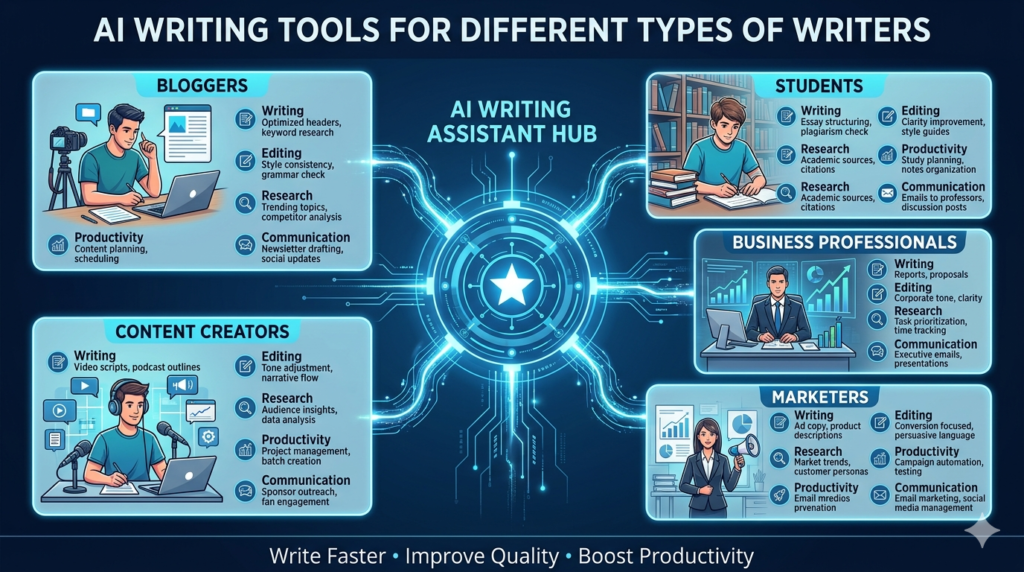
AI Writing Tools for Different Types of Writers
Both free and premium versions of the best AI writing tools can provide significant value depending on your writing requirements. Different writers have different goals, and AI writing tools can support a variety of writing styles and professional needs.
Bloggers
Bloggers use AI for content planning, article creation, SEO optimization, keyword research, and workflow management. AI helps maintain publishing consistency while reducing content production time.
Students
Students often use AI tools for brainstorming, summarization, note organization, grammar correction, and academic writing support. AI can help explain concepts and improve the structure of assignments.
Content Creators
Content creators use AI to generate scripts, captions, newsletters, social media content, and promotional materials. AI helps streamline content production across multiple platforms.
Marketers
Marketing professionals rely on AI for advertising copy, email campaigns, landing pages, product descriptions, and content strategy. AI allows marketers to create and test content faster.
Business Professionals
Business users often employ AI writing tools for reports, presentations, emails, proposals, and workplace communication. These tools improve clarity and reduce administrative workload.
Because writing requirements vary significantly across professions, selecting the right AI writing tool often depends on individual goals and workflow needs.
Best Practices for Using AI Writing Tools
To get the most value from the best AI writing tools, writers should combine AI assistance with human creativity, expertise, and careful editing. Although AI writing tools can be extremely helpful, achieving the best results requires a thoughtful approach. The most successful writers use AI as an assistant rather than a replacement for expertise and critical thinking.
A good starting point is using AI for planning and organization. Generating outlines, collecting ideas, and structuring information are areas where AI performs particularly well. Writers can then build upon these foundations with original insights and expertise.
Fact-checking remains essential. AI-generated content should always be reviewed for accuracy, especially when writing about technical, financial, legal, scientific, or educational topics.
Writers should also maintain their own voice. Over-reliance on AI-generated text can result in generic content that lacks personality and originality. Adding personal experiences, examples, opinions, and analysis helps differentiate content from competitors.
Editing is equally important. Even high-quality AI-generated drafts benefit from human review. Revising content for clarity, readability, and audience relevance ensures better final results.
The best outcomes occur when writers combine AI efficiency with human judgment, creativity, and subject matter expertise.
Common Mistakes to Avoid
AI writing tools can be extremely powerful, but many users fail to achieve good results because they use them incorrectly. One of the most common mistakes is blindly copying and publishing AI-generated content without reviewing it. While AI can create impressive drafts, it may occasionally include factual inaccuracies, weak explanations, or generic information that reduces content quality.
Another mistake is relying entirely on AI for creativity and critical thinking. AI can assist with writing, but it cannot fully replace personal experience, expertise, unique perspectives, and subject knowledge. Content that lacks human insight often struggles to stand out in competitive markets.
Many writers also make the mistake of using too many tools at the same time. Switching constantly between multiple platforms can complicate workflows and reduce productivity. In most cases, a small set of carefully selected tools provides better results.
Ignoring audience needs is another common problem. Writers sometimes focus on generating content quickly while forgetting the importance of solving reader problems and delivering useful information.
The most effective approach is to use AI as a productivity assistant while maintaining full responsibility for quality, accuracy, and value.
Free vs Paid AI Writing Tools
Many writers begin with free AI writing tools because they provide enough functionality for everyday tasks. Free plans often include content generation, grammar checking, summarization, brainstorming, and basic editing features.
For students, casual bloggers, and occasional content creators, free tools are often sufficient. They allow users to learn AI-assisted writing workflows without financial commitment.
Paid plans become valuable when writing needs become more advanced. Premium subscriptions usually provide access to more powerful AI models, larger usage limits, faster responses, customization options, and advanced workflow features.
Professional writers, marketers, agencies, and businesses often benefit from paid plans because the additional capabilities can significantly improve productivity and content quality.
The best strategy is to start with free options and upgrade only when specific limitations begin affecting your workflow or output quality.
How to Choose the Right AI Writing Tool
Choosing among the best AI writing tools depends on your writing goals, preferred workflow, and content requirements. Selecting the right AI writing tool depends on your goals, content type, and workflow requirements. Different platforms excel in different areas, so understanding your priorities is important.
If you need an all-purpose writing assistant, ChatGPT offers flexibility for brainstorming, drafting, editing, and content planning. Writers focused on long-form content often prefer Claude because of its natural writing style.
Those who need grammar correction and proofreading support may find Grammarly more useful, while QuillBot is ideal for rewriting and paraphrasing. Marketing teams often choose Jasper AI because of its copywriting and conversion-focused features.
When evaluating a tool, consider factors such as:
- Ease of use
- Writing quality
- Pricing
- Customization options
- Workflow integration
- Available features
The best AI writing tool is not necessarily the most expensive one. It is the tool that solves your specific writing challenges while fitting naturally into your daily workflow.
Real-World Writing Use Cases
The best AI writing tools are now used across blogging, marketing, education, business communication, and content creation. AI writing tools are used across many industries and professional environments.
Blog Writing
Bloggers use AI for content planning, article creation, keyword research, and editing. AI helps accelerate publishing while supporting content quality.
Marketing Content
Marketing teams rely on AI to create advertisements, email campaigns, landing pages, product descriptions, and promotional materials.
Academic Writing
Students and researchers use AI to summarize information, organize notes, brainstorm ideas, and improve writing clarity.
Business Communication
Professionals use AI to draft emails, reports, proposals, presentations, and internal communications more efficiently.
Content Creation
Creators use AI to produce scripts, captions, newsletters, social media content, and multimedia marketing materials.
These use cases demonstrate how AI writing tools support productivity and communication across a wide range of professions.
Future of AI Writing
The best AI writing tools of the future will become more personalized, accurate, and deeply integrated into everyday content workflows. The future of AI writing is expected to be more advanced, personalized, and integrated into everyday workflows. AI systems are becoming better at understanding context, user intent, audience preferences, and content objectives.
Future writing assistants may function more like collaborative partners than simple tools. They could help manage entire content strategies, conduct research, optimize SEO, personalize messaging, and adapt content for different platforms automatically.
Another major trend is workflow integration. AI writing capabilities are increasingly being embedded directly into business software, productivity tools, content management systems, and publishing platforms.
Personalization will also play a larger role. Writers may be able to train AI systems to reflect their preferred tone, style, and brand voice more accurately than ever before.
As technology continues to evolve, writers who learn how to combine AI efficiency with human creativity will gain significant advantages in productivity and content quality.
Frequently Asked Questions
What are the best AI writing tools in 2026?
Some of the best AI writing tools in 2026 include ChatGPT, Claude, Grammarly, QuillBot, and Jasper AI. These tools help with content creation, editing, proofreading, paraphrasing, and marketing copywriting.
Which AI writing tool is best for bloggers?
ChatGPT, Claude, and Grammarly are among the best AI writing tools for bloggers because they assist with content creation, editing, readability improvements, and productivity.
Are AI writing tools free to use?
Many AI writing tools offer free plans, including ChatGPT, Claude, Grammarly, and QuillBot. Premium plans provide advanced features, higher limits, and additional customization options.
Can AI writing tools replace human writers?
No. AI writing tools can assist with research, drafting, editing, and idea generation, but human creativity, expertise, judgment, and originality remain essential for producing high-quality content.
Which AI writing tool is best for long-form content?
Claude is often considered one of the best AI writing tools for long-form content because it maintains context well, produces natural language, and creates detailed articles with strong readability.
What is the best AI tool for grammar correction?
Grammarly is one of the best AI writing tools for grammar correction, proofreading, clarity improvement, and professional communication.
Can AI writing tools improve productivity?
Yes. AI writing tools can automate repetitive tasks such as outlining, drafting, editing, summarizing, and research, helping writers save time and improve productivity.
Are AI-generated articles good for SEO?
AI-generated articles can perform well in search engines when they are accurate, well-structured, useful to readers, and reviewed by humans to add originality and expertise.
Choosing the Right AI Writing Tool
Artificial intelligence is transforming the way people create content. Writers now have access to powerful tools that can assist with brainstorming, drafting, editing, research, and productivity. These capabilities help individuals and organizations produce content more efficiently while maintaining quality standards. By selecting the best AI writing tools for your needs, you can improve productivity, writing quality, and long-term content performance.
Tools such as ChatGPT, Claude, Grammarly, QuillBot, and Jasper AI each serve different purposes within the writing process. Some focus on content generation, others specialize in editing, while some excel at marketing and communication.
The most successful writers will not be those who rely entirely on automation. Instead, they will be the individuals who combine AI-powered efficiency with human creativity, expertise, and critical thinking.
By selecting the right AI writing tools and using them responsibly, writers can improve productivity, enhance content quality, and prepare themselves for the future of digital communication.
Related AI Guides: