
Artificial intelligence is transforming education and helping teachers become more productive than ever before. Modern AI tools can assist with lesson planning, content creation, grading, classroom management, student engagement, and administrative tasks.
In 2026, educators around the world are using AI to save time, improve teaching quality, and create more personalized learning experiences. Many powerful AI tools are available for free or at affordable prices, making them accessible to teachers at all levels.
This guide explores the best AI tools for teachers in 2026 and explains how they can improve efficiency, enhance learning, and support classroom success.
What Are AI Tools for Teachers?
AI tools for teachers are software applications that use artificial intelligence to help educators perform academic and administrative tasks more efficiently.
These tools can generate lesson plans, create quizzes, summarize content, improve writing, design presentations, and assist with student communication. Rather than replacing teachers, AI acts as a productivity assistant that reduces repetitive work and allows educators to focus more on teaching.
As AI technology continues to improve, teachers are finding new ways to integrate these tools into classrooms and educational workflows.
Why Teachers Are Using AI Tools
Teachers often spend many hours preparing lessons, creating assignments, grading work, and managing administrative responsibilities.
AI tools help automate many of these tasks, reducing workload while improving efficiency. They can generate teaching materials, create assessment questions, summarize research articles, and even suggest classroom activities.
The growing popularity of AI tools in education is driven by their ability to save time, support creativity, and help teachers deliver more engaging learning experiences.
Quick Comparison Table of the Best AI Tools for Teachers
| Tool | Best For | Free Plan | Main Strength |
|---|---|---|---|
| ChatGPT | Lesson planning | Yes | Versatility |
| Canva AI | Presentations | Yes | Visual design |
| NotebookLM | Research & notes | Yes | Document analysis |
| Grammarly | Writing | Yes | Language improvement |
| Microsoft Copilot | Productivity | Yes | Office integration |
| MagicSchool AI | Education | Yes | Teacher-focused features |
ChatGPT for Teachers
ChatGPT is one of the most versatile AI tools available for educators. It can assist with lesson planning, classroom activities, assessment creation, student feedback, and educational content development.
Teachers can use ChatGPT to generate worksheets, discussion questions, quizzes, project ideas, and simplified explanations for difficult concepts. It is particularly useful for adapting content to different grade levels and learning abilities.
Best Uses
- Lesson planning
- Quiz generation
- Student feedback
- Classroom discussions
- Assignment creation
Advantages
- Easy to use
- Supports multiple subjects
- Saves preparation time
- Generates educational content quickly
Many teachers consider ChatGPT one of the most valuable AI tools because it can support a wide variety of teaching tasks within a single platform.
Canva AI for Educators
Canva AI has become one of the most popular tools for educators because it simplifies visual content creation. Teachers can create presentations, worksheets, posters, infographics, lesson materials, certificates, and classroom resources without advanced design skills.
AI-powered features help generate layouts, graphics, and presentation content quickly, allowing teachers to spend less time designing and more time teaching.
Best Uses
- Classroom presentations
- Educational posters
- Worksheets
- Student projects
- Visual learning resources
Advantages
- Easy to use
- Professional templates
- AI-assisted design
- Free education-friendly features
NotebookLM for Lesson Planning
NotebookLM is a powerful AI research assistant developed by Google. Teachers can upload lesson materials, curriculum documents, research papers, and educational resources and then ask questions based on those documents.
This capability makes it extremely useful for lesson planning, content review, and organizing large amounts of educational information.
Best Uses
- Lesson planning
- Curriculum development
- Research organization
- Educational content review
Advantages
- Works with uploaded documents
- Generates summaries
- Helps organize information
- Supports educational research
Grammarly for Academic Writing
Grammarly helps teachers improve writing quality, grammar, spelling, and clarity. Educators frequently use Grammarly when preparing lesson plans, reports, emails, academic content, and classroom communications.
The tool helps ensure professional and error-free writing while saving valuable editing time.
Best Uses
- Academic writing
- Emails
- Reports
- Educational materials
- Student feedback
Advantages
- Real-time corrections
- Easy integration
- Improves readability
- Free plan available
Microsoft Copilot for Teachers
Microsoft Copilot enhances productivity by integrating AI assistance directly into Microsoft applications such as Word, PowerPoint, Excel, and Outlook.
Teachers can use Copilot to create lesson materials, summarize documents, generate presentations, analyze educational data, and streamline administrative work.
Best Uses
- Document creation
- Presentation development
- Administrative tasks
- Data analysis
Advantages
- Microsoft integration
- Productivity enhancement
- Time-saving features
- Professional workflows
MagicSchool AI
MagicSchool AI is specifically designed for educators and offers tools focused on teaching and classroom management.
The platform can generate lesson plans, assessments, rubrics, classroom activities, and educational resources tailored to different subjects and grade levels.
Best Uses
- Lesson plans
- Rubrics
- Assessments
- Classroom activities
- Educational resources
Advantages
- Built for teachers
- Education-focused features
- Saves preparation time
- Supports multiple subjects
Benefits of AI Tools for Teachers
Teachers face increasing workloads that include lesson planning, grading, classroom management, parent communication, and administrative responsibilities. AI tools help reduce this burden by automating repetitive tasks and improving productivity.
Some of the major benefits include:
- Faster lesson preparation
- Improved classroom engagement
- Better content organization
- Reduced administrative workload
- More personalized learning support
- Enhanced communication with students and parents
- Increased productivity
By reducing time spent on routine tasks, teachers can focus more on instruction, creativity, and student development.
How AI Improves Teaching Quality
Beyond saving time, AI tools can also help improve the quality of teaching. Educators can use AI to create more engaging lesson plans, generate diverse learning materials, and adapt content for different learning levels.
AI can assist teachers in identifying knowledge gaps, suggesting additional resources, and creating personalized learning experiences. This helps students receive more targeted support and improves overall classroom engagement.
Teachers can also use AI to generate examples, discussion topics, project ideas, and assessment materials that encourage critical thinking and active participation.
By reducing routine workload and providing creative assistance, AI enables educators to focus on meaningful teaching interactions and student development. The result is a more efficient, engaging, and student-centered learning environment.
How AI Saves Time for Educators
One of the biggest advantages of AI in education is time savings. Teachers often spend many hours preparing lessons, creating assessments, reviewing assignments, and managing classroom documentation.
AI tools can generate quizzes, summarize educational content, draft lesson plans, create presentation materials, and assist with grading. Tasks that previously required hours can often be completed in minutes.
This increased efficiency allows educators to dedicate more time to student interaction, classroom engagement, and professional development.
Common Mistakes Teachers Make with AI
Although AI tools are extremely useful, some educators make mistakes that reduce their effectiveness.
Common mistakes include:
- Using AI-generated content without reviewing it
- Relying entirely on AI recommendations
- Ignoring fact-checking requirements
- Sharing sensitive student information with AI platforms
- Using too many tools simultaneously
Teachers should treat AI as an assistant rather than a replacement for professional judgment and educational expertise.
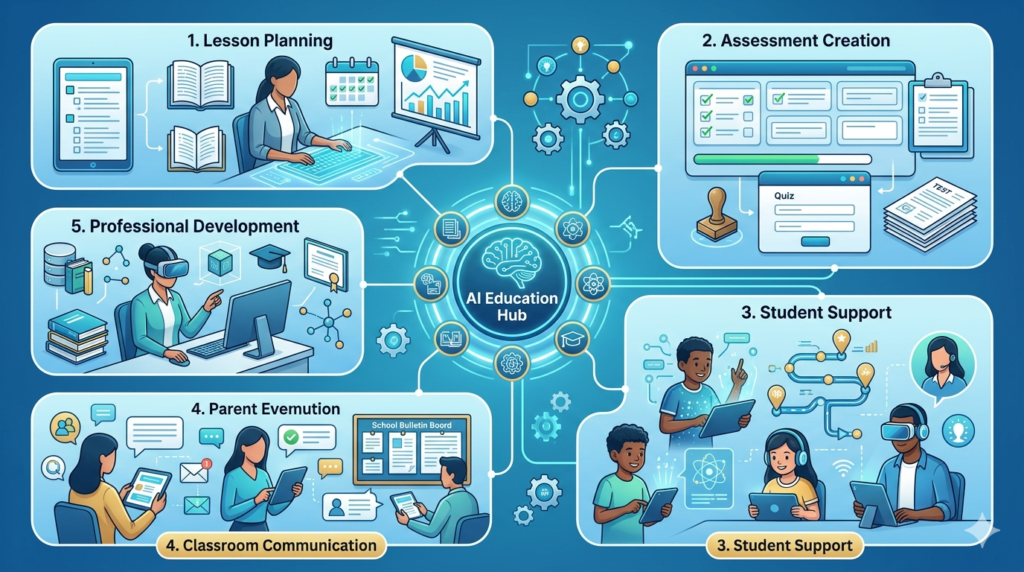
Real-World Uses of AI in Education
Lesson Planning
Teachers use AI tools to create lesson plans, learning objectives, classroom activities, and assessment materials more efficiently.
Assessment Creation
AI can generate quizzes, worksheets, practice questions, and evaluation criteria tailored to different grade levels and learning goals.
Student Support
Educators use AI to provide additional learning resources, simplified explanations, and personalized support for students with different learning needs.
Classroom Communication
AI assists with drafting emails, announcements, newsletters, and parent communications, helping teachers save time while maintaining professional communication standards.
Professional Development
Teachers can use AI tools to summarize educational research, analyze teaching strategies, and stay informed about new developments in education.
AI in Different Teaching Environments
Artificial intelligence is being used across a wide range of educational environments, from primary schools to universities and online learning platforms.
AI for School Teachers
School teachers use AI tools to create lesson plans, worksheets, classroom activities, and learning materials that match different grade levels. AI can also help simplify complex topics and provide additional learning resources for students who need extra support.
AI for College and University Educators
Higher education professionals often deal with large volumes of research, academic writing, curriculum development, and student assessment. AI tools help summarize research papers, organize course materials, generate discussion topics, and improve productivity.
AI for Online Educators
Online teachers and course creators use AI to develop training materials, presentation slides, quizzes, video scripts, and learning resources. AI can significantly reduce the time required to create digital educational content.
AI for Special Education
AI tools can support personalized learning by adapting explanations and educational resources to different learning abilities. This helps educators provide more targeted support to students with diverse educational needs.
AI for Administrative Work
Teachers and educational institutions spend considerable time on documentation, reporting, scheduling, and communication. AI tools help automate these processes, reducing administrative workload and improving efficiency.
As educational technology continues to evolve, AI will become increasingly integrated into teaching workflows across all levels of education.
Personalized Learning and Student Engagement
One of the most valuable applications of AI in education is its ability to support personalized learning. Every student learns at a different pace and has unique strengths, weaknesses, and interests. AI tools help teachers adapt educational content to meet these diverse learning needs.
Teachers can use AI to create differentiated assignments, generate multiple versions of learning materials, and provide additional explanations for students who require extra support. Advanced AI systems can also identify areas where students are struggling and recommend targeted learning resources.
AI-powered educational tools can increase student engagement by creating interactive activities, quizzes, discussion prompts, and personalized learning experiences. These features help make lessons more dynamic and encourage active participation in the classroom.
For teachers, personalized learning becomes easier to manage because AI can assist with content adaptation and resource generation. This allows educators to spend more time supporting students individually and less time preparing multiple versions of the same materials.
As schools continue to adopt educational technology, AI-driven personalization is expected to become an increasingly important part of modern teaching and learning.
Future of AI in Teaching
Artificial intelligence is expected to play a major role in the future of education. AI-powered learning systems will become more personalized and capable of adapting to individual student needs.
Future educational platforms may automatically identify learning gaps, recommend targeted learning resources, and provide real-time feedback to both students and teachers.
Teachers will increasingly use AI to automate routine administrative work while focusing more on mentoring, creativity, critical thinking, and student engagement. Rather than replacing educators, AI will act as a powerful teaching assistant that improves efficiency and supports better learning outcomes.
As AI technology continues to evolve, educators who learn how to integrate these tools effectively will be better prepared for the future of teaching.
Frequently Asked Questions
What are the best AI tools for teachers in 2026?
Some of the best AI tools for teachers in 2026 include ChatGPT, MagicSchool AI, NotebookLM, Canva AI, Grammarly, and Microsoft Copilot. These tools help with lesson planning, classroom management, content creation, and productivity.
Which AI tool is best for lesson planning?
ChatGPT, NotebookLM, and MagicSchool AI are among the best AI tools for lesson planning because they help generate lesson ideas, activities, assessments, and curriculum materials quickly.
Can AI help teachers save time?
Yes. AI can automate lesson planning, quiz creation, content summarization, administrative work, and classroom communication, allowing teachers to spend more time with students.
Are AI tools safe for educators?
Most major AI tools are safe when used responsibly. Teachers should avoid sharing sensitive student information and should always review AI-generated content before using it in the classroom.
What is the best AI tool for creating educational presentations?
Canva AI is one of the best AI tools for creating educational presentations, worksheets, infographics, certificates, and classroom visuals.
Can AI improve student engagement?
Yes. AI can help teachers create interactive activities, personalized learning materials, discussion prompts, quizzes, and engaging classroom resources that improve student participation.
Which AI tool is best for academic writing and communication?
Grammarly is one of the best AI tools for academic writing because it improves grammar, clarity, readability, emails, reports, and professional communication.
Can AI support personalized learning?
Yes. AI tools can help teachers adapt content to different learning levels, provide additional explanations, and create customized learning experiences for students.
Can AI replace teachers?
No. AI can support educators by automating routine tasks and improving productivity, but teaching, mentorship, classroom management, emotional support, and educational expertise require human teachers.
Enhancing Education Through AI-Powered Teaching
AI tools are becoming essential resources for modern educators. From lesson planning and content creation to grading support and classroom communication, these tools help teachers work more efficiently while improving the learning experience.
Platforms such as ChatGPT, Canva AI, NotebookLM, Grammarly, Microsoft Copilot, and MagicSchool AI demonstrate how artificial intelligence can support educators in meaningful ways.
The key to success is using AI responsibly and strategically. Teachers who combine educational expertise with AI-powered productivity tools can save time, reduce workload, and create more engaging learning environments for their students.
As technology continues to evolve, AI will become an increasingly valuable partner in education and professional teaching practice.
Related AI Guides: