
Understanding the Global AI Knowledge Atlas
Artificial intelligence is often explained through definitions, technologies, tools and applications. However, understanding AI also requires a wider global view. We need to know where important AI research is taking place, which countries are building advanced systems, who the leading pioneers are, and how governments, universities and companies are shaping its development.
The Ultimate Global AI Knowledge Atlas presents this wider picture in one structured reference guide. Instead of explaining only what artificial intelligence is, this atlas explores where AI is being developed, who is developing it, what resources support it and how progress differs across countries and regions.
AI development is not evenly distributed around the world. Some countries lead in advanced research, computing infrastructure, investment and foundation models. Others are making significant progress in specialised areas such as robotics, multilingual AI, healthcare, agriculture, public services and responsible technology. Many developing nations are also adopting AI rapidly, although they may face limitations related to computing power, funding, skilled professionals, reliable datasets and digital infrastructure.
The global AI ecosystem includes much more than technology companies. Universities conduct foundational research, governments create national strategies, laboratories test new methods, semiconductor companies produce specialised hardware, cloud providers supply computing resources and international organisations develop standards and ethical frameworks. Researchers, engineers, policymakers, educators and entrepreneurs all contribute to this expanding knowledge network.
The Global AI Knowledge Atlas connects these different elements. It covers major AI countries and regions, influential pioneers, leading research institutions, important companies, model families, computing infrastructure, national policies and language initiatives. It also examines the global AI divide—the differences in access to data, talent, investment, advanced chips and computing resources.
India receives special attention because of its large technical workforce, growing startup ecosystem, public digital infrastructure and extraordinary linguistic diversity. The development of AI systems for Hindi and other Indian languages demonstrates why the future of artificial intelligence cannot be understood only through English-language models or a small group of technology centres.
This atlas is not intended to repeat a complete history of artificial intelligence, provide another list of AI tools or redefine every technical term. Those subjects require their own detailed guides. Its purpose is to organise global AI knowledge geographically and institutionally, allowing readers to see the relationships among countries, people, organisations, technologies and policies.
Students can use it for study and quick reference, teachers can use it to explain the international AI landscape, and researchers can use it as a starting point for exploring major institutions and regional developments. General readers can also use the atlas to understand why progress in artificial intelligence depends not only on algorithms but also on infrastructure, education, language, policy, economics and international cooperation.
By bringing these elements together, The Ultimate Global AI Knowledge Atlas provides a clearer view of the worldwide system shaping artificial intelligence today and influencing its future direction.
The Global AI Landscape: More Than a Race Between Countries
Artificial intelligence is frequently described as a competition between the United States and China. Although these two countries are major centres of AI development, the complete global landscape is far more diverse. Canada has played an important role in deep learning research, the United Kingdom has produced influential AI laboratories, France has developed a growing open-model ecosystem, Japan is known for robotics, and South Korea is strong in electronics and semiconductor technology. India is becoming increasingly important because of its technical workforce, digital infrastructure and demand for multilingual AI.
The Global AI Knowledge Atlas views this landscape as an interconnected system rather than a simple ranking of nations. An AI model may be designed by a company in one country, trained on chips manufactured in another, supported by cloud infrastructure operating across several regions and used by people speaking hundreds of languages. This makes modern AI development international, even when a particular company or model is associated with one country.
According to the Stanford AI Index Report 2026, global corporate investment in AI reached approximately $581.7 billion in 2025. Private AI investment alone reached $344.7 billion, with the United States accounting for $285.9 billion. However, private investment does not provide a complete measurement of national AI capacity. Government funding, university research, semiconductor production, scientific publications, patents, public infrastructure and access to skilled professionals must also be considered.
What Makes a Country an AI Leader?
A country does not become an AI leader simply by having several successful technology companies. Its position depends on a combination of research, talent, funding, infrastructure, policy and real-world implementation.
The following factors help explain the global distribution of AI power:
- Research and Scientific Contribution
Universities and research institutions produce new algorithms, publish scientific papers and train future AI specialists. A country may have a strong academic contribution even when it has relatively few globally recognised AI companies.
- Computing Infrastructure
Advanced AI development requires data centres, cloud platforms, high-performance computing systems and specialised processors. Access to computing power has become especially important for training large foundation models.
- Investment and Business Ecosystem
Public funding, private investment, venture capital and startup support help transform research into products and services. Countries with mature investment ecosystems can develop and commercialise AI more rapidly.
- Skilled AI Workforce
Researchers, data scientists, engineers, software developers and domain specialists form the human foundation of an AI ecosystem. Education systems and international migration strongly influence where this talent is concentrated.
- Data and Language Resources
AI systems require suitable training data. Countries with well-organised digital records, open datasets and strong language resources may have an advantage. However, many languages and communities remain poorly represented in major datasets.
- Hardware and Semiconductor Capacity
AI depends on graphics processing units, specialised accelerators, memory systems and advanced semiconductor manufacturing. Chip design may occur in one country while fabrication, assembly and testing take place in several others.
- Government Policy and Regulation
National AI strategies can support research, education, infrastructure and responsible adoption. Governments also create rules related to privacy, transparency, safety, copyright and high-risk uses of AI.
- Adoption Across Society
A country’s AI strength is also reflected in how effectively the technology is used in healthcare, education, agriculture, manufacturing, finance, transportation and public administration.
The Main Components of Global AI Power
| Component | What It Includes | Why It Matters |
|---|---|---|
| Research | Papers, discoveries, universities and laboratories | Creates new AI knowledge |
| Talent | Researchers, engineers and data specialists | Builds and improves AI systems |
| Compute | Chips, supercomputers, cloud services and data centres | Supports model training and deployment |
| Capital | Government funding and private investment | Converts ideas into scalable projects |
| Data | Public, commercial, scientific and language datasets | Provides material for training AI |
| Industry | Companies, startups and technology platforms | Brings AI into practical use |
| Policy | Strategies, laws, standards and ethical frameworks | Guides safe and responsible development |
| Adoption | Use of AI across economic and social sectors | Produces real-world value |
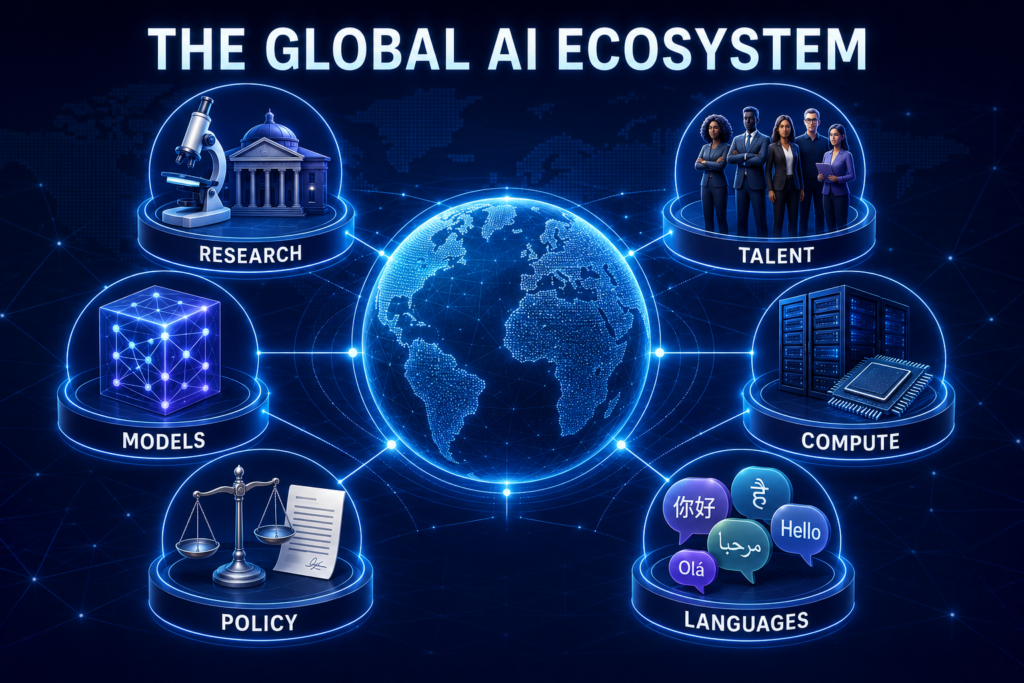
No single indicator can accurately represent all these components. For example, one country may lead in private investment, another in scientific publications, another in industrial robotics and another in semiconductor manufacturing. The Global AI Knowledge Atlas therefore avoids declaring one universal winner. Instead, it identifies the different strengths that countries and regions contribute to the international AI ecosystem.
Readers interested in the technological journey that created this modern landscape can also explore the History of Artificial Intelligence. The present atlas moves beyond the historical sequence and maps the geographical, institutional and economic structure of AI development today.
From National Competition to Global Interdependence
Competition encourages countries to invest in research, infrastructure and domestic AI industries. At the same time, no major AI ecosystem operates in complete isolation. Researchers collaborate internationally, scientific papers circulate across borders, open-source projects receive contributions from many countries and global companies recruit talent from around the world.
AI governance is also becoming international. The OECD AI Policy Observatory provides information on more than 900 AI policies and initiatives, while its Policy Navigator includes material from over 80 jurisdictions and organisations. Such resources show that governments are not only competing in AI development; they are also learning from one another and working towards shared principles for trustworthy technology.
This combination of competition and interdependence is central to understanding the Global AI Knowledge Atlas. The next stage is to examine how these capabilities are distributed across the world’s major regions.
AI Development Across Major World Regions
The global development of artificial intelligence can be understood more clearly by examining the strengths of different regions. Some regions lead in foundation models and private investment, while others are recognized for robotics, semiconductor manufacturing, academic research, multilingual technology or AI regulation.
The Global AI Knowledge Atlas divides the world into seven broad regions: North America, Europe, East Asia, South Asia, the Middle East, Africa, Latin America, and Australia and Oceania. These divisions are used for easy study, but AI activity regularly crosses national and regional boundaries.
North America: A Major Centre of AI Research and Industry
North America occupies a central position in the modern AI ecosystem. The United States leads in private investment, advanced model development, cloud infrastructure and the number of major AI companies. Canada has made foundational contributions to deep learning and continues to support a respected network of universities, research laboratories and AI institutes.
The region combines several important advantages:
- internationally recognised universities;
- large technology companies;
- mature venture-capital networks;
- advanced cloud and data-centre infrastructure;
- access to specialised AI hardware;
- strong links between academic research and industry; and
- the ability to attract researchers from many countries.
However, North America is not a single, uniform AI environment. The United States and Canada have different institutional histories, policy approaches and areas of specialisation.
The United States: Scale, Models and Commercial Innovation
The United States has one of the world’s largest and most influential AI ecosystems. Universities such as Stanford University, Massachusetts Institute of Technology, Carnegie Mellon University and the University of California, Berkeley have made important contributions to computer science, machine learning, robotics and natural language processing.
The country is also home to many organisations developing widely used AI systems. OpenAI, Google, Microsoft, Meta, Anthropic, NVIDIA, Amazon, IBM and several specialised startups operate within the American AI ecosystem. Their work includes foundation models, generative AI, cloud services, autonomous systems, enterprise software, AI chips and safety research.
The Stanford AI Index Report 2026 reported that the United States produced 59 notable AI models in 2025, compared with 35 from China and two from Europe under the report’s geographic classification. These figures demonstrate the scale of American model development, although the number of models alone does not measure their safety, openness, accessibility or social value.
American leadership is supported by a powerful commercial structure. Technology companies can combine research talent, large datasets, advanced chips, cloud platforms and enormous financial resources. This allows them to train and deploy systems that would be difficult for smaller companies, universities or developing countries to reproduce.
The United States also has extensive computing infrastructure. According to the same Stanford report, it hosted 5,427 data centres, more than ten times the number recorded for any other individual country. Data centres vary greatly in their size and purpose, but their concentration demonstrates the importance of computing infrastructure in the American AI economy.
Government policy increasingly treats AI as an economic, scientific and strategic priority. The America’s AI Action Plan introduced more than 90 federal policy actions organised around accelerating innovation, building AI infrastructure and strengthening international leadership.
Despite these strengths, the United States faces important challenges. Advanced AI development is concentrated within a relatively small number of companies. Training methods, datasets, model sizes and energy requirements are not always disclosed. Questions related to privacy, copyright, misinformation, employment, competition, bias and accountability remain part of continuing public and legal debate.
Canada: A Foundational Centre of Deep Learning
Canada’s AI influence is especially significant in academic research. Toronto, Montreal and Edmonton became important centres for machine learning and deep learning through long-term university research and public support.
Researchers associated with Canadian institutions helped advance neural networks at a time when the field received less commercial attention. Geoffrey Hinton worked at the University of Toronto, Yoshua Bengio developed a major research community in Montreal, and Richard Sutton contributed to reinforcement learning research at the University of Alberta. Their work helped establish Canada as one of the intellectual centres of modern AI.
Canada’s major AI institutions include:
| Institution | Location | Principal Area of Contribution |
|---|---|---|
| Vector Institute | Toronto | Machine learning and deep learning |
| Mila | Montreal | Machine learning and responsible AI |
| Amii | Edmonton | Machine intelligence and reinforcement learning |
| University of Toronto | Toronto | Neural networks and computer science |
| Université de Montréal | Montreal | Deep learning and language research |
| University of Alberta | Edmonton | Reinforcement learning |
Canada was the first country to introduce a funded national AI strategy. According to the Government of Canada, approximately C$742 million had been invested in the Canadian AI ecosystem through national initiatives since 2017.
The country has also worked to connect AI development with responsible public use. Its AI Strategy for the Federal Public Service 2025–2027 focuses on adopting AI in ways intended to improve government services while maintaining responsibility and public trust.
Canada’s challenge is converting its research strength into companies that can grow at the same scale as the largest American technology firms. Many researchers trained in Canada are recruited by global companies, and promising Canadian startups may depend on foreign investment or computing infrastructure. Nevertheless, Canada’s academic institutions, public research networks and contributions to deep learning give it an influence greater than its population or domestic technology market might suggest.
Readers unfamiliar with terms such as neural networks, foundation models and reinforcement learning can consult the AI Glossary without interrupting the geographical structure of this atlas.
North America’s Position in the Global AI Knowledge Atlas
North America demonstrates how research universities, private investment, computing infrastructure and technology companies can reinforce one another. The United States supplies extraordinary commercial scale and model-building capacity, while Canada contributes a strong tradition of publicly supported research and academic collaboration.
The region’s influence is substantial, but its AI systems still depend on a global network. Advanced chips rely on international semiconductor supply chains, researchers move across borders, training data comes from users and cultures worldwide, and products are deployed in countries with different languages and legal systems.
North America should therefore be understood as a leading AI Centre rather than a completely independent AI ecosystem. The next major region, Europe, presents a different model based on strong scientific institutions, industrial expertise, public research and an influential regulatory approach.
Europe: Research Excellence, Industrial AI and Global Regulation
Europe has a broad and diverse artificial intelligence ecosystem built around universities, public research organisations, industrial companies, startups and national innovation programmes. Unlike North America, where a relatively small group of large technology companies controls much of the advanced model market, European AI development is distributed across several countries and institutions.
The region has made major contributions to computer science, machine learning, robotics, computer vision and the theoretical foundations of artificial intelligence. It is also influential in automotive engineering, advanced manufacturing, healthcare, aerospace, energy and scientific research. These strengths encourage the development of specialised AI systems that can operate within established industries.
In the Global AI Knowledge Atlas, Europe includes both European Union members and other important European AI centres such as the United Kingdom, Switzerland and Norway. The European Union provides a shared regulatory and investment framework, while individual countries maintain their own research institutions, companies and areas of technical specialisation.
Leading European AI Countries
| Country | Major AI Strengths | Important Organisations or Centres |
|---|---|---|
| United Kingdom | AI research, foundation models, life sciences and safety | Google DeepMind, University of Oxford, University of Cambridge, The Alan Turing Institute |
| France | Open models, mathematics, public research and startups | Mistral AI, Inria, CNRS, Paris-Saclay |
| Germany | Industrial AI, manufacturing, automotive systems and robotics | DFKI, Fraunhofer Institutes, Technical University of Munich |
| Switzerland | Machine learning, robotics and scientific research | ETH Zurich, EPFL, Idiap Research Institute |
| Netherlands | Computer vision, data science and responsible AI | University of Amsterdam, Delft University of Technology |
| Sweden | Telecommunications, language technology and sustainable computing | KTH Royal Institute of Technology, AI Sweden |
| Finland | AI education, telecommunications and public innovation | University of Helsinki, Aalto University |
| Italy | Robotics, supercomputing, healthcare and industrial research | Italian Institute of Technology, CINECA |
| Spain | Language technologies, supercomputing and digital innovation | Barcelona Supercomputing Center |
| Norway | Maritime AI, energy systems and responsible technology | Norwegian University of Science and Technology, Simula Research Laboratory |
These countries do not contribute in identical ways. The United Kingdom has a strong connection between academic research and internationally influential AI companies. France combines mathematical expertise with public research institutions and a growing foundation-model industry. Germany is particularly important in industrial automation, engineering and manufacturing. Switzerland has globally respected technical universities, while Nordic countries often connect AI development with public services, sustainability and responsible innovation.
The United Kingdom: Research and Frontier AI
The United Kingdom has played an important role throughout the history of artificial intelligence. Alan Turing’s work helped establish the intellectual foundations of computing, while British universities have remained active in machine learning, neuroscience, robotics and computer science.
Google DeepMind, founded in London in 2010, became one of the world’s most influential AI research laboratories. Its work has included reinforcement learning, game-playing systems, scientific discovery and protein-structure prediction. Although DeepMind is now part of Google, its London origin demonstrates how European research environments can produce organisations with global influence.
The University of Oxford, University of Cambridge, University College London, Imperial College London and the University of Edinburgh are among the country’s recognised centres of AI and computer science research. The Alan Turing Institute serves as the United Kingdom’s national institute for data science and artificial intelligence.
The UK also hosts research focused on AI safety, evaluation and governance. Its principal challenge is maintaining domestic ownership, investment and computing capacity when many successful companies and researchers are attracted to larger international technology groups.
France: Mathematics, Open Models and AI Startups
France has developed a visible position in European AI through its mathematical tradition, engineering education, public research system and startup ecosystem. Institutions such as Inria, CNRS and Paris-Saclay contribute to machine learning, computer vision, robotics and scientific computing.
Mistral AI has strengthened France’s position in the foundation-model market. The company became known for developing efficient language models and releasing several models with accessible weights. Its emergence showed that advanced generative AI development is not restricted entirely to American and Chinese companies.
France also supports AI through national investment, research programmes and European collaboration. However, like other European countries, it must compete for specialised talent, private capital and access to large-scale computing resources.
Germany: Industrial AI and Engineering
Germany’s AI strength is closely connected to its manufacturing, automotive, mechanical engineering and industrial sectors. Rather than focusing only on consumer chatbots, German organisations often apply AI to production systems, quality control, robotics, logistics, mobility and predictive maintenance.
The German Research Center for Artificial Intelligence, commonly known as DFKI, is one of the country’s major AI research organisations. Fraunhofer institutes, technical universities and industrial companies also work on applied AI systems.
Germany illustrates an important principle of the Global AI Knowledge Atlas: global AI leadership should not be measured only by the number of foundation models. A country may hold an influential position by integrating AI into factories, vehicles, scientific instruments and specialised engineering processes.
Switzerland and Other European Research Centres
Switzerland has a relatively small population but a strong international research presence. ETH Zurich and EPFL conduct advanced work in machine learning, robotics, computer vision, autonomous systems and scientific AI. The country also benefits from its pharmaceutical, financial and precision-engineering industries.
The Netherlands contributes through universities and research communities working on computer vision, language processing, data science and responsible AI. Spain and Italy have important supercomputing facilities, while Nordic countries contribute to telecommunications, clean technology, public-sector innovation and human-centred digital services.
Central and Eastern European countries are also developing stronger AI communities. Poland, the Czech Republic, Romania, Slovenia and other countries are expanding research, technical education, startup activity and access to shared European computing infrastructure.
Europe’s AI Factories and Computing Infrastructure
One of Europe’s major challenges has been limited access to the scale of computing infrastructure available to the largest American technology companies. The European Union is addressing this gap through supercomputers, AI Factories and planned AI Gigafactories.
According to the European Commission’s AI Factories programme, European AI Factories are being connected with the EuroHPC supercomputing network. These facilities are intended to provide startups, researchers and industrial organisations with resources for developing, fine-tuning and testing AI models.
The European Commission’s AI Continent Action Plan set out several major objectives:
- at least 19 AI Factories across Europe;
- up to five large AI Gigafactories;
- greater access to computing resources for startups and researchers;
- increased cloud and data-centre capacity;
- improved availability of high-quality data; and
- wider adoption of AI in strategic industries.
The AI Continent Action Plan is connected with the InvestAI initiative, which aims to mobilise €200 billion for AI investment, including funding intended to support large-scale computing facilities.
These programmes are designed to reduce Europe’s dependence on computing infrastructure controlled outside the region. Their success will depend on implementation, availability of advanced chips, energy capacity, private participation and the ability of organisations to turn shared infrastructure into competitive AI systems.
The European Union AI Act
Europe’s most distinctive global influence may come from regulation. The European Union has developed a risk-based legal framework intended to establish different obligations for different types of AI systems.
The EU AI Act entered into force on 1 August 2024 and became broadly applicable on 2 August 2026, although some requirements follow extended timelines. The framework includes rules covering prohibited practices, transparency, general-purpose AI models and high-risk systems.
Under the risk-based approach, AI systems that may significantly affect safety or fundamental rights can face stricter requirements than systems considered to present minimal risk. The framework also addresses responsibilities related to documentation, human oversight, transparency, testing and risk management.
The European approach has international importance because companies outside Europe may still need to follow EU requirements when providing AI products or services within the European market. This effect can influence how global companies design, document and evaluate their systems.
However, regulation also creates a difficult balance. Strong protections can improve public trust and reduce harmful uses, but complex compliance requirements may place heavier burdens on startups and smaller organisations. Europe therefore needs to combine responsible regulation with investment, accessible computing resources and support for innovation.
Europe’s Position in the Global AI Knowledge Atlas
Europe may not currently match the United States in private AI investment or the number of major foundation models, but it remains influential in several areas:
- foundational scientific research;
- industrial and manufacturing applications;
- robotics and engineering;
- public supercomputing infrastructure;
- responsible and human-centred AI;
- privacy and digital rights; and
- international AI regulation.
Europe’s AI future will depend on whether it can convert its research strength, industrial knowledge and regulatory influence into globally competitive products and models. Its emerging AI Factories and investment programmes represent an attempt to close the infrastructure gap without abandoning European principles related to safety, accountability and fundamental rights.
The next region, East Asia, presents another distinctive AI landscape shaped by large-scale research, semiconductor manufacturing, robotics, electronics and rapidly advancing foundation models.
East Asia: Models, Robotics, Electronics and Semiconductor Power
East Asia is one of the most important regions in the global artificial intelligence ecosystem. China contributes research publications, patents, foundation models and large-scale commercial applications. Japan has long-standing expertise in robotics, manufacturing and automation. South Korea combines AI development with advanced electronics, memory chips and consumer technology, while Taiwan occupies a critical position in semiconductor manufacturing.
These strengths make East Asia more than a competitor in software development. The region contributes to nearly every layer of the AI system, including research, hardware, robotics, telecommunications, manufacturing and consumer applications.
Major AI Strengths Across East Asia
| Country or Economy | Major AI Strengths | Important Organisations |
|---|---|---|
| China | Research, patents, foundation models, computer vision and large-scale applications | Alibaba, Baidu, Tencent, Huawei, DeepSeek, ByteDance, Tsinghua University |
| Japan | Robotics, manufacturing, automotive AI and physical systems | Sony, Toyota, Honda, Preferred Networks, RIKEN, University of Tokyo |
| South Korea | Semiconductors, electronics, telecommunications and industrial AI | Samsung, SK Hynix, LG AI Research, Naver, KAIST |
| Taiwan | Advanced semiconductor manufacturing and AI hardware supply | TSMC, MediaTek, National Taiwan University |
| Hong Kong | Academic research, finance and international collaboration | Chinese University of Hong Kong, Hong Kong University of Science and Technology |
Although these locations are geographically close, their AI ecosystems have developed through different industrial and institutional foundations.
China: Research Scale and Rapid Model Development
China has built one of the world’s largest AI research and commercial ecosystems. It has extensive university networks, large digital platforms, significant government support, a growing foundation-model industry and access to enormous domestic markets.
The country’s leading universities include Tsinghua University, Peking University, Zhejiang University, Shanghai Jiao Tong University and the Chinese University of Hong Kong. Research organisations such as the Chinese Academy of Sciences and the Shanghai Artificial Intelligence Laboratory contribute to machine learning, computer vision, robotics, language technology and scientific AI.
Chinese technology companies have developed major AI model families and platforms:
| Organisation | Important AI System or Area |
|---|---|
| Alibaba | Qwen model family and cloud AI |
| Baidu | ERNIE models, search and autonomous driving |
| Tencent | Hunyuan models and digital services |
| Huawei | Pangu models, computing systems and telecommunications |
| DeepSeek | Language and reasoning models |
| ByteDance | Doubao models and content platforms |
| Zhipu AI | GLM model family |
| Moonshot AI | Kimi assistant and language models |
| iFlytek | Speech recognition and language technology |
The Stanford AI Index Report 2026 states that China led in AI publication volume, citations and patent grants, while the United States produced more notable models in 2025. China produced 35 models classified as notable, compared with 59 in the United States.
China’s share of the 100 most-cited AI papers also increased from 33 in 2021 to 41 in 2024. These figures indicate that China’s contribution is not limited to the quantity of publications; its presence in influential research has also grown.
Chinese companies are particularly active in:
- large language models;
- computer vision and facial recognition;
- e-commerce recommendations;
- digital payments and financial technology;
- autonomous vehicles;
- smart manufacturing;
- logistics and delivery systems;
- speech recognition;
- urban infrastructure; and
- industrial robotics.
The country’s large population and highly developed digital platforms provide opportunities to test and deploy AI at scale. Chinese researchers and companies have also focused on model efficiency, partly because access to the most advanced foreign AI chips has been restricted.
DeepSeek attracted international attention by demonstrating that highly capable models could be developed with a strong emphasis on training and inference efficiency. Alibaba’s Qwen family has also become important in the open-model ecosystem, while companies such as Baidu, Tencent and Huawei continue to develop models for commercial and industrial use.
However, China faces significant challenges. Restrictions on advanced semiconductors affect access to certain high-performance chips and manufacturing technologies. Questions also exist around government oversight, censorship, privacy, surveillance and the transparency of training data. These issues influence how Chinese AI systems are developed and received internationally.
Japan: Robotics, Manufacturing and Physical AI
Japan has been associated with robotics and intelligent machines for several decades. Its strengths come from automotive engineering, electronics, precision manufacturing, industrial automation and human–robot interaction.
Japanese companies such as Toyota, Honda, Sony, FANUC, SoftBank Robotics and Kawasaki Heavy Industries have applied intelligent systems to vehicles, factories, entertainment devices and robots. Universities and institutions including the University of Tokyo, Kyoto University, Osaka University, RIKEN and the National Institute of Advanced Industrial Science and Technology contribute to AI research.
Japan’s approach is strongly connected to physical AI—the integration of AI with robots, vehicles, sensors and machines operating in the real world. Important areas include:
- industrial robots;
- autonomous and assisted vehicles;
- healthcare and care-support robots;
- smart factories;
- disaster-response technology;
- logistics automation;
- computer vision; and
- energy-efficient AI systems.
The country’s ageing population and labour shortages have increased interest in automation. Robots are being explored not only for industrial productivity but also for healthcare, delivery, agriculture and public services.
Japan is also strengthening its domestic generative AI capacity. The Ministry of Economy, Trade and Industry launched the GENIAC programme to provide computing resources and other support for foundation-model development. In 2026, the programme expanded its attention to manufacturing data and robotic foundation models.
According to Japan’s Ministry of Economy, Trade and Industry, the programme supports projects that prepare industrial data for AI and develop foundation models capable of controlling robotic systems such as autonomous vehicles, drones and ships.
Japan’s challenges include a shortage of software professionals, competition from larger model developers and the need to convert its industrial expertise into modern AI platforms. Its strongest opportunity may lie in combining generative AI with its established manufacturing and robotics capabilities.
South Korea: Semiconductors, Electronics and AI Services
South Korea has a highly developed digital economy supported by fast communication networks, advanced consumer electronics and a powerful semiconductor industry. Samsung Electronics and SK Hynix are especially important in the production of memory used by computing systems and AI accelerators.
High-bandwidth memory has become a critical component of advanced AI hardware because large models require rapid movement of data between processors and memory. South Korea’s semiconductor expertise therefore gives it an important position in the infrastructure supporting global AI development.
The country also has active AI companies and research institutions. Naver has developed Korean-language AI services and HyperCLOVA models. LG AI Research has developed the EXAONE model family, while Samsung applies AI across smartphones, appliances, electronics and semiconductor production.
Institutions such as KAIST, Seoul National University and the Electronics and Telecommunications Research Institute contribute to machine learning, robotics, computer vision and language technology.
South Korea also demonstrates strong inventive activity. The Stanford AI Index 2026 identified it as the leading country in AI patents per capita. This measure does not automatically indicate commercial success, but it reflects a high concentration of technical development relative to population.
The Korean AI ecosystem has several notable advantages:
- advanced semiconductor production;
- strong electronics and telecommunications companies;
- widespread digital connectivity;
- experience in consumer technology;
- Korean-language model development; and
- integration of AI into manufacturing.
Its limitations include a smaller domestic market than China or the United States and dependence on international supply chains for some semiconductor equipment and technologies.
Taiwan: The Manufacturing Centre Behind Advanced AI Chips
Taiwan plays a specialised but essential role in the Global AI Knowledge Atlas. It is not best known for large consumer-facing AI models, but it is central to the production of the advanced semiconductors used to train and operate those models.
Taiwan Semiconductor Manufacturing Company, commonly known as TSMC, manufactures chips designed by many international technology companies. These include processors and accelerators used in data centres, smartphones, vehicles and other intelligent systems.
The distinction between chip design and chip fabrication is important. A company may design an AI processor in the United States, but the physical chip may be manufactured in Taiwan using highly advanced fabrication processes. This makes the global AI hardware supply chain dependent on specialised facilities, equipment, materials and technical expertise distributed across several countries.
Stanford’s 2026 report noted that TSMC fabricates most leading AI chips used in major data centres. This concentration creates both technical efficiency and geopolitical risk. Natural disasters, conflict, trade restrictions or supply-chain disruptions could affect AI development far beyond East Asia.
Taiwan also has research universities and technology companies working in semiconductor design, electronics, edge AI and smart manufacturing. MediaTek develops processors used in mobile and connected devices, while universities contribute to computer science and engineering research.
East Asia’s Position in the Global AI Knowledge Atlas
East Asia demonstrates that AI leadership operates across several interconnected layers:
- China contributes research scale, patents, models and commercial deployment;
- Japan contributes robotics, manufacturing and physical AI;
- South Korea contributes memory chips, electronics and telecommunications;
- Taiwan provides advanced semiconductor fabrication; and
- regional universities supply research and technical talent.
The region’s greatest strength is its ability to connect software intelligence with physical products. AI models require chips, chips require advanced manufacturing, robots require sensors and control systems, and consumer applications require reliable electronic devices.
East Asia also shows why global AI development cannot be reduced to chatbot performance. A country that does not produce the most famous language model may still control an essential part of the hardware, robotics or manufacturing system on which that model depends.
The next region, South Asia, is shaped by different conditions: a large population, rapidly expanding digital services, a growing technical workforce and exceptional linguistic diversity.
South Asia: Talent, Digital Scale and Multilingual AI
South Asia represents one of the world’s largest and most linguistically diverse populations. Its AI ecosystem is led by India, but Pakistan, Bangladesh, Sri Lanka, Nepal, Bhutan and the Maldives are also exploring artificial intelligence through universities, startups, digital services and government programmes.
The region does not yet possess the same concentration of frontier-model companies, advanced chips or large computing facilities found in North America and East Asia. Its main strengths are different: a young population, a large information-technology workforce, expanding digital services, growing startup communities and strong demand for affordable AI solutions.
AI development in South Asia is particularly relevant to agriculture, education, healthcare, financial inclusion, public administration, disaster management and local-language communication.
Major AI Strengths Across South Asia
| Country | Major AI Strengths and Opportunities |
|---|---|
| India | IT talent, digital public infrastructure, startups, multilingual AI and large-scale applications |
| Pakistan | Software services, university research, agriculture and Urdu-language AI |
| Bangladesh | Digital services, garment manufacturing, education and Bengali-language technology |
| Sri Lanka | Software development, business services, healthcare and agricultural applications |
| Nepal | Disaster management, agriculture, tourism and Nepali-language resources |
| Bhutan | Digital public services, education and responsible technology |
| Maldives | Tourism, climate monitoring and digital government |
The AI capacity of these countries varies considerably. India has the region’s largest research, industry and startup ecosystem, while smaller countries often focus on specific national problems and practical applications.
India: The Largest AI Ecosystem in South Asia
India has several characteristics that could support a distinctive position in global AI development. It has a large pool of software professionals, an expanding startup ecosystem, internationally recognised technical institutions and hundreds of millions of users generating demand for digital services.
Major Indian institutions involved in AI research include the Indian Institutes of Technology, Indian Institute of Science, International Institute of Information Technology Hyderabad, Indian Statistical Institute and several national research laboratories.
Indian technology companies and startups work in areas such as:
- language translation;
- conversational AI;
- healthcare diagnosis;
- financial technology;
- agricultural advisory services;
- education technology;
- identity verification;
- logistics;
- business automation; and
- public digital services.
Large IT service companies, including Tata Consultancy Services, Infosys, Wipro and HCLTech, apply AI to enterprise operations and international business services. Startups such as Sarvam AI, Krutrim and several specialised language-technology companies are working on models and applications designed for Indian users.
India’s linguistic diversity is both a challenge and an opportunity. The country has 22 constitutionally recognised scheduled languages and hundreds of additional languages and varieties. Many people communicate online using a mixture of regional languages and English. AI systems developed primarily with English-language data may not understand these users accurately.
Projects involving Hindi and other Indian languages are therefore strategically important. Speech recognition, translation, text generation and voice-based services can help people who may not use English or a conventional computer interface.
The IndiaAI Mission
The Government of India approved the IndiaAI Mission in March 2024 to develop domestic AI capacity across seven pillars:
| IndiaAI Pillar | Main Purpose |
|---|---|
| Compute Capacity | Expand affordable access to AI computing resources |
| Innovation Centre | Support the development of Indian foundation models |
| AIKosh Dataset Platform | Provide datasets, models and development resources |
| Application Development | Encourage AI solutions for important national sectors |
| FutureSkills | Develop AI education and professional skills |
| Startup Financing | Support AI startups and commercial innovation |
| Safe and Trusted AI | Promote security, responsibility and risk management |
The AIKosh platform describes the mission as an effort to build a sovereign, inclusive and future-ready AI ecosystem. AIKosh is intended to provide researchers, students and developers with access to datasets, models, toolkits and other AI resources.
The IndiaAI Compute initiative also aims to make computing resources available at more affordable rates to academic institutions, researchers, students, startups, small businesses and industry. Access to compute is important because many Indian institutions cannot independently purchase and maintain large clusters of advanced GPUs.
India will receive a separate detailed section later in the Global AI Knowledge Atlas. That section will examine its research institutions, companies, language projects, public infrastructure, policy environment, strengths and limitations without repeating the entire regional overview.
Pakistan: Software Talent and Urdu-Language Opportunities
Pakistan has a growing software-services industry and a large population of young technology users. Universities such as the National University of Sciences and Technology, Lahore University of Management Sciences, COMSATS University and the National University of Computer and Emerging Sciences contribute to computer science and AI education.
Potential areas of AI development include:
- agricultural forecasting;
- medical support systems;
- financial services;
- Urdu speech and text processing;
- education technology;
- disaster prediction; and
- business-process automation.
Urdu-language AI is an important opportunity because international models may not always understand local vocabulary, writing styles, cultural context or mixed Urdu-English communication.
Pakistan faces limitations related to research funding, computing infrastructure, reliable datasets and the migration of skilled professionals. Stronger university–industry collaboration and shared computing resources could help convert technical talent into locally developed AI products.
Bangladesh: Digital Services and Bengali-Language AI
Bangladesh has developed an expanding digital-services sector supported by software professionals, mobile connectivity and a large domestic population. Bengali-language technology is an especially important area because Bengali is spoken by hundreds of millions of people globally.
AI can support Bangladesh in:
- agricultural advice and crop monitoring;
- flood and cyclone forecasting;
- garment manufacturing;
- healthcare access;
- digital education;
- financial inclusion; and
- Bengali speech recognition and translation.
The country’s garment industry creates opportunities for computer vision, quality inspection, demand forecasting and supply-chain optimisation. At the same time, automation may affect certain categories of employment, making skills development and worker transition important policy concerns.
Sri Lanka and the Smaller South Asian Ecosystems
Sri Lanka has a recognised software and business-services sector. Its universities and technology companies work in data science, language processing, finance, agriculture and healthcare. Sinhala and Tamil language technologies are important for making AI accessible to the country’s population.
Nepal can use AI in earthquake assessment, weather forecasting, mountain research, agriculture and tourism. Nepali-language datasets and speech systems remain limited compared with widely supported global languages.
Bhutan’s smaller population makes large-scale commercial AI development difficult, but it can apply AI to digital public services, education, environmental conservation and healthcare. Its development approach may also provide useful lessons in balancing technology with social and environmental priorities.
The Maldives has opportunities in tourism management, marine research, climate monitoring and digital government. However, its small population and dispersed geography create infrastructure and skills challenges.
Employment, Education and the Regional AI Divide
South Asia has a large workforce employed in agriculture, manufacturing, business services and informal economic activities. AI may increase productivity in some occupations while changing or reducing demand in others.
The World Bank’s South Asia Development Update reported that demand for AI skills was increasing across the region. It also warned that some moderately educated workers in information technology and business services could face disruption as generative AI becomes capable of performing more routine tasks.
This creates two connected priorities:
- Teaching people how to use AI effectively in their existing work.
- Preparing workers whose routine tasks may be automated or significantly changed.
Students and teachers can begin with accessible resources such as the Best Free AI Tools for Students, but long-term readiness requires more than learning individual tools. It requires digital literacy, critical thinking, subject knowledge, data skills and an understanding of responsible AI use.
South Asia’s Position in the Global AI Knowledge Atlas
South Asia’s greatest AI advantages are its human talent, demographic scale, digital growth and linguistic diversity. Its greatest limitations include unequal internet access, limited computing infrastructure, shortages of high-quality local datasets and uneven AI education.
The region is unlikely to succeed by copying every feature of the American or Chinese AI ecosystems. Its strongest path may involve building affordable and multilingual systems designed for local needs.
South Asia can make an important global contribution through:
- low-cost AI solutions;
- multilingual models;
- voice-based interfaces;
- public digital infrastructure;
- agricultural technology;
- accessible healthcare;
- large-scale education; and
- AI designed for developing economies.
The next region, the Middle East, is following a different strategy based on government investment, national transformation programmes, computing infrastructure and the rapid development of Arabic-language AI.
The Middle East: National Investment, Sovereign AI and Arabic Models
The Middle East has emerged as a rapidly developing AI region supported by government investment, national transformation programmes, research partnerships and new computing infrastructure. The United Arab Emirates and Saudi Arabia are building large state-supported AI ecosystems, while Israel has a mature research and startup environment. Qatar also contributes through university research, language technology and specialised computing projects.
The region’s AI development is influenced by several economic and strategic priorities:
- reducing dependence on oil and traditional industries;
- building knowledge-based economies;
- improving digital government services;
- attracting international researchers and technology companies;
- developing Arabic-language AI;
- strengthening national data and computing capacity; and
- creating sovereign AI systems that can operate under domestic control.
This approach differs from the largely private-sector-led model of the United States. Governments and state-supported organisations play a particularly visible role in building AI infrastructure across the Middle East.
Major AI Centres in the Middle East
| Country | Major AI Strengths | Important Organisations and Initiatives |
|---|---|---|
| United Arab Emirates | Foundation models, government adoption, research and investment | TII, MBZUAI, G42, AI71, Falcon models |
| Saudi Arabia | National data strategy, Arabic AI, smart cities and public investment | SDAIA, KAUST, HUMAIN, ALLaM |
| Israel | Startups, cybersecurity, computer vision, autonomous systems and academic research | Technion, Hebrew University, Weizmann Institute, Mobileye |
| Qatar | Arabic-language technology, university research and computing | QCRI, Qatar Computing Research Institute, Hamad Bin Khalifa University |
| Türkiye | Defence technology, computer vision, manufacturing and university research | TÜBİTAK, technical universities and technology companies |
| Bahrain | Financial technology, cloud services and digital government | Government digital initiatives and fintech organisations |
| Jordan | Software talent, Arabic-language services and education technology | Universities and regional technology startups |
The region contains major differences in population, wealth, research capacity and political systems. Some countries can invest heavily in infrastructure, while others contribute through skilled professionals, universities or specialised applications.
United Arab Emirates: A State-Led AI Ecosystem
The United Arab Emirates has made artificial intelligence an important part of its economic and government strategy. Abu Dhabi and Dubai have invested in research institutions, computing capacity, startups and partnerships with international technology companies.
The UAE’s important AI organisations include:
| Organisation | Role in the AI Ecosystem |
|---|---|
| Technology Innovation Institute | Applied research and development of Falcon models |
| Mohamed bin Zayed University of Artificial Intelligence | Graduate education and AI research |
| G42 | Cloud computing, healthcare AI and enterprise technology |
| AI71 | AI products and applications based on local research |
| Advanced Technology Research Council | Coordination and support for advanced research |
| Core42 | Cloud and computing infrastructure |
The Mohamed bin Zayed University of Artificial Intelligence, commonly known as MBZUAI, was established in Abu Dhabi as a graduate-level university focused specifically on AI. It offers research and education in machine learning, computer vision, natural language processing and related disciplines.
The UAE has also worked to introduce AI into government services, healthcare, transportation, energy, finance and urban planning. Its relatively small population makes it possible to test digital systems within a highly connected environment, although successful pilot projects still need careful evaluation before wider adoption.
Falcon: A Major AI Model Family from the Middle East
The Falcon family, developed by the Technology Innovation Institute in Abu Dhabi, gave the Middle East a visible position in the global foundation-model ecosystem.
Falcon models have included systems designed for:
- general language generation;
- reasoning;
- Arabic-language processing;
- multimodal perception;
- long-context applications;
- efficient operation on limited hardware; and
- research and commercial development.
The Technology Innovation Institute introduced Falcon Arabic and Falcon-H1 in 2025. Falcon Arabic was trained using native Arabic material rather than depending entirely on translated English content. This is important because Arabic has many regional dialects, writing styles and cultural contexts that may be poorly represented in general-purpose datasets.
In January 2026, TII released Falcon-H1 Arabic, followed by Falcon Perception, a compact multimodal system capable of connecting written instructions with visual information. The development of these systems demonstrates that the UAE is attempting to become an AI producer rather than only a buyer of foreign technology.
However, the long-term influence of the Falcon ecosystem will depend on developer adoption, independent evaluation, research transparency and the creation of useful applications around the models.
Saudi Arabia: Data, Infrastructure and National Transformation
Saudi Arabia is investing in artificial intelligence as part of its wider economic transformation. Its AI development is connected to digital government, energy, healthcare, smart cities, education, Arabic-language technology and large infrastructure projects.
The Saudi Data and Artificial Intelligence Authority, known as SDAIA, coordinates important parts of the country’s national data and AI agenda. Universities such as King Abdullah University of Science and Technology and King Saud University contribute to research, scientific computing and professional education.
Saudi AI initiatives include work in:
- Arabic language models;
- public-sector data systems;
- smart-city technology;
- healthcare analysis;
- energy optimisation;
- transportation;
- pilgrimage and crowd management; and
- environmental monitoring.
The ALLaM model family was developed to improve Arabic-language understanding and generation. Arabic models are strategically important because systems trained mainly on English data may produce weaker results for regional dialects, historical texts, legal documents and culturally specific questions.
Saudi Arabia’s ability to finance computing infrastructure gives it the potential to become a major regional AI centre. At the same time, money alone cannot create a sustainable research ecosystem. Long-term progress also requires universities, independent researchers, skilled engineers, high-quality datasets and an environment that supports experimentation and scientific exchange.
Israel: Research, Startups and Specialised AI
Israel has a well-established technology sector supported by universities, military-linked technical experience, venture capital and a dense startup ecosystem. Its AI strengths are particularly visible in cybersecurity, computer vision, autonomous driving, medical technology, agriculture and business software.
Major academic institutions include:
- Technion–Israel Institute of Technology;
- Hebrew University of Jerusalem;
- Tel Aviv University;
- Weizmann Institute of Science; and
- Ben-Gurion University of the Negev.
Israeli companies have developed technologies used in autonomous vehicles, cybersecurity systems, medical imaging, precision agriculture and enterprise analytics. Mobileye became internationally recognised for computer-vision and driver-assistance technology.
Israel’s AI ecosystem benefits from strong connections between research, entrepreneurship and specialised technology development. However, regional conflict, security concerns and political instability can affect investment, collaboration and the movement of talent.
The inclusion of Israel in the Global AI Knowledge Atlas is based on its geographical and technological position. It does not imply that all countries in the region share the same political relationships or participate in a unified innovation system.
Qatar and Other Emerging AI Ecosystems
Qatar has invested in university research, high-performance computing and Arabic-language technology. The Qatar Computing Research Institute works in areas including Arabic language processing, data analytics, cybersecurity and computational science.
Arabic speech recognition and text analysis have practical applications in government services, education, media archives and cultural preservation. Qatar’s research environment also benefits from partnerships with international universities and institutions.
Türkiye has a larger industrial and university base, with AI applications in manufacturing, autonomous systems, computer vision, defence technologies and public services. Its geographical position connects European, Asian and Middle Eastern technology networks.
Jordan has a growing software and startup community, while Bahrain has promoted financial technology, cloud adoption and digital government. Oman and Kuwait are also exploring AI through national digital strategies, energy applications and public services.
These smaller ecosystems may not build frontier models independently, but they can contribute through regional datasets, language resources, skilled developers and specialised applications.
Arabic-Language AI as a Regional Priority
Arabic is spoken across many countries, but it is not a single uniform language in everyday use. Modern Standard Arabic is used in formal writing and media, while people commonly speak regional dialects that differ in vocabulary, pronunciation and grammar.
Arabic AI must therefore handle:
- Modern Standard Arabic;
- Gulf dialects;
- Egyptian Arabic;
- Levantine Arabic;
- Maghrebi varieties;
- mixed Arabic–English communication;
- different transliteration styles; and
- historical and religious texts.
A model that performs well on formal Arabic may still struggle with everyday conversations. The limited availability of balanced, carefully documented and legally usable Arabic datasets remains a major challenge.
Locally developed models can improve linguistic representation, but they must also be evaluated for accuracy, dialect coverage, cultural bias, safety and transparency. Simply describing a system as an Arabic model does not guarantee that it represents all Arabic-speaking communities equally.
Sovereign AI and the Search for Technological Independence
Sovereign AI refers to a country’s ability to develop or control important elements of its own AI infrastructure, models, datasets and policies. Middle Eastern governments increasingly view this capability as strategically important.
A sovereign AI ecosystem may include:
- domestic computing infrastructure;
- locally governed datasets;
- national or regional foundation models;
- cybersecurity protections;
- language and cultural representation;
- locally trained professionals; and
- the ability to deploy AI without complete dependence on foreign providers.
Complete technological independence is difficult because advanced chips, manufacturing equipment, cloud software and research knowledge come from international supply chains. Sovereign AI therefore usually means reducing critical dependence rather than isolating a country from global technology.
The Middle East’s Position in the Global AI Knowledge Atlas
The Middle East has several important advantages:
- substantial government investment;
- the ability to build new computing infrastructure;
- ambitious national transformation programmes;
- demand for Arabic-language models;
- strong energy resources; and
- growing international research partnerships.
Its main challenges include dependence on imported chips and expertise, limited local research communities in some countries, unequal development across the region and concerns related to surveillance, privacy, transparency and freedom of research.
The region’s long-term success will be measured not only by the money invested or the size of announced projects. It will depend on whether AI initiatives produce sustainable research institutions, useful local applications, skilled professionals and technology that benefits wider society.
The next region, Africa, presents a different AI landscape shaped by mobile technology, limited computing infrastructure, young populations and the need to build systems for thousands of local languages and communities.
Africa: Local Innovation, Language Diversity and the Compute Gap
Africa’s artificial intelligence ecosystem is developing around mobile technology, local startups, university research and solutions designed for regional needs. South Africa, Egypt, Nigeria, Kenya, Morocco, Ghana, Rwanda, Tunisia, Senegal and Ethiopia are among the countries building visible AI communities.
The continent is sometimes discussed only in terms of limited infrastructure and foreign technological dependence. However, this view overlooks the work of African researchers, developers and entrepreneurs applying AI to agriculture, healthcare, financial inclusion, education, climate monitoring and local-language communication.
Africa’s position in the Global AI Knowledge Atlas is particularly important because it reveals a central question about technological inclusion: will AI systems be created with African languages, cultures and development priorities in mind, or will the continent mainly use systems designed elsewhere?
Major AI Centres in Africa
| Country | Major AI Strengths and Opportunities |
|---|---|
| South Africa | University research, financial technology, healthcare, mining and data science |
| Egypt | Arabic-language AI, engineering education, digital government and startups |
| Nigeria | Large digital market, fintech, startups, language technology and creative industries |
| Kenya | Mobile technology, agricultural AI, financial inclusion and research |
| Morocco | University research, industrial applications, renewable energy and Francophone AI |
| Ghana | Responsible AI, university programmes, agriculture and education technology |
| Rwanda | Digital government, healthcare innovation and technology policy |
| Tunisia | Engineering talent, software development and Arabic–French language technology |
| Senegal | Francophone AI, research, public services and agricultural applications |
| Ethiopia | Language technology, agriculture and government-led digital development |
These countries represent different parts of Africa and should not be treated as a single uniform ecosystem. North Africa has strong links with the Middle East and Europe, while Sub-Saharan countries often build AI around mobile-first services and local development needs.
South Africa: Research and Industrial Applications
South Africa has one of the continent’s most established university and technology ecosystems. The University of Cape Town, University of the Witwatersrand, Stellenbosch University, University of Pretoria and several research organisations contribute to machine learning, data science, robotics and computational research.
The country’s major areas of AI application include:
- banking and financial services;
- medical analysis;
- mining and mineral exploration;
- agriculture;
- telecommunications;
- fraud detection;
- energy management; and
- wildlife conservation.
South Africa benefits from established financial, telecommunications and industrial sectors. These sectors generate demand for specialised AI systems that can detect fraud, analyse risk, monitor machinery and optimise complex operations.
The country also has active research communities working on African-language technology and responsible AI. However, unequal access to digital education, high-speed internet and computing resources means that AI opportunities are not evenly distributed across its population.
Egypt: Arabic AI and a Large Technical Workforce
Egypt has one of Africa’s largest populations and a substantial university system. Its geographical and linguistic position connects African, Arab and Mediterranean technology networks.
Universities such as Cairo University, Ain Shams University and Alexandria University contribute to engineering and computer science education. Egyptian researchers and companies work in Arabic natural language processing, healthcare, financial services, education and public-sector digitalisation.
Egypt has an important role in Arabic-language AI because Egyptian Arabic is widely understood through television, cinema and digital media. However, spoken Egyptian Arabic differs from Modern Standard Arabic, creating the need for specialised speech and text datasets.
The country’s large population creates opportunities for AI in public services, transportation, healthcare and education. At the same time, infrastructure limitations, uneven digital access and the availability of skilled employment affect the growth of its domestic AI industry.
Nigeria: Startups, Financial Technology and Local Languages
Nigeria has Africa’s largest population and one of its most active startup environments. Lagos has become an important centre for financial technology, digital commerce, software services and entrepreneurship.
AI is being explored in Nigeria for:
- fraud and credit-risk analysis;
- digital payments;
- agricultural information;
- medical support;
- customer service;
- educational technology;
- media and creative production; and
- Nigerian-language processing.
Nigeria’s linguistic diversity creates both a major challenge and an opportunity. English is widely used in formal institutions, but languages such as Hausa, Yoruba and Igbo are spoken by millions of people. Voice-based AI systems could make digital services more accessible to users who prefer these languages or have limited literacy.
Nigeria’s large digital market attracts investment, but reliable electricity, affordable broadband, local computing infrastructure and access to capital remain important constraints. Many Nigerian AI startups depend on foreign cloud platforms and external foundation models.
Kenya: Mobile Innovation and Applied AI
Kenya is recognised for mobile financial technology and digital entrepreneurship. Nairobi’s technology community has produced startups and research initiatives working in agriculture, health, finance, logistics and education.
AI applications in Kenya include:
- crop-disease identification;
- weather and yield prediction;
- digital lending;
- medical image analysis;
- wildlife monitoring;
- transportation planning; and
- Swahili-language services.
Kenya’s experience with mobile-first products provides useful lessons for AI systems designed for people who access the internet mainly through smartphones. An application that requires an expensive computer, constant broadband connection or international credit card may not be suitable for many African users.
Local developers therefore often focus on lightweight services, mobile interfaces, voice interaction and integration with existing communication platforms.
Morocco, Ghana and Rwanda
Morocco has invested in research, industrial development, automotive manufacturing, renewable energy and digital transformation. Mohammed VI Polytechnic University has become an important centre for data science and AI research.
In 2024, the AI Movement centre in Morocco became the first UNESCO-affiliated AI centre in Africa. It focuses on research, skills, policy and AI applications connected to African development.
Ghana has growing university programmes and research communities working on responsible AI, agriculture, language technology and education. Institutions such as the University of Ghana, Kwame Nkrumah University of Science and Technology and Ashesi University contribute to technical education and innovation.
Rwanda has used its smaller size to test digital government and healthcare technologies. Its AI opportunities include medical delivery systems, public administration, agricultural planning and digital identity services. However, as with other smaller countries, Rwanda depends heavily on international partnerships, external infrastructure and imported technology.
African Languages: The Missing Layer of Global AI
Africa contains extraordinary linguistic diversity. Thousands of languages are spoken across the continent, but only a small proportion have sufficient digital text, speech recordings, dictionaries and labelled datasets for modern AI development.
This creates practical problems. A model may fail to recognise African names, locations, accents or cultural references. Machine translation may produce inaccurate results, and speech-recognition systems may work poorly for users speaking local languages.
The Masakhane research community works to strengthen natural language processing for African languages through open, participatory research. Its approach is based on the principle that Africans should shape and own technologies that represent their languages and cultures.
Important language-related requirements include:
- digitising books and historical records;
- recording diverse speech samples;
- building dictionaries and translation datasets;
- documenting dialects and writing systems;
- creating culturally appropriate evaluation benchmarks;
- protecting community ownership and consent; and
- training local researchers and language specialists.
UNESCO has described African languages as a major blind spot in AI. Its African Languages and AI report highlights projects creating thousands of hours of spoken-language data from countries including Kenya, South Africa and Nigeria.
Improving language representation is not only a technical task. Communities must have a role in deciding how their language data is collected, stored, licensed and used.
AI for Agriculture, Health and Climate Resilience
AI applications in Africa often focus on basic development needs rather than high-cost consumer products. Agriculture is especially important because millions of people depend on farming and are affected by uncertain weather, pests, water shortages and limited access to expert advice.
AI systems can assist with:
- identifying plant diseases from photographs;
- predicting rainfall and crop yields;
- monitoring soil and water;
- providing market-price information;
- detecting livestock illness; and
- delivering advice through local-language voice services.
In healthcare, AI may support medical-image analysis, disease surveillance, patient triage and the distribution of limited resources. However, systems trained mainly on data from Europe, North America or Asia may not perform equally well for African populations and healthcare environments.
Climate-related applications include flood prediction, drought monitoring, wildfire detection, renewable-energy planning and wildlife protection. These tools can be valuable, but they require reliable local data and connection with people who understand regional conditions.
The African Union Continental AI Strategy
The African Union Continental Artificial Intelligence Strategy was endorsed in July 2024. It promotes an Africa-centred, development-focused approach to responsible and equitable AI.
The strategy identifies several connected priorities:
| Priority | Intended Outcome |
|---|---|
| Infrastructure | Improve connectivity, computing capacity and access to technology |
| Skills | Educate, attract and retain African AI professionals |
| Datasets | Develop representative and responsibly governed African data |
| Innovation | Support local researchers, startups and practical applications |
| Governance | Protect people from bias, misuse and harmful AI systems |
| Cooperation | Encourage collaboration among African countries and international partners |
The continental approach recognises that many African countries cannot independently build every part of an advanced AI ecosystem. Shared computing centres, research networks, language datasets and regional policies could reduce costs and increase bargaining power.
Africa’s Compute and Funding Gap
Advanced AI development requires expensive processors, reliable electricity, cooling systems, high-speed connectivity and specialised engineers. These resources are concentrated in a small number of countries and companies.
The African Union reported in 2025 that Africa accounted for approximately 1% of global AI computing capacity and about 3% of the global AI talent pool. It also noted that more than 83% of African AI startup funding during the first quarter of 2025 went to Kenya, Nigeria, South Africa and Egypt.
These figures show two levels of inequality:
- Africa receives a small share of global AI resources.
- Resources within Africa are concentrated in a few countries and cities.
Foreign cloud services can provide access to computing power, but they may create long-term dependence, high operating costs and questions about where African data is stored. Regional computing centres powered by renewable energy could provide a more sustainable foundation, although they would require major investment and cooperation.
Africa’s Position in the Global AI Knowledge Atlas
Africa’s AI future should not be measured only by whether it produces the world’s largest language model. The continent can make important contributions by building systems that work under real-world constraints and serve communities overlooked by global technology companies.
Its most important opportunities include:
- African-language AI;
- mobile-first services;
- low-cost healthcare tools;
- agricultural support;
- climate adaptation;
- financial inclusion;
- responsible community data practices; and
- AI designed for limited-connectivity environments.
Africa’s greatest challenge is gaining enough control over infrastructure, data and research to become a producer rather than only a consumer of artificial intelligence. Local researchers and startups are already demonstrating what is possible, but their work requires stronger institutions, sustainable funding and wider access to computing resources.
The next region, Latin America, combines strong university traditions, large multilingual markets, public-sector experimentation and growing interest in AI for agriculture, healthcare, environmental protection and digital government.
Latin America: Regional Talent, Public Innovation and Responsible AI
Latin America has a growing artificial intelligence ecosystem supported by universities, startups, public research institutions and digital-government programmes. Brazil, Mexico, Chile, Argentina, Colombia and Uruguay are among the region’s most visible AI centres, while Peru, Ecuador, Costa Rica and other countries are expanding their research and policy capacity.
The region has fewer frontier-model companies and less computing infrastructure than North America, Europe or East Asia. However, it has important strengths in agriculture, biodiversity, mining, financial technology, healthcare, public services and Spanish- and Portuguese-language applications.
Latin America’s AI development is shaped by several common conditions:
- large urban populations;
- strong university traditions;
- growing financial-technology sectors;
- high mobile and social-media use;
- unequal access to digital infrastructure;
- dependence on foreign cloud platforms;
- rich biodiversity and natural resources; and
- demand for technology adapted to regional languages and institutions.
The region is not linguistically uniform. Portuguese is dominant in Brazil, Spanish is spoken across most other countries, and millions of people speak Indigenous languages such as Quechua, Guaraní, Aymara, Nahuatl and Mayan languages.
Major AI Centres in Latin America
| Country | Major AI Strengths and Opportunities |
|---|---|
| Brazil | Research scale, Portuguese-language AI, agriculture, banking and environmental monitoring |
| Mexico | Manufacturing, universities, finance, healthcare and connection with the North American market |
| Chile | AI policy, mining, astronomy, research and digital government |
| Argentina | Scientific research, software talent, agriculture and entrepreneurship |
| Colombia | Responsible AI, public services, financial technology and urban innovation |
| Uruguay | Digital government, early AI strategy and technology services |
| Peru | Mining, agriculture, public services and Indigenous-language technology |
| Costa Rica | Technology services, education, medical devices and environmental applications |
| Ecuador | Agriculture, biodiversity and responsible AI governance |
These countries have different levels of research funding, technical education and infrastructure. Brazil has the largest domestic market, while Chile and Uruguay have used their smaller scale to advance national strategies and public-sector experimentation.
Brazil: The Region’s Largest AI Ecosystem
Brazil has Latin America’s largest population, economy and research system. Universities such as the University of São Paulo, University of Campinas, Federal University of Minas Gerais and Federal University of Rio de Janeiro contribute to machine learning, computer vision, robotics and natural language processing.
Brazilian AI activity covers:
- banking and financial technology;
- agricultural monitoring;
- healthcare;
- energy;
- industrial automation;
- Portuguese-language models;
- environmental protection;
- digital government; and
- fraud detection.
The country’s large banking sector has encouraged the use of AI in credit analysis, customer support, payment security and risk management. Its agricultural industry uses satellite imagery, sensors and predictive systems to monitor crops, soil, pests and weather conditions.
Brazil also has a major opportunity to develop AI for Portuguese. Although Portuguese is spoken by hundreds of millions of people globally, it has considerably fewer high-quality digital resources than English. Brazilian Portuguese also differs in vocabulary, pronunciation and common usage from European Portuguese.
The Brazilian Artificial Intelligence Plan
The Brazilian Artificial Intelligence Plan 2024–2028 was introduced under the theme “AI for the Good of All.” It aims to strengthen national infrastructure, education, research, public services, business innovation and responsible governance.
According to the Government of Brazil, the proposed plan involved investment of approximately US$4 billion. Brazilian government sources also describe the planned national investment as approximately R$23 billion.
The plan includes activity across several areas:
| Area | Intended Purpose |
|---|---|
| Infrastructure | Expand national computing and research capacity |
| Skills | Train students, researchers and professionals |
| Public Services | Apply AI to improve government operations |
| Business Innovation | Support AI adoption in Brazilian industries |
| Regulation | Develop responsible governance and risk assessment |
| Portuguese AI | Build models using national language and cultural data |
A major goal is to reduce Brazil’s dependence on foreign AI systems. This does not mean complete technological isolation; rather, it means creating enough domestic infrastructure and expertise to develop systems aligned with Brazilian needs.
Brazil’s long-term challenge is turning ambitious plans into accessible resources for universities, startups and institutions outside the country’s wealthiest regions.
AI for the Amazon and Environmental Protection
Latin America contains globally important forests, rivers, coastlines and biodiversity. AI can support environmental protection by analysing large volumes of satellite, sensor and field data.
Potential applications include:
- detecting deforestation;
- identifying illegal mining;
- monitoring forest fires;
- mapping wildlife populations;
- predicting droughts and floods;
- tracking changes in land use; and
- supporting climate research.
The Amazon rainforest extends across several countries, although most of it lies within Brazil. Environmental AI therefore requires regional cooperation and access to trustworthy satellite and geographic data.
AI monitoring cannot protect forests by itself. Effective action also depends on environmental law, local institutions, field enforcement and the participation of Indigenous and rural communities. Technology should support these groups rather than collect or use knowledge without their consent.
Mexico: Manufacturing, Research and North American Connections
Mexico has a large economy, strong manufacturing industries and close economic links with the United States and Canada. Its universities and technical institutions work in computer science, robotics, automation and data analysis.
The National Autonomous University of Mexico, Monterrey Institute of Technology, National Polytechnic Institute and other institutions contribute to AI education and research.
Mexico’s potential AI applications include:
- automotive manufacturing;
- logistics and supply chains;
- financial services;
- medical technology;
- agricultural production;
- public administration;
- Spanish-language systems; and
- smart-city services.
Mexico’s manufacturing sector can benefit from predictive maintenance, computer vision and automated quality control. Its geographic position also creates opportunities to participate in North American semiconductor, electronics and technology supply chains.
In 2024, UNESCO presented an AI Readiness Assessment for Mexico. The assessment examined the country’s legal, institutional, social, scientific and economic readiness for responsible AI.
Mexico faces regional inequality in internet access, education and technical resources. Advanced technology activity is concentrated in major cities and industrial centres, while rural and Indigenous communities may receive fewer benefits.
Chile: Policy, Mining and Scientific Research
Chile has developed a visible regional position through digital-government initiatives, university research and national AI planning. Its stable research institutions and international partnerships have supported work in data science, astronomy, mining and public policy.
Chile’s mining industry creates applications for AI in:
- mineral exploration;
- machinery maintenance;
- worker safety;
- energy efficiency;
- water management; and
- environmental monitoring.
The country’s astronomical observatories also generate enormous quantities of scientific data. Machine learning can help researchers classify objects, detect unusual events and analyse images of the universe.
Chile demonstrates how a country without a very large population can build AI influence through specialised research, policy coordination and regional collaboration.
Argentina: Scientific Tradition and Software Talent
Argentina has a strong history of public education, scientific research and software development. The University of Buenos Aires, National University of Córdoba and research organisations such as CONICET contribute to computer science, mathematics and data science.
Argentine developers and startups work in:
- agricultural technology;
- financial services;
- e-commerce;
- healthcare;
- business software;
- satellite data; and
- Spanish-language applications.
Economic instability and limited long-term research funding can make it difficult to retain technical professionals. Many Argentine researchers and developers work for companies based abroad. This creates international connections but can also weaken domestic institutions.
Argentina’s agriculture and scientific communities provide opportunities to develop specialised AI systems with regional value.
Colombia: Responsible AI and Public-Sector Innovation
Colombia has emerged as an important Latin American centre for responsible AI policy, public-sector experimentation and technology entrepreneurship. Bogotá and Medellín host universities, startups and digital-innovation programmes.
The country applies AI to financial services, urban planning, healthcare, agriculture and public administration. Colombia has also worked with UNESCO to evaluate its readiness for ethical and responsible AI.
UNESCO’s AI Readiness Assessment for Colombia involved more than 3,380 stakeholders from government, academia, civil society and other sectors. Colombia has also applied UNESCO guidance to the use of AI within parts of its judicial system.
Public-sector AI can improve efficiency, but it can also affect rights, benefits, policing, employment and access to services. Systems used by governments therefore require transparency, appeal procedures and human oversight.
Uruguay and Smaller Regional Ecosystems
Uruguay has a relatively small population but a strong digital-government foundation. It published an early national AI strategy for digital government and has worked to update its approach through public consultation and UNESCO’s readiness-assessment process.
Costa Rica has opportunities in technology services, medical devices, education and environmental protection. Peru can apply AI to mining, agriculture, healthcare and Indigenous-language access. Ecuador is exploring AI governance and applications related to agriculture and biodiversity.
Smaller countries may not be able to build large foundation models, but they can cooperate through regional computing centres, shared language datasets and public research networks.
Spanish, Portuguese and Indigenous-Language AI
Spanish is widely supported by global language models, but performance can vary across regional vocabulary, accents, legal systems and cultural references. A system trained mostly on material from Spain or the United States may not accurately represent users in Colombia, Mexico, Chile or Argentina.
Portuguese-language AI must also account for Brazilian vocabulary, pronunciation and social context. Indigenous languages face a much larger data shortage.
Developing inclusive language technology requires:
- regional text and speech datasets;
- participation by local language communities;
- culturally relevant evaluation;
- protection of Indigenous knowledge;
- clear consent and licensing;
- support for different accents and dialects; and
- interfaces that work on affordable mobile devices.
Indigenous-language data should not be treated as a free resource for companies to collect without community control. Some knowledge may be sacred, private or governed through traditions that are not reflected in conventional data licences.
Latin America’s Infrastructure and Investment Challenges
Much of Latin America’s AI activity depends on cloud platforms, foundation models and specialised chips developed outside the region. This dependence can increase costs and reduce control over sensitive data.
Other challenges include:
- unequal broadband access;
- limited high-performance computing;
- inconsistent research funding;
- migration of skilled professionals;
- fragmented national policies;
- shortage of local datasets; and
- concentration of startups in a few major cities.
Regional cooperation could help universities and startups share computing resources, scientific datasets and evaluation tools. Countries can also coordinate policy without adopting identical regulations.
Latin America’s Position in the Global AI Knowledge Atlas
Latin America’s greatest AI strengths lie in its universities, multilingual population, natural resources, public innovation and experience solving problems under economic constraints.
The region can make distinctive contributions through:
- Portuguese- and Spanish-language AI;
- Indigenous-language inclusion;
- agriculture and food production;
- biodiversity monitoring;
- digital government;
- financial technology;
- mining and energy;
- public healthcare; and
- responsible AI for emerging economies.
Latin America does not need to reproduce every part of the American or Chinese model-building ecosystem. Its strongest strategy may be to develop specialised, socially useful and environmentally responsible AI while increasing regional control over data and infrastructure.
The next region, Australia and Oceania, combines advanced university research and public institutions with unique opportunities in climate science, mining, marine ecosystems, agriculture and Indigenous-language preservation.
Australia and Oceania: Research, Climate Science and Responsible Adoption
Australia and Oceania form a geographically large but unevenly developed AI region. Australia has advanced universities, research organisations, cloud infrastructure and a growing AI industry. New Zealand contributes through agricultural technology, healthcare research, digital government and responsible-AI policy. Pacific Island nations have smaller technology ecosystems but important opportunities in climate monitoring, disaster preparedness, marine science and public services.
The region’s geographical isolation, environmental diversity and exposure to natural hazards influence its AI priorities. Artificial intelligence is being applied not only to business software but also to bushfire detection, reef monitoring, agriculture, mining, healthcare and emergency management.
Major AI Centres and Opportunities in Oceania
| Country or Area | Major AI Strengths and Opportunities |
|---|---|
| Australia | University research, healthcare, mining, agriculture, climate science and AI safety |
| New Zealand | Agricultural technology, healthcare, digital government and responsible AI |
| Papua New Guinea | Agriculture, public health, language access and disaster monitoring |
| Fiji | Climate resilience, tourism, marine ecosystems and digital government |
| Pacific Island nations | Weather forecasting, ocean monitoring, disaster warning and remote services |
Australia and New Zealand account for most of the region’s formal AI research and commercial activity. Smaller Pacific states generally depend on imported platforms, international research partnerships and cloud services.
Australia: A Strong Research and Applied-AI Ecosystem
Australia has internationally recognised universities and public research organisations working in machine learning, robotics, computer vision, medical technology and data science.
Important institutions include:
- Commonwealth Scientific and Industrial Research Organisation;
- Australian National University;
- University of Melbourne;
- University of Sydney;
- University of New South Wales;
- Monash University;
- University of Queensland;
- University of Technology Sydney; and
- Australian Institute for Machine Learning.
Australia’s AI ecosystem is particularly strong in applied fields where the country already has scientific or industrial expertise.
These fields include:
- medical imaging and healthcare;
- mining and mineral exploration;
- agricultural monitoring;
- environmental science;
- cybersecurity;
- financial services;
- autonomous systems;
- space and astronomy; and
- emergency management.
Australia produces a larger share of international AI research than might be expected from its population. According to the Australian Government’s National AI Plan, the country produces approximately 1.9% of global AI research publications. Its research extends beyond computer science into medicine, agriculture, environmental science and the social sciences.
Australia’s National AI Plan
Australia released its National AI Plan in December 2025. The plan brings together economic opportunity, national capability, public benefit and safety.
Its three broad goals are:
| Goal | Main Direction |
|---|---|
| Capture the Opportunities | Attract investment and strengthen domestic AI capability |
| Spread the Benefits | Support adoption, skills and improved public services |
| Keep Australians Safe | Improve safety, security, evaluation and public trust |
The plan recognises that Australia is unlikely to compete with the largest countries across every part of frontier AI development. It can instead build strength in research, trusted infrastructure, specialised applications and responsible adoption.
Australia is also attracting investment in data centres. Its geographic stability, technical workforce, renewable-energy potential and connection with Asia-Pacific markets make it a possible regional infrastructure centre.
However, data centres require large amounts of electricity, water, land and network capacity. Investment must therefore be considered alongside energy planning, environmental impact and benefits for local communities.
Healthcare and Medical AI
Australia has a strong medical research system and has developed AI applications for medical imaging, disease detection, patient monitoring and hospital planning.
AI can assist clinicians by identifying patterns in scans, organising records and supporting treatment decisions. It may also improve access to specialist services in remote areas where patients must travel long distances.
Australia’s rural and remote geography makes telehealth and digital diagnostics especially valuable. However, medical AI must be tested across different population groups and healthcare environments.
Aboriginal and Torres Strait Islander communities have distinct health needs, cultural rights and expectations regarding community data. Health information should not be collected or reused without appropriate governance, consent and community participation.
Mining, Agriculture and Environmental Science
Mining is an important part of the Australian economy. AI is used to analyse geological information, monitor equipment, improve worker safety and manage energy use.
Agricultural applications include:
- crop and pasture monitoring;
- livestock management;
- weed detection;
- water optimisation;
- weather forecasting;
- autonomous machinery; and
- pest and disease identification.
Australia also has globally significant ecosystems, including the Great Barrier Reef, forests, deserts and coastal environments. AI can help scientists examine satellite images, underwater recordings, sensor measurements and wildlife data.
These systems may detect coral bleaching, identify animal species, monitor land degradation and predict environmental changes. Their accuracy depends on reliable field data and collaboration between AI specialists, scientists and local communities.
AI for Bushfires and Natural Disasters
Australia and Pacific Island nations are exposed to bushfires, cyclones, floods, droughts and other natural hazards. AI can support emergency management by combining weather, satellite, sensor and historical data.
Potential applications include:
- early fire detection;
- flood forecasting;
- cyclone tracking;
- evacuation planning;
- infrastructure-risk assessment;
- emergency-resource allocation; and
- post-disaster damage mapping.
The Commonwealth Scientific and Industrial Research Organisation has supported research involving computer vision, simulation and digital twins for emergency management and critical infrastructure.
AI predictions should support rather than replace emergency professionals. Incorrect warnings can create panic, while missed events can put lives at risk. Disaster systems therefore require continuous testing, human oversight and clear communication.
New Zealand: Agriculture, Research and Responsible AI
New Zealand has a smaller AI ecosystem than Australia but strong capabilities in agricultural science, bioengineering, healthcare, environmental research and digital services.
Major universities include the University of Auckland, University of Otago, Victoria University of Wellington, University of Canterbury and University of Waikato.
New Zealand’s AI opportunities include:
- precision agriculture;
- dairy and livestock management;
- future food production;
- medical research;
- climate and environmental modelling;
- digital public services; and
- support for small businesses.
The country released its first national AI strategy in July 2025. According to New Zealand’s Ministry of Business, Innovation and Employment, the strategy is intended to give businesses confidence to adopt and develop AI while following principles related to fairness, privacy, safety and human rights.
New Zealand also announced investment of up to NZ$70 million over seven years to support AI research and commercialisation through the New Zealand Institute for Advanced Technology.
Māori Language, Knowledge and Data Governance
Māori-language technology is an important part of New Zealand’s AI landscape. Speech recognition, translation and educational systems can support language revitalisation, but the collection and use of Indigenous data require special care.
Māori data sovereignty is based on the principle that Māori people should have authority over data connected to their communities, language, culture and resources.
This means AI developers must consider:
- who collected the data;
- whether the community gave meaningful consent;
- where the data is stored;
- who can access or licence it;
- whether cultural knowledge should be included at all; and
- how benefits are returned to the community.
These questions also apply to Aboriginal, Torres Strait Islander and Pacific Island communities. Technical availability does not automatically create ethical permission to use cultural data.
Pacific Island Nations: AI Under Environmental Pressure
Pacific Island countries contribute relatively little to global AI research, but they face some of the problems for which data analysis and prediction may be most valuable.
AI can assist with:
- sea-level monitoring;
- cyclone and storm prediction;
- coral-reef protection;
- fisheries management;
- coastal planning;
- tourism;
- remote healthcare; and
- digital education.
Small populations, geographic isolation and limited infrastructure make it difficult to maintain domestic data centres or large AI research programmes. Internet connectivity can also be expensive or unreliable across remote islands.
Regional partnerships with Australia, New Zealand, universities and international organisations can provide technical support. However, Pacific countries should have a meaningful role in deciding how their environmental and community data is collected and used.
Climate-related datasets are globally valuable. Their benefits should not flow only to foreign researchers or companies while local communities remain without access to the resulting systems.
The Regional Dependence on Foreign AI Platforms
Australia and New Zealand have advanced research communities, but most widely used foundation models and cloud platforms are controlled by companies based elsewhere.
This creates dependence in several areas:
- model access and pricing;
- data storage;
- cloud infrastructure;
- specialised chips;
- platform rules;
- language priorities; and
- technical standards.
International partnerships can bring investment and expertise, but domestic institutions must retain enough knowledge to evaluate imported systems and protect national interests.
Australia’s high adoption of systems such as Claude also shows the region’s willingness to experiment with generative AI. Readers who need a practical explanation of that platform can consult the Claude AI Complete Guide, while the present atlas remains focused on the geographical AI ecosystem.
Australia and Oceania’s Position in the Global AI Knowledge Atlas
Australia and Oceania demonstrate how AI can connect advanced research with environmental and geographical challenges.
The region’s major strengths include:
- respected universities and public research institutions;
- healthcare and medical technology;
- agriculture and mining;
- climate and marine science;
- responsible-AI policy;
- disaster-management research; and
- connections with Asian and Western research networks.
Its challenges include foreign platform dependence, limited domestic frontier-model development, large infrastructure requirements and the need to protect Indigenous data rights.
For Pacific Island nations, the priority is not building the largest AI model. It is gaining fair access to reliable systems that support climate resilience, healthcare, education and public services without losing control over local data and cultural knowledge.
With this section, the regional map of the Global AI Knowledge Atlas is complete. The next part moves from regions to the individual countries that have the greatest influence on global AI research, infrastructure, models, investment and governance.
Global AI Pioneers and Their Lasting Contributions
Artificial intelligence was not created by one person, institution or country. It developed through contributions from mathematicians, computer scientists, psychologists, engineers, linguists and neuroscientists working across several generations.
Some pioneers established the theoretical foundations of computing. Others developed symbolic reasoning, neural networks, computer vision, speech recognition, robotics, reinforcement learning and responsible AI.
The Global AI Knowledge Atlas connects these individuals with the countries, institutions and research traditions that shaped their work.
Foundational and Early AI Pioneers
| Pioneer | Country or Main Research Base | Major Contribution |
|---|---|---|
| Alan Turing | United Kingdom | Foundations of computing, machine intelligence and the Turing Test |
| John McCarthy | United States | Coined the term artificial intelligence, created Lisp and helped establish AI laboratories |
| Marvin Minsky | United States | Early neural networks, robotics and theories of machine cognition |
| Allen Newell | United States | Symbolic AI, problem-solving systems and cognitive architectures |
| Herbert A. Simon | United States | Decision theory, symbolic reasoning and early AI programmes |
| Claude Shannon | United States | Information theory, digital circuits and machine chess |
| Norbert Wiener | United States | Cybernetics, feedback and control systems |
| Arthur Samuel | United States | Early machine learning through a self-improving checkers programme |
| Frank Rosenblatt | United States | Developed the perceptron, an early trainable neural-network model |
| Lotfi A. Zadeh | Azerbaijan/Iran/United States | Developed fuzzy logic for reasoning with uncertainty |
Pioneers of Machine Learning and Neural Networks
| Pioneer | Country or Main Research Base | Major Contribution |
|---|---|---|
| John Hopfield | United States | Hopfield networks and associative memory |
| Geoffrey Hinton | United Kingdom/Canada | Neural networks, Boltzmann machines and deep learning |
| Yann LeCun | France/United States | Convolutional neural networks and computer vision |
| Yoshua Bengio | France/Canada | Deep learning, representation learning and neural language models |
| Kunihiko Fukushima | Japan | Developed the neocognitron, an important predecessor of modern convolutional networks |
| Vladimir Vapnik | Russia/United States | Statistical learning theory and support vector machines |
| Judea Pearl | Israel/United States | Probabilistic reasoning, Bayesian networks and causal inference |
| Richard Sutton | Canada | Reinforcement learning and temporal-difference methods |
| Andrew Barto | United States | Reinforcement learning and adaptive control |
| Sepp Hochreiter | Austria/Germany | Co-developed long short-term memory networks |
| Jürgen Schmidhuber | Germany/Switzerland | Co-developed LSTM and contributed to neural-network research |
The 2018 ACM A.M. Turing Award was shared by Geoffrey Hinton, Yann LeCun and Yoshua Bengio for breakthroughs that made deep neural networks an essential part of computing.
In 2024, John Hopfield and Geoffrey Hinton received the Nobel Prize in Physics for foundational discoveries and inventions that enabled machine learning with artificial neural networks. The award reflected the growing scientific influence of methods that now support image recognition, language models and many forms of generative AI.
Pioneers of Speech, Vision, Robotics and Modern AI
| Pioneer | Country or Main Research Base | Major Contribution |
|---|---|---|
| Raj Reddy | India/United States | Speech recognition, robotics and human–computer interaction |
| Fei-Fei Li | China/United States | ImageNet and large-scale visual recognition |
| Rodney Brooks | Australia/United States | Behaviour-based robotics and intelligent machines |
| Cynthia Breazeal | United States | Social robotics and human–robot interaction |
| Takeo Kanade | Japan/United States | Computer vision, facial recognition and autonomous systems |
| Andrew Ng | United Kingdom/Hong Kong/United States | Machine learning education, deep learning and applied AI |
| Demis Hassabis | United Kingdom | Deep reinforcement learning and scientific AI |
| Ilya Sutskever | Russia/Canada/United States | Deep learning, sequence modelling and large neural networks |
| Ian Goodfellow | United States | Introduced generative adversarial networks |
| Ashish Vaswani | India/United States | Lead author of the Transformer architecture paper |
| Timnit Gebru | Ethiopia/United States | Algorithmic bias, dataset documentation and responsible AI |
| Joy Buolamwini | Ghana/Canada/United States | Research and advocacy concerning facial-recognition bias |
Alan Turing and the Question of Machine Intelligence
Alan Turing helped establish the mathematical foundations of general-purpose computing. In his 1950 paper “Computing Machinery and Intelligence,” he examined whether machines could demonstrate intelligent behaviour.
The imitation game described in that paper later became widely known as the Turing Test. It evaluates whether a human judge can reliably distinguish a machine’s written responses from those of a person.
The Turing Test does not provide a complete definition of intelligence, consciousness or understanding. Nevertheless, it shifted discussion from an abstract philosophical question to the observable behaviour of a computing system.
John McCarthy and the Birth of Artificial Intelligence as a Field
John McCarthy proposed the term “artificial intelligence” for the Dartmouth research project held in 1956. The workshop helped establish AI as a distinct field of academic study.
McCarthy also created Lisp, a programming language that became closely associated with early AI research. He contributed to time-sharing systems and helped establish major AI laboratories at MIT and Stanford.
The Computer History Museum records the public presentation of Lisp in 1959. Lisp and its descendants allowed researchers to work flexibly with symbols, lists and recursive processes used in early reasoning systems.
The Deep Learning Researchers
Geoffrey Hinton, Yann LeCun and Yoshua Bengio continued working on neural networks during periods when many researchers considered the approach unpromising.
Their contributions developed along complementary paths:
- Hinton advanced learning methods and deep neural architectures;
- LeCun developed convolutional networks for visual recognition; and
- Bengio contributed to representation learning and neural language modelling.
The availability of larger datasets, faster processors and improved training methods eventually allowed these ideas to produce major advances in speech recognition, computer vision and natural language processing.
Their careers also demonstrate the international nature of AI. Their education, citizenship, institutional affiliations and collaborations connect the United Kingdom, France, Canada and the United States.
Fei-Fei Li and the Importance of Data
Fei-Fei Li led the development of ImageNet, a large organised dataset of labelled images. ImageNet helped researchers train and compare computer-vision systems at a scale that had previously been difficult.
Its influence demonstrated that progress in AI depends not only on algorithms. Carefully organised datasets, evaluation methods and computing resources can be equally important.
ImageNet also encouraged later discussion about dataset bias, labels, consent and the human labour required to organise training data.
Raj Reddy and Global Speech Recognition Research
Raj Reddy was born in India and later became a leading researcher at Carnegie Mellon University. His work contributed to speech recognition, robotics and systems designed to improve human access to information.
He founded and led Carnegie Mellon’s Robotics Institute. The Computer History Museum describes his influence on speech, language, vision, autonomous systems and robotics education.
Reddy’s career is an important example of how international education and migration shape the global AI ecosystem. A researcher may be connected to several countries through birthplace, education, institutional work and scientific collaboration.
Beyond Individual Inventors
Lists of pioneers are useful, but they can create the misleading impression that major discoveries were produced by isolated individuals. AI research usually involves teams of graduate students, engineers, data workers, institutions and earlier scientific ideas.
For example, the Transformer architecture was introduced in a 2017 paper written by eight researchers: Ashish Vaswani, Noam Shazeer, Niki Parmar, Jakob Uszkoreit, Llion Jones, Aidan N. Gomez, Łukasz Kaiser and Illia Polosukhin. Its later influence came from the work of thousands of researchers and developers.
The same principle applies to modern language models, robotics and computer vision. The Global AI Knowledge Atlas therefore treats pioneers as important contributors within a larger international knowledge network rather than as the sole creators of AI.
The next section maps the universities, laboratories and research organisations that continue to produce and spread this knowledge around the world.
Leading AI Research Institutions and Laboratories
Modern AI research is produced through a global network of universities, corporate laboratories, public institutes and independent organisations. Universities often conduct foundational and long-term research, while industry laboratories have the computing resources required to build large models.
The distinction is not absolute. Universities collaborate with companies, researchers move between sectors and many important papers have authors from multiple institutions.
Major University and Public AI Research Centres
| Institution | Country | Major Areas of Work |
|---|---|---|
| Stanford University | United States | Machine learning, robotics, computer vision, human-centred AI and AI policy |
| MIT CSAIL | United States | Robotics, language, computer vision and intelligent systems |
| Carnegie Mellon University | United States | Robotics, speech, machine learning and autonomous systems |
| University of California, Berkeley | United States | Machine learning, robotics and AI safety |
| University of Toronto | Canada | Neural networks, deep learning and computer vision |
| Mila | Canada | Deep learning, language models and responsible AI |
| Vector Institute | Canada | Machine learning research and industry collaboration |
| University of Oxford | United Kingdom | Machine learning, computer vision, ethics and healthcare AI |
| University of Cambridge | United Kingdom | Computer science, robotics and machine intelligence |
| The Alan Turing Institute | United Kingdom | Data science, AI research and public policy |
| ETH Zurich | Switzerland | Robotics, machine learning and autonomous systems |
| EPFL | Switzerland | Computer vision, robotics and scientific AI |
| Inria | France | Computer science, machine learning and robotics |
| DFKI | Germany | Industrial AI, language technology and intelligent systems |
| Tsinghua University | China | Machine learning, computer vision and foundation models |
| Peking University | China | AI research, language processing and robotics |
| Chinese Academy of Sciences | China | Scientific research, computing and intelligent systems |
| University of Tokyo | Japan | Robotics, machine learning and intelligent engineering |
| RIKEN | Japan | Scientific AI, computing and robotics |
| KAIST | South Korea | Machine learning, robotics and electronic systems |
| Indian Institute of Science | India | Machine learning, data science and computational research |
| Indian Institutes of Technology | India | AI education, research and applied engineering |
| MBZUAI | United Arab Emirates | Graduate AI education, computer vision and language research |
| University of Cape Town | South Africa | Data science, language technology and applied AI |
| University of São Paulo | Brazil | Machine learning, robotics and Portuguese-language technology |
| Australian National University | Australia | Machine learning, computer vision and scientific AI |
The list is selective rather than exhaustive. Hundreds of other universities make important contributions, and influence cannot be measured accurately through reputation alone.
Major Corporate and Independent AI Laboratories
| Laboratory or Organisation | Main Base | Known Areas of Contribution |
|---|---|---|
| Google DeepMind | United Kingdom/United States | Foundation models, reinforcement learning and scientific AI |
| OpenAI | United States | GPT models, multimodal AI and generative systems |
| Anthropic | United States | Claude models, alignment and AI safety |
| Meta AI | United States | Llama models, computer vision and open research |
| Microsoft Research | United States/Global | Machine learning, language, healthcare and productivity systems |
| IBM Research | United States/Global | Enterprise AI, computing and scientific applications |
| NVIDIA Research | United States | AI hardware, accelerated computing and model development |
| Allen Institute for AI | United States | Open models, scientific AI and natural language processing |
| Mistral AI | France | Efficient and open-weight language models |
| Technology Innovation Institute | United Arab Emirates | Falcon models and applied research |
| Shanghai AI Laboratory | China | Computer vision, foundation models and scientific research |
| Alibaba DAMO Academy | China | Qwen models, cloud AI and applied research |
| Baidu Research | China | ERNIE models, autonomous driving and language technology |
| LG AI Research | South Korea | EXAONE models and industrial applications |
| Naver AI Lab | South Korea | Korean-language models and digital services |
Industry has become especially influential in frontier-model development because large systems require extensive computing infrastructure, specialised chips, engineering teams and financial investment.
According to the Stanford AI Index Report 2026, industry produced more than 90% of the notable AI models identified for 2025.
Major AI Model Families and Computing Infrastructure
AI models are the visible products of a much larger system involving research, datasets, processors, data centres, software frameworks and energy. A model may be associated with one company or country, but its development usually depends on an international supply chain.
The Global AI Knowledge Atlas therefore maps both major model families and the infrastructure required to build and operate them.
Major AI Model Families Around the World
| Model Family | Developing Organisation | Main Country or Region | General Focus |
|---|---|---|---|
| GPT | OpenAI | United States | Language, reasoning, coding and multimodal tasks |
| Gemini | Google DeepMind | United States/United Kingdom | Multimodal AI, reasoning and integration with Google services |
| Claude | Anthropic | United States | Language, reasoning, coding and AI safety |
| Llama | Meta | United States | Open-weight language models and developer applications |
| Grok | xAI | United States | Language, reasoning and real-time information services |
| Command | Cohere | Canada | Enterprise language and retrieval applications |
| Mistral | Mistral AI | France | Efficient open-weight and commercial language models |
| Qwen | Alibaba | China | Multilingual, multimodal and coding models |
| ERNIE | Baidu | China | Language understanding and commercial AI services |
| DeepSeek | DeepSeek | China | Language, coding and reasoning models |
| Hunyuan | Tencent | China | Language, media and enterprise applications |
| Pangu | Huawei | China | Industrial, scientific and language applications |
| GLM | Zhipu AI | China | Bilingual and general-purpose language models |
| Falcon | Technology Innovation Institute | United Arab Emirates | Open models, Arabic AI and efficient deployment |
| ALLaM | Saudi AI ecosystem | Saudi Arabia | Arabic-language understanding and generation |
| EXAONE | LG AI Research | South Korea | Bilingual, multimodal and industrial AI |
| HyperCLOVA | Naver | South Korea | Korean-language and commercial AI |
| Sarvam models | Sarvam AI | India | Indian languages, voice and local applications |
This table is not a performance ranking. Model capabilities change rapidly, and benchmark results may depend on model size, testing conditions, prompts and access to external tools.
Readers interested in the practical capabilities of individual systems can explore the Google Gemini Complete Guide and Claude AI Complete Guide. This atlas focuses on their organisational and geographical origins.
Closed, Open-Weight and Open-Source Models
AI models are distributed under different levels of access.
| Access Type | What Users Generally Receive |
|---|---|
| Closed Model | Access through an application or API without downloadable model weights |
| Open-Weight Model | Downloadable model weights, often with licence conditions |
| Open-Source Model | Model components released under terms intended to support inspection and modification |
| Research Model | Access mainly for scientific testing or non-commercial research |
These labels are sometimes used inconsistently. Downloadable weights do not necessarily provide access to the training data, complete source code or development process. A model should therefore not be described as fully open without examining its documentation and licence.
The Hardware Behind Artificial Intelligence
Modern AI systems depend on specialised processors capable of performing many mathematical operations in parallel. Graphics processing units became widely used for neural-network training because they can process large arrays of numbers efficiently.
The main hardware contributors include:
| Organisation | Main Base | AI Hardware Role |
|---|---|---|
| NVIDIA | United States | Designs widely used GPUs and AI accelerators |
| AMD | United States | Designs GPUs and data-centre accelerators |
| Intel | United States | Produces CPUs and specialised AI processors |
| United States | Designs Tensor Processing Units | |
| Amazon Web Services | United States | Designs Trainium and Inferentia chips |
| Huawei | China | Develops Ascend AI processors |
| Samsung Electronics | South Korea | Produces memory and semiconductor components |
| SK Hynix | South Korea | Produces high-bandwidth memory |
| TSMC | Taiwan | Manufactures many of the world’s advanced AI chips |
| ASML | Netherlands | Produces lithography equipment used in advanced chip manufacturing |
The difference between design and manufacturing is essential. NVIDIA may design an accelerator in the United States, TSMC may fabricate it in Taiwan, ASML equipment from the Netherlands may support the manufacturing process, and memory from South Korea may be incorporated into the final system.
This interdependence makes AI hardware vulnerable to trade restrictions, geopolitical conflict, manufacturing delays and shortages.
Data Centres and Cloud Infrastructure
AI models are trained and served through data centres containing processors, memory, storage, cooling systems and high-speed networks.
Major global cloud providers include:
- Amazon Web Services;
- Microsoft Azure;
- Google Cloud;
- Alibaba Cloud;
- Oracle Cloud;
- Tencent Cloud; and
- Huawei Cloud.
Cloud services allow organisations to rent computing resources instead of building their own facilities. This makes AI development more accessible, but it also concentrates infrastructure within a small number of companies.
Data centres have economic and environmental effects. They require electricity, cooling, water, land and network connectivity. Their rapid expansion can create jobs and computing capacity, but it may also place pressure on local energy and water systems.
Compute as a Measure of Global AI Power
Access to advanced computing has become one of the clearest divisions in the global AI landscape. Large companies and wealthy countries can train models using thousands of specialised accelerators. Smaller universities, startups and developing nations may struggle to afford even limited experiments.
Compute influences:
- the size of models that can be trained;
- the speed of research;
- the number of experiments researchers can conduct;
- access to advanced scientific systems;
- the cost of providing AI services; and
- the ability to maintain domestic technological control.
However, more computing power does not automatically produce better or more responsible AI. Efficient architectures, carefully selected data, specialised models and high-quality evaluation can sometimes provide greater practical value than simply increasing model size.
The next section examines how governments are responding to these powerful systems through national strategies, regulation and international cooperation.
Global AI Policies, Regulation and International Cooperation
Artificial intelligence crosses national borders, but laws and public institutions remain largely national. An AI model may be developed in one country, hosted in another and used by millions of people in jurisdictions with different rules.
Governments are responding through national strategies, risk frameworks, sector-specific regulations and international agreements. Their approaches differ according to political systems, economic priorities and levels of technological development.
Major AI Governance Approaches
| Country or Region | General Policy Approach |
|---|---|
| European Union | Risk-based legal regulation and protection of fundamental rights |
| United States | Innovation-led approach combined with sector-specific and national-security measures |
| China | Government oversight, platform regulation and support for domestic AI development |
| United Kingdom | Principles-based regulation through existing authorities |
| Canada | Responsible innovation, public-sector governance and research support |
| India | Mission-led infrastructure, skills, applications and safe AI development |
| Japan | Innovation-friendly guidance and international coordination |
| South Korea | Technology investment, industrial development and emerging legal safeguards |
| United Arab Emirates | State-supported research, government adoption and sovereign AI |
| African Union | Continental cooperation, inclusion and development-focused AI |
| Brazil | National capacity, responsible regulation and public-interest applications |
| Australia | Innovation, adoption, AI safety and public benefit |
These categories provide a broad comparison rather than a complete legal description. National rules continue to develop and may apply differently across healthcare, finance, employment, education, policing and consumer services.
The Risk-Based Approach
A risk-based framework applies stronger obligations to AI systems that could cause greater harm.
| Risk Level | Example |
|---|---|
| Minimal Risk | Spam filters or basic game systems |
| Transparency Risk | Chatbots or certain AI-generated content |
| High Risk | Systems affecting employment, education, credit, healthcare or critical infrastructure |
| Unacceptable Risk | Uses prohibited because they conflict with safety or fundamental rights |
The European Union AI Act is the best-known example of this model. It entered into force in 2024 and became broadly applicable in August 2026, although some high-risk requirements follow extended implementation dates.
Risk categories can make regulation more proportionate, but classification is not always simple. The same technology may create low risk in entertainment and high risk when used to make medical or employment decisions.
The OECD AI Principles
The OECD AI Principles were adopted in 2019 and updated in 2024. They encourage AI that is innovative, trustworthy and consistent with human rights and democratic values.
Their major themes include:
- inclusive growth and human well-being;
- human rights, fairness and privacy;
- transparency and explainability;
- robustness, security and safety; and
- accountability throughout the AI lifecycle.
The principles are not a single global law. They provide a shared reference that countries can use when creating national policies and risk-management frameworks.
The United Nations Global Digital Compact
World leaders adopted the United Nations Global Digital Compact in September 2024 as part of the Pact for the Future. It provides a framework for digital cooperation and international AI governance.
The compact calls for:
- an inclusive and safe digital future;
- protection of human rights;
- wider access to digital technology;
- cooperation on AI risks and benefits;
- participation by developing countries; and
- improved global data governance.
In August 2025, the United Nations General Assembly established an Independent International Scientific Panel on AI and a Global Dialogue on AI Governance. The first Global Dialogue session took place in Geneva in July 2026.
These initiatives do not create a world government for AI. Their purpose is to provide scientific advice and a forum where countries can discuss issues that cannot be solved through isolated national action.
The Council of Europe AI Convention
The Council of Europe Framework Convention on Artificial Intelligence and Human Rights, Democracy and the Rule of Law was opened for signature in September 2024.
It is the first international legally binding treaty designed specifically to address AI’s relationship with human rights, democracy and the rule of law. Countries outside Europe can also participate in the convention.
This framework is different from the European Union AI Act. The EU AI Act establishes detailed regulatory requirements within the European Union, while the Council of Europe convention creates broader international commitments linked to human rights and democratic institutions.
Why Global Cooperation Is Necessary
No country can independently manage every effect of AI. International cooperation is required for:
- model safety evaluation;
- cybersecurity;
- cross-border data protection;
- AI-generated misinformation;
- scientific standards;
- semiconductor supply chains;
- autonomous weapons;
- protection of children;
- international trade; and
- access for developing countries.
However, cooperation should not allow a small number of technologically powerful countries or companies to define global rules for everyone else. Developing nations need meaningful representation because they may experience the effects of AI systems without controlling their design.
The next section examines this imbalance through language representation, access to computing resources and the growing global AI divide.
The Global AI Divide: Who Can Build, Access and Benefit from AI?
Artificial intelligence is spreading rapidly, but its resources and benefits are not distributed equally. A small group of countries and companies controls much of the advanced computing infrastructure, foundation-model development, cloud capacity and private investment.
This inequality is known as the global AI divide. It separates countries that can build and control advanced AI systems from those that mainly depend on imported models and services.
Main Dimensions of the Global AI Divide
| Dimension | Nature of the Inequality |
|---|---|
| Computing Power | Advanced processors and data centres are concentrated in a few countries |
| Investment | Most private AI funding goes to established technology centres |
| Research | Leading laboratories attract more funding, talent and international recognition |
| Data | Many countries lack organised, representative and legally usable datasets |
| Languages | English and other widely digitised languages receive stronger AI support |
| Skills | Access to advanced AI education differs across countries and communities |
| Infrastructure | Reliable electricity, broadband and cloud services are not universally available |
| Governance | Developing countries have limited influence over global technical standards |
| Affordability | Subscription and computing costs may be prohibitive in lower-income economies |
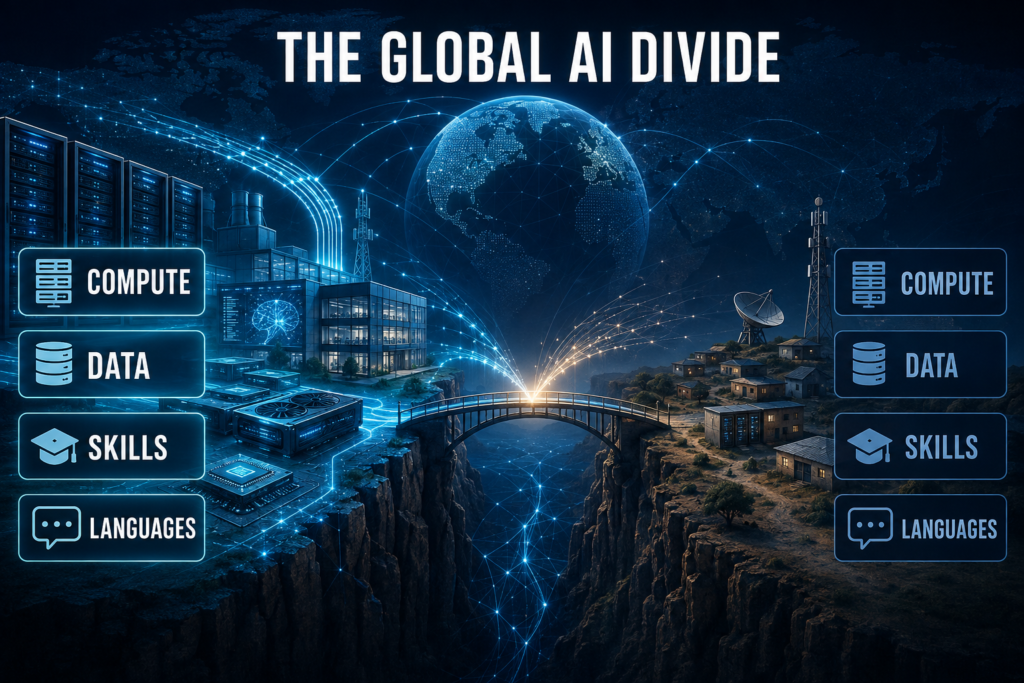
These inequalities reinforce one another. A country with limited computing infrastructure may struggle to support researchers. Skilled professionals may then move abroad, weakening local institutions and reducing the development of domestic models.
The Global AI Language Divide
Language is one of the most visible forms of AI inequality. English dominates large portions of online content, scientific publishing, software documentation and model-training data.
Other widely digitised languages, including Chinese, Spanish, French, German and Japanese, also receive substantial support. However, thousands of languages have limited digital text, speech recordings and evaluation datasets.
Low-resource languages may experience:
- inaccurate translation;
- poor speech recognition;
- misunderstanding of names and locations;
- weak representation of local knowledge;
- failure to recognise dialects;
- culturally inappropriate answers; and
- exclusion from voice-based public services.
The language divide affects Hindi and other Indian languages, African languages, Indigenous American languages, Pacific languages and many regional varieties worldwide.
UNESCO has warned that unequal access to AI can create a new digital divide. Its work on AI literacy and inclusion emphasises multilingual resources, accessible education and cooperation among governments, technology companies, educational institutions and communities.
Building inclusive language AI requires more than translating English material. Developers need native-language data, cultural knowledge, regional evaluation and participation by people who actually use the language.
Data Ownership and Digital Dependence
Developing countries generate valuable linguistic, agricultural, health, environmental and cultural data. However, the infrastructure used to store and process this data may be controlled by foreign companies.
This creates important questions:
- Who owns locally collected data?
- Where is it stored?
- Who is allowed to train models with it?
- Can communities withdraw permission?
- Do local institutions share the economic benefits?
- Can a country continue using the system if prices or access rules change?
Data sovereignty does not require every country to isolate its digital systems. It requires meaningful control over important national and community data, along with clear rules for consent, security and benefit sharing.
Closing the Global AI Divide
No single policy can eliminate global AI inequality. Progress requires coordinated action across infrastructure, education, data and governance.
Important steps include:
- Building regional computing centres that universities and startups can share.
- Expanding affordable broadband and reliable electricity.
- Supporting open datasets with clear documentation and responsible licences.
- Investing in local universities, researchers and technical education.
- Developing AI systems for regional languages and practical needs.
- Including developing countries in international AI governance.
- Supporting smaller and efficient models that do not require enormous computing resources.
- Protecting Indigenous and community control over cultural data.
- Evaluating imported systems under local social and linguistic conditions.
- Ensuring that AI improves public services without excluding people who lack digital access.
The goal should not be for every country to build the largest foundation model. Countries need enough knowledge, infrastructure and institutional capacity to choose, evaluate, adapt and govern the systems they use.
Conclusion: Reading the World Through the Global AI Knowledge Atlas
The Ultimate Global AI Knowledge Atlas shows that artificial intelligence is not produced within a single laboratory, company or nation. It is created through an international network of researchers, universities, companies, data centres, semiconductor manufacturers, governments and communities.
Different regions contribute different strengths. North America leads in private investment, cloud infrastructure and frontier models. Europe combines scientific research, industrial AI and global regulatory influence. East Asia connects foundation models with robotics, electronics and semiconductor manufacturing. South Asia contributes technical talent, digital scale and multilingual innovation.
The Middle East is building state-supported infrastructure and Arabic-language models. Africa is developing mobile-first and locally relevant AI despite a severe compute gap. Latin America applies AI to public services, agriculture, finance and environmental protection. Australia and Oceania connect research with healthcare, climate science and disaster management.
This atlas also demonstrates that AI leadership cannot be measured through one ranking. Model development, research, hardware, language coverage, industrial adoption and responsible governance are different forms of technological strength.
The future of AI will depend on more than creating increasingly powerful systems. It will depend on who can access them, whose languages they understand, which communities control their data and whether their benefits are distributed fairly.
Used as a reference, the Global AI Knowledge Atlas allows students, teachers, researchers and general readers to connect AI technologies with the people, countries and institutions behind them. Used as a global map, it reveals both extraordinary innovation and the inequalities that must still be addressed.
Artificial intelligence may be global in reach, but it will become genuinely global in value only when every region has a meaningful opportunity to understand, shape and benefit from it.