
Artificial intelligence is reshaping the blogging industry. In the past, bloggers spent most of their time researching keywords, outlining articles, optimizing content, creating graphics, and managing publishing schedules manually. Today, AI tools can automate many of these tasks and help bloggers focus on creating valuable content for their audiences.
The blogging landscape has also become more competitive. Search engines increasingly reward websites that demonstrate topical authority, strong user experience, and comprehensive coverage of a subject. As a result, bloggers need efficient systems that allow them to publish high-quality content consistently.
AI tools provide that advantage. They help with keyword research, SEO optimization, content planning, writing assistance, image generation, workflow management, and audience engagement. Whether you are a beginner blogger, affiliate marketer, niche publisher, or professional content creator, AI can significantly improve productivity and growth potential.
What Are AI Tools for Bloggers?
AI tools for bloggers are software applications that use artificial intelligence to support content creation, research, optimization, publishing, and blog management. Unlike traditional software that performs only specific tasks, modern AI platforms can understand natural language, analyze context, and generate useful outputs based on user instructions.
For bloggers, AI tools can simplify nearly every stage of the publishing process. They can help identify content opportunities, generate article outlines, suggest headline ideas, improve readability, optimize SEO elements, create graphics, and organize editorial workflows.
One of the biggest advantages of AI tools is their ability to reduce repetitive work. Instead of spending hours analyzing competitors or creating content structures from scratch, bloggers can use AI to generate strong foundations and then refine them with their own expertise and experience.
AI tools are not designed to replace human creativity. Rather, they function as productivity assistants that help bloggers work faster, maintain consistency, and scale content production more efficiently.
As blogging continues to evolve, AI tools are becoming an essential part of modern content publishing strategies.
Why Bloggers Are Adopting AI Workflows
The demands placed on bloggers have increased significantly over the last few years. Successful blogging now requires much more than writing articles. Bloggers must conduct keyword research, monitor competitors, optimize for search engines, manage internal linking, create visuals, build email lists, and engage with audiences across multiple platforms.
Handling all of these responsibilities manually can be overwhelming, especially for solo bloggers and small content teams. AI workflows help solve this problem by automating many time-consuming tasks.
For example, bloggers can use AI to generate content ideas, create outlines, summarize research materials, improve article structure, and develop content calendars. Instead of spending hours organizing information, they can focus on adding insights, expertise, and personal experiences that make their content unique.
AI also helps improve consistency. Maintaining a regular publishing schedule is one of the biggest challenges for bloggers. By reducing the amount of time required for planning and preparation, AI allows creators to publish more frequently without sacrificing quality.
As competition grows across nearly every niche, bloggers are increasingly adopting AI workflows to improve efficiency, increase output, and build stronger content ecosystems.
Quick Comparison Table of AI Tools for Bloggers
| Tool | Best For | Free Plan | Main Strength |
|---|---|---|---|
| Surfer AI | SEO Optimization | No | Search visibility |
| AIOSEO AI Assistant | WordPress SEO | Limited | On-page optimization |
| NotebookLM | Research | Yes | Source-based learning |
| Claude | Long-form writing | Yes | Natural writing quality |
| Canva AI | Visual content | Yes | Graphic design |
Surfer AI: Your SEO and Search Visibility Expert
For bloggers who depend on organic traffic, SEO remains one of the most important growth channels. Surfer AI is designed specifically to help content creators optimize articles for search visibility by analyzing live search engine results and identifying ranking patterns.
One of the biggest challenges in SEO is understanding what search engines expect for a particular keyword. Surfer AI simplifies this process by evaluating top-ranking pages and providing recommendations related to content structure, keyword usage, semantic relevance, headings, and topic coverage.
Instead of guessing which terms to include or how detailed an article should be, bloggers can use Surfer AI to build data-driven content strategies. The platform helps identify content gaps, related topics, and optimization opportunities that might otherwise be overlooked.
Another valuable feature is content scoring. As bloggers write or edit content, Surfer AI evaluates the draft and provides real-time recommendations. This makes optimization more systematic and reduces the risk of missing important ranking signals.
Best Uses
- SEO content planning
- Content optimization
- Keyword targeting
- Competitor analysis
- Topical authority building
Advantages
- Data-driven recommendations
- Real-time optimization guidance
- Improved search visibility
- Better content structure
- Strong SEO workflow integration
For bloggers focused on long-term organic traffic growth, Surfer AI can be one of the most valuable tools in an AI-powered publishing workflow.
AIOSEO AI Assistant: The Seamless WordPress Tool
For WordPress bloggers, managing on-page SEO can become repetitive and time-consuming. Every article requires title optimization, meta descriptions, URL structures, schema implementation, internal linking, and technical checks. AIOSEO AI Assistant simplifies these tasks by integrating SEO guidance directly into the WordPress environment.
One of the biggest advantages of AIOSEO is convenience. Instead of switching between multiple SEO tools, bloggers can optimize content from within their publishing dashboard. This improves workflow efficiency and reduces distractions during the writing process.
The platform helps generate SEO-friendly titles, improve meta descriptions, optimize keyword placement, and identify technical issues that may impact search visibility. It also provides recommendations for improving content structure and readability.
For bloggers managing large content libraries, AIOSEO can save significant amounts of time while maintaining SEO consistency across the entire website.
Best Uses
- Meta description generation
- Title optimization
- Technical SEO improvements
- Internal linking support
- WordPress SEO management
Advantages
- Direct WordPress integration
- Easy workflow management
- Time-saving automation
- Beginner-friendly interface
- Improved on-page optimization
NotebookLM: Your Private Fact-Grounding Hub
One of the biggest challenges in modern blogging is maintaining accuracy while publishing content quickly. Generic AI systems sometimes generate information that sounds convincing but may not always be reliable. NotebookLM addresses this issue by allowing bloggers to work directly with their own sources.
Bloggers can upload PDFs, research documents, reports, transcripts, notes, and reference materials. NotebookLM then uses only those sources when answering questions and generating summaries. This creates a much safer research environment compared to relying entirely on open-ended AI systems.
The platform is particularly useful for bloggers writing educational, academic, financial, scientific, or technical content where accuracy is critical. Instead of searching through dozens of documents manually, creators can quickly extract insights and identify key information.
NotebookLM also helps organize large research projects and build comprehensive content clusters around specific topics.
Best Uses
- Research-based blogging
- Source verification
- Content planning
- Knowledge organization
- Technical writing
Advantages
- Uses uploaded sources only
- Reduces misinformation risks
- Excellent for research
- Improves content quality
- Strong fact-grounding capabilities
Claude: High-Quality Human-Sounding Drafts
Many AI writing tools can generate content, but not all of them produce writing that feels natural and engaging. Claude has become popular among bloggers because of its ability to create content that reads more like human writing and less like machine-generated text.
The platform excels at long-form content creation. Bloggers often use Claude to draft comprehensive guides, opinion pieces, educational articles, and narrative-style content. It handles context well and maintains consistency across large documents.
Another advantage is readability. Claude tends to avoid overly repetitive phrasing and produces smoother transitions between ideas. This helps bloggers create articles that are more enjoyable for readers while maintaining professional quality.
Although human editing remains essential, Claude provides a strong foundation for writers who need help generating first drafts efficiently.
Best Uses
- Long-form blog posts
- Educational content
- Storytelling articles
- Email newsletters
- Thought leadership content
Advantages
- Natural writing style
- Strong context retention
- Good readability
- Long-form capabilities
- Human-like tone
Canva AI: Boosting CTR with Professional Visuals
Content quality alone is not enough to attract readers. Visual presentation plays a major role in determining whether users click on an article, engage with content, or share it across platforms. Canva AI helps bloggers create professional graphics without requiring advanced design skills.
The platform offers AI-powered tools for creating featured images, infographics, Pinterest graphics, social media visuals, blog banners, and promotional content. These visual assets help improve click-through rates and strengthen brand identity.
For bloggers managing multiple articles each week, Canva AI dramatically reduces design time. Instead of creating every visual from scratch, users can generate layouts, edit images, and customize templates within minutes.
Strong visuals also improve content engagement and increase the likelihood of social sharing, making Canva one of the most valuable tools in a blogging workflow.
Best Uses
- Featured images
- Blog graphics
- Infographics
- Social media visuals
- Branding assets
Advantages
- Easy to use
- Large template library
- AI-assisted design
- Fast workflow
- Professional results
Additional Free and Paid AI Tools for Bloggers
Beyond the major platforms discussed above, several additional AI tools can improve blogging productivity and content quality.
ChatGPT
ChatGPT remains one of the most versatile AI assistants available. Bloggers use it for brainstorming, content planning, outlining, rewriting, and idea generation. It is often the starting point for content development workflows.
Perplexity
Perplexity combines AI conversation with web-based research. It is particularly useful for finding information quickly and exploring unfamiliar topics while providing source references.
Notion AI
Notion AI helps bloggers manage editorial calendars, organize content ideas, track projects, and maintain documentation within a centralized workspace.
QuillBot
QuillBot focuses on rewriting and improving sentence structure. Bloggers often use it to improve readability and eliminate awkward phrasing.
Grammarly
Grammarly remains one of the best tools for editing and proofreading. It helps identify grammar issues, improve clarity, and maintain professional writing standards.
Together, these tools create a complete blogging ecosystem that supports research, writing, editing, organization, and publishing.
Benefits of Using AI Tools for Bloggers
AI tools offer significant advantages for bloggers who want to publish high-quality content consistently while managing limited time and resources. One of the most important benefits is efficiency. Tasks that previously required hours of research, planning, editing, and optimization can now be completed much faster with the assistance of AI.
Another major benefit is scalability. As blogs grow, content production demands increase. Bloggers often need to publish articles, update existing content, create graphics, manage newsletters, and monitor SEO performance. AI helps handle these responsibilities without requiring a large team.
AI tools also improve content quality. Modern platforms can identify readability issues, suggest structural improvements, optimize keyword placement, and highlight content gaps. This helps bloggers create more comprehensive articles that satisfy both readers and search engines.
Cost savings represent another important advantage. Small publishers and independent bloggers can access capabilities that previously required professional writers, designers, editors, and SEO specialists.
Perhaps the greatest benefit is consistency. Successful blogging often depends on maintaining a regular publishing schedule. AI reduces preparation time and allows creators to stay productive even during busy periods, making it easier to build long-term authority and audience trust.
How AI Improves Blogging Productivity
Productivity is one of the primary reasons bloggers adopt AI tools. The blogging process involves many repetitive activities that consume time but do not necessarily require deep creative thinking. Examples include keyword research, outlining articles, formatting content, generating meta descriptions, proofreading, and creating graphics.
AI automates many of these tasks, allowing bloggers to focus on content strategy and audience engagement. Instead of starting with a blank page, writers can generate structured outlines and then concentrate on adding expertise, insights, and personal experiences.
Research workflows also become faster. AI tools can summarize reports, analyze documents, organize notes, and identify relevant information within large collections of data. This reduces the amount of time spent gathering background information.
Content repurposing is another productivity advantage. A single article can be transformed into newsletters, social media posts, Pinterest descriptions, video scripts, and promotional materials using AI assistance.
By reducing repetitive work and streamlining content production, AI enables bloggers to publish more consistently while maintaining quality standards.
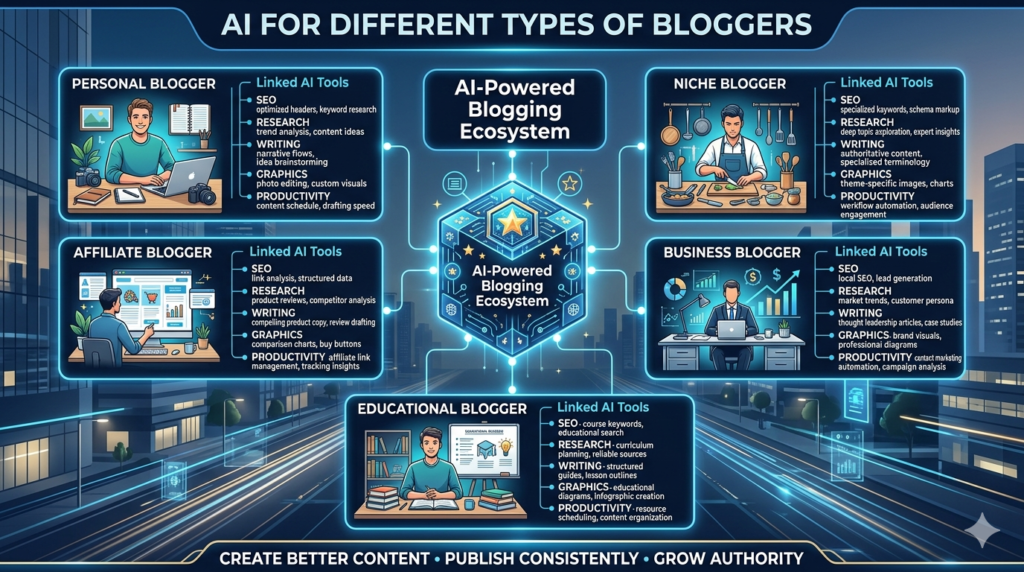
AI for Different Types of Bloggers
Different blogging models require different workflows, and AI tools can support each type of creator in unique ways.
Personal Bloggers
Personal bloggers often focus on storytelling, experiences, and opinions. AI can assist with content organization, editing, and idea generation while allowing the writer’s authentic voice to remain central.
Niche Bloggers
Niche bloggers need deep topical coverage and strong authority. AI helps identify related topics, content gaps, and keyword opportunities that strengthen niche expertise.
Affiliate Bloggers
Affiliate marketers use AI to create comparison articles, buying guides, product summaries, and SEO-focused content. AI can accelerate research while improving publishing efficiency.
Business Bloggers
Businesses use blogs to attract customers and generate leads. AI helps create educational content, marketing materials, and industry insights that support brand growth.
Academic and Educational Bloggers
Writers in research-heavy niches benefit from AI tools that organize sources, summarize information, and assist with content planning while maintaining accuracy.
Because blogging goals vary significantly, the ideal AI workflow often depends on the creator’s niche, audience, and publishing objectives.
The Golden Rule: Building a Safe Hybrid Workflow
The most successful bloggers do not rely entirely on AI, nor do they ignore it. Instead, they build hybrid workflows that combine AI efficiency with human expertise and judgment.
A safe workflow begins with research. Bloggers should gather reliable sources, statistics, case studies, and firsthand knowledge before using AI tools to organize information. This ensures that the final content remains accurate and valuable.
The next step is content planning. AI can help generate outlines, identify subtopics, and structure information logically. However, bloggers should always review and refine these suggestions to match their audience and objectives.
When drafting content, AI can accelerate production, but personal insights, real experiences, and expert opinions should be added manually. These elements differentiate high-quality blogs from generic AI-generated content.
Finally, human editing remains essential. Every article should be reviewed for accuracy, readability, originality, and usefulness before publication.
The goal is not to replace human creativity with automation. The goal is to combine the strengths of both, creating a publishing system that is efficient, scalable, and trustworthy.
Common Pitfalls and Mistakes to Avoid
Although AI tools can dramatically improve blogging efficiency, many creators use them incorrectly. One of the most common mistakes is publishing AI-generated content without reviewing it carefully. While AI can generate impressive drafts, it may occasionally include inaccurate information, weak explanations, or generic statements that provide little value to readers.
Another frequent mistake is focusing entirely on content volume while ignoring content quality. Publishing large numbers of articles may seem productive, but search engines increasingly prioritize expertise, usefulness, originality, and user satisfaction. Bloggers who depend solely on automation often struggle to build long-term authority.
Many creators also make the mistake of using too many AI tools simultaneously. This can create unnecessary complexity, increase costs, and slow down workflows. In most cases, a small collection of carefully selected tools performs better than a large collection of overlapping platforms.
Ignoring user intent is another serious problem. Even perfectly optimized content will fail if it does not answer the questions readers are actually asking. Successful bloggers use AI to support their content strategy rather than replace strategic thinking.
The most effective approach is to treat AI as an assistant that improves productivity while keeping human expertise at the center of the publishing process.
Free vs Paid AI Blogging Platforms
Many bloggers begin with free AI tools because they provide enough functionality for basic content creation, research, and editing. Free plans often include access to AI chat systems, writing assistants, grammar correction tools, and limited design capabilities.
For new bloggers, these free options are usually sufficient. They allow creators to learn AI workflows, improve productivity, and experiment with different tools without financial risk.
Paid plans become valuable when content production increases. Premium subscriptions typically offer higher usage limits, faster performance, access to advanced models, enhanced customization, and additional workflow features.
Professional bloggers often benefit from paid tools because they save time and support larger publishing operations. SEO optimization platforms, advanced research tools, and premium AI writing assistants can contribute directly to business growth when used strategically.
The best approach is to begin with free plans and upgrade only when specific limitations begin affecting productivity or content quality.
How to Choose the Right AI Tool for Your Blog
Choosing the right AI tool depends largely on your blogging goals. Different bloggers face different challenges, and no single platform is perfect for every situation.
If your primary focus is SEO and search visibility, tools such as Surfer AI and AIOSEO can help improve optimization and content structure. Bloggers who publish research-heavy content may benefit more from NotebookLM and Perplexity because of their information organization capabilities.
Writers who prioritize readability and long-form content often prefer Claude, while creators focused on visuals may find Canva AI more valuable. Productivity-oriented bloggers frequently use Notion AI to manage editorial calendars and workflows.
When evaluating AI tools, consider the following questions:
- What problem am I trying to solve?
- Will this tool save meaningful amounts of time?
- Does it integrate with my existing workflow?
- Is the free version sufficient?
- Will it help improve content quality?
The best AI stack is usually the simplest one. Choose tools that solve real problems rather than collecting software you rarely use.
Real-World Blogging Use Cases
AI tools are already being used successfully across many blogging niches and publishing models.
Affiliate Blogging
Affiliate marketers use AI to identify keyword opportunities, create comparison articles, optimize product reviews, and improve content planning.
Niche Blogging
Niche publishers use AI to build topical authority, identify content gaps, and develop comprehensive content clusters around specific subjects.
Business Blogging
Companies use AI to create educational articles, support lead generation, improve customer education, and strengthen brand visibility.
Educational Blogging
Researchers, educators, and academic bloggers use AI to organize sources, summarize complex materials, and improve content development.
News and Trend Blogging
AI helps identify emerging topics, monitor industry developments, and accelerate content production for time-sensitive subjects.
These practical applications demonstrate that AI can support nearly every stage of the blogging process while improving productivity and efficiency.
Future of AI Blogging
The future of blogging will be increasingly influenced by artificial intelligence. AI systems are becoming more capable of understanding user intent, analyzing content quality, and supporting complex publishing workflows.
Future blogging tools will likely combine research, writing, optimization, design, publishing, analytics, and audience engagement within unified platforms. This will reduce workflow fragmentation and improve productivity for creators.
Personalization is expected to become another major trend. AI may help bloggers create content experiences tailored to individual reader preferences, interests, and behavior patterns.
Search engines are also evolving. As conversational search and AI-generated search experiences become more common, bloggers will need to focus on expertise, authority, and unique insights rather than simple keyword targeting.
The creators who succeed in the future will be those who combine AI efficiency with authentic expertise, original thinking, and genuine value for readers.
Best AI Tools for Bloggers: Quick Recommendations
Choosing the best AI tools for bloggers depends on your specific goals and workflow. Bloggers who focus on SEO and organic traffic may benefit most from Surfer AI and AIOSEO, while writers who prioritize content quality often prefer Claude and ChatGPT.
For research-intensive blogging, NotebookLM and Perplexity provide valuable support by organizing information and improving accuracy. Bloggers who regularly create featured images, infographics, and social media graphics can save significant time with Canva AI.
The best AI tools for bloggers are not necessarily the most expensive ones. Instead, the ideal combination is the one that improves productivity, supports content quality, and fits naturally into your publishing workflow. Most bloggers can achieve excellent results by combining two or three carefully selected tools rather than relying on a large collection of platforms.
As blogging becomes more competitive, using the best AI tools for bloggers can help creators publish consistently, improve search visibility, and build long-term authority in their niche.
Frequently Asked Questions
What are the best AI tools for bloggers in 2026?
Some of the best AI tools for bloggers in 2026 include Surfer AI, Claude, NotebookLM, Canva AI, ChatGPT, Perplexity, and AIOSEO. These tools help with SEO, content creation, research, visual design, and workflow management.
Which AI tool is best for SEO blogging?
Surfer AI and AIOSEO are among the best AI tools for SEO blogging because they help optimize content structure, keyword usage, on-page SEO, and search visibility.
Can AI write complete blog posts?
Yes. AI tools can generate complete blog post drafts, outlines, and content ideas. However, human editing is still important for accuracy, originality, and expertise.
Does Google penalize AI-generated content?
No. Google focuses on content quality rather than how content is created. Helpful, accurate, and user-focused content can rank well even when AI is used responsibly.
Which AI tool is best for blog research?
NotebookLM and Perplexity are among the best AI tools for blog research because they help organize information, summarize sources, and improve content accuracy.
What is the best AI tool for creating blog images?
Canva AI is one of the best AI tools for creating blog graphics, featured images, infographics, Pinterest visuals, and social media content.
Are free AI tools enough for blogging?
For most beginner bloggers, free AI tools provide enough functionality for writing, research, editing, and content planning. Premium tools become more valuable as content production grows.
How can AI improve blogging productivity?
AI tools automate repetitive tasks such as research, outlining, editing, SEO optimization, and content planning, allowing bloggers to focus on strategy and audience engagement.
Should bloggers rely completely on AI?
No. The most successful bloggers use AI as a productivity assistant while adding personal experience, expertise, original insights, and human judgment to their content.
Building a Sustainable AI-Powered Blogging Workflow
Artificial intelligence is transforming blogging by making research, content creation, optimization, and workflow management more efficient than ever before. Bloggers who use AI strategically can save time, improve consistency, and focus more on delivering value to their audiences.
Tools such as Surfer AI, AIOSEO, NotebookLM, Claude, Canva AI, ChatGPT, and Notion AI each solve different challenges within the publishing process. The key is not to use every available tool but to build a workflow that matches your goals and content strategy.
The most successful bloggers will continue to combine AI-powered productivity with human creativity, expertise, and critical thinking. AI can accelerate execution, but authentic insights and valuable experiences remain the foundation of long-term blogging success.
As digital publishing continues to evolve, bloggers who learn how to integrate AI responsibly will be better positioned to build authority, grow audiences, and compete effectively in the future of online content creation.
Related AI Guides: