
The best AI tools for small businesses help owners automate tasks, improve productivity, and grow their operations more efficiently. Artificial intelligence is no longer limited to large corporations with massive budgets. Today, small businesses can use powerful AI tools to improve productivity, automate routine tasks, enhance customer service, and accelerate growth.
In 2026, AI tools have become essential for entrepreneurs, startups, local businesses, consultants, agencies, and online businesses. These tools help business owners save time, reduce operational costs, and compete more effectively in increasingly competitive markets.
Whether you run an online store, service business, marketing agency, consulting firm, or local business, AI can help streamline operations and improve decision-making.
What Are AI Tools for Small Businesses?
AI tools for small businesses are software applications that use artificial intelligence to automate tasks, improve productivity, and support business operations.
These tools can assist with content creation, customer communication, marketing, sales, data analysis, project management, and workflow automation. Instead of hiring large teams for every task, small businesses can leverage AI to accomplish more with limited resources.
Modern AI platforms are becoming increasingly accessible, making advanced technology available to businesses of all sizes.
AI tools are especially valuable for small businesses because they help companies operate more efficiently without requiring large budgets or extensive teams. In the past, many business functions such as content creation, customer support, marketing, data analysis, and workflow management required dedicated employees or external agencies.
Today, AI allows small businesses to access capabilities that were once available only to larger organizations. Business owners can automate repetitive tasks, improve communication, generate reports, create marketing campaigns, and manage projects more effectively.
AI tools also help businesses make better decisions by organizing information and providing actionable insights. Whether a company operates online, offline, or through a combination of both, AI can support growth by reducing manual workload and increasing productivity.
As technology becomes more affordable and accessible, AI is becoming a practical business asset rather than an experimental technology. Small businesses that adopt AI effectively can often compete more successfully against larger competitors while maintaining operational efficiency.
Why Small Businesses Are Adopting AI
Many entrepreneurs now rely on the best AI tools for small businesses to reduce workload and improve operational efficiency. Small business owners often face challenges such as limited budgets, time constraints, staffing shortages, and growing competition.
AI helps solve these challenges by automating repetitive work and improving operational efficiency. Business owners can use AI to generate marketing content, respond to customer inquiries, organize projects, analyze information, and improve communication.
As a result, businesses can focus more on growth, customer relationships, and strategic planning rather than spending excessive time on routine administrative tasks.
The ability to increase productivity without significantly increasing costs is one of the primary reasons small businesses are rapidly adopting AI technologies.
Another major reason for AI adoption is the increasing pressure to do more with limited resources. Small businesses often operate with small teams where owners and employees must handle multiple responsibilities at the same time.
AI helps reduce this pressure by automating routine work such as responding to customer inquiries, generating marketing content, scheduling tasks, organizing information, and creating business documents. This allows employees to focus on higher-value activities such as customer relationships, sales, and strategic planning.
Businesses also use AI to improve customer experiences. Faster responses, personalized communication, and better content help companies build stronger relationships with customers while maintaining professional standards.
In competitive markets, speed and efficiency can provide significant advantages. AI enables businesses to respond more quickly to opportunities, adapt to changing conditions, and maintain productivity without constantly increasing operational costs.
Quick Comparison Table of the Best AI Tools for Small Businesses
| Tool | Best For | Free Plan | Main Strength |
|---|---|---|---|
| ChatGPT | Productivity | Yes | Versatility |
| Canva AI | Marketing | Yes | Visual content |
| HubSpot AI | Customer management | Yes | CRM support |
| Grammarly | Communication | Yes | Professional writing |
| Notion AI | Organization | Yes | Workflow management |
| Microsoft Copilot | Productivity | Yes | Business integration |
ChatGPT for Business Productivity
ChatGPT is one of the most versatile AI tools available for small businesses. It can help create marketing content, write emails, generate business ideas, draft proposals, prepare reports, and improve customer communication.
Many entrepreneurs use ChatGPT to accelerate content creation and reduce the time required for routine business tasks. The platform can also assist with brainstorming, market research, planning, and workflow optimization.
Best Uses
- Email writing
- Marketing content
- Business planning
- Customer communication
- Research and analysis
Advantages
- Easy to use
- Supports multiple business functions
- Saves significant time
- Cost-effective solution
For many small businesses, ChatGPT serves as a digital assistant that improves efficiency across multiple departments and business activities.
Beyond basic content generation, ChatGPT can support a wide variety of business functions. Entrepreneurs often use it to draft proposals, prepare client communications, create marketing strategies, generate social media content, and develop business plans.
Customer service teams can use ChatGPT to create response templates, frequently asked questions, and support documentation. Marketing teams can generate campaign ideas, advertising copy, and promotional materials more efficiently.
The platform is also valuable for internal business operations. Managers can use ChatGPT to summarize reports, organize information, prepare meeting agendas, and improve workflow efficiency. Startups and small businesses particularly benefit because they often need versatile tools that can support multiple departments without significant costs.
When combined with human expertise and business knowledge, ChatGPT becomes a powerful productivity assistant that helps organizations save time while maintaining quality and consistency.
Canva AI for Marketing
Marketing is one of the most important functions of any small business, and Canva AI helps business owners create professional marketing materials without hiring designers. The platform allows users to create social media graphics, advertisements, promotional banners, presentations, brochures, flyers, and branding assets quickly.
AI-powered features help generate layouts, remove backgrounds, create images, and improve designs automatically. This significantly reduces the time and cost required to produce professional-quality marketing content.
Small businesses often struggle to maintain consistent branding across different platforms. Canva AI solves this problem by providing templates and design systems that ensure visual consistency.
Best Uses
- Social media marketing
- Business presentations
- Promotional graphics
- Branding materials
- Advertisements
Advantages
- Beginner-friendly
- Professional templates
- Fast design workflow
- Affordable solution
HubSpot AI for Customer Management
HubSpot AI helps small businesses manage customer relationships more effectively. The platform combines customer relationship management (CRM), marketing automation, sales tools, and AI-powered insights in a single system.
Business owners can track leads, manage customer interactions, automate follow-ups, and improve sales processes. AI-powered recommendations help identify opportunities and improve decision-making.
For growing businesses, maintaining strong customer relationships is essential. HubSpot AI helps organize customer data and streamline communication while reducing manual administrative work.
Best Uses
- CRM management
- Lead tracking
- Sales automation
- Customer communication
- Marketing campaigns
Advantages
- Centralized customer data
- Automation features
- Sales support
- Business growth tools
Grammarly for Professional Communication
Professional communication plays a major role in business success. Grammarly helps small businesses improve emails, reports, proposals, website content, and customer communications.
The platform provides real-time grammar corrections, clarity improvements, tone suggestions, and readability enhancements. This helps businesses maintain a professional image while reducing communication errors.
For companies that interact regularly with customers, partners, and suppliers, clear communication can improve trust and strengthen business relationships.
Best Uses
- Email communication
- Business reports
- Proposals
- Website content
- Customer support
Advantages
- Improved writing quality
- Real-time suggestions
- Professional communication
- Easy integration
Notion AI for Business Organization
Notion AI helps businesses organize information, manage projects, document processes, and coordinate team activities. Small business owners often manage multiple responsibilities simultaneously, making organization essential.
The platform combines note-taking, project management, knowledge management, and AI-powered assistance into a single workspace. Teams can collaborate more effectively while keeping important information accessible and organized.
Notion AI can summarize notes, generate content drafts, and improve workflow management, making it valuable for businesses seeking operational efficiency.
Best Uses
- Project management
- Team collaboration
- Documentation
- Workflow organization
- Knowledge management
Advantages
- Centralized workspace
- Productivity improvement
- Team coordination
- Flexible workflows
Microsoft Copilot for Business Workflows
Microsoft Copilot integrates artificial intelligence directly into business applications such as Word, Excel, PowerPoint, Outlook, and Teams. This allows businesses to automate routine work and improve productivity within familiar software environments.
Business owners can use Copilot to generate reports, analyze spreadsheets, create presentations, draft emails, and summarize meetings. These capabilities reduce administrative workload and improve efficiency.
For organizations already using Microsoft products, Copilot offers a seamless way to introduce AI into daily operations without requiring major workflow changes.
Best Uses
- Document creation
- Spreadsheet analysis
- Email drafting
- Presentation development
- Meeting summaries
Advantages
- Microsoft integration
- Productivity enhancement
- Workflow automation
- Business efficiency
Benefits of AI Tools for Small Businesses
The best AI tools for small businesses can save time, reduce costs, and support long-term business growth. Small businesses often operate with limited budgets, smaller teams, and fewer resources than large corporations. AI tools help bridge this gap by providing capabilities that improve productivity, efficiency, and decision-making without requiring significant investment.
One of the biggest benefits is time savings. Business owners spend a considerable amount of time handling emails, customer inquiries, marketing activities, scheduling, reporting, and administrative work. AI can automate many of these repetitive tasks, allowing owners to focus on business growth and customer relationships.
AI also helps improve marketing effectiveness. Businesses can create professional content, advertisements, social media posts, and promotional materials much faster than traditional methods. This allows companies to maintain a strong online presence while reducing marketing costs.
Another major benefit is improved customer service. AI-powered tools can help businesses respond more quickly to customer inquiries, organize customer data, and maintain consistent communication.
As competition increases across industries, AI provides small businesses with practical tools that improve efficiency, reduce costs, and support sustainable growth.
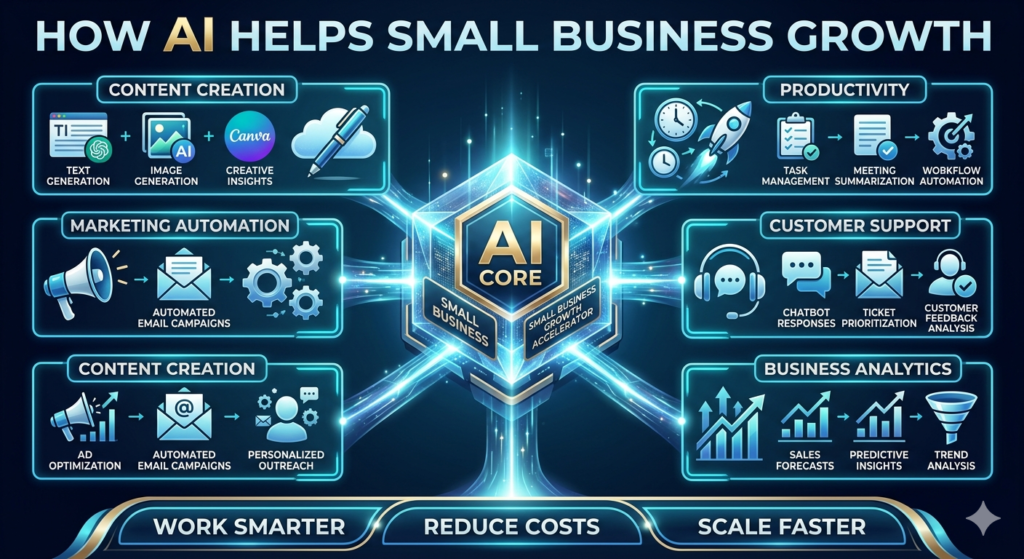
How AI Helps Business Growth
Using the best AI tools for small businesses allows companies to scale operations without significantly increasing expenses. Growth is one of the primary goals of every business, and AI can play an important role in achieving that objective. By automating routine tasks, businesses can operate more efficiently and allocate resources toward expansion activities.
AI helps companies identify opportunities through data analysis, customer insights, and market research. Business owners can use AI-generated reports and recommendations to make better decisions and respond more quickly to changing market conditions.
Marketing is another area where AI contributes to growth. Businesses can create targeted campaigns, generate content at scale, and personalize communication with customers. These capabilities improve engagement and help attract new customers while strengthening relationships with existing ones.
AI also supports operational scalability. As a business grows, managing larger volumes of customers, content, and administrative work becomes more challenging. AI tools help maintain productivity without requiring proportional increases in staffing costs.
For many small businesses, AI serves as a growth accelerator by improving efficiency, supporting marketing efforts, and enabling smarter decision-making.
Common Mistakes Businesses Make with AI
While AI offers significant advantages, businesses often make mistakes that reduce its effectiveness. One common error is adopting AI tools without a clear objective. Companies sometimes invest in multiple platforms without understanding how those tools support business goals.
Another mistake is relying entirely on AI-generated content or recommendations without human review. AI can produce useful outputs, but business decisions, customer communication, and marketing materials should always be reviewed for accuracy and relevance.
Some organizations also underestimate the importance of employee training. Even the best AI tools provide limited value if staff members do not understand how to use them effectively.
Security and privacy concerns represent another challenge. Businesses should avoid sharing sensitive customer information with AI systems unless proper safeguards and compliance requirements are in place.
Successful AI adoption requires a balanced approach that combines technology with human expertise, oversight, and strategic planning.
Real-World Uses of AI in Small Businesses
The best AI tools for small businesses are already being used for marketing, customer service, content creation, and workflow automation. Small businesses use AI across many different functions and industries. One of the most common applications is marketing. Companies use AI to create advertisements, social media campaigns, promotional graphics, and email marketing content more efficiently.
Customer service is another important area. AI-powered chat assistants, automated responses, and customer management systems help businesses provide faster support while maintaining service quality.
Many companies use AI for content creation, including blog articles, website copy, product descriptions, and marketing materials. This helps maintain consistent communication while reducing production time.
AI also supports internal operations such as project management, scheduling, reporting, documentation, and workflow organization. These improvements allow businesses to operate more efficiently and focus on strategic priorities.
As AI technology becomes more accessible, businesses of all sizes are finding practical ways to increase productivity, improve customer experiences, and strengthen their competitive position in the marketplace.
Future of AI for Small Businesses
As technology evolves, the best AI tools for small businesses will become even more powerful and accessible. The future of AI for small businesses looks extremely promising. As artificial intelligence becomes more affordable and accessible, even very small companies will be able to use advanced tools that were previously available only to large enterprises.
Future AI systems will become more personalized and industry-specific. Businesses will be able to use AI assistants trained on their own processes, products, services, and customer data. This will improve decision-making and increase operational efficiency.
AI will also play a larger role in customer service, sales forecasting, marketing automation, and business analytics. Instead of spending hours analyzing reports, business owners will receive actionable recommendations in real time.
Another important trend is the integration of multiple AI capabilities into a single platform. Future business systems may combine content creation, customer management, financial analysis, marketing automation, and productivity tools within one AI-powered ecosystem.
Small businesses that adopt AI strategically today will be better positioned to compete, grow, and adapt to future market changes.
Frequently Asked Questions
What are the best AI tools for small businesses in 2026?
Some of the best AI tools for small businesses in 2026 include ChatGPT, Canva AI, HubSpot AI, Grammarly, Notion AI, and Microsoft Copilot. These tools help improve productivity, marketing, customer service, and business operations.
Can small businesses afford AI tools?
Yes. Many AI platforms offer free plans and affordable subscription options, making AI accessible even for startups and small businesses with limited budgets.
How can AI help small business growth?
AI can automate repetitive tasks, improve marketing campaigns, enhance customer service, support decision-making, and increase productivity, helping businesses grow more efficiently.
Which AI tool is best for small business productivity?
ChatGPT and Microsoft Copilot are among the best AI tools for business productivity because they assist with content creation, communication, reporting, planning, and workflow automation.
Is AI useful for local businesses?
Yes. Local businesses can use AI for customer communication, appointment management, social media marketing, content creation, and operational efficiency.
Which AI tool is best for small business marketing?
Canva AI and ChatGPT are excellent AI tools for small business marketing because they help create graphics, advertisements, social media content, and promotional campaigns.
Can AI improve customer service?
Yes. AI tools can help businesses respond to customer inquiries faster, automate support workflows, organize customer data, and maintain consistent communication.
What is the best AI CRM for small businesses?
HubSpot AI is one of the best AI-powered CRM platforms for small businesses because it combines customer management, sales automation, marketing tools, and business insights.
Will AI replace employees in small businesses?
In most cases, AI works best as a productivity assistant. It helps employees complete tasks more efficiently while human expertise, creativity, and decision-making remain essential.
Growing Your Business with AI
Choosing the best AI tools for small businesses can provide a competitive advantage in today’s rapidly changing business environment. Artificial intelligence is becoming an essential business tool rather than an optional technology. Small businesses that embrace AI can improve efficiency, reduce costs, enhance customer experiences, and compete more effectively in modern markets.
Tools such as ChatGPT, Canva AI, HubSpot AI, Grammarly, Notion AI, and Microsoft Copilot demonstrate how AI can support multiple business functions without requiring large budgets or technical expertise.
The most successful businesses will be those that combine AI-powered productivity with human creativity, strategic thinking, and strong customer relationships. By using AI responsibly and effectively, small businesses can create sustainable advantages and position themselves for long-term growth.
As AI technology continues to evolve, its role in business operations will become increasingly important, making now an excellent time for small businesses to begin exploring and adopting AI solutions.
Related AI Guides: