
unning a business involves dozens of repetitive tasks every day. Teams spend hours managing emails, updating spreadsheets, responding to customers, scheduling meetings, creating reports, and handling administrative work.
While these activities are important, they often reduce the time available for strategy, innovation, and business growth.
This is where artificial intelligence is transforming modern businesses.
AI-powered automation tools can handle repetitive processes, improve productivity, reduce errors, and help businesses operate more efficiently. Whether you run a startup, small business, agency, ecommerce store, or large company, AI automation can save time and improve results.
Businesses that are new to AI may also want to start with our What Is Artificial Intelligence? The Complete Beginner’s Guide to AI before exploring advanced automation solutions.
In this guide, we will explore the best AI tools for business automation in 2026, compare their features, advantages, limitations, and ideal use cases to help you choose the right platform for your business.
Why AI Business Automation Is Growing So Fast
Business automation is no longer a luxury available only to large enterprises. Today, businesses of all sizes can use AI tools to automate workflows and improve efficiency.
Several factors are driving this growth:
- Increasing workload
- Rising labor costs
- Growing customer expectations
- Need for faster decision-making
- Expansion of remote work
- Availability of affordable AI tools
Many of the automation solutions discussed in this article also complement the platforms featured in our Best AI Tools for Small Businesses in 2026 guide.
AI automation helps organizations achieve more with fewer resources while maintaining high-quality service and operations.
What Makes a Great AI Automation Tool?
Choosing the right automation platform is important because every business has different requirements.
The best AI automation tools typically offer:
Ease of Use
A good platform should be easy to implement and use, even for non-technical users.
Workflow Automation
The tool should automate repetitive tasks without requiring constant supervision.
Integrations
Strong integration support allows businesses to connect multiple applications and automate data transfer.
Scalability
The platform should grow alongside your business.
Security
Business data must remain secure and protected.
Pricing
The cost should provide a strong return on investment.
Quick Comparison of the Best AI Automation Tools
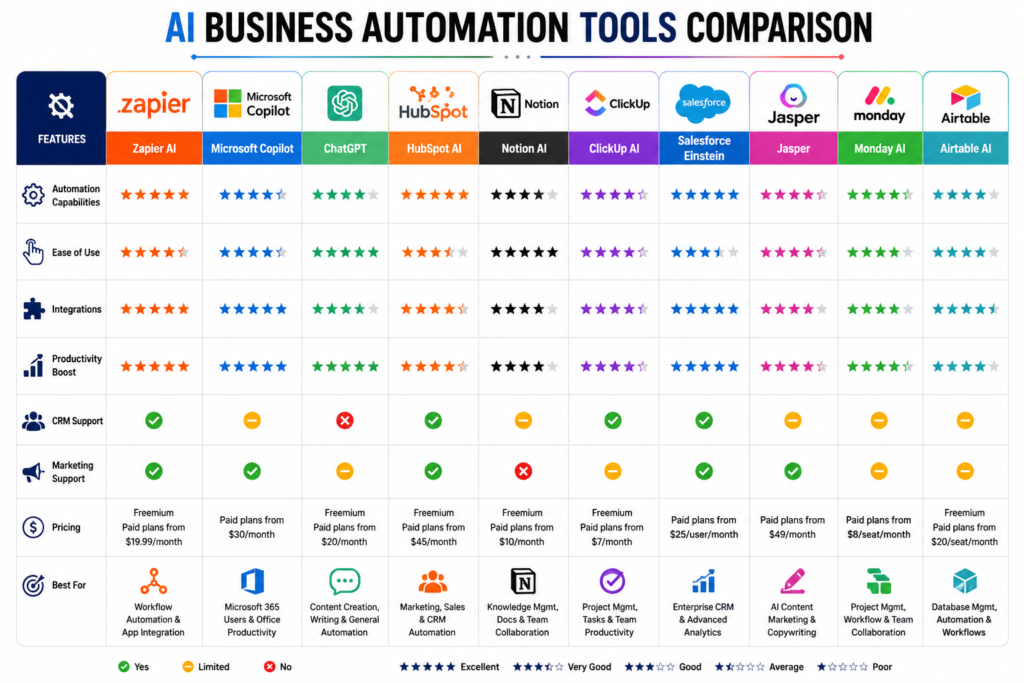
| Tool | Best For | Key Strength |
|---|---|---|
| Zapier AI | Workflow Automation | App Integrations |
| Microsoft Copilot | Office Productivity | Microsoft Ecosystem |
| ChatGPT | General Business Tasks | Versatility |
| HubSpot AI | CRM Automation | Customer Management |
| Notion AI | Documentation | Knowledge Management |
| ClickUp AI | Project Management | Team Productivity |
| Salesforce Einstein | Enterprise Automation | Predictive Analytics |
| Jasper | Marketing Automation | Content Creation |
| Monday AI | Workflow Management | Team Collaboration |
| Airtable AI | Data Automation | Business Organization |
Best AI Tools for Business Automation in 2026
1. Zapier AI
Zapier is one of the most popular workflow automation platforms available today. It connects thousands of applications and allows businesses to automate tasks without coding.
| Feature | Details |
|---|---|
| Best For | Workflow Automation |
| Ease of Use | Easy |
| Integrations | 7,000+ Apps |
| Pricing | Freemium |
| Ideal Users | Startups, SMBs, Agencies |
Pros
- Easy to use
- Huge integration library
- No coding required
- Saves significant time
Cons
- Advanced workflows can become expensive
- Complex automations require learning
2. Microsoft Copilot
Microsoft Copilot helps businesses automate daily office work across Microsoft 365 applications.
| Feature | Details |
|---|---|
| Best For | Office Productivity |
| Integration | Microsoft 365 |
| Key Benefit | AI-Powered Assistance |
| Ideal Users | Microsoft-Based Organizations |
Pros
- Strong productivity features
- Excellent integration
- Time-saving automation
Cons
- Best for Microsoft users
- Premium features increase costs
3. ChatGPT
ChatGPT has become one of the most versatile AI assistants for businesses. It can generate content, answer questions, create reports, assist customer communication, and support daily operations.
ChatGPT is also featured in our Best AI Chatbots in 2026 guide.
| Feature | Details |
|---|---|
| Best For | Business Assistance |
| Main Strength | Versatility |
| Content Creation | Excellent |
| Automation Support | Strong |
Pros
- Highly flexible
- Easy to use
- Supports multiple business functions
Cons
- Requires quality prompts
- Human review remains important
4. HubSpot AI
HubSpot AI combines customer relationship management, marketing automation, sales automation, and customer support into a single platform.
It helps businesses manage leads, automate communication, and improve customer engagement throughout the sales funnel.
| Feature | Details |
|---|---|
| Best For | CRM & Marketing Automation |
| Key Strength | Customer Management |
| Automation Level | High |
| Ideal Users | Small to Medium Businesses |
Pros
- Powerful CRM system
- Excellent marketing automation
- Strong customer management features
- User-friendly interface
Cons
- Premium plans can be expensive
- Advanced setup requires time
5. Notion AI
Notion AI helps businesses organize information, create documentation, summarize content, and improve team collaboration.
Companies that manage large amounts of knowledge and documentation often use Notion AI to streamline operations.
| Feature | Details |
|---|---|
| Best For | Documentation & Knowledge Management |
| Main Benefit | Team Collaboration |
| Ease of Use | Easy |
| Ideal Users | Teams and Agencies |
Pros
- Excellent knowledge management
- Improves collaboration
- Easy organization of information
- Flexible workspace
Cons
- Limited workflow automation compared to Zapier
- Setup may take time
6. ClickUp AI
ClickUp AI combines project management, task tracking, automation, and AI assistance into a single platform.
Businesses use ClickUp AI to automate workflows, manage projects, and improve team productivity.
Organizations looking to improve efficiency can also explore our Best AI Productivity Tools in 2026 guide.
| Feature | Details |
|---|---|
| Best For | Project Management |
| Main Strength | Productivity Automation |
| Collaboration | Excellent |
| Ideal Users | Teams and Agencies |
Pros
- Strong project management tools
- Workflow automation
- Team collaboration features
- AI-powered assistance
Cons
- Learning curve for beginners
- Advanced features require setup
7. Salesforce Einstein
Salesforce Einstein is an enterprise-grade AI platform built into Salesforce CRM.
It provides predictive analytics, customer insights, sales forecasting, and advanced automation capabilities.
| Feature | Details |
|---|---|
| Best For | Enterprise Automation |
| Main Strength | Predictive Analytics |
| CRM Features | Advanced |
| Ideal Users | Large Organizations |
Pros
- Powerful analytics
- Enterprise-level automation
- Excellent customer insights
- Scalable platform
Cons
- Expensive for smaller businesses
- Requires implementation expertise
8. Jasper
Jasper is widely used for marketing automation and content creation.
Marketing teams use Jasper to generate blog posts, social media content, email campaigns, advertising copy, and marketing assets.
Businesses interested in marketing automation should also read our Best AI Tools for Marketing in 2026 guide.
| Feature | Details |
|---|---|
| Best For | Marketing Automation |
| Main Strength | Content Creation |
| Brand Voice Support | Yes |
| Ideal Users | Marketing Teams |
Pros
- High-quality content generation
- Strong marketing workflows
- Easy to use
- Supports team collaboration
Cons
- Monthly subscription cost
- Requires content review
9. Monday AI
Monday AI improves project management and workflow automation through intelligent recommendations and automated processes.
It helps teams stay organized and improve collaboration.
| Feature | Details |
|---|---|
| Best For | Workflow Management |
| Main Strength | Team Coordination |
| Ease of Use | High |
| Ideal Users | Growing Businesses |
Pros
- Easy-to-use interface
- Strong project visibility
- Effective workflow automation
- Excellent collaboration features
Cons
- Premium features cost extra
- Advanced workflows need setup
10. Airtable AI
Airtable AI combines databases, project management, and automation into one flexible platform.
Businesses use it to organize information, automate workflows, and improve reporting.
| Feature | Details |
|---|---|
| Best For | Data Automation |
| Main Strength | Information Management |
| Reporting Features | Strong |
| Ideal Users | Data-Driven Businesses |
Pros
- Flexible platform
- Powerful organization features
- Useful reporting capabilities
- Supports automation
Cons
- Learning curve for beginners
- Advanced features require paid plans
Common Business Processes That Can Be Automated with AI
One of the biggest advantages of AI is its ability to automate repetitive business activities. Instead of spending hours on routine tasks, businesses can use AI tools to complete them faster and more accurately.
Tasks That AI Can Automate
| Business Process | How AI Helps |
|---|---|
| Email Management | Organizes inboxes and drafts responses |
| Customer Support | Provides instant answers and assistance |
| Lead Generation | Identifies potential customers |
| Content Creation | Generates blogs, emails, and social posts |
| Reporting | Creates automated reports |
| Scheduling | Books meetings and sends reminders |
| Data Entry | Updates records automatically |
| Social Media | Schedules and manages content |
Email Automation
AI tools can prioritize emails, draft replies, and automate follow-ups. This reduces administrative workload and improves communication efficiency.
Customer Support Automation
Businesses increasingly rely on AI chatbots to provide 24/7 customer support. Automated support systems can handle common questions while human agents focus on complex issues.
Marketing Automation
AI can automate:
- Email campaigns
- Social media scheduling
- Audience targeting
- Campaign reporting
- Content creation
This helps marketing teams save time while improving performance.
Reporting and Analytics
AI tools can automatically collect business data, generate reports, and identify trends that support better decision-making.
AI Automation for Small Businesses vs Large Enterprises
The automation needs of a small business are very different from those of a large enterprise. Choosing the right AI tool depends on your budget, team size, business goals, and workflow complexity.
Comparison Between Small Businesses and Enterprises
| Factor | Small Business | Large Enterprise |
|---|---|---|
| Budget | Limited | Larger Budget |
| Team Size | Small Teams | Large Departments |
| Automation Needs | Basic to Moderate | Advanced |
| Setup Complexity | Easy | Complex |
| Data Volume | Lower | High |
| Recommended Tools | Zapier, ChatGPT, HubSpot | Salesforce Einstein, Microsoft Copilot |
AI Automation for Small Businesses
Small businesses often have limited resources and need solutions that provide maximum value without requiring technical expertise.
Popular choices include:
- Zapier AI
- ChatGPT
- HubSpot AI
- Notion AI
These platforms help automate customer communication, content creation, workflow management, scheduling, and reporting.
Businesses looking to improve efficiency should also explore our Best AI Tools for Small Businesses in 2026 guide.
AI Automation for Large Enterprises
Enterprise organizations usually require advanced analytics, predictive insights, CRM automation, and large-scale workflow management.
Solutions such as Salesforce Einstein and Microsoft Copilot provide enterprise-grade capabilities designed to support complex business environments.
Which Option Is Best?
There is no single solution that works for every organization. Small businesses often benefit from simplicity and affordability, while larger organizations require scalability and advanced functionality.
The best approach is to start with a few critical processes and gradually expand automation efforts as your business grows.
Benefits of AI Business Automation
Businesses adopt AI automation because it delivers measurable improvements across multiple areas of operation.
Key Benefits
| Benefit | Business Impact |
|---|---|
| Increased Productivity | Teams complete more work in less time |
| Cost Reduction | Lower operational expenses |
| Improved Accuracy | Fewer manual mistakes |
| Better Customer Experience | Faster support and communication |
| Scalability | Supports business growth |
| Faster Decision Making | Real-time insights and reporting |
Improved Productivity
One of the biggest advantages of AI automation is productivity improvement.
Employees spend less time on repetitive work and more time on activities that create value for customers and the business.
Organizations often combine automation platforms with the solutions featured in our Best AI Productivity Tools in 2026 guide to maximize efficiency.
Reduced Operational Costs
Automation helps businesses reduce expenses by minimizing repetitive manual work.
Rather than hiring additional staff for routine tasks, organizations can use AI tools to handle many activities automatically.
Better Customer Experience
Customers expect fast responses and personalized experiences.
AI-powered automation helps businesses provide:
- Faster replies
- Better support
- Consistent communication
- Improved customer satisfaction
Enhanced Decision Making
Modern AI platforms can analyze large amounts of data and generate insights that help managers make smarter decisions.
This allows businesses to respond quickly to opportunities and challenges.
Common Mistakes to Avoid When Implementing AI Automation
Although AI automation offers many benefits, businesses often make mistakes during implementation.
1. Automating Everything at Once
Many organizations try to automate every process immediately.
A better approach is to start with a few high-impact workflows and expand gradually.
2. Choosing the Wrong Tool
Not every automation platform is suitable for every business.
Before investing in software, consider:
- Budget
- Team size
- Existing tools
- Business objectives
3. Ignoring Employee Training
Employees need to understand how automation systems work.
Proper training improves adoption and helps teams maximize the value of AI tools.
4. Failing to Monitor Results
Automation should not be treated as a one-time project.
Businesses should regularly review performance metrics and make adjustments when necessary.
5. Overlooking Data Security
AI systems often process sensitive business information.
Organizations should ensure proper security practices and compliance measures are in place.
Business Automation Trends in 2026
AI-powered automation continues to evolve rapidly.
Several important trends are shaping the future of business operations.
Autonomous Workflows
Future AI systems will manage increasingly complex workflows with minimal human involvement.
Predictive Analytics
Businesses will rely more heavily on AI to predict customer behavior, market trends, and operational challenges.
Smarter Customer Service
AI assistants and chatbots will become more accurate, personalized, and capable of handling complex customer interactions.
AI-Powered Decision Support
Business leaders will use AI-generated insights to make faster and more informed decisions.
Increased Integration Across Platforms
Automation tools will connect more seamlessly with CRM systems, project management platforms, marketing software, and communication tools.
Choosing the Right Automation Strategy for Your Business
The best AI automation tool depends on your business goals, team size, and existing software ecosystem.
Small businesses often find Zapier AI, ChatGPT, HubSpot AI, and Notion AI sufficient for most automation needs. Marketing teams frequently benefit from Jasper, while project-focused organizations may prefer ClickUp AI or Monday AI.
Larger enterprises that require advanced analytics and customer management capabilities should consider Salesforce Einstein or Microsoft Copilot.
There is no universal solution for every organization. The most successful businesses usually combine multiple AI tools to create efficient workflows that save time, improve productivity, and support long-term growth.
As AI technology continues to advance, businesses that embrace automation today will be better positioned to compete, scale, and adapt to future challenges.
Frequently Asked Questions About AI Business Automation
What are the best AI tools for business automation in 2026?
Some of the best AI tools for business automation in 2026 include Zapier AI, Microsoft Copilot, ChatGPT, HubSpot AI, Notion AI, ClickUp AI, Salesforce Einstein, Jasper, Monday AI, and Airtable AI. These tools help businesses automate workflows, improve productivity, and reduce manual work.
How can AI automate business processes?
AI can automate repetitive tasks such as email management, customer support, content creation, lead generation, appointment scheduling, reporting, and data entry. This helps businesses save time and operate more efficiently.
Which AI automation tool is best for small businesses?
Zapier AI, ChatGPT, HubSpot AI, and Notion AI are among the best choices for small businesses because they are affordable, easy to use, and capable of automating common business workflows.
Can AI business automation reduce costs?
Yes. AI automation can reduce operational costs by minimizing repetitive manual work, improving efficiency, reducing errors, and helping employees focus on higher-value tasks.
Is AI automation suitable for startups?
Yes. Startups can benefit significantly from AI automation because it helps them manage operations, improve productivity, automate customer communication, and scale more effectively with limited resources.
What is the biggest benefit of AI business automation?
The biggest benefit is increased efficiency. AI automation allows businesses to complete repetitive tasks faster, reduce errors, improve productivity, and support long-term growth.