
Introduction
AI voice generators have rapidly transformed the way individuals and businesses create audio content. What once required professional voice actors, expensive recording studios, and hours of editing can now be accomplished within minutes using artificial intelligence.
Today, AI voice technology is being used across multiple industries, including content creation, education, marketing, customer support, audiobook production, podcasting, gaming, and video production. These tools can generate realistic human-like voices, clone existing voices, support multiple languages, and produce professional-quality audio at scale.
The growing popularity of YouTube channels, podcasts, online courses, and digital marketing campaigns has significantly increased the demand for high-quality voice content. As a result, AI voice generators have become essential productivity tools for creators, businesses, and educators.
Many creators who use the solutions discussed in Best AI Tools for Content Creators in 2026 also rely on AI voice generators to produce professional audio without investing in costly recording equipment.
In this guide, we will explore the best AI voice generators in 2026, compare their features, discuss their advantages and limitations, and help you choose the right platform for your needs.
What Are AI Voice Generators?
AI voice generators are software applications that use artificial intelligence and machine learning to convert written text into natural-sounding speech.
Unlike traditional text-to-speech systems that often sounded robotic, modern AI voice generators can produce highly realistic voices with natural pronunciation, emotion, tone variation, and conversational flow.
These tools can create voiceovers for:
- YouTube videos
- Podcasts
- Audiobooks
- Online courses
- Advertisements
- Customer support systems
- Presentations
- Social media content
- Corporate training materials
Many advanced platforms also support voice cloning, allowing users to create digital versions of real voices.
Why AI Voice Generators Are Becoming Popular
The rapid adoption of AI voice technology is driven by several factors.
Reduced Production Costs
Businesses no longer need to hire voice actors for every project.
Faster Content Creation
Voiceovers can be generated within minutes instead of hours or days.
Multilingual Support
Many platforms support dozens of languages and accents.
Scalability
Organizations can produce large volumes of audio content efficiently.
Consistent Audio Quality
AI voices maintain consistent quality across all recordings.
Accessibility
Voice technology makes content more accessible to diverse audiences.
These benefits make AI voice generators valuable tools for creators, educators, marketers, and businesses alike.
How AI Voice Generators Work
Modern AI voice generators use advanced deep learning models trained on large datasets of human speech.
The process typically involves:
Text Analysis
The AI analyzes the text to understand pronunciation, punctuation, and sentence structure.
Speech Synthesis
Deep learning models convert text into speech while maintaining natural voice patterns.
Voice Optimization
The system adjusts tone, pacing, pauses, and emphasis to improve realism.
Audio Generation
The final voice recording is produced in a downloadable audio format.
Recent advances in artificial intelligence have significantly improved speech quality. The technologies discussed in What Is Artificial Intelligence? continue to drive innovation in voice synthesis and natural language processing.
Key Features to Look for in AI Voice Generators
Before selecting an AI voice generator, it is important to evaluate the features that matter most.
Natural-Sounding Voices
The generated speech should sound realistic and human-like.
Voice Cloning
Some platforms allow users to replicate real voices.
Multiple Languages
Support for multiple languages expands global reach.
Emotional Speech
Advanced systems can generate different speaking styles and emotions.
Custom Voice Settings
Users should be able to adjust speed, tone, pitch, and pauses.
Commercial Licensing
Businesses should verify that generated audio can be used commercially.
Integration Options
API access and third-party integrations can improve workflow efficiency.
Popular Use Cases of AI Voice Generators
AI voice technology is used across a wide range of industries.
YouTube Voiceovers
Creators can produce professional narrations without recording equipment.
Podcast Production
AI voices can assist with scripted podcasts and narration.
Audiobook Creation
Publishers can convert books into audio formats more efficiently.
Marketing Campaigns
Businesses can generate voiceovers for advertisements and promotional content.
Online Learning
Educators can create narrated lessons and training materials.
Customer Support
AI voices power virtual assistants and automated support systems.
Social Media Content
Short-form videos often use AI-generated narration to improve engagement.
As digital content continues to grow, AI voice generators are becoming an essential part of modern content creation workflows.
Best AI Voice Generators in 2026
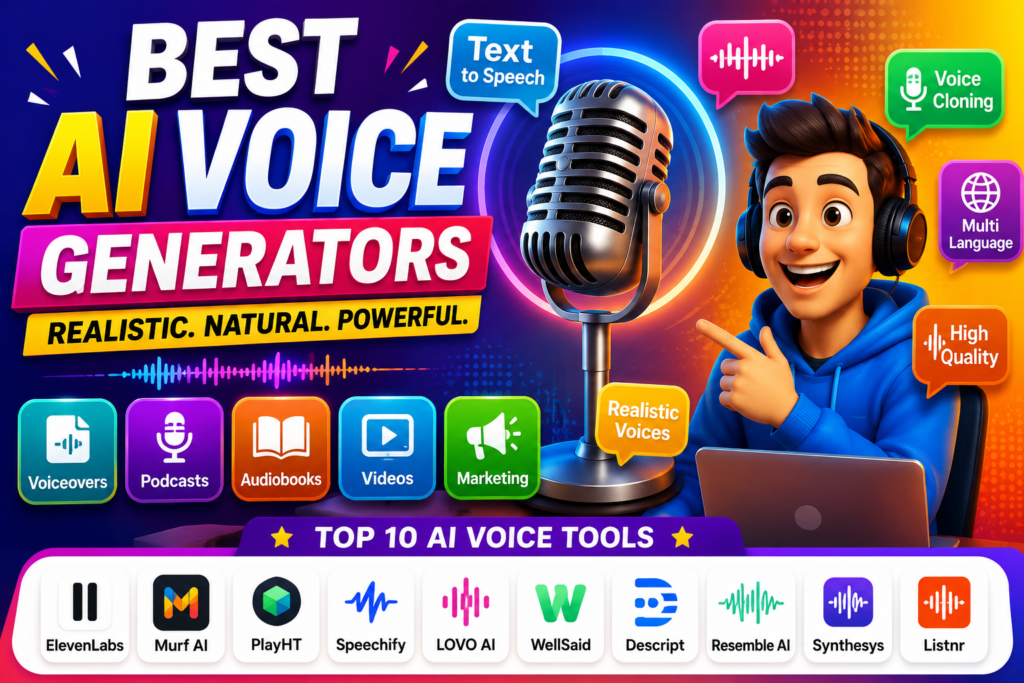
The following platforms are among the best AI voice generators available today.
1. ElevenLabs
ElevenLabs is widely regarded as one of the most realistic AI voice generation platforms currently available.
Its advanced speech synthesis technology produces highly natural voices with emotional expression and impressive voice cloning capabilities.
Best For
- YouTube Creators
- Audiobooks
- Professional Narration
- Voice Cloning
Key Features
- Ultra-realistic AI voices
- Voice cloning
- Multiple languages
- Emotion control
- Professional voiceovers
Pros
- Industry-leading voice quality
- Excellent multilingual support
- Powerful voice cloning
Cons
- Premium features can be expensive
2. Murf AI
Murf AI is a popular platform for businesses, educators, and content creators seeking professional voiceovers.
The platform combines AI voice generation with video and presentation workflows.
Best For
- Business Presentations
- Training Videos
- Educational Content
Key Features
- Natural voice generation
- Voice customization
- Presentation integration
- Team collaboration
Pros
- Easy to use
- Business-friendly features
- Professional audio quality
Cons
- Limited voice cloning options
3. PlayHT
PlayHT provides high-quality text-to-speech technology with a large collection of voices and languages.
It is frequently used by creators, publishers, and businesses.
Best For
- Podcasts
- Articles to Audio
- Content Publishing
Key Features
- Voice cloning
- AI narration
- Multiple languages
- API access
Pros
- Large voice library
- Good speech quality
- Flexible integrations
Cons
- Advanced features require higher plans
4. Speechify
Speechify is one of the most widely used AI voice tools for listening to written content.
Students, professionals, and readers use it to convert text into speech for learning and productivity purposes.
Best For
- Students
- Professionals
- Accessibility
Key Features
- Text-to-speech
- Mobile applications
- Multiple languages
- Reading assistance
Pros
- Excellent accessibility features
- Easy to use
- Fast speech processing
Cons
- More focused on reading than content creation
Students can also benefit from the tools featured in Best Free AI Tools for Students in 2026 to improve learning and productivity.
5. LOVO AI
LOVO AI offers realistic voice generation with extensive customization capabilities.
Its voice library includes numerous languages, accents, and speaking styles.
Best For
- Marketing
- Video Production
- Corporate Training
Key Features
- AI voice generation
- Voice customization
- Video voiceovers
- Commercial licensing
Pros
- Large voice selection
- Professional audio quality
- Strong business use cases
Cons
- Some advanced features require premium plans
6. WellSaid Labs
WellSaid Labs focuses on professional-grade AI voice generation for businesses and enterprises.
Its voices are commonly used in corporate learning and commercial content production.
Best For
- Enterprise Training
- Corporate Learning
- Professional Narration
Key Features
- Studio-quality voices
- Enterprise solutions
- Team collaboration
- Commercial licensing
Pros
- Excellent voice quality
- Strong enterprise support
- Reliable performance
Cons
- Higher pricing compared to competitors
7. Descript
Descript combines audio editing, video editing, transcription, and AI voice generation within a single platform.
This makes it particularly attractive for content creators and podcasters.
Best For
- Podcasters
- YouTubers
- Content Creators
Key Features
- AI voice generation
- Audio editing
- Video editing
- Transcription tools
Pros
- All-in-one content platform
- Excellent editing features
- Creator-focused workflow
Cons
- Voice generation is not its primary focus
Creators who regularly produce videos may also find useful solutions in Best AI Tools for YouTube Creators.
8. Resemble AI
Resemble AI is a powerful voice generation platform known for its advanced voice cloning capabilities.
Businesses and developers frequently use it for virtual assistants, customer support systems, gaming, and interactive applications.
Best For
- Voice Cloning
- Customer Support
- Developers
- Interactive Applications
Key Features
- Real-time voice generation
- Voice cloning
- API integration
- Multilingual support
- Custom voice creation
Pros
- Advanced voice cloning technology
- Strong developer tools
- Real-time voice capabilities
Cons
- Requires technical knowledge for advanced use cases
9. Synthesys
Synthesys specializes in AI-generated voices and avatars for business presentations, marketing videos, and professional content creation.
The platform is widely used by marketers, trainers, and agencies.
Best For
- Marketing Videos
- Business Content
- Corporate Training
Key Features
- AI voiceovers
- AI avatars
- Commercial licensing
- Multiple voice styles
Pros
- Professional business features
- Good voice quality
- Easy content creation
Cons
- Limited editing features compared to dedicated audio platforms
10. Listnr
Listnr is a growing AI voice generation platform that helps creators convert text into realistic speech quickly.
It supports numerous languages and voices, making it suitable for global audiences.
Best For
- Bloggers
- Content Publishers
- Audio Articles
Key Features
- Text-to-speech conversion
- Podcast creation
- Multiple languages
- Voice customization
Pros
- User-friendly interface
- Good multilingual support
- Affordable plans
Cons
- Smaller voice library than some competitors
AI Voice Generators Comparison Table
| Tool | Best For | Key Strength |
|---|---|---|
| ElevenLabs | Professional Narration | Realistic Voices |
| Murf AI | Business Content | Presentation Integration |
| PlayHT | Podcasts | Voice Library |
| Speechify | Learning | Accessibility |
| LOVO AI | Marketing | Voice Customization |
| WellSaid Labs | Enterprise | Studio-Quality Voices |
| Descript | Content Creators | Audio & Video Editing |
| Resemble AI | Voice Cloning | Real-Time Voice AI |
| Synthesys | Business Videos | AI Avatars |
| Listnr | Audio Publishing | Simplicity |
Benefits of AI Voice Generators
AI voice technology offers numerous advantages for creators and businesses.
Significant Time Savings
Voiceovers can be generated within minutes rather than hours.
Reduced Production Costs
Organizations can reduce expenses associated with voice recording and studio production.
Multilingual Content Creation
Many platforms support dozens of languages and accents.
Consistent Audio Quality
AI-generated voices maintain a consistent tone and quality.
Scalability
Businesses can create large volumes of audio content efficiently.
Improved Accessibility
Audio content helps make information accessible to broader audiences.
Limitations of AI Voice Generators
Despite their advantages, AI voice generators still have some limitations.
Emotional Accuracy
Although modern voices sound natural, human voice actors still perform better in highly emotional situations.
Licensing Restrictions
Some platforms have limitations regarding commercial usage.
Voice Cloning Ethics
Voice cloning technology raises privacy and consent concerns.
Subscription Costs
Premium voice platforms can become expensive for heavy users.
Content Review Requirements
Generated audio should always be reviewed before publication.
How to Choose the Right AI Voice Generator
Selecting the right platform depends on your goals and content requirements.
For YouTube Creators
Recommended tools:
- ElevenLabs
- Murf AI
- Descript
For Businesses
Recommended tools:
- Murf AI
- WellSaid Labs
- Synthesys
For Voice Cloning
Recommended tools:
- ElevenLabs
- Resemble AI
For Students and Learning
Recommended tools:
- Speechify
For Podcasts and Audiobooks
Recommended tools:
- PlayHT
- ElevenLabs
- Listnr
The best choice depends on budget, voice quality requirements, language support, and commercial usage needs.
Common Mistakes to Avoid When Using AI Voices
Many users fail to achieve professional results because they overlook important best practices.
Using Default Voice Settings
Adjusting speed, tone, and pauses often improves audio quality significantly.
Ignoring Pronunciation Errors
Always review generated audio before publishing.
Choosing the Wrong Voice Style
The voice should match the target audience and content type.
Overlooking Commercial Licensing
Businesses should verify commercial rights before using generated voices.
Using AI Voices Without Editing
Minor edits often make recordings sound much more natural.
Proper optimization can dramatically improve the final listening experience.
Future of AI Voice Generation
AI voice technology is evolving rapidly and is expected to become even more realistic, accessible, and powerful in the coming years.
Several innovations are already shaping the future of AI-generated speech.
Hyper-Realistic Voices
Future AI models will produce voices that are almost indistinguishable from human speech.
Real-Time Voice Translation
Users will be able to speak in one language while AI instantly generates speech in another language using the same voice.
Emotion-Aware Voice Generation
AI systems will increasingly understand context and generate appropriate emotions such as excitement, empathy, confidence, or urgency.
Personalized Voice Assistants
Businesses and individuals will create customized voice assistants that reflect their brand identity or personal communication style.
Improved Accessibility
AI voice technology will continue making digital content more accessible for people with visual impairments and reading difficulties.
Better Content Localization
Global businesses will use AI voices to localize content efficiently across multiple countries and languages.
As artificial intelligence continues advancing, AI voice generators will become an essential part of content creation, education, marketing, customer support, and business communication.
AI Voice Generation Trends in 2026
Several important trends are currently influencing the voice AI industry.
Voice Cloning Adoption
More creators and businesses are using voice cloning to maintain consistent branding across content.
AI Podcasts
AI-generated podcasts are becoming increasingly common.
Audiobook Automation
Publishers are using AI voices to convert written content into audio formats at scale.
Video Narration Growth
Video creators continue adopting AI voiceovers for YouTube, social media, and educational content.
Conversational AI Integration
Voice technology is increasingly integrated with chatbots and virtual assistants.
Businesses exploring conversational AI may also benefit from the solutions discussed in Best AI Chatbots in 2026.
Enterprise Adoption
Large organizations are using AI voice technology for employee training, customer service, and corporate communications.
Final Thoughts
AI voice generators have transformed the way individuals and organizations create audio content.
Whether you are a YouTuber, podcaster, educator, marketer, business owner, or content creator, AI voice technology can significantly reduce production costs while improving efficiency and scalability.
ElevenLabs, Murf AI, PlayHT, Speechify, LOVO AI, WellSaid Labs, Descript, Resemble AI, Synthesys, and Listnr are among the best AI voice generators available in 2026.
The ideal choice depends on your goals, budget, language requirements, and content type. By selecting the right platform and following best practices, users can create professional-quality audio content without expensive recording equipment or large production teams.
As AI technology continues to evolve, voice generation will play an increasingly important role in digital communication, marketing, education, and content creation.
Frequently Asked Questions About AI Voice Generators
What is an AI voice generator?
An AI voice generator is a software tool that converts written text into natural-sounding speech using artificial intelligence and machine learning technologies.
Which AI voice generator is the most realistic?
ElevenLabs is widely regarded as one of the most realistic AI voice generators due to its advanced voice synthesis and voice cloning capabilities.
Can AI voice generators clone real voices?
Yes. Many platforms, including ElevenLabs and Resemble AI, offer voice cloning features that can replicate real voices with proper authorization.
Are AI-generated voices legal to use?
Yes. AI-generated voices are generally legal to use, but users should review licensing terms and obtain permission before cloning or replicating real voices.
Can AI voice generators be used for YouTube videos?
Yes. Many YouTubers use AI voice generators to create professional narrations, tutorials, reviews, and educational content.
Which AI voice generator is best for businesses?
Murf AI, WellSaid Labs, and Synthesys are popular choices for businesses due to their professional voice quality and commercial usage options.
Do AI voice generators support multiple languages?
Yes. Most leading AI voice generators support multiple languages, accents, and regional voice variations.
Can AI voice generators create audiobook narrations?
Yes. Platforms such as ElevenLabs, PlayHT, and Listnr are frequently used for audiobook production and long-form narration.
What are the main benefits of AI voice generators?
The main benefits include lower production costs, faster content creation, multilingual support, consistent audio quality, and improved accessibility.
What is the future of AI voice technology?
The future of AI voice technology includes hyper-realistic voices, real-time translation, emotion-aware speech synthesis, advanced voice cloning, and deeper integration with virtual assistants and conversational AI systems.