
Artificial Intelligence (AI) is transforming nearly every industry, but its impact on education may be one of the most significant developments of the 21st century. From personalized learning platforms and AI tutors to automated grading systems and intelligent research assistants, AI is changing how students learn and how teachers teach.
Historically, education followed a one-size-fits-all approach. A teacher delivered the same lesson to an entire classroom regardless of individual learning styles, strengths, or weaknesses. While this model successfully educated millions of students, it often struggled to address individual learning needs.
Today, artificial intelligence is helping overcome these limitations. Modern AI systems can analyze student performance, identify learning gaps, recommend personalized study materials, and provide real-time feedback. This shift is creating a more flexible, accessible, and effective learning environment for students around the world.
The rapid growth of generative AI tools such as ChatGPT, Gemini, Claude, and NotebookLM has further accelerated this transformation. These tools are no longer limited to technology professionals. Students, teachers, researchers, and educational institutions are increasingly using AI to improve learning outcomes, enhance productivity, and simplify complex academic tasks.
However, AI in education is not simply about replacing traditional teaching methods with machines. Instead, it represents a new model of human-AI collaboration where technology supports educators and empowers learners.
In this guide, we will explore how artificial intelligence is transforming education, the technologies behind modern educational AI systems, the most popular AI tools used by students and teachers, real-world case studies, benefits, challenges, and the future of AI-powered learning.
What Is AI in Education?
AI in Education refers to the use of artificial intelligence technologies to improve teaching, learning, assessment, administration, and educational decision-making.
These systems use technologies such as:
- Machine Learning
- Natural Language Processing (NLP)
- Large Language Models (LLMs)
- Predictive Analytics
- Computer Vision
- Speech Recognition
to create smarter and more personalized learning experiences.
Unlike traditional educational software that simply delivers information, AI-powered systems can analyze data, adapt to student behavior, provide customized recommendations, and continuously improve over time.
For example, an AI tutor can identify that a student struggles with algebra but performs well in geometry. Instead of presenting identical content to every learner, the system can recommend additional algebra practice while allowing the student to progress more quickly in geometry.
This ability to personalize learning at scale is one of the most important reasons why AI is becoming increasingly valuable in education.
Readers who are new to artificial intelligence can also explore our What Is Artificial Intelligence? guide to understand the foundations of modern AI systems.
The Evolution of AI in Education
The relationship between artificial intelligence and education did not begin with ChatGPT or modern generative AI tools. Its roots can be traced back several decades.
Early Computer-Assisted Learning
During the 1960s and 1970s, educational institutions began experimenting with computer-assisted instruction systems. These early programs provided basic exercises and quizzes but lacked true intelligence.
Intelligent Tutoring Systems
In the 1980s and 1990s, researchers developed Intelligent Tutoring Systems (ITS) capable of adapting learning content based on student performance. These systems represented one of the earliest practical applications of AI in education.
The Rise of Online Learning
The growth of the internet in the late 1990s and early 2000s expanded access to digital education. Online learning platforms collected large amounts of educational data, creating opportunities for machine learning algorithms to improve learning experiences.
The Generative AI Revolution
A major turning point occurred in November 2022 when OpenAI launched ChatGPT. For the first time, millions of students and teachers gained access to an AI assistant capable of answering questions, explaining concepts, generating content, and supporting research.
Soon after, companies such as Google, Anthropic, Microsoft, and Khan Academy introduced their own educational AI initiatives.
Today, AI-powered tools such as ChatGPT, Gemini, NotebookLM, Khanmigo, Grammarly, and Duolingo Max are helping learners worldwide study more effectively and efficiently.
For a broader understanding of how AI evolved to reach this stage, readers can explore our History of Artificial Intelligence guide.
The Core Technologies Behind AI in Education
The rapid growth of AI in education is powered by several advanced technologies working together behind the scenes. While students and teachers often interact with a simple chatbot or learning platform, these systems rely on sophisticated computational models that analyze data, understand language, predict outcomes, and personalize learning experiences.
Understanding these technologies helps educators and learners appreciate how modern educational AI systems function.
Natural Language Processing (NLP)
Natural Language Processing (NLP) is a branch of artificial intelligence that enables computers to understand, interpret, and generate human language.
Historically, educational software could only evaluate structured responses such as multiple-choice questions. Modern NLP systems, however, can analyze essays, reports, discussion posts, and open-ended responses.
For example, when a student submits an essay, an NLP-powered system can evaluate:
- Grammar and spelling
- Writing clarity
- Sentence structure
- Argument quality
- Topic relevance
- Readability
This allows students to receive instant feedback without waiting for manual evaluation.
Tools such as ChatGPT, Gemini, Grammarly, and QuillBot heavily rely on NLP technology to help students improve their writing and communication skills.
Large Language Models (LLMs)
Large Language Models (LLMs) represent one of the most significant breakthroughs in modern education technology.
An LLM is trained on enormous amounts of text data and can generate human-like responses to questions and prompts.
Some of the most popular educational LLMs include:
- ChatGPT (OpenAI)
- Gemini (Google)
- Claude (Anthropic)
- Microsoft Copilot
Unlike traditional search engines, LLMs can engage in conversations, explain difficult concepts, generate examples, simplify technical topics, and provide personalized learning support.
For example, if a student asks:
Explain photosynthesis for a 10-year-old.
An LLM can instantly adjust its explanation based on the learner’s age and understanding level.
Readers interested in mastering AI communication can also explore our AI Prompt Engineering Guide to learn how better prompts produce better educational outcomes.
Machine Learning
Machine Learning enables AI systems to learn from data and improve performance over time.
Instead of relying on fixed rules, machine learning algorithms identify patterns and make predictions based on previous interactions.
In education, machine learning helps platforms:
- Track student progress
- Predict learning outcomes
- Recommend study resources
- Identify weak areas
- Personalize learning paths
For example, if a student repeatedly struggles with algebra but performs well in geometry, a machine learning system can automatically recommend additional algebra exercises and tutorials.
This creates a more personalized educational experience than traditional one-size-fits-all instruction.
Predictive Analytics
Predictive Analytics is one of the most powerful applications of AI in education.
These systems analyze historical and real-time student data to forecast future academic performance.
Educational institutions use predictive analytics to identify:
- Students at risk of failure
- Potential dropouts
- Learning difficulties
- Attendance concerns
- Engagement patterns
For instance, if a student’s assignment completion rate suddenly drops, an AI system may alert teachers before academic performance declines significantly.
This early-warning capability helps educators provide timely interventions and support.
Speech Recognition and Voice AI
Modern educational platforms increasingly use speech recognition technology to improve accessibility and engagement.
Speech AI enables students to:
- Dictate assignments
- Practice pronunciation
- Learn languages
- Interact through voice commands
- Access hands-free learning experiences
Platforms such as Duolingo Max and language-learning applications use voice recognition to provide real-time pronunciation feedback.
This technology is particularly valuable for language learners and students with accessibility needs.
Computer Vision
Computer Vision allows AI systems to interpret and analyze visual information.
In education, computer vision can support:
- Diagram analysis
- Handwriting recognition
- Science experiments
- Interactive learning environments
- Visual accessibility tools
For example, a student can upload a handwritten mathematics problem, and an AI system can analyze the image and provide step-by-step guidance.
Tools such as Photomath have become popular examples of computer vision applied to education.
How AI Is Transforming Learning
Artificial intelligence is not simply digitizing education—it is fundamentally changing how learning takes place.
Traditional education often follows a standardized path where all learners move through the same content at the same pace.
AI enables a more adaptive approach by recognizing that every learner is different.
Personalized Learning
Personalized learning is perhaps the most important contribution of AI to education.
Instead of treating all students equally, AI systems create individualized learning experiences based on:
- Learning speed
- Performance data
- Knowledge gaps
- Interests
- Study habits
This allows students to progress at their own pace rather than being limited by the average performance of a classroom.
Adaptive Learning Platforms
Adaptive learning platforms continuously adjust educational content based on student performance.
If a learner demonstrates mastery of a concept, the system increases complexity.
If the learner struggles, the system provides additional explanations, practice exercises, and alternative learning materials.
This creates a dynamic learning pathway tailored to each individual student.
Intelligent Tutoring Systems
Modern AI tutors function like personalized teaching assistants available 24 hours a day.
Unlike static educational content, intelligent tutoring systems can:
- Answer questions
- Explain concepts
- Provide examples
- Generate quizzes
- Offer feedback
- Track progress
Platforms such as Khanmigo, ChatGPT, and Gemini are increasingly being used as AI-powered tutoring companions by students around the world.
For students looking for practical learning assistants, many of these platforms are also featured in our Best Free AI Tools for Students in 2026 guide.
Most Popular AI Tools in Education (2026)
The rapid adoption of artificial intelligence has introduced a wide range of educational tools designed for students, teachers, researchers, and lifelong learners. While hundreds of AI platforms are available today, only a handful have become widely adopted across schools, colleges, universities, and professional learning environments.
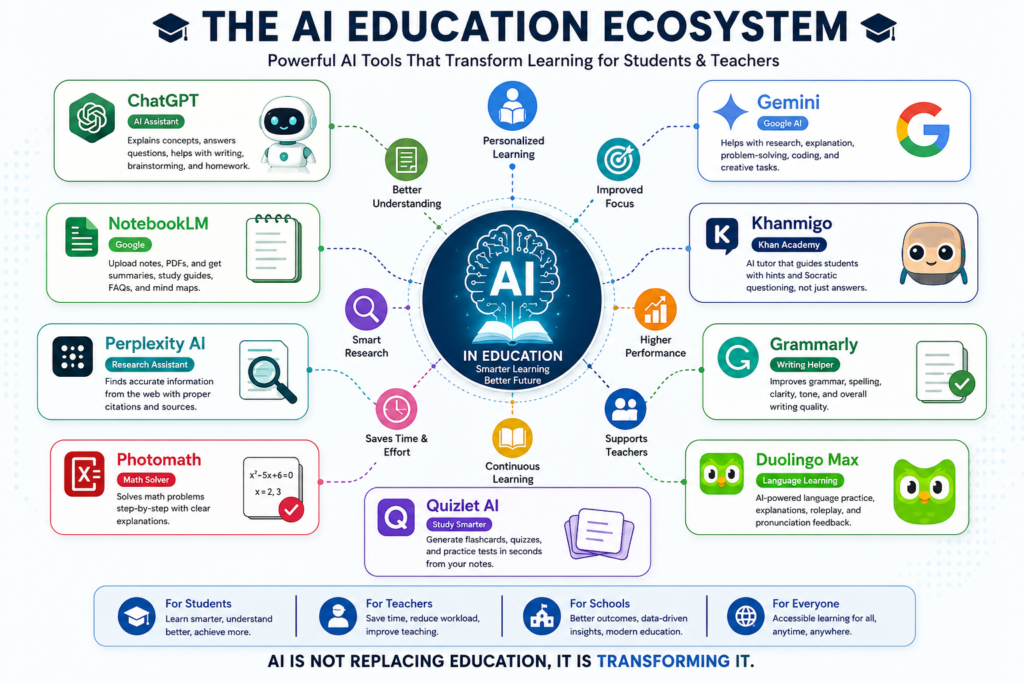
The following tools represent some of the most influential AI-powered educational platforms in 2026.
| Tool | Company | Launch Year | Best For |
|---|---|---|---|
| ChatGPT | OpenAI | 2022 | Learning, Writing, Research |
| Gemini | 2023 | Research and Knowledge Discovery | |
| NotebookLM | 2023 | Study Assistant and Note Analysis | |
| Khanmigo | Khan Academy | 2023 | AI Tutoring |
| Perplexity AI | Perplexity | 2022 | Research and Fact Finding |
| Grammarly | Grammarly | 2009 | Writing Improvement |
| Photomath | 2014 | Mathematics Learning | |
| Duolingo Max | Duolingo | 2023 | Language Learning |
| Quizlet AI | Quizlet | 2023 | Flashcards and Study Tools |
ChatGPT
In November 2022, OpenAI launched ChatGPT, one of the most influential educational technologies in modern history.
ChatGPT rapidly became popular among students, teachers, researchers, and professionals due to its ability to explain concepts, answer questions, summarize information, generate study materials, and assist with academic writing.
Students commonly use ChatGPT for:
- Concept explanations
- Homework support
- Essay planning
- Coding assistance
- Research summaries
- Exam preparation
Teachers use ChatGPT to create lesson plans, quizzes, classroom activities, and educational content.
Its widespread adoption has fundamentally changed how learners access knowledge and interact with information.
Readers interested in learning more can explore our ChatGPT Complete Guide.
Gemini
Google introduced Gemini as its next-generation AI assistant designed to compete with ChatGPT and other advanced AI systems.
Gemini integrates deeply with Google’s ecosystem, making it particularly useful for students and researchers who rely on Google Search, Google Docs, Google Drive, and Google Workspace.
Gemini excels in:
- Research assistance
- Information gathering
- Data interpretation
- Academic writing support
- Classroom productivity
Its integration with Google’s knowledge ecosystem makes it one of the most valuable educational AI tools available today.
Readers can learn more in our Gemini Complete Guide.
NotebookLM
NotebookLM is one of the most innovative educational AI tools introduced by Google.
Unlike traditional chatbots that primarily rely on internet-based information, NotebookLM focuses on user-provided sources.
Students can upload:
- PDFs
- Lecture notes
- Research papers
- Course materials
- Study guides
The system then analyzes those materials and generates:
- Summaries
- FAQs
- Study notes
- Timelines
- Key insights
- Audio overviews
This makes NotebookLM particularly useful for college students, researchers, and professionals managing large amounts of information.
Khanmigo
Khanmigo is an AI-powered tutor developed by Khan Academy and launched in 2023.
Unlike many AI systems that simply provide answers, Khanmigo is designed around the Socratic method of teaching.
Instead of solving problems directly, it guides students toward discovering solutions independently.
This approach helps learners:
- Develop critical thinking
- Improve problem-solving skills
- Understand concepts deeply
- Avoid overreliance on AI-generated answers
Khanmigo represents one of the strongest examples of responsible AI integration in education.
Perplexity AI
Perplexity AI has become increasingly popular among students and researchers because of its research-focused design.
Unlike many chatbots, Perplexity provides source citations alongside its answers.
This feature allows users to:
- Verify information
- Explore original sources
- Conduct academic research
- Improve fact-checking
For students working on assignments, projects, and research papers, Perplexity offers a more transparent learning experience than many traditional AI systems.
Readers interested in AI-powered research can also explore our Best AI Research Tools in 2026 guide.
Grammarly
Grammarly is one of the most widely used AI-powered writing assistants in education.
Although it launched long before the generative AI boom, the platform has continuously evolved through machine learning and natural language processing technologies.
Students use Grammarly to:
- Correct grammar mistakes
- Improve sentence structure
- Enhance clarity
- Improve academic writing
- Strengthen professional communication
Today, Grammarly is used by millions of students and educators worldwide.
Photomath
Photomath transformed mathematics education by making problem-solving more interactive and accessible.
Students can simply scan a mathematical problem using a smartphone camera.
The system then provides:
- Step-by-step solutions
- Explanations
- Visual guidance
- Learning support
Rather than only displaying answers, Photomath helps students understand how solutions are reached.
Duolingo Max
Duolingo has long been one of the world’s most popular language-learning platforms.
In 2023, the company introduced Duolingo Max, which incorporates advanced AI technologies to create a more immersive learning experience.
AI-powered features include:
- Realistic conversations
- Personalized feedback
- Pronunciation support
- Interactive language practice
These capabilities help learners develop practical communication skills more effectively than traditional language-learning methods.
Quizlet AI
Quizlet has integrated artificial intelligence into its learning ecosystem to help students study more efficiently.
Quizlet AI can automatically generate:
- Flashcards
- Practice tests
- Study guides
- Learning recommendations
This reduces the time students spend creating study materials and allows them to focus more on learning itself.
AI for Students
Artificial intelligence provides students with powerful tools for learning, productivity, research, and skill development.
Students use AI to:
- Learn difficult concepts
- Generate summaries
- Create notes
- Conduct research
- Practice languages
- Solve mathematical problems
- Improve writing skills
- Prepare for examinations
For many learners, AI functions as a personal study assistant available 24 hours a day.
However, successful students use AI as a learning partner rather than a replacement for independent thinking.
AI for Teachers
While much of the public discussion focuses on how students use AI, educators may be among the biggest beneficiaries of artificial intelligence in education.
Teachers spend a significant portion of their time on administrative tasks rather than direct instruction. Artificial intelligence helps reduce this workload by automating repetitive processes and allowing educators to focus more on teaching, mentoring, and student engagement.
Modern teachers use AI for:
- Lesson planning
- Quiz generation
- Assignment creation
- Classroom activities
- Student feedback
- Content summarization
- Research assistance
- Administrative support
For example, a teacher preparing a lesson on climate change can use AI to generate learning objectives, classroom discussion questions, assessment rubrics, and interactive activities within minutes.
AI-Powered Teaching Assistants
Several educational platforms now function as virtual teaching assistants.
Tools such as ChatGPT, Gemini, Khanmigo, Brisk Teaching, and Eduaide AI help teachers:
- Create customized learning materials
- Adapt content for different grade levels
- Generate differentiated assignments
- Develop assessment questions
- Improve instructional efficiency
These tools reduce administrative workload while improving instructional quality.
Automated Assessment and Feedback
One of the most time-consuming responsibilities for educators is grading.
AI-powered assessment systems can evaluate:
- Objective tests
- Short responses
- Essays
- Writing assignments
- Language exercises
These systems provide immediate feedback, enabling students to improve faster while reducing teacher workload.
Although human oversight remains essential, AI significantly accelerates the assessment process.
Supporting Inclusive Classrooms
AI is also helping teachers create more inclusive learning environments.
Educational AI systems can:
- Convert speech into text
- Convert text into speech
- Translate content into multiple languages
- Generate accessibility-friendly materials
- Support students with diverse learning needs
This makes education more accessible for students with disabilities, language barriers, or different learning preferences.
Real-World Examples of AI in Education
The impact of AI in education is not limited to theory. Around the world, educational institutions, governments, and technology companies are already implementing AI-powered learning systems.
Khan Academy and Khanmigo
Founded by Sal Khan in 2008, Khan Academy became one of the world’s most respected online education platforms.
In 2023, Khan Academy introduced Khanmigo, an AI tutor powered by advanced language models.
Unlike traditional chatbots that simply provide answers, Khanmigo encourages students to think critically by asking guiding questions and promoting active learning.
This approach aligns closely with the Socratic method of education and demonstrates how AI can support deeper understanding rather than passive memorization.
Duolingo Max
Language learning platform Duolingo introduced Duolingo Max in 2023.
The platform uses artificial intelligence to create realistic language-learning conversations and personalized explanations.
Students can engage in interactive dialogues, receive immediate feedback, and improve communication skills through immersive practice.
This demonstrates how AI can replicate aspects of one-on-one tutoring at scale.
South Korea’s AI-Powered Textbooks
South Korea has emerged as one of the world’s leading adopters of AI in education.
The South Korean government has invested heavily in AI-powered digital textbooks and intelligent learning systems.
These platforms help teachers:
- Monitor student progress
- Identify learning difficulties
- Personalize instruction
- Improve academic outcomes
South Korea’s strategy illustrates how national education systems can integrate AI to enhance learning at scale.
Singapore’s Smart Education Ecosystem
Singapore has also become a global leader in educational innovation.
The country’s education system increasingly uses data analytics, machine learning, and digital learning platforms to support personalized education.
Singapore’s long-term vision focuses on developing future-ready learners equipped with digital literacy, critical thinking, and AI-related skills.
Many educational experts consider Singapore one of the most successful examples of technology-enhanced education worldwide.
Benefits of AI in Education
Artificial intelligence offers numerous advantages for students, teachers, institutions, and lifelong learners.
Personalized Learning
AI systems adapt educational content to individual needs.
Students learn at their own pace and receive targeted support where necessary.
Improved Accessibility
AI helps remove barriers for learners with disabilities and language differences.
Features such as real-time translation, speech recognition, and text-to-speech improve educational access for millions of learners.
Faster Feedback
Students receive immediate feedback instead of waiting days or weeks for evaluation.
This accelerates learning and helps identify weaknesses more quickly.
Enhanced Research Capabilities
AI tools help students and researchers find information, summarize sources, and organize complex materials more efficiently.
Platforms such as NotebookLM, Gemini, and Perplexity have become valuable research assistants.
Increased Teacher Productivity
By automating repetitive administrative tasks, AI allows teachers to dedicate more time to instruction, mentoring, and student development.
Lifelong Learning Opportunities
AI makes education more flexible and accessible for professionals, remote learners, and individuals pursuing continuous skill development throughout their careers.
For readers interested in research-focused AI platforms, our Perplexity AI Complete Guide explores one of the most powerful AI research assistants available today.
Challenges and Risks of AI in Education
Despite its enormous potential, artificial intelligence is not without challenges. Educational institutions must carefully balance innovation with responsibility to ensure that AI enhances learning rather than creating new problems.
A successful AI-powered education system requires thoughtful implementation, ethical oversight, and human supervision.
The Digital Divide
One of the most significant concerns surrounding AI in education is unequal access to technology.
Many students around the world still lack access to:
- Reliable internet connections
- Modern computers
- Smartphones or tablets
- Premium educational software
While students in technologically advanced regions may benefit from AI-powered learning assistants, students in underserved communities risk falling further behind.
Educational leaders must ensure that AI adoption promotes inclusion rather than increasing educational inequality.
Data Privacy and Security
Modern AI systems depend heavily on data.
Educational platforms often collect information related to:
- Student performance
- Learning behavior
- Assessment results
- Attendance records
- User interactions
This creates important questions about privacy, security, and responsible data management.
Schools and universities must ensure that student information is protected through strong security measures and transparent data policies.
As AI becomes more integrated into education, privacy protection will remain a major priority for governments and institutions worldwide.
Academic Integrity and Plagiarism
The rise of generative AI has created new challenges for educators.
Students can now use AI systems to generate:
- Essays
- Assignments
- Reports
- Research summaries
- Programming code
While these tools can support learning, they can also be misused.
Educational institutions increasingly emphasize responsible AI usage policies that encourage students to use AI as a learning assistant rather than as a replacement for independent work.
The goal is not to ban AI but to teach learners how to use it ethically and effectively.
Overdependence on AI
Artificial intelligence can provide answers quickly, but excessive reliance on AI may weaken critical thinking and problem-solving skills.
Learning often requires effort, experimentation, and intellectual struggle.
If students become dependent on AI-generated responses for every task, they may miss opportunities to develop:
- Analytical thinking
- Creativity
- Research skills
- Independent judgment
The most effective educational approach combines human thinking with AI assistance rather than replacing one with the other.
AI Bias and Accuracy Concerns
AI systems are trained on large datasets that may contain biases, inaccuracies, or outdated information.
As a result, AI-generated content is not always correct.
Students and educators must learn to:
- Verify information
- Cross-check sources
- Evaluate evidence
- Apply critical thinking
This makes AI literacy an essential skill for modern learners.
The Evolving Role of Teachers
Some people fear that artificial intelligence will eventually replace teachers.
In reality, AI is far more likely to transform teaching than eliminate it.
Throughout history, new technologies have changed education without replacing educators.
The introduction of textbooks, calculators, computers, and the internet all altered classroom practices, yet teachers remained central to the learning process.
AI follows the same pattern.
From Information Provider to Learning Facilitator
Traditionally, teachers served as the primary source of knowledge in the classroom.
Today, students can access information instantly through digital technologies and AI assistants.
As a result, the teacher’s role is evolving from information provider to learning facilitator.
Modern educators increasingly focus on:
- Critical thinking
- Problem solving
- Creativity
- Collaboration
- Communication
- Ethical decision making
These are areas where human guidance remains irreplaceable.
Human Skills That AI Cannot Replace
Although AI can analyze data and generate content, it cannot fully replicate uniquely human qualities such as:
- Empathy
- Emotional intelligence
- Mentorship
- Leadership
- Inspiration
- Ethical judgment
Students often remember teachers not because of the information they delivered but because of the encouragement, motivation, and support they provided.
These human dimensions of education remain essential in the age of AI.
The Need for AI Literacy
As AI becomes increasingly common, educators themselves must develop AI literacy.
Teachers need to understand:
- How AI systems work
- Their strengths and limitations
- Responsible classroom applications
- Ethical considerations
- Data privacy issues
Institutions that invest in AI literacy training will be better prepared for the future of education.
The Future of AI in Education
The future of education will likely be shaped by increasingly intelligent, personalized, and immersive learning systems.
Many experts believe that AI will become a standard component of education over the next decade.
Hyper-Personalized Learning
Future AI systems will be able to create highly individualized learning experiences.
Instead of following a fixed curriculum sequence, students may receive customized educational pathways based on:
- Learning style
- Performance
- Interests
- Career goals
- Skill gaps
This could dramatically improve learning efficiency and outcomes.
AI Tutors for Every Learner
Advanced AI tutors may eventually provide personalized academic support to every student regardless of geographic location or economic background.
Students could receive:
- Instant feedback
- Customized explanations
- Interactive practice
- Continuous guidance
This has the potential to make high-quality education more accessible worldwide.
Immersive Learning Environments
Artificial intelligence will increasingly combine with technologies such as:
- Virtual Reality (VR)
- Augmented Reality (AR)
- Mixed Reality (MR)
to create highly interactive learning experiences.
Imagine studying ancient civilizations by walking through a virtual historical city or learning biology by exploring a three-dimensional human body model.
These experiences may become common in future classrooms.
AI-Powered Career Guidance
Future educational systems may use AI to help learners identify strengths, interests, and career opportunities.
Students could receive personalized recommendations for:
- Courses
- Certifications
- Skills development
- Career pathways
This could improve workforce readiness and lifelong learning outcomes.
The Rise of AI Agents
One of the most important future developments may be AI agents.
Unlike today’s chatbots, AI agents can perform complex multi-step tasks autonomously.
In education, AI agents may:
- Create personalized study plans
- Track learning progress
- Schedule learning activities
- Recommend resources
- Monitor skill development
These capabilities could significantly enhance the learning experience.
Readers interested in upcoming developments can also explore our AI Trends in 2026 guide.
Final Thoughts
Artificial intelligence is transforming education in ways that were once considered impossible. The future of AI in Education will depend on how effectively institutions balance innovation, ethics, and human-centered learning. From personalized learning and intelligent tutoring systems to automated assessment and AI-powered research assistants, educational technology is becoming more adaptive, accessible, and effective.
Tools such as ChatGPT, Gemini, NotebookLM, Khanmigo, Perplexity AI, Grammarly, and Duolingo Max demonstrate how artificial intelligence can support both students and teachers across a wide range of learning activities.
However, the future of education is not about replacing teachers with machines. Instead, it is about creating a collaborative partnership where artificial intelligence handles repetitive, data-driven tasks while educators focus on mentorship, critical thinking, creativity, and human development.
As educational institutions continue adopting AI technologies, the most successful systems will be those that balance innovation with ethics, efficiency with inclusion, and automation with humanity.
The future of learning will not be powered by artificial intelligence alone—it will be shaped by how effectively humans and AI work together to create better educational experiences for everyone.
What is AI in Education?
AI in Education refers to the use of artificial intelligence technologies to improve teaching, learning, assessment, and educational administration. AI-powered systems can personalize learning, provide instant feedback, identify knowledge gaps, and support both students and teachers through intelligent educational tools.
How is AI transforming education?
AI is transforming education through personalized learning, intelligent tutoring systems, automated grading, research assistance, adaptive learning platforms, and AI-powered study tools. These technologies help learners study more efficiently while reducing administrative workload for teachers.
What are the best AI tools for students in 2026?
Some of the most popular AI tools for students in 2026 include ChatGPT, Gemini, NotebookLM, Khanmigo, Perplexity AI, Photomath, Grammarly, Duolingo Max, and Quizlet AI. These tools assist with learning, research, writing, language practice, note-taking, and exam preparation.
Can AI help students learn difficult subjects?
Yes. AI tools can explain complex concepts in simpler language, generate examples, create quizzes, provide summaries, and offer personalized learning support. Students can use AI to better understand mathematics, science, history, languages, coding, and many other subjects.
Is using AI for homework considered cheating?
Using AI as a learning assistant is generally acceptable, but copying AI-generated assignments without understanding or modifying them may be considered academic dishonesty. Students should use AI to learn concepts, generate ideas, and improve their work rather than replacing their own effort.
Can AI replace teachers in the future?
No. AI can assist with teaching, grading, and administrative tasks, but it cannot replace human qualities such as empathy, mentorship, motivation, emotional support, and ethical guidance. The future of education is likely to involve collaboration between teachers and AI systems.
What are the benefits of AI in Education?
Major benefits include personalized learning, improved accessibility, faster feedback, better research support, enhanced student engagement, increased teacher productivity, and greater access to educational resources worldwide.
What are the risks of AI in Education?
The main risks include data privacy concerns, AI-generated misinformation, overdependence on technology, academic integrity issues, algorithmic bias, and unequal access to advanced educational technologies.
How can AI help students prepare for exams?
AI can help students prepare for exams by generating practice questions, creating summaries, identifying weak areas, producing flashcards, explaining difficult topics, and offering personalized study plans. Tools such as NotebookLM, Quizlet AI, ChatGPT, and Gemini are widely used for exam preparation.
What is the future of AI in Education?
The future of AI in Education includes hyper-personalized learning, intelligent AI tutors, immersive virtual learning environments, AI-powered career guidance, adaptive learning systems, and AI agents that can help students manage and optimize their educational journey.