
Introduction
The history of artificial intelligence is a fascinating journey that spans centuries of human imagination, scientific discovery, and technological innovation. Today, artificial intelligence powers chatbots, virtual assistants, recommendation systems, autonomous vehicles, and advanced research tools. However, the idea of creating intelligent machines did not begin in the modern computer age.
Long before computers existed, philosophers, mathematicians, and inventors dreamed of building machines that could imitate human thinking and decision-making. These early ideas eventually evolved into the field we now know as Artificial Intelligence (AI).
The history of artificial intelligence is filled with remarkable breakthroughs, ambitious experiments, periods of rapid growth, and even times of disappointment known as AI winters. From the mechanical inventions of ancient civilizations to the groundbreaking work of Alan Turing and the emergence of modern AI systems such as ChatGPT, Gemini, and Claude, AI has undergone an extraordinary transformation.
Understanding the history of artificial intelligence is important because it helps us appreciate how AI evolved, why certain technologies succeeded or failed, and where the future of AI may be heading. It also reveals how advances in mathematics, computing, neuroscience, and data science contributed to the development of intelligent systems.
Today, AI is transforming education, healthcare, business, marketing, research, and countless other industries. Yet modern AI is built upon decades of research and innovation carried out by scientists, engineers, and visionaries around the world.
In this complete guide, you will learn:
- What artificial intelligence is
- The ancient ideas that inspired AI
- The pioneers who shaped the field
- The Dartmouth Conference of 1956
- Major AI milestones and breakthroughs
- The rise and fall of AI winters
- The machine learning and deep learning revolutions
- The emergence of ChatGPT and generative AI
- The future of artificial intelligence
By the end of this article, you will have a clear understanding of how artificial intelligence evolved from ancient ideas into one of the most influential technologies of the modern world.
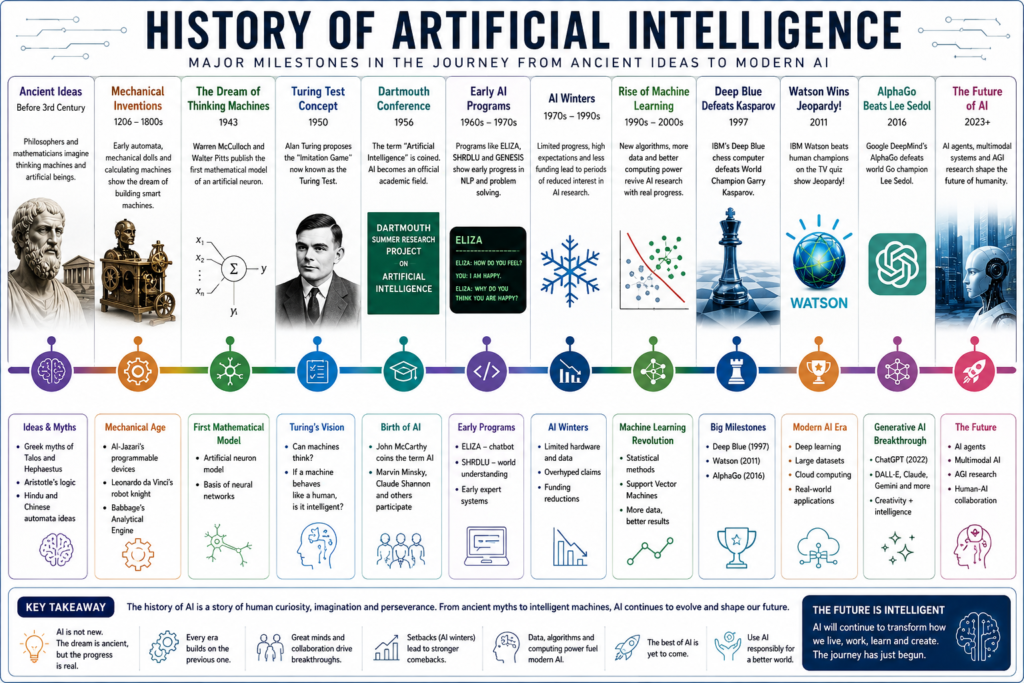
What Is Artificial Intelligence?
Artificial Intelligence (AI) refers to the ability of machines and computer systems to perform tasks that normally require human intelligence. These tasks include learning, reasoning, problem-solving, decision-making, language understanding, pattern recognition, and creativity.
In simple terms, AI enables machines to simulate certain aspects of human intelligence.
Modern AI systems can:
- Understand and generate human language
- Analyze large amounts of data
- Recognize images and speech
- Make predictions and recommendations
- Solve complex problems
- Automate repetitive tasks
Although artificial intelligence may seem like a recent invention, the concept of creating intelligent machines has existed for centuries. The journey toward modern AI began long before computers, software, or the internet were invented.
To understand how AI became one of the most transformative technologies of the twenty-first century, we must first explore the ancient ideas and inventions that inspired the dream of intelligent machines.
Ancient Ideas That Inspired Artificial Intelligence
The history of artificial intelligence did not begin with computers. The desire to create intelligent machines can be traced back thousands of years to ancient civilizations, myths, and mechanical inventions.
Throughout history, humans have been fascinated by the idea of creating artificial beings capable of performing tasks, making decisions, or even thinking like humans. While these early concepts were not true artificial intelligence in the modern sense, they laid the foundation for future innovations.
Intelligent Machines in Ancient Mythology
Many ancient cultures imagined artificial beings with human-like abilities.
In Greek mythology, stories described mechanical servants created by the god Hephaestus. One famous example was Talos, a giant bronze automaton that protected the island of Crete. Talos could patrol the coastline and defend the island from invaders, making it one of the earliest recorded examples of an artificial intelligent being in human imagination.
Ancient Chinese and Egyptian legends also contained stories of mechanical devices and automated objects that appeared to mimic human actions.
Although these creations existed only in myths and legends, they demonstrate that the idea of artificial intelligence has fascinated people for thousands of years.
Early Mechanical Automata
As civilizations advanced, inventors began building mechanical devices capable of performing simple actions automatically.
These machines, known as automata, were designed to imitate the movements of humans or animals.
Some notable examples include:
- Mechanical birds that could flap their wings
- Automated water clocks
- Self-moving statues
- Mechanical musicians
- Automated puppets
Ancient Greek engineer Hero of Alexandria developed several automated machines powered by water, steam, and air pressure. His inventions demonstrated that machines could perform tasks without direct human control.
While these devices were not intelligent, they introduced the idea that machines could imitate living beings.
The Age of Calculation
One of the most important developments in the history of artificial intelligence was humanity’s growing ability to perform calculations using machines.
Several inventions helped move civilization closer to modern computing:
The Abacus
Developed thousands of years ago, the abacus became one of the earliest tools used for mathematical calculations.
It allowed people to perform arithmetic operations more efficiently and demonstrated how tools could extend human intelligence.
Mechanical Calculators
During the seventeenth century, inventors such as Blaise Pascal and Gottfried Wilhelm Leibniz created mechanical calculators capable of performing mathematical operations automatically.
These inventions represented an important step toward machine-based problem solving.
Logical Reasoning and Mathematics
At the same time, philosophers and mathematicians began exploring the idea that human reasoning could be expressed through logical rules.
Thinkers such as Aristotle developed systems of logic that influenced scientific thinking for centuries.
The concept that reasoning could be represented through rules later became one of the foundations of artificial intelligence.
Why These Ancient Ideas Matter
Although ancient myths, automata, and calculating devices were not true AI systems, they played an important role in the evolution of intelligent machines.
They introduced three important ideas:
- Machines can imitate human actions.
- Complex tasks can be automated.
- Human reasoning may be represented through logical processes.
These concepts eventually inspired scientists and inventors to pursue a much bigger goal: creating machines capable of thinking, learning, and solving problems.
The next major breakthrough in the history of artificial intelligence came with the birth of modern computing, where visionary pioneers such as Charles Babbage, Ada Lovelace, and Alan Turing laid the foundations for the AI revolution.
The Birth of Modern Computing
The history of artificial intelligence took a major turn during the nineteenth and twentieth centuries with the development of modern computing. Before intelligent machines could exist, humans first needed machines capable of processing information and performing calculations automatically.
Several visionary thinkers helped create the foundations upon which modern artificial intelligence would eventually be built.
Charles Babbage: The Father of the Computer
Charles Babbage was an English mathematician and inventor from the United Kingdom who is often referred to as the “Father of the Computer.”
In the 1830s, Babbage designed the Analytical Engine, a revolutionary mechanical machine that contained many of the features found in modern computers.
The Analytical Engine included:
- A processing unit
- Memory storage
- Input mechanisms
- Output systems
- Programmable instructions
Although the machine was never fully completed due to technological limitations of the time, its design introduced concepts that would later become fundamental to computer science and artificial intelligence.
Babbage’s work demonstrated that machines could follow instructions and perform complex calculations automatically.
Ada Lovelace: The First Computer Programmer
Ada Lovelace, a British mathematician from the United Kingdom, worked closely with Charles Babbage and is widely regarded as the world’s first computer programmer.
While studying the Analytical Engine, she realized that such a machine could do much more than mathematical calculations.
Ada proposed that future machines might be able to:
- Create music
- Process symbols
- Solve complex problems
- Manipulate information
Her vision was remarkably ahead of its time.
Many historians consider Ada Lovelace’s ideas to be among the earliest concepts related to artificial intelligence because she understood that machines could potentially perform tasks beyond simple arithmetic.
The Rise of Computational Thinking
During the late nineteenth and early twentieth centuries, advances in mathematics and logic accelerated the development of computing concepts.
Researchers began exploring whether human reasoning could be expressed through mathematical rules and logical systems.
This idea became increasingly important because artificial intelligence depends heavily on logic, reasoning, and decision-making processes.
The question slowly emerged:
Can a machine think?
This question would eventually become one of the most important debates in the history of artificial intelligence.
Alan Turing and the Foundations of AI
One of the most influential figures in the history of Artificial Intelligence was Alan Turing (1912–1954), a British mathematician, computer scientist, and cryptanalyst from the United Kingdom.
During World War II, Turing played a critical role in breaking the German Enigma Code at Bletchley Park, helping the Allied forces gain a significant strategic advantage. Many historians consider his work one of the most important contributions to the Allied victory.
However, Turing’s greatest impact on Artificial Intelligence came after the war.
In 1950, he published the groundbreaking paper “Computing Machinery and Intelligence”, in which he explored a revolutionary question:
“Can machines think?”
To address this question, Turing proposed the famous Turing Test, a method for evaluating whether a machine could exhibit intelligent behavior indistinguishable from that of a human.
Turing believed that machines could potentially simulate human intelligence if they were provided with sufficient computational power and appropriate instructions. His ideas fundamentally changed how scientists viewed computers.
Instead of seeing computers merely as calculating machines, Turing envisioned them as intelligent problem-solving systems capable of learning, reasoning, and decision-making.
Today, Alan Turing is widely regarded as one of the founding fathers of modern computer science and one of the earliest visionaries whose ideas helped shape the future of Artificial Intelligence.
The Turing Test
In 1950, Alan Turing published a landmark paper titled “Computing Machinery and Intelligence.”
In this paper, he introduced what later became known as the Turing Test.
The test was designed to answer a simple but profound question:
Can a machine think?
The basic concept was straightforward.
A human evaluator communicates with both a human and a machine through text-based conversations.
If the evaluator cannot reliably determine which participant is the machine, the machine can be considered intelligent according to the test.
Although modern AI researchers debate its limitations, the Turing Test remains one of the most famous concepts in the history of artificial intelligence.
It also helped establish a framework for evaluating machine intelligence that continues to influence AI research today.
Why This Era Was Important
The contributions of Charles Babbage, Ada Lovelace, and Alan Turing transformed the concept of intelligent machines from a philosophical idea into a scientific possibility.
Working across different periods of history, these pioneers established many of the fundamental principles that continue to influence Artificial Intelligence today.
Their work demonstrated that:
- Machines can process and manipulate information.
- Machines can follow predefined instructions and algorithms.
- Logic and reasoning can be represented mathematically.
- Human problem-solving processes can potentially be simulated by computers.
- Intelligence can be evaluated through observable behavior, a concept later formalized through the Turing Test.
Together, these groundbreaking ideas laid the intellectual foundation for modern computing and Artificial Intelligence.
By the mid-twentieth century, researchers had begun to believe that machines might eventually perform tasks traditionally associated with human intelligence. This growing optimism led to the next major milestone in AI history:
In 1956, a group of researchers gathered at Dartmouth College, New Hampshire, United States, for the historic Dartmouth Summer Research Project on Artificial Intelligence, where the term “Artificial Intelligence” was officially introduced for the first time.
For readers who are new to AI concepts, our What Is Artificial Intelligence? guide provides a simple explanation of how modern AI systems work and why they have become so important in today’s world.
The Dartmouth Conference of 1956: The Official Birth of AI
Although the foundations of artificial intelligence had been developing for decades, the field officially began in 1956 at a historic event known as the Dartmouth Summer Research Project on Artificial Intelligence.
This conference is widely regarded as the birthplace of modern artificial intelligence.
Turing was a British mathematician, computer scientist, and codebreaker from the United Kingdom. United States, by a group of pioneering researchers who believed that machines could eventually simulate aspects of human intelligence.
Most importantly, this was the first time the term “Artificial Intelligence” was formally introduced.
John McCarthy: The Father of Artificial Intelligence
One of the key organizers of the Dartmouth Conference was John McCarthy, a computer scientist who later became known as the “Father of Artificial Intelligence.”
McCarthy believed that intelligence could be described so precisely that machines could eventually be programmed to simulate it.
His vision helped establish AI as a legitimate scientific field.
In addition to coining the term Artificial Intelligence, McCarthy later developed important programming concepts and contributed significantly to AI research.
Other Important Participants
Several influential scientists attended the Dartmouth Conference, including:
- Marvin Minsky
- Claude Shannon
- Allen Newell
- Herbert Simon
- Nathaniel Rochester
These researchers shared a common belief that machines could eventually learn, reason, solve problems, and even improve themselves.
Their ideas would shape AI research for decades.
The Main Goal of the Conference
The researchers proposed an ambitious objective:
Every aspect of learning and intelligence can, in principle, be described so precisely that a machine can be made to simulate it.
At the time, this idea seemed revolutionary.
Computers were still primitive compared to modern systems, yet these scientists envisioned machines capable of reasoning, language understanding, and problem-solving.
Although progress proved far more difficult than expected, the conference marked the official beginning of artificial intelligence as an academic discipline.
Why the Dartmouth Conference Matters
The Dartmouth Conference was important because it:
- Introduced the term Artificial Intelligence
- Established AI as a research field
- Brought together leading scientists
- Inspired future AI projects
- Laid the foundation for decades of innovation
For this reason, 1956 is often considered the most important year in the history of artificial intelligence.
Early AI Successes (1956–1970)
Following the Dartmouth Conference, optimism about artificial intelligence grew rapidly.
Researchers believed that machines would soon be capable of performing many tasks associated with human intelligence.
During the late 1950s and 1960s, several groundbreaking AI systems demonstrated that computers could solve problems, process language, and simulate certain forms of reasoning.
Logic Theorist (1956)
One of the earliest successful Artificial Intelligence programs was Logic Theorist, developed in 1956 by Allen Newell, Herbert A. Simon, and Cliff Shaw in the United States.
The program was designed to prove mathematical theorems automatically and is widely regarded as one of the first genuine AI systems ever created.
Logic Theorist demonstrated that a computer could perform tasks requiring logical reasoning rather than simply executing calculations. In several cases, it successfully proved mathematical theorems from Principia Mathematica, a landmark work by Alfred North Whitehead and Bertrand Russell.
Its success provided early evidence that machines could imitate certain aspects of human problem-solving and reasoning.
Many AI historians consider Logic Theorist to be the first true Artificial Intelligence program.
💡 Did You Know?
Herbert Simon famously predicted in 1957:
“There are now in the world machines that think, that learn and that create.”
Although the prediction was optimistic, it reflected the excitement surrounding early AI research.
General Problem Solver (GPS)
Building on the success of Logic Theorist, Allen Newell and Herbert Simon later developed the General Problem Solver (GPS) during the late 1950s.
The goal of GPS was ambitious.
Researchers hoped to create a system capable of solving a wide variety of problems using logical reasoning rather than being limited to a single task.
GPS introduced concepts such as:
🔹 Goal-based problem solving
🔹 Means-end analysis
🔹 Logical reasoning strategies
🔹 Symbolic information processing
Although GPS had practical limitations, it demonstrated that computers could apply rules and strategies to reach solutions in a way that resembled human reasoning.
Many modern AI planning systems continue to use concepts inspired by these pioneering approaches.
🧠 Research Insight
The work of Newell and Simon helped establish the field of Symbolic AI, which dominated Artificial Intelligence research for several decades.
ELIZA (1966)
One of the most famous early AI programs was ELIZA, developed in 1966 by Joseph Weizenbaum at MIT (Massachusetts Institute of Technology), United States.
ELIZA simulated a psychotherapist by responding to user inputs with carefully designed text responses.
For example:
User:
“I feel stressed.”
ELIZA:
“Why do you feel stressed?”
Although ELIZA did not truly understand language, many users felt as though they were having a meaningful conversation with the computer.
This phenomenon surprised researchers and demonstrated how easily humans can attribute intelligence and understanding to machines.
ELIZA became one of the earliest demonstrations of Natural Language Processing (NLP) and human-computer interaction.
Today, advanced conversational AI systems such as ChatGPT, Gemini, and Claude have evolved far beyond ELIZA’s capabilities, but ELIZA remains a historic milestone in AI development.
💡 Did You Know?
Joseph Weizenbaum was later concerned that people trusted ELIZA too much, even though the program did not genuinely understand human language.
SHRDLU (1970)
Another significant milestone in early AI research was SHRDLU, created in 1970 by Terry Winograd at MIT.
SHRDLU operated within a virtual world containing simple objects such as blocks, pyramids, and cubes.
Users could type commands and ask questions, and the system could:
🔹 Understand instructions
🔹 Manipulate virtual objects
🔹 Answer questions
🔹 Demonstrate basic reasoning
🔹 Maintain conversational context
For its time, SHRDLU represented a remarkable advance in Natural Language Understanding.
Unlike many earlier systems, SHRDLU could understand the meaning of commands within its limited environment and respond intelligently.
Its success led many researchers to believe that human-level Artificial Intelligence might be achieved within a few decades.
Although that prediction proved overly optimistic, SHRDLU remains one of the most influential projects in the history of AI and Natural Language Processing.des.
Growing Optimism
By the late 1960s, AI researchers were extremely optimistic.
Early successes suggested that intelligent machines might soon:
- Translate languages
- Solve complex scientific problems
- Understand human speech
- Perform advanced reasoning
Governments and research institutions invested heavily in AI projects.
However, despite these promising developments, researchers soon encountered major technical limitations.
The excitement surrounding AI began to fade as expectations exceeded reality, leading to the first major setback in the history of artificial intelligence—the First AI Winter.
The First AI Winter (1974–1980)
Despite the remarkable achievements of the 1950s and 1960s, Artificial Intelligence researchers soon encountered serious obstacles that slowed the field’s progress.
During the early years of AI research, many scientists believed that human-level machine intelligence might be achieved within a few decades. Enthusiasm was high, funding was abundant, and expectations continued to grow.
However, reality proved far more challenging.
The computers of that era lacked the processing power, memory capacity, and data needed to solve complex real-world problems. Many AI systems performed well in controlled laboratory environments but struggled when applied to practical situations.
As ambitious promises failed to produce immediate results, governments and funding agencies began to lose confidence in AI research.
This difficult period became known as the First AI Winter—a time when funding declined, optimism faded, and progress slowed significantly.
💡 Did You Know?
During the 1960s, some researchers predicted that fully intelligent machines could be developed within a generation. These expectations later proved overly optimistic.
Why Did the First AI Winter Happen?
Several factors contributed to the decline of Artificial Intelligence research during the 1970s:
🔹 Limited computing power
🔹 Insufficient data for training intelligent systems
🔹 Overly optimistic predictions by researchers
🔹 Difficulty solving real-world problems
🔹 High costs and limited practical applications
🔹 Reduced government and institutional funding
A major turning point came in 1973 when mathematician Sir James Lighthill published the influential Lighthill Report for the British government.
The report criticized the limited progress of Artificial Intelligence research and questioned whether the field was delivering meaningful results.
Its conclusions led to funding cuts in the United Kingdom and influenced attitudes toward AI research in other countries as well.
🧠 Research Insight
The Lighthill Report is often considered one of the most important events contributing to the First AI Winter.
Impact of the First AI Winter
The First AI Winter had a significant impact on the AI community and research institutions worldwide.
It resulted in:
🔹 Reduced research funding
🔹 Slower technological progress
🔹 Cancellation of many AI projects
🔹 Increased skepticism among governments and investors
🔹 Fewer academic research opportunities
Many researchers shifted their focus to other areas of computer science, while others continued working quietly on AI despite the lack of public enthusiasm.
Although progress slowed considerably, Artificial Intelligence research never completely stopped.
The lessons learned during this challenging period eventually inspired researchers to develop new methods, better algorithms, and more realistic expectations.
These efforts would pave the way for the next major revival of Artificial Intelligence during the 1980s, driven by the rise of Expert Systems and renewed commercial interest in AI technology.
“Winter was not the end of Artificial Intelligence—it was a period of reflection that ultimately prepared the field for its next breakthrough.”
Expert Systems and the AI Boom
During the late 1970s and 1980s, artificial intelligence experienced a major revival through the development of Expert Systems.
Expert Systems were computer programs designed to imitate the decision-making abilities of human experts in specific fields.
Instead of learning from data, these systems relied on large collections of rules created by specialists.
How Expert Systems Worked
An Expert System typically contained:
- A knowledge base
- A set of rules
- An inference engine
The system would analyze information and apply predefined rules to reach conclusions.
For example, a medical Expert System could help doctors identify diseases based on symptoms and patient information.
Popular Expert Systems
Some of the most influential Expert Systems included:
MYCIN
Developed in the 1970s, MYCIN helped diagnose bacterial infections and recommend treatments.
XCON
Used by Digital Equipment Corporation, XCON assisted in configuring computer systems for customers.
These systems demonstrated that AI could deliver practical business value.
The AI Boom of the 1980s
The success of Expert Systems attracted significant investment.
Businesses, governments, and universities increased funding for AI research.
Many organizations believed that intelligent software would soon transform industries around the world.
The field once again appeared to be entering a golden age.
The Second AI Winter (1987–1993)
Unfortunately, the optimism surrounding Expert Systems did not last forever.
During the 1980s, Expert Systems became one of the most commercially successful applications of Artificial Intelligence. Large corporations invested millions of dollars in AI projects, believing that intelligent software would soon revolutionize business operations.
However, significant challenges gradually emerged.
As Expert Systems grew larger and more complex, maintaining them became increasingly difficult. Updating thousands of manually created rules required extensive time, expertise, and financial resources.
Furthermore, Expert Systems lacked flexibility.
They could perform exceptionally well within narrow domains but struggled when confronted with unfamiliar situations or changing environments. Unlike modern Machine Learning systems, they could not learn from experience or adapt automatically.
As a result, many organizations began questioning whether AI could truly deliver on its ambitious promises.
This growing disappointment eventually led to another major decline in AI enthusiasm known as the Second AI Winter.
💡 Did You Know?
By the late 1980s, some companies had invested millions of dollars in Expert System projects that became difficult and expensive to maintain.
Why Did the Second AI Winter Occur?
Several factors contributed to the decline of Artificial Intelligence during the late 1980s and early 1990s:
🔹 High maintenance costs
🔹 Limited adaptability and learning capabilities
🔹 Expensive specialized hardware
🔹 Unrealistic expectations from businesses and investors
🔹 Slower-than-expected technological progress
🔹 Declining commercial returns from Expert Systems
Another major factor was the collapse of the Lisp Machine Market.
Companies such as Symbolics and Lisp Machines Inc. had built specialized computers specifically designed for AI applications. However, as general-purpose computers became more powerful and affordable, demand for these expensive AI machines declined rapidly.
By the early 1990s, many organizations reduced or completely abandoned their AI investments.
This difficult period became known as the Second AI Winter, marking another temporary setback in the history of Artificial Intelligence.
🧠 Research Insight
Unlike the First AI Winter, which was driven largely by limited computing power and unrealistic expectations, the Second AI Winter was influenced by commercial failures and the practical limitations of rule-based AI systems.
Lessons Learned from the Second AI Winter
Although the Second AI Winter slowed progress, it provided valuable lessons that would ultimately shape the future of Artificial Intelligence.
Researchers began to realize that intelligence could not simply be programmed through thousands of fixed rules.
Human intelligence is flexible, adaptive, and capable of learning from experience.
To build truly intelligent systems, machines would need similar capabilities.
This realization encouraged scientists to explore new approaches focused on learning rather than rule-based programming.
Researchers increasingly turned their attention toward:
🔹 Statistical methods
🔹 Pattern recognition
🔹 Neural Networks
🔹 Data-driven learning approaches
🔹 Adaptive systems
These ideas would eventually lead to one of the most important breakthroughs in AI history:
Machine Learning.
Rather than telling a computer exactly what to do, researchers began teaching machines how to learn from data and improve over time.
This shift would ultimately spark the modern AI revolution that transformed Artificial Intelligence from a struggling research field into one of the most influential technologies of the twenty-first century.
“The AI Winters taught researchers an important lesson: intelligence is not simply programmed—it must be learned.”
The Rise of Machine Learning
After two difficult AI Winters, researchers began searching for a new approach that could overcome the limitations of rule-based systems.
The solution emerged through a powerful idea:
Instead of explicitly programming every rule, computers should be able to learn from data.
This concept gave rise to Machine Learning, a breakthrough that would completely transform the future of Artificial Intelligence.
Unlike Expert Systems, which relied on thousands of manually written rules, Machine Learning enabled computers to discover patterns, make predictions, and improve their performance through experience.
This shift marked one of the most important turning points in the history of Artificial Intelligence.
💡 Did You Know?
Many experts consider Machine Learning to be the technology that revived Artificial Intelligence after decades of limited progress and repeated setbacks.
What Is Machine Learning?
Machine Learning (ML) is a branch of Artificial Intelligence that enables computers to learn from data and improve performance without being explicitly programmed for every task.
Rather than following fixed instructions, Machine Learning systems analyze data, identify patterns, and make decisions based on previous experience.
As computer scientist Arthur Samuel explained in 1959, Machine Learning is:
“The field of study that gives computers the ability to learn without being explicitly programmed.”
This definition remains one of the most widely cited descriptions of Machine Learning today.
Why Machine Learning Succeeded
Several technological developments contributed to the rapid growth of Machine Learning during the 1990s and 2000s.
🌐 More Data
The expansion of the internet created vast amounts of digital information.
Websites, emails, online transactions, social media platforms, and digital records generated data on an unprecedented scale.
For Machine Learning systems, this data became a valuable source of knowledge.
⚡ Faster Computers
Advances in computer processors, storage systems, and graphics processing units (GPUs) provided the computational power needed to train increasingly complex models.
Tasks that once required weeks could now be completed much faster.
🧠 Better Algorithms
Researchers developed more sophisticated learning techniques capable of handling larger datasets and more challenging problems.
Important advances occurred in:
🔹 Statistical Learning
🔹 Neural Networks
🔹 Decision Trees
🔹 Support Vector Machines
🔹 Ensemble Learning
Together, these developments enabled Artificial Intelligence systems to achieve levels of performance that had previously seemed impossible.
🧠 Research Insight
Many researchers describe the combination of Big Data, Powerful Computing, and Advanced Algorithms as the three forces that fueled the Machine Learning revolution.
Important Machine Learning Applications
As Machine Learning matured, it began powering many technologies used by billions of people every day.
These included:
🔹 Search Engines
🔹 Recommendation Systems
🔹 Fraud Detection
🔹 Speech Recognition
🔹 Image Recognition
🔹 Personalized Advertising
🔹 Spam Filtering
🔹 Language Translation
Companies such as Google, Amazon, Microsoft, Netflix, and Facebook demonstrated how Machine Learning could solve real-world problems at a massive scale.
These practical successes renewed public confidence in Artificial Intelligence and proved that AI could create measurable business and societal value.
🚀 AI in Real Life
Every time Netflix recommends a movie, Google predicts a search query, or a bank detects suspicious transactions, Machine Learning is working behind the scenes.
Preparing the Way for Deep Learning
Although Machine Learning dramatically improved the capabilities of Artificial Intelligence, researchers continued searching for methods capable of solving even more complex challenges.
This search eventually led to the revival of Neural Networks and the emergence of Deep Learning.
During the 2010s, Deep Learning systems achieved unprecedented success in image recognition, speech recognition, language understanding, and content generation.
These breakthroughs would ultimately lead to modern AI technologies such as ChatGPT, Gemini, Claude, and many other advanced AI systems used today.
“Machine Learning taught computers how to learn. Deep Learning taught them how to understand increasingly complex patterns.”
The Deep Learning Revolution
The history of artificial intelligence entered a new era during the 2000s and 2010s with the rise of Deep Learning. While machine learning had already demonstrated impressive capabilities, deep learning enabled AI systems to process vast amounts of data and solve problems that were once considered impossible.
Deep learning is inspired by the structure of the human brain. It uses artificial neural networks with multiple layers to learn patterns from data and make intelligent decisions.
The Three Pioneers of Deep Learning
Geoffrey Hinton and Yoshua Bengio from Canada, along with Yann LeCun from France, are widely recognized as the pioneers of modern deep learning.
Geoffrey Hinton
Often called the “Godfather of AI,” Geoffrey Hinton played a major role in developing neural networks and deep learning techniques.
Yann LeCun
Yann LeCun pioneered convolutional neural networks (CNNs), which became essential for image recognition and computer vision.
Yoshua Bengio
Yoshua Bengio made significant contributions to neural networks, machine learning, and natural language processing.
Together, these researchers helped transform artificial intelligence from a promising technology into a practical reality.
Why Deep Learning Changed Everything
Deep learning achieved breakthroughs in areas such as:
- Image recognition
- Speech recognition
- Natural language processing
- Autonomous vehicles
- Medical diagnosis
- Recommendation systems
For the first time, AI systems began outperforming humans in specific tasks.
AlphaGo Defeats a World Champion
One of the most significant milestones in the history of artificial intelligence occurred in 2016 when Google DeepMind’s AlphaGo defeated South Korean Go champion Lee Sedol, demonstrating the remarkable potential of deep learning and modern AI systems.
Google DeepMind’s AlphaGo defeated Lee Sedol, one of the world’s greatest Go players.
Go is considered far more complex than chess because it has an enormous number of possible moves.
Many experts believed it would take decades before AI could master the game.
AlphaGo’s victory shocked the world and demonstrated the remarkable potential of deep learning.
Major AI Milestones Timeline
The history of artificial intelligence includes several important milestones that shaped the evolution of modern AI.
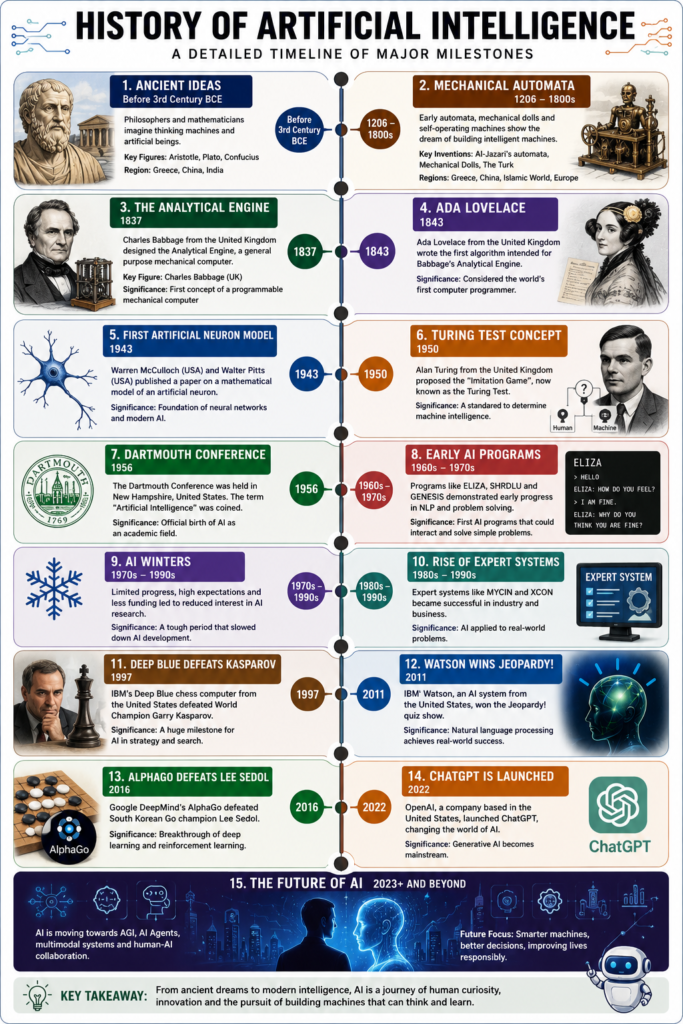
| Year | Major Event |
|---|---|
| 1943 | First Artificial Neuron Model Developed |
| 1950 | Alan Turing Introduces the Turing Test |
| 1956 | Dartmouth Conference and Birth of AI |
| 1956 | Logic Theorist Created |
| 1966 | ELIZA Chatbot Developed |
| 1974 | First AI Winter Begins |
| 1980 | Expert Systems Boom |
| 1987 | Second AI Winter Begins |
| 1997 | IBM Deep Blue Defeats Garry Kasparov |
| 2011 | IBM Watson Wins Jeopardy! |
| 2012 | Deep Learning Breakthrough in Image Recognition |
| 2016 | AlphaGo Defeats Lee Sedol |
| 2022 | ChatGPT Launches Globally |
| 2023 | Generative AI Adoption Explodes |
| 2025+ | Rise of AI Agents and Autonomous Systems |
This timeline demonstrates how artificial intelligence evolved from theoretical concepts into a technology used by billions of people worldwide.
The ChatGPT Revolution and Generative AI
The next major chapter in the history of artificial intelligence began with the rise of Generative AI.
Unlike traditional AI systems that focused on analysis and prediction, generative AI can create entirely new content, including text, images, audio, videos, and computer code.
The Launch of ChatGPT
In November 2022, OpenAI, a leading artificial intelligence company based in the United States, introduced ChatGPT to the public.
The response was unprecedented.
Millions of users adopted the platform within weeks, making ChatGPT one of the fastest-growing technology products in history.
ChatGPT demonstrated that AI could:
- Write articles
- Answer questions
- Generate code
- Summarize documents
- Create marketing content
- Assist with research
- Support education
This breakthrough brought artificial intelligence into mainstream society.
Readers interested in learning how to write better prompts for modern AI systems can explore our AI Prompt Engineering Guide.
The Rise of AI Competition
Following the success of ChatGPT, many technology companies accelerated their AI initiatives.
Several powerful AI systems emerged, including:
- Google Gemini
- Claude
- Grok
- Perplexity AI
- Microsoft Copilot
Each platform introduced unique capabilities and expanded the possibilities of artificial intelligence.
For a detailed comparison of leading AI assistants, read our ChatGPT vs Gemini vs Claude guide.
The Generative AI Era
Today, generative AI is transforming industries worldwide.
People use AI to:
- Create content
- Design images
- Generate videos
- Build software
- Conduct research
- Automate workflows
- Improve productivity
The widespread adoption of generative AI represents one of the most significant developments in the history of artificial intelligence.
Businesses seeking to automate operations can also benefit from the tools discussed in our Best AI Tools for Business Automation in 2026 guide.
How Artificial Intelligence Changed Different Industries
Artificial intelligence is no longer limited to research laboratories or technology companies. Today, AI influences nearly every industry and affects billions of people worldwide.
From education and healthcare to marketing and business operations, AI has transformed the way people learn, work, communicate, and solve problems.
Education
Artificial intelligence has made learning more personalized and accessible.
Modern AI tools help students:
- Understand complex topics
- Generate study notes
- Create quizzes
- Improve research skills
- Learn at their own pace
Teachers also use AI to create lesson plans, assessments, and educational content more efficiently.
Readers interested in educational AI solutions can explore our AI in Education guide and Best Free AI Tools for Students in 2026.
Healthcare
AI is helping healthcare professionals improve diagnosis, treatment planning, and patient care.
AI-powered systems can:
- Analyze medical images
- Detect diseases earlier
- Assist doctors in decision-making
- Predict health risks
- Accelerate drug discovery
These advancements are improving healthcare outcomes around the world.
Business and Entrepreneurship
Businesses use artificial intelligence to improve efficiency, automate repetitive tasks, and make better decisions.
Common applications include:
- Customer support
- Data analysis
- Sales forecasting
- Workflow automation
- Business intelligence
Startup founders and entrepreneurs increasingly rely on AI to validate ideas, conduct market research, and scale operations.
For practical business applications, readers can also see our Best AI Tools for Startups in 2026 and Best AI Tools for Small Businesses in 2026 guides.
Marketing and Content Creation
AI has transformed digital marketing by helping organizations create content, analyze customer behavior, and optimize campaigns.
Marketing professionals use AI for:
- Content generation
- SEO optimization
- Email marketing
- Audience research
- Advertising campaigns
Creators and marketers can learn more through our Best AI Tools for Marketing in 2026 and Best AI SEO Tools guides.
Research and Innovation
Researchers use AI to process enormous datasets, identify patterns, and accelerate discoveries.
AI is now widely used in:
- Scientific research
- Climate studies
- Engineering
- Finance
- Social sciences
The impact of AI on research continues to grow as more advanced models become available.
Interesting Facts About AI History
The history of Artificial Intelligence is filled with remarkable breakthroughs, visionary scientists, and transformative discoveries that changed the course of technology.
- The term “Artificial Intelligence” was officially introduced in 1956 at the famous Dartmouth Conference, widely regarded as the birth of modern AI.
- In 1950, British mathematician Alan Turing proposed the Turing Test, a benchmark designed to evaluate whether a machine can exhibit intelligent behavior similar to a human.
- ELIZA, developed by Joseph Weizenbaum in 1966, is considered one of the world’s earliest chatbots and demonstrated how computers could simulate human conversation.
- In 1997, IBM Deep Blue defeated world chess champion Garry Kasparov, marking one of the most significant milestones in AI history.
- In 2011, IBM Watson won the popular quiz show Jeopardy!, outperforming some of the best human contestants and showcasing advances in Natural Language Processing.
- In 2016, AlphaGo, developed by Google DeepMind, defeated world Go champion Lee Sedol, a breakthrough many experts believed would take decades longer to achieve.
- Released in 2022, ChatGPT became one of the fastest-growing consumer applications in history, bringing Generative AI into mainstream use worldwide.
- Modern AI systems can now generate text, images, audio, video, software code, and even scientific research assistance, demonstrating capabilities once thought impossible.
- The rise of Deep Learning during the 2010s helped revive Artificial Intelligence after several periods of slow progress known as the “AI Winters.”
- Today, Artificial Intelligence is used by businesses, governments, universities, healthcare organizations, researchers, and individuals across nearly every sector of society.
Key Lessons from the History of Artificial Intelligence
The history of artificial intelligence teaches several important lessons.
Innovation Takes Time
Many ideas that power modern AI were proposed decades before technology became capable of implementing them.
Progress Is Not Always Linear
The AI winters demonstrated that technological progress often includes setbacks and periods of slower growth.
Data and Computing Power Matter
Many AI breakthroughs became possible only after significant improvements in hardware, storage, and data availability.
Human Creativity Remains Important
AI systems are powerful tools, but human creativity, judgment, ethics, and critical thinking remain essential.
Adaptability Drives Success
The most successful AI systems are those that can learn, improve, and adapt to changing environments.
The Future of Artificial Intelligence
The future of artificial intelligence appears more promising than ever.
Researchers are working on increasingly capable AI systems that can understand multiple forms of information, reason more effectively, and assist humans in complex tasks.
Several trends are expected to shape the future of AI:
- AI Agents
- Multimodal AI
- Personalized AI Assistants
- Autonomous Systems
- Scientific Discovery
- Advanced Robotics
- Human-AI Collaboration
Future AI systems will likely become more powerful, more accessible, and more deeply integrated into everyday life.
Readers interested in upcoming developments can explore our Future of Artificial Intelligence guide for a deeper look at emerging trends and opportunities.
Conclusion
The history of artificial intelligence is a remarkable story of imagination, innovation, persistence, and scientific progress.
From ancient myths and mechanical automata to modern AI systems such as ChatGPT, Gemini, Claude, and autonomous AI agents, the journey of artificial intelligence has been shaped by generations of researchers, inventors, and visionaries.
The field has experienced periods of extraordinary success as well as significant setbacks. Yet each challenge contributed valuable lessons that helped advance the technology we use today.
Artificial intelligence is no longer a futuristic concept. It is already transforming education, healthcare, business, marketing, research, and countless other industries.
Understanding the history of artificial intelligence helps us appreciate how far the technology has come, recognize the achievements that made modern AI possible, and prepare for the opportunities and challenges that lie ahead.
As AI continues to evolve, one thing remains clear: the history of artificial intelligence is still being written, and the next chapter may be even more transformative than anything we have seen so far.
Q1. What is the history of artificial intelligence?
The history of artificial intelligence is the story of how humans developed machines capable of performing tasks that normally require human intelligence. It began with ancient ideas about intelligent machines, evolved through the work of pioneers such as Charles Babbage, Ada Lovelace, and Alan Turing, and eventually led to modern AI systems like ChatGPT, Gemini, and Claude.
Who is known as the father of artificial intelligence?
John McCarthy is widely known as the father of artificial intelligence because he coined the term “Artificial Intelligence” and organized the Dartmouth Conference in 1956, which officially launched AI as a scientific field.
When was artificial intelligence invented?
Artificial intelligence as a formal academic field began in 1956 during the Dartmouth Conference. However, the ideas that inspired AI can be traced back to ancient civilizations and early mechanical inventions.
What was the Dartmouth Conference?
The Dartmouth Conference was a research workshop held in 1956 at Dartmouth College. It is considered the birthplace of artificial intelligence because the term “Artificial Intelligence” was introduced there for the first time.
What is the Turing Test in artificial intelligence?
The Turing Test is a method proposed by Alan Turing in 1950 to evaluate machine intelligence. A machine passes the test if a human evaluator cannot reliably distinguish it from a human during a conversation.
Why did AI experience AI winters?
AI winters occurred because researchers made overly optimistic predictions while available computers, data, and algorithms were not advanced enough to achieve expected results. This led to reduced funding and slower progress.
What are the major milestones in AI history?
Major milestones include the Turing Test (1950), Dartmouth Conference (1956), ELIZA chatbot (1966), Deep Blue defeating Garry Kasparov (1997), AlphaGo defeating Lee Sedol (2016), and the launch of ChatGPT (2022).
How did ChatGPT change artificial intelligence?
ChatGPT made advanced AI accessible to millions of people. It demonstrated how generative AI could assist with writing, research, coding, learning, and business tasks, accelerating global AI adoption.
What is the future of artificial intelligence?
The future of artificial intelligence includes AI agents, multimodal systems, autonomous technologies, advanced robotics, scientific discovery, and deeper human-AI collaboration across industries.
Why is understanding AI history important?
Understanding AI history helps people learn how artificial intelligence evolved, why certain breakthroughs succeeded, what challenges researchers faced, and how AI may continue to shape the future.